Porträtt av Morris Graves

Morris Gravess målningar: De 30 mest kända, ur ett galleris perspektiv

Uppdaterad november 2026 · rangordnad efter vår popularitetspoäng (sökningar, besök och beställningar för varje verk) · 32 verk av Morris Graves i vår katalog

Kortfattat

Ur galleriets perspektiv är Morris Gravess mest kända målning Bird Singing in the Moonlight (1938). Crow, Surf and Moon (1943) och Logged Mountains (1943) fullbordar trion som alla känner igen. Av de 32 verk av Morris Graves i vår katalog presenterar galleriet nedan de 30 mest kända, var och en som ett original med sitt år, sitt museum och vad som gör det unikt.

1910 – 2001, Fox Flest verk: Art Museum

Galleriets 10 främsta målningar av Morris Graves

3
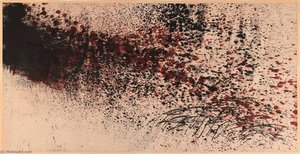
Logged Mountains (1943) av Morris Graves

Logged Mountains

1943 · Smithsonian American Art Museum, Washington, D.C.

The Logged Mountains painting by Morris Graves is a thought-provoking artwork that showcases the artist's skill in combining natural elements with artistic expression. Created in 1943, this oil on canvas painting measures 66 x 92 cm and is currently housed at the Smithsonian American Art Museum in the United States. Artist Background Morris Graves was an American artist known for his delicate and contemplative drawings that capture the essence of…

Morris Gravess målningar, rankade 11 till 30

Museerna som förvarar Morris Gravess originalverk

De 3 museer som innehar flest av målningarna på denna sida.

Museum Stad Verk av Morris Graves Målningar från denna lista
Art Museum, SeattleArt Museum Seattle 6 Crow, Surf and Moon, Bird in the Night, Sea, Fish and Constellation
The Phillips Collection, Washington, D.C.The Phillips Collection Washington, D.C. 3 Surf and Bird, Young Gander Ready for Flight, August Still Life
Smithsonian American Art Museum, Washington, D.C.Smithsonian American Art Museum Washington, D.C. 1 Logged Mountains

Morris Graves, ett signaturverk per decennium

Verk per decennium

Välj ett decennium för att se originalverket som definierar det.

Morris Gravess målningar: galleriets svar

Vilken av Morris Gravess målningar är den mest kända av alla?Visa svaret

Bird Singing in the Moonlight (1938). Därefter följer Crow, Surf and Moon (1943) och Logged Mountains (1943).

Hur gammal var Morris Graves när Bird Singing in the Moonlight färdigställdes?Visa svaret

28 år gammal: Bird Singing in the Moonlight är från 1938, och Morris Graves föddes 1910.

Vilka är Morris Gravess 10 främsta målningar?Visa svaret

Bird Singing in the Moonlight, Crow, Surf and Moon, Logged Mountains, Surf and Bird, Snake and Moon, Wheelbarrow, Bird in the Night, Sea, Fish and Constellation, Bird in the Spirit och Nestling. Rankingen ovan visar varje verks årtal och museum.

Hur många verk skapade Morris Graves?Visa svaret

Vår katalog innehåller 32 verk av Morris Graves, daterade från 1934 till 1988.

Var hänger Morris Gravess mest kända original?Visa svaret

Främst i Art Museum (Seattle), The Phillips Collection (Washington, D.C.) och Smithsonian American Art Museum (Washington, D.C.). Museitabellen ovan listar alla.

När skapade Morris Graves sina mest kända målningar?Visa svaret

Under 1940s: 11 av de 30 verk som finns på denna sida skapades då, varav Crow, Surf and Moon.

Vilka är Morris Gravess tidigaste och senaste kända verk?Visa svaret

På den här sidan är det tidigaste Wheelbarrow (1934) och det senaste Summer Still Life (1988).

Vilka original av Morris Graves finns i Art Museums samlingar?Visa svaret

Crow, Surf and Moon, Bird in the Night och Sea, Fish and Constellation: Art Museum, Seattle har 6 av verken på denna sida.

Morris Graves: konstnären

The Visionary of the Pacific Northwest

In the mist-shrouded landscapes where the rugged beauty of Oregon meets the contemplative stillness of the Puget Sound, the spirit of Morris Graves found its eternal home. Born in 1910, Graves was an artist who did not merely observe the world but sought to pierce through its physical veil to reveal the consciousness beneath. As a cornerstone of the Northwest School, his work emerged from a profound intimacy with nature—a landscape steeped in both wild resilience and a quiet, almost spiritual, grace. His journey was one of self-directed discovery, eschewing traditional academic rigor for a life lived in deep conversation with the elements: the flight of a bird, the delicate curve of a petal, and the shifting light of a coastal morning.

Eastern Echoes and the Mystic's Eye

The essence of Graves’s artistry was deeply intertwined with his fascination with Eastern aesthetics and Zen Buddhism. A formative voyage to Japan in the early 1930s left an indelible mark on his soul, instilling a reverence for simplicity, suggestion, and the beauty of the ephemeral. This influence manifested in a unique symbolic vocabulary where animals—most notably birds—served not as mere biological subjects but as metaphors for the human psyche and the fragility of existence. Through his mastery of texture and light, he developed a language that was both intimate and universal, characterized by:

  • Symbolic Motifs: The recurring use of birds, flowers, and chalices to represent spiritual vessels and the essence of life.
  • Atmospheric Depth: A technique that captures the ethereal, misty quality of the Northwest through delicate washes and shadows.
  • Philosophical Resonance: An integration of Eastern meditative principles into the very structure of his compositions.

His ability to blend these elements allowed him to create works like Folded Wings Memory the Moon Weeping, which haunt the viewer with their sense of isolation and transcendence.

A Legacy of Light and Shadow

Throughout his prolific career, Graves’s evolution was marked by a transition from delicate, contemplative drawings to more complex, abstract expressions. His breakthrough in 1942 at New York's Museum of Modern Art cemented his position as a leading figure of American Modernism, standing alongside contemporaries such as Mark Tobey. Even as he moved toward the abstractions of the machine age in later years, his work remained anchored in a deep-seated respect for quietude and the natural order. Pieces such as Hibernation and Logged Mountains stand as testaments to his ability to capture the tension between the organic world and the encroaching modern era. His legacy remains that of a true mystic, an artist who transformed the damp, grey atmosphere of the Pacific Northwest into a luminous window onto the infinite.