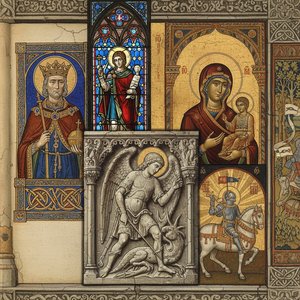
Michael Zeno Diemer: A Visionary Painter of Biblical Landscapes
Michael Zeno Diemer (1867 – 1939) was a German painter who emerged from Munich’s artistic milieu during the late nineteenth and early twentieth centuries, leaving an indelible mark on Impressionism and Romanesque Revival art movements. Though overshadowed by his contemporaries like Edvard Munch and Gustav Klimt, Diemer possessed a singular vision—a profound engagement with religious themes expressed through meticulously crafted landscapes imbued with symbolic resonance. His work reflects not only artistic innovation but also the spiritual anxieties of his time, capturing both beauty and melancholy in equal measure.
Early Life & Artistic Training: Born in Munich in 1867, Diemer received a formal artistic education at Königliche Akademie der Künste München (Royal Academy of Arts), where he studied under Wilhelm Leibl and Albert Richter. Leibl’s influence instilled in him a dedication to realism and tonal painting—techniques that would become foundational to Diemer's distinctive style.
Impressionistic Beginnings: Initially drawn to Impressionism, Diemer produced canvases like “Hart Am Wind” (1893), showcasing the shimmering effects of light on water surfaces with remarkable sensitivity. However, he quickly moved beyond mere optical observation, seeking deeper emotional and spiritual expression.
Romanesque Revival & Biblical Inspiration: Diemer’s artistic trajectory took a decisive turn toward Romanesque Revival aesthetics—a reaction against the perceived excesses of Impressionism and Symbolism. He was captivated by the monumental grandeur and solemn spirituality of medieval churches and landscapes, particularly those depicting biblical scenes.
Notable Works & Artistic Style: His oeuvre includes numerous paintings portraying figures from the Old Testament, notably “Viking Ships Off Rocky Coast” (1906), which exemplifies his masterful command of atmospheric perspective and dramatic composition. Diemer’s brushstrokes are deliberate and controlled, prioritizing tonal harmony over vibrant color palettes—a stylistic choice that underscores his preoccupation with conveying inner emotion rather than simply reproducing visual reality.
Legacy & Historical Significance: Though largely unrecognized during his lifetime, Diemer's work gained posthumous acclaim for its evocative portrayal of faith and its masterful execution. He remains a significant figure in German art history, representing a crucial bridge between Impressionism and the burgeoning Expressionist movement—a testament to his enduring artistic vision.
Influences & Artistic Development
Diemer’s artistic sensibilities were profoundly shaped by several key influences. Leibl's realism served as an anchor, grounding him in observational accuracy while simultaneously encouraging a nuanced understanding of tonal painting—a technique championed by Rembrandt and Caravaggio. Furthermore, Diemer drew inspiration from the landscapes of Caspar David Friedrich, whose Romantic idealism resonated with his own desire to capture sublime beauty alongside spiritual contemplation. The austere grandeur of Romanesque churches provided a visual vocabulary for conveying religious fervor and moral seriousness.
Major Achievements & Recognition
Despite facing considerable challenges in securing commercial success during his lifetime—primarily due to the prevailing artistic climate—Diemer achieved considerable recognition within Munich’s art circles. He was awarded honorary membership at Königliche Akademie der Künste München, cementing his reputation as a respected artist and teacher. His paintings were exhibited extensively throughout Germany and internationally, attracting critical acclaim for their expressive power and technical virtuosity. Notably, Diemer's contribution to the Michaelskirche project—a monumental Renaissance church commissioned by King Ludwig II—demonstrates his commitment to artistic excellence and his ability to collaborate effectively on ambitious architectural endeavors.
The Michael C. Carlos Museum Collection
Diemer’s artistic explorations found a prominent home within the Michael C. Carlos Museum of Emory University's impressive collection of ancient art, showcasing his fascination with biblical narratives and monumental landscapes. The museum’s holdings offer invaluable insight into Diemer’s stylistic influences and underscore the broader context of European artistic production during the Belle Époque—a period characterized by both innovation and conservative traditions.
Explore the rich history of Medieval Art (c. 500 – c. 1500) with OriginalUniqueArt. Discover Byzantine mosaics, Gothic cathedrals & Renaissance masterpieces. Expert insights & museum-quality reproductions.
Hur kan jag se alla konstverk av Michael Zeno Diemer?
Alla verk av Michael Zeno Diemer på denna webbplats kan utforskas via artistens Samtliga konstverk-sida.
Hur många konstverk av Michael Zeno Diemer finns tillgängliga att bläddra bland?
Du kan bläddra bland 26 konstverk verk av Michael Zeno Diemer på sidan Samtliga konstverk.
Under vilka andra namn är Michael Zeno Diemer känd?
Michael Zeno Diemer är även känd som Michael-Zeno, Zeno Diemer, Mich. Zeno Diemer, Z. Diemer, Zeno Mich. Diemer.
I vilken stad och vilket land föddes Michael Zeno Diemer?
Michael Zeno Diemer föddes i Munich, i Germany.
Kan jag utforska Michael Zeno Diemers verk via nyckelord?
Sidan Efter nyckelord för Michael Zeno Diemer grupperar konstnärens verk efter nyckelord.
Finns det en kronologisk genomgång av Michael Zeno Diemer?
Michael Zeno Diemers karriär presenteras period för period på artistens Karriärlinje-sida: en horisontell tidslinje över konstverken, uppdelade i kapitel efter olika karriärperioder.
Var kommer Michael Zeno Diemer ifrån?
Michael Zeno Diemer föddes i Germany.
Finns det en virtuell 3D-visning av Michael Zeno Diemers verk?
Virtuellt 3D-galleri för Michael Zeno Diemer är en sida som visar konstnärens verk i ett virtuellt tredimensionellt galleri.
Vilka stämningar uttrycker Michael Zeno Diemers konstverk?
Känslomässigt rum för Michael Zeno Diemer är en sida där konstnärens verk är sorterade efter stämning.