Porträtt av Mästare Mateo

De 44 mest kända Mästare Mateo-målningarna, varje ett unikt konstverk

Uppdaterad oktober 2026 · rangordnad efter vår popularitetspoäng (sökningar, besök och beställningar för varje verk) · 44 verk av Mästare Mateo i vår katalog

Kortfattat

The disappeared façade at the end of the Camino (1211) är den målning av Mästare Mateo som drar till sig flest blickar; originalet finns på Catedral de Santiago Foundation Museum, Santiago de Compostela. Därefter dras blicken till Base of the mullion of the Portico of Glory (1188) och Trinity of the Portico of Glory (1188). Bland de 44 verk av Mästare Mateo i vår katalog är dessa 44 de mest kända, var och en ett unikt original presenterat med sitt år, sitt museum och anledningen till dess tidlösa betydelse.

1161 – 1217 Romanesque Flest verk: Catedral de Santiago Foundation Museum

Topp 10 målningar av Mästare Mateo, ur galleriets perspektiv

2
Base of the mullion of the Portico of Glory (1188) av Mästare Mateo

Base of the mullion of the Portico of Glory

1188 · Stone · Catedral de Santiago Foundation Museum, Santiago de Compostela

To stand before the Portico of Glory is to witness a profound shift in the language of stone. This specific base of the mullion, carved around 1188, offers a glimpse into the transition from the rigid forms of the Romanesque to a more fluid, naturalistic sensibility. Here, the stone does not merely exist; it breathes. The sculptor, Master Mateo, utilized a technique known as trabajo vivo, layering limestone to create…

3
Trinity of the Portico of Glory (1188) av Mästare Mateo

Trinity of the Portico of Glory

1188 · Stone · Catedral de Santiago Foundation Museum, Santiago de Compostela

Divine Presence in Stone The capital features God the Father holding the Christ child upon his lap. Above them, the Holy Spirit takes form as a dove at the peak of the composition. Angels surround these central figures, carrying incense burners to complete the celestial scene. This sculptural arrangement uses the trabajo vivo technique, layering stone slabs to create textures that mimic flesh and fabric. The result is a sense…

4
Statue-column of king David (1188) av Mästare Mateo

Statue-column of king David

1188 · Stone · Catedral de Santiago Foundation Museum, Santiago de Compostela

In the hallowed atmosphere of the Santiago Cathedral, where history and spirituality converge, stands a figure of profound majesty: the Statue-column of King David. Carved by the legendary Master Mateo around 1188, this Romanesque masterpiece is far more than a mere architectural ornament; it is a window into the soul of the twelfth century. The sculpture captures the biblical monarch in a moment of eternal resonance, seated upon a cross-frame…
5
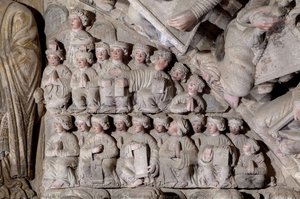
The Glory, Central Arch, Portico of Glory (1211) av Mästare Mateo

The Glory, Central Arch, Portico of Glory

1211 · Stone · Catedral de Santiago Foundation Museum, Santiago de Compostela

The Glory, Central Arch, Portico of Glory is a sculptural work by Master Mateo. It forms a primary component of the Portico of Glory, located at the Cathedral of Santiago de Compostela in Spain. This specific section of the portal was part of a complete three-piece set that reached its conclusion in 1211. The work is currently held at The Catedral de Santiago Foundation in Santiago de Compostela.

6
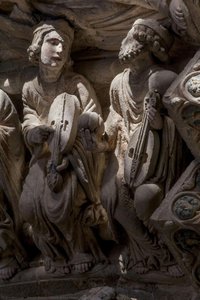
The Elders holding instruments, Central Arch, Portico of Glory (1211) av Mästare Mateo

The Elders holding instruments, Central Arch, Portico of Glory

1211 · Stone · Catedral de Santiago Foundation Museum, Santiago de Compostela

Within the sacred shadows of the Portico of Glory, a profound scene unfolds in stone. The Elders holding instruments, Central Arch, Portico of Glory emerges from the limestone, appearing as if caught in a moment of eternal preparation. This work, created by the hands of Master Mateo, brings the figures of the Apocalypse into a tangible, breathing presence. They sit amidst the radial archivolts, their bodies leaning toward one another…

8
Saint Matthew, Central Arch, Portico of Glory (1211) av Mästare Mateo

Saint Matthew, Central Arch, Portico of Glory

1211 · Stone · Catedral de Santiago Foundation Museum, Santiago de Compostela

The stone breathes under the soft, diffuse light of the cathedral, revealing a figure caught in a moment of eternal devotion. Here, within the central arch of the Portico of Glory, Saint Matthew sits with a quiet, heavy presence. He is a winged presence, his form emerging from the granite with a startling sense of life. He leans over a desk, his knees supporting the weight of his task, as…

9
Saint Luke, Central Arch, Portico of Glory (1211) av Mästare Mateo

Saint Luke, Central Arch, Portico of Glory

1211 · Stone · Catedral de Santiago Foundation Museum, Santiago de Compostela

The limestone relief of Saint Luke, carved around 1211, occupies a central position within the Portico of Glory at the Cathedral of Santiago de Compostela in Spain. The figure is depicted reclining on his right side, a posture that suggests both physical repose and deep introspection. In his left hand, he holds a book, while his head rests upon a lamb, a direct reference to his role as an Evangelist…

10
Arma Christi, Central Arch, Portico of Glory (1211) av Mästare Mateo

Arma Christi, Central Arch, Portico of Glory

1211 · Stone · Catedral de Santiago Foundation Museum, Santiago de Compostela

The relief known as Arma Christi, Central Arch, Portico of Glory is a sculptural work by the artist Master Mateo. This specific piece is situated within the Central Arch of the Portico of Glory. It was created in 1211. The work is part of a larger architectural and sculptural program located at the Santiago de Compostela Cathedral in Galicia, Spain.

Mästare Mateos berömda målningar, nummer 11 till 44

11Santo dos Croques of the Portico of Glory (1200) av Mästare MateoSanto dos Croques of the Portico of Glory1200 · Catedral de Santiago Foundation Museum 12Saint Matthew (1200) av Mästare MateoSaint Matthew1200 · Catedral de Santiago Foundation Museum 13Statues of David and Solomon (1188) av Mästare MateoStatues of David and Solomon1188 · Catedral de Santiago Foundation Museum 14Portico de la Gloria (1168) av Mästare MateoPortico de la Gloria1168 · Cathedral 15Portico de la Gloria (detail) (1168) av Mästare MateoPortico de la Gloria (detail)1168 · Cathedral 16Portico de la Gloria (1168) av Mästare MateoPortico de la Gloria1168 · Cathedral 17Portico de la Gloria (detail) (1168) av Mästare MateoPortico de la Gloria (detail)1168 · Cathedral 18Right arch of the Portico of Glory. Iconography of the condemned (1188) av Mästare MateoRight arch of the Portico of Glory. Iconography of the condemned1188 · Catedral de Santiago Foundation Museum 19Right arch of the Portico of Glory (1188) av Mästare MateoRight arch of the Portico of Glory1188 · Catedral de Santiago Foundation Museum 20Left arch of the Portico of Glory (1188) av Mästare MateoLeft arch of the Portico of Glory1188 · Catedral de Santiago Foundation Museum 21Right columns of the central arch of the Portico of Gloryh (1188) av Mästare MateoRight columns of the central arch of the Portico of Gloryh1188 · Catedral de Santiago Foundation Museum 22Saint Marcus, Central Arch, Portico of Glory (1211) av Mästare MateoSaint Marcus, Central Arch, Portico of Glory1211 · Catedral de Santiago Foundation Museum 23Saint John, Central Arch, Portico of Glory (1211) av Mästare MateoSaint John, Central Arch, Portico of Glory1211 · Catedral de Santiago Foundation Museum 24Ordo Prophetarum, The counter facade, Portico of Glory (1211) av Mästare MateoOrdo Prophetarum, The counter facade, Portico of Glory1211 · Catedral de Santiago Foundation Museum 25The Sybil, The counter facade, Portico of Glory (1211) av Mästare MateoThe Sybil, The counter facade, Portico of Glory1211 · Catedral de Santiago Foundation Museum 26Right arch of the Portico of Glory. Iconography of the blessed (1211) av Mästare MateoRight arch of the Portico of Glory. Iconography of the blessed1211 · Catedral de Santiago Foundation Museum 27Detail of the Elders, Central Arch, Portico of Glory (1211) av Mästare MateoDetail of the Elders, Central Arch, Portico of Glory1211 · Catedral de Santiago Foundation Museum 28Tribune of Portico of Glory (1211) av Mästare MateoTribune of Portico of Glory1211 · Catedral de Santiago Foundation Museum 29Angels, The Tribune, Portico of Glory (1211) av Mästare MateoAngels, The Tribune, Portico of Glory1211 · Catedral de Santiago Foundation Museum 30Portico of Glory (1211) av Mästare MateoPortico of Glory1211 · Catedral de Santiago Foundation Museum 31Keystones from Portico of the Glory (1211) av Mästare MateoKeystones from Portico of the Glory1211 · Catedral de Santiago Foundation Museum 32Detail Maiestas Domini of The Portico of Glory (1211) av Mästare MateoDetail Maiestas Domini of The Portico of Glory1211 · Catedral de Santiago Foundation Museum 33Arma Christi, Central Arch, Portico of Glory (1211) av Mästare MateoArma Christi, Central Arch, Portico of Glory1211 · Catedral de Santiago Foundation Museum 34The Just, Central Arch, Portico of Glory (1211) av Mästare MateoThe Just, Central Arch, Portico of Glory1211 · Catedral de Santiago Foundation Museum 35Detail of the Elders, Central Arch, Portico of Glory (1211) av Mästare MateoDetail of the Elders, Central Arch, Portico of Glory1211 · Catedral de Santiago Foundation Museum 36Detail of the Blessed, Central Arch, Portico of Glory (1211) av Mästare MateoDetail of the Blessed, Central Arch, Portico of Glory1211 · Catedral de Santiago Foundation Museum 37Central Arch of The Portico of Glory (1211) av Mästare MateoCentral Arch of The Portico of Glory1211 · Catedral de Santiago Foundation Museum 38Organistrum, Central Arch, Portico of Glory (1211) av Mästare MateoOrganistrum, Central Arch, Portico of Glory1211 · Catedral de Santiago Foundation Museum 39Drawing José Vega y Verdugo (1656-1657) Archivo de la Catedral (1657) av Mästare MateoDrawing José Vega y Verdugo (1656-1657) Archivo de la Catedral1657 · Catedral de Santiago Foundation Museum 40Left arch of the Portico of Glory. Iconography (1188) av Mästare MateoLeft arch of the Portico of Glory. Iconography1188 · Catedral de Santiago Foundation Museum 41Estatuas-columna de dos profetas procedentes de la desaparecida fachada exterior del Pórtico de la Gloria\n\n- Isaac (1188) av Mästare MateoEstatuas-columna de dos profetas procedentes de la desaparecida fachada exterior del Pórtico de la Gloria\n\n- Isaac1188 · Catedral de Santiago Foundation Museum 42Rose window (1200) av Mästare MateoRose window1200 · Catedral de Santiago Foundation Museum 43Stony choir reconstruction (1211) av Mästare MateoStony choir reconstruction1211 · Catedral de Santiago Foundation Museum 44Lintels Central Arch of The Portico of Glory (1188) av Mästare MateoLintels Central Arch of The Portico of Glory1188 · Catedral de Santiago Foundation Museum

Motiven som fångade Mästare Mateos blick

De fyra motiv som återkommer oftast i dessa originalverk, var och ett med sitt främsta exempel.

Museerna som förvarar Mästare Mateos originalverk

De 2 museer som innehar flest av målningarna på denna sida.

Museum Stad Verk av Mästare Mateo Målningar från denna lista
Catedral de Santiago Foundation Museum, Santiago de CompostelaCatedral de Santiago Foundation Museum Santiago de Compostela 40 The disappeared façade at the end of the Camino, Base of the mullion of the Portico of Glory, Trinity of the Portico of Glory
Cathedral, Santiago de CompostelaCathedral Santiago de Compostela 4 Portico de la Gloria, Portico de la Gloria (detail), Portico de la Gloria

Mästare Mateo genom decennierna: ett unikt original för varje era

Verk per decennium

Välj ett decennium för att se originalverket som definierar det.

Mästare Mateos målningar: frågor till galleriet

Vilket är Mästare Mateos mest kända verk?Visa svaret

The disappeared façade at the end of the Camino (1211), Catedral de Santiago Foundation Museum, Santiago de Compostela. Base of the mullion of the Portico of Glory (1188) och Trinity of the Portico of Glory (1188) följer efter.

Vid vilken ålder skapade Mästare Mateo The disappeared façade at the end of the Camino?Visa svaret

50 år gammal: The disappeared façade at the end of the Camino är från 1211, och Mästare Mateo föddes 1161.

Vilka tio målningar av Mästare Mateo är de mest kända?Visa svaret

The disappeared façade at the end of the Camino, Base of the mullion of the Portico of Glory, Trinity of the Portico of Glory, Statue-column of king David, The Glory, Central Arch, Portico of Glory, The Elders holding instruments, Central Arch, Portico of Glory, Voussoirs with the punishment of lust, Saint Matthew, Central Arch, Portico of Glory, Saint Luke, Central Arch, Portico of Glory och Arma Christi, Central Arch, Portico of Glory. Rankingen ovan visar varje verks årtal och museum.

Hur många verk av Mästare Mateo är kända?Visa svaret

Vår katalog innehåller 44 verk av Mästare Mateo, daterade från 1188 till 1211.

Var kan de mest kända originalen av Mästare Mateo ses?Visa svaret

Främst i Catedral de Santiago Foundation Museum (Santiago de Compostela) och Cathedral (Santiago de Compostela). Museitabellen ovan listar alla.

Under vilken period skapade Mästare Mateo sina mest kända målningar?Visa svaret

Under 1210s: 24 av de 44 verk som finns på denna sida skapades då, varav The disappeared façade at the end of the Camino.

Vilket av de kända verken av Mästare Mateo är det tidigaste respektive det senaste?Visa svaret

På den här sidan är det tidigaste Base of the mullion of the Portico of Glory (1188) och det senaste The disappeared façade at the end of the Camino (1211).

Vilka motiv föredrog Mästare Mateo?Visa svaret

Sculpture (6), Medieval art (5) och Stone (4), fördelat på 44 verk på denna sida.

Vilka material använde Mästare Mateo mest av när hen målade?Visa svaret

Stone, för 11 av de 44 verk som finns på denna sida.

Vilken konstinriktning tillhör Mästare Mateos verk?Visa svaret

Romanesque, om man dömer efter originalen på denna sida.

Vilka original av Mästare Mateo kan jag se på Catedral de Santiago Foundation Museum?Visa svaret

The disappeared façade at the end of the Camino, Base of the mullion of the Portico of Glory och Trinity of the Portico of Glory: Catedral de Santiago Foundation Museum, Santiago de Compostela har 40 av verken på denna sida.

Mästare Mateo: ett porträtt av konstnären

Själens glans i Santiago

Mästare Mateo, en skulptör vars namn förblir höljt i mysterier trots hans monumentala bidrag till katedralen i Santiago de Compostela, står som en av de mest vördade gestalterna inom den romanska konsten i Spanien. Han föddes omkring 1161 i Galicien, och även om de exakta detaljerna kring hans liv är få, vilar Mästare Mateos arv främst på hans oöverträffade mästerverk: Portico de la Gloria. Detta häpnadsväckande arkitektoniska underverk dominerar katedralens fasad och förkroppsligar 1100-talets andliga glöd. Han framträdde som skulptör under en tid präglad av intensiv religiös hängivenhet och konstnärlig innovation, i en värld där pilgrimsleden till Santiago redan var en transformativ resa för tusentals själar.

Genesisen till hans största verk tog sin början omkring 1188, när han fick i uppdrag att övervaka skapandet av den tredelade portalen som skulle bli hans magnum opus. Själva projektet med katedralen hade planerats decennier tidigare, driven av kung Alfonso VIII och född ur platsens enorma religiösa betydelse. Inom denna heliga kontext högg Mästare Mateo inte bara i sten; han blåste liv i den. Hans medverkan i Portico de la Adamant var ett gudomligt uppdrag som förvandlade en strukturell nödvändighet till ett teologiskt narrativ som än idag fängslar både pilgrimer och konsthistoriker.

En symfoni i sten: Teknik och stil

Mästare Mateos skulpturala stil kännetecknas av en anmärkningsvärd realism som utgjorde ett djupt avsteg från tidigare, mer stela romanska konventioner. Medan hans samtida ofta förlitade sig på stiliserade, platta figurer, studerade Mästare Mateo noggrant mänsklig anatomi och draperiernas komplexa rörelser, vilket resulterade i en häpnadsväckande precision i hans avbildningar. Hans bemästring av kalkstensskulptur var oöverträffad, särskilt genom användningen av tekniken trabajo vivo. Denna metod innebar att man lade lager av stenplattor för att skapa texturerade ytor som efterliknade hudens och tygets utseende, vilket gav en känsla av rörelse och vitalitet åt det statiska mediet.

Detta innovativa tillvägagångssätt gjorde det möjligt för honom att överbrygga gapet mellan det jordiska och det gudomliga. När man betraktar hans verk kan man se hur han skickligt använde ljus och skugga för att förstärka reliefernas djup. Hans förmåga att manipulera stenen för att antyda mjukheten i en helgons klädnad eller den muskulära spänningen hos en biblisk gestalt lyfte hans hantverk till en sofistikeringsnivå som sällan skådats under medeltiden. Denna tekniska briljans säkerställde att hans figurer inte bara var symboler, utan påtagliga närvaron i katedralens ingång.

Portico de la Gloria: Ett vittnesbörd om tro

Portico de la Gloria fungerar som det ultimata vittnesbördet om Mästare Mateos konstnärliga och andliga vision. Dess centrala paneler skildrar djupa scener från evangelierna – inklusive födelsen, bebådelsen och korsfästelsen – arrangerade på ett sätt som leder betraktaren genom en helig historia. Ikonografin är vidsträckt och komplex och omfattar:

  • Den centrala bågen: Med ikoniska figurer som Sankt Lukas, där den intrikata romanska skulpturen uppvisar ett djupt religiöst symbolvärde.
  • Den vänstra bågen: Ett mästerverk i 1100-talets spanska reliefskulptur som visar detaljerade bibliska berättelser.
  • Den högra bågen: En uppvisning i intrikat skönhet som demonstrerar hans förmåga att hantera komplex arkitektonisk och skulptural integration.

Genom dessa verk uppnådde Mästare Mateo en historisk betydelse som sträcker sig bortom hans egen födelseperiod. Han förde den romanska stilen mot den framväxande elegansen i den gotiska stilen och lämnade efter sig ett arv som förblir hjärtat i Santiago de Compostela. Hans arbete står som en permanent bro mellan det medeltida medvetandet och det eviga, vilket säkerställer att även århundraden efter hans död år 1217, fortsätter glansen i hans stensymfoni att inge vördnad.