Porträtt av Luis De Morales

De 50 mest kända Luis De Morales-målningarna, varje ett unikt konstverk

Uppdaterad november 2026 · rangordnad efter vår popularitetspoäng (sökningar, besök och beställningar för varje verk) · 51 verk av Luis De Morales i vår katalog

Kortfattat

Virgin and Child with the Infant St John the Baptist (1550) är den målning av Luis De Morales som drar till sig flest blickar; originalet finns på Museo del Prado, Madrid. Därefter dras blicken till The Crucifixion (1566) och The Annuncation (1565). Bland de 51 verk av Luis De Morales i vår katalog är dessa 50 de mest kända, var och en ett unikt original presenterat med sitt år, sitt museum och anledningen till dess tidlösa betydelse.

1509 – 1586, Badajoz Spanish renaissance Flest verk: Museo del Prado

Topp 10 målningar av Luis De Morales, ur galleriets perspektiv

1
Virgin and Child with the Infant St John the Baptist (1550) av Luis De Morales

Virgin and Child with the Infant St John the Baptist

1550 · Oil On Canvas · Museo del Prado, Madrid

In this 1550 portrait, the Virgin Mary holds the infant Jesus in a close, physical embrace. The child is depicted nursing, a detail that grounds the religious scene in a moment of biological necessity and maternal intimacy. To the left and right of the central figures, two winged beings—angels or saints—occupy the periphery of the frame. These figures are positioned against a backdrop of dense trees, which provides a sense…

2
The Crucifixion (1566) av Luis De Morales

The Crucifixion

1566 · Oil On Panel · Museo del Prado, Madrid

The heavy silence of the scene is held within The Crucifixion, a profound work of religious art created by the Spanish painter Luis de Morales. Dating to 1566, this piece captures a moment of intense spiritual weight. The central focus remains fixed upon the Crucifixion of Jesus Christ, a subject that demands the viewer's immediate and solemn attention.

3
The Annuncation (1565) av Luis De Morales

The Annuncation

1565 · Oil On Panel · Museo del Prado, Madrid

The Annunciation by Luis de Morales captures a moment of divine stillness. Painted about 1565, the work presents a quiet encounter between the celestial and the earthly. The Archangel Gabriel and the Virgin Mary occupy a shared, intimate space, separated by a single white lily in a slender vase. A white dove descends through soft light, marking the presence of the Holy Spirit above the figures.

4
The Resurrection of Christ (1566) av Luis De Morales

The Resurrection of Christ

1566 · Oil · Museo del Prado, Madrid

A sudden, vertical force breaks the stillness of the tomb. Christ rises from the heavy stone sarcophagus, his body caught in a moment of divine momentum. The light is not merely a glow; it is a weightless, golden flood that carves the musculature of his torso out of the surrounding shadows. Behind him, a shroud of reddish-pink fabric billows like a sudden flame, tracing the path of his upward movement.…

5
The Birth of the Virgin (1562) av Luis De Morales

The Birth of the Virgin

1562 · Oil · Museo del Prado, Madrid

The air in the room feels heavy, thick with the quiet gravity of a life beginning. Within this shallow, intimate space, four women gather, their forms tightly grouped as if to shield the profound miracle unfolding before them. A woman reclines in the bed, her presence marked by the soft contours of her face and the weight of the linens surrounding her. Nearby, another figure holds a newborn infant, the…

6
The Virgin and Child with a Spindle (1566) av Luis De Morales

The Virgin and Child with a Spindle

1566 · Oil · Museo del Prado, Madrid

The composition is a vertical portrait set against a dark, undifferentiated background. In the center, the Virgin Mary holds the Christ Child. She wears a red gown beneath a heavy blue mantle, while a translucent veil rests upon her head. The skin of both figures appears pale and luminous against the deep shadows. The child holds a wooden spindle, its straight, thin lines cutting through the soft folds of the…

7
Saint John the Baptist (1566) av Luis De Morales

Saint John the Baptist

1566 · Oil On Panel · Museo del Prado, Madrid

The portrait presents a close-up, bust-length view of Saint John the Baptist, positioned slightly off-center. He gazes toward the left with an expression defined by weariness and contemplation. The composition utilizes a chiaroscuro technique, where a strong directional light source illuminates one side of the face, carving out the hollows of the eyes and the texture of the beard against deep, shadowy recesses. This interplay of light and dark creates…

8
Virgin and Child-Morales (1586) av Luis De Morales

Virgin and Child-Morales

1586 · Oil On Canvas · Machado de Castro National Museum, Coimbra

The Virgin gently cradles her son within a space defined by shadow and soft light. A newborn hand tucks through the folds of a red gown, searching for milk. This small gesture anchors the composition, pulling the viewer into a quiet, domestic moment of care. The faces of mother and child lean toward one another, their gazes interlocking with a tender, silent weight. Behind them, a pitch-dark background swallows the…

9
Ecce Homo (1565) av Luis De Morales

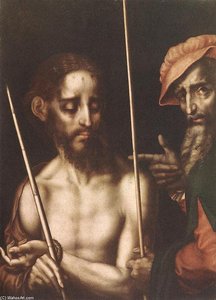
Ecce Homo

1565 · Oil On Canvas · Museo del Prado, Madrid

The shadows press closely against the figure, creating a void that seems to swallow everything but the man himself. In this vertical portrait, the upper torso and head of Jesus Christ emerge from a near-black background, caught in a heavy, dramatic chiaroscuro. A soft light descends from the upper left, catching the smooth, porcelain-like texture of his skin and casting gentle shadows across the musculature of his chest and arms.…

10
Pietà av Luis De Morales

Pietà

Oil On Panel · Louvre, Paris

In the quiet, somber depths of Luis de Morales’s Pietà, one encounters more than just a religious scene; one enters a profound meditation on human suffering and divine grace. Executed between 1565 and 1570, this masterpiece serves as a cornerstone of the Spanish Renaissance, capturing the exact moment when the weight of mortality meets the infinite strength of maternal love. The painting depicts the Virgin Mary cradling the lifeless, broken…

Luis De Moraless berömda målningar, nummer 11 till 50

11Christ Justifying his Passion (1565) av Luis De MoralesChrist Justifying his Passion1565 · Museo del Prado 12Christ, Man of Sorrows (1566) av Luis De MoralesChrist, Man of Sorrows1566 · Museo del Prado 13Pietà (1567) av Luis De MoralesPietà1567 · Museo del Prado 14Saint Juan de Ribera (1566) av Luis De MoralesSaint Juan de Ribera1566 · Museo del Prado 15Ecce Homo (1547) av Luis De MoralesEcce Homo1547 · Staatliche Kunstsammlungen Dresden 16The Adoration of the Shepherds (1567) av Luis De MoralesThe Adoration of the Shepherds1567 · Museo del Prado 17Man of Sorrows (1560) av Luis De MoralesMan of Sorrows1560 · Minneapolis Institute of Art 18The Lamentation (1560) av Luis De MoralesThe Lamentation1560 · Metropolitan Museum of Art 19The Purification of the Virgin or The Presentation in the Temple (1562) av Luis De MoralesThe Purification of the Virgin or The Presentation in the Temple1562 · Museo del Prado 20Pietà (1560) av Luis De MoralesPietà1560 · Real Academia de Bellas Artes de San Fernando 21Ecce Homo (1570) av Luis De MoralesEcce Homo1570 · Museu Nacional d'Art de Catalunya 22The Virgin and Child with the Infant Saint John the Baptist (1570) av Luis De MoralesThe Virgin and Child with the Infant Saint John the Baptist1570 · Museo del Prado 23The Virgin Dolorosa (1565) av Luis De MoralesThe Virgin Dolorosa1565 · Museo del Prado 24The Adoration of the Magi (1567) av Luis De MoralesThe Adoration of the Magi1567 · Museo del Prado 25Christ Carrying the Cross (1547) av Luis De MoralesChrist Carrying the Cross1547 · Bavarian State Painting Collections 26Christ Carrying the Cro (1546) av Luis De MoralesChrist Carrying the Cro1546 · Yale University Art Gallery 27Triptych of the Pietà, St John and St Mary Magdalene (1567) av Luis De MoralesTriptych of the Pietà, St John and St Mary Magdalene1567 · Museo del Prado 28Holy Family (1557) av Luis De MoralesHoly Family1557 · Hispanic Society Museum - Library 29Saint Jerome in the Wilderness (1570) av Luis De MoralesSaint Jerome in the Wilderness1570 · National Gallery of Ireland 30Ecce Homo (1565) av Luis De MoralesEcce Homo1565 · Fundación Banco Santander 31Christ before Pilate (1570) av Luis De MoralesChrist before Pilate1570 · Real Academia de Bellas Artes de San Fernando 32Christ Carrying the Cross (1566) av Luis De MoralesChrist Carrying the Cross1566 · Museo del Patriarca 33The Agony in the Garden (1545) av Luis De MoralesThe Agony in the Garden1545 · Museo del Prado 34Madonna and Child av Luis De MoralesMadonna and ChildBowes Museum 35The Virgin and Child (1567) av Luis De MoralesThe Virgin and Child1567 · The Ashmolean Museum of Art and Archaeology 36Virgin and Child (1520) av Luis De MoralesVirgin and Child1520 · Museu do Caramulo 37Virgin and Child with a Spindle (1567) av Luis De MoralesVirgin and Child with a Spindle1567 · Staatliche Museen zu Berlin 38Christ at the Column av Luis De MoralesChrist at the ColumnNational Museum of Fine Arts 39Virgin and Child av Luis De MoralesVirgin and ChildMuseum of Fine Arts 40Madonna and Child av Luis De MoralesMadonna and ChildCampion Hall 41Pietà 1724 av Luis De MoralesPietà 1724 42Christ at the Column av Luis De MoralesChrist at the ColumnKingston Lacy 43Triptych of Bishop Juan de Ribera av Luis De MoralesTriptych of Bishop Juan de RiberaMuseum of Cádiz 44The Virgin and Child av Luis De MoralesThe Virgin and ChildNational Gallery 45Ecce Homo av Luis De MoralesEcce HomoHispanic Society Museum - Library 46Christ as the Man of Sorrows av Luis De MoralesChrist as the Man of Sorrows 47St Stephen av Luis De MoralesSt StephenMuseo del Prado 48Madonna with the Child (1570) av Luis De MoralesMadonna with the Child1570 · Museo del Prado 49Mater Dolorosa (1570) av Luis De MoralesMater Dolorosa1570 · Ermitaget 50Madonna with the Child (1570) av Luis De MoralesMadonna with the Child1570 · Ermitaget

Luis De Moraless berömda målningar, period för period

Motiven som fångade Luis De Moraless blick

De fyra motiv som återkommer oftast i dessa originalverk, var och ett med sitt främsta exempel.

Museerna som förvarar Luis De Moraless originalverk

De 8 museer som innehar flest av målningarna på denna sida.

Museum Stad Verk av Luis De Morales Målningar från denna lista
Museo del Prado, MadridMuseo del Prado Madrid 21 Virgin and Child with the Infant St John the Baptist, The Crucifixion, The Annuncation
Real Academia de Bellas Artes de San Fernando, MadridReal Academia de Bellas Artes de San Fernando Madrid 2 Pietà, Christ before Pilate
Hispanic Society Museum - Library, New YorkHispanic Society Museum - Library New York 2 Holy Family, Ecce Homo
Ermitaget, Sankt PetersburgErmitaget Sankt Petersburg 2 Mater Dolorosa, Madonna with the Child
Machado de Castro National Museum, CoimbraMachado de Castro National Museum Coimbra 1 Virgin and Child-Morales
Louvre, ParisLouvre Paris 1 Pietà
Staatliche Kunstsammlungen Dresden, DresdenStaatliche Kunstsammlungen Dresden Dresden 1 Ecce Homo
Minneapolis Institute of Art, MinneapolisMinneapolis Institute of Art Minneapolis 1 Man of Sorrows

Luis De Morales genom decennierna: ett unikt original för varje era

Verk per decennium

Välj ett decennium för att se originalverket som definierar det.

Luis De Moraless målningar: frågor till galleriet

Vilket är Luis De Moraless mest kända verk?Visa svaret

Virgin and Child with the Infant St John the Baptist (1550), Museo del Prado, Madrid. The Crucifixion (1566) och The Annuncation (1565) följer efter.

Vid vilken ålder skapade Luis De Morales Virgin and Child with the Infant St John the Baptist?Visa svaret

41 år gammal: Virgin and Child with the Infant St John the Baptist är från 1550, och Luis De Morales föddes 1509.

Vilka tio målningar av Luis De Morales är de mest kända?Visa svaret

Virgin and Child with the Infant St John the Baptist, The Crucifixion, The Annuncation, The Resurrection of Christ, The Birth of the Virgin, The Virgin and Child with a Spindle, Saint John the Baptist, Virgin and Child-Morales, Ecce Homo och Pietà. Rankingen ovan visar varje verks årtal och museum.

Hur många verk av Luis De Morales är kända?Visa svaret

Vår katalog innehåller 51 verk av Luis De Morales, daterade från 1520 till 1586.

Var kan de mest kända originalen av Luis De Morales ses?Visa svaret

Främst i Museo del Prado (Madrid), Real Academia de Bellas Artes de San Fernando (Madrid) och Hispanic Society Museum - Library (New York). Museitabellen ovan listar alla.

Under vilken period skapade Luis De Morales sina mest kända målningar?Visa svaret

Under 1560s: 23 av de 50 verk som finns på denna sida skapades då, varav The Crucifixion.

Vilket av de kända verken av Luis De Morales är det tidigaste respektive det senaste?Visa svaret

På den här sidan är det tidigaste Virgin and Child (1520) och det senaste Virgin and Child-Morales (1586).

Vilka motiv föredrog Luis De Morales?Visa svaret

Man (22), Woman (20) och Dark background (18), fördelat på 50 verk på denna sida.

Vilka material använde Luis De Morales mest av när hen målade?Visa svaret

Oil On Panel, för 27 av de 50 verk som finns på denna sida.

Vilken konstinriktning tillhör Luis De Moraless verk?Visa svaret

Spanish renaissance, om man dömer efter originalen på denna sida.

Vilka original av Luis De Morales kan jag se på Museo del Prado?Visa svaret

Virgin and Child with the Infant St John the Baptist, The Crucifixion och The Annuncation: Museo del Prado, Madrid har 21 av verken på denna sida.

Luis De Morales: ett porträtt av konstnären

Luis de Morales: Den gudomlige målaren från Badajoz

Luis de Morales (ca. 1509 – 9 maj 1586), kärleksfullt känd som ”El Divino”, står som en av de mest vördade gestalterna inom den spanska renässanskonsten – en målare vars djupa spiritualitet och häpnadsväckande realism fångade betraktarna under sin livstid och fortsätter att väcka beundran århundraden senare. Född i Badajoz, Extremadura, utspelades Morales konstnärliga resa mot en bakgrund av framväxande humanistiska ideal och religiös hängivenhet, vilket formade honom till en oöverträffad mästare av andlig bildkonst och cementerade hans arv som sin eras främsta konstnär.
  • Tidigt liv och influenser: Lite är definitivt känt om Morales formativa år utöver dokumenterade uppgifter som visar att han föddes i Badajoz omkring 1509. Hans konstnärliga utbildning inleddes sannolikt under ledning av Hernando Sturmio, en flamländsk målare etablerad i Badajoz, och möjligen Pedro de Campaña, en framstående konstnär verksam i Sevilla – platser som var kända för sina levande konstnärliga traditioner under renässansen.
  • Den lombardiska skolan och florentinska ekon: Morales tidiga verk bär oförvägranliga spår av Leonardo da Vincis lombardiska skola – kännetecknad av subtil sfumato (mjuka övergångar) och atmosfäriskt perspektiv. Samtidigt absorberade han influenser från Michelangelo, vars monumentala skulpturer gav honom en mästerlig förståelse för anatomi och uttrycksfull gestik. Dessa formativa erfarenheter satte djupa spår i hans konstnärliga sinne.

En period definierad av anatomisk precision och andligt djup

Morales konstnärliga produktion kan delas in i två distinkta perioder som speglar föränderliga stilistiska trender och intellektuella strömningar. Den första fasen, som sträckte sig ungefär från 1539 till 1560, präglades av ett fortsatt engagemang för florentinsk estetik – särskilt Michelangelos anatomiska stringens – vilket resulterade i målningar genomsyrade av påtaglig emotion och dramatisk spänning. Verk som La Virgen del Pajarito exemplifierar denna tidiga stil, där minutiösa detaljer förmedlar en djup andlig kontemplation.
  • Den andra blomstringstiden: Efter sitt äktenskap med Leonor de Chaves och den efterföljande flytten till Alcántara, upplevde Morales en anmärkningsvärda konstnärlig renässans. Under denna period skapade han mästerverk som tänjde på renässansens tekniska gränser – särskilt vad gäller anatomisk korrekthet – inspirerad av tyska och flamländska målare som förespråkade chiaroscuro (kontrast mellan ljus och mörker) samt en noggrann observation av naturen.
  • Betydande prestationer: Bland hans mest hyllade målningar finns La Piedad (1560), förvarad i katedralen i Badajoz, en hjärtskärande skildring av Maria som sörjer Jesu död – ett bevis på Morales oöverträffade förmåga att förmedla sorgsen emotion; San Juan de Ribera (1564), som finns i Prado-museet i Madrid; samt Ecce Homo, utställd på Hispanic Society of America. Dessa verk står som bestående symboler för renässansens fromhet och konstnärliga excellens.

Arv och erkännande

Luis de Morales inflytande sträckte sig långt bortom hans egen livstid, vilket etablerade honom som en hörnsten i den spanska renässanskonsten och säkrade hans plats bland sin generations främsta målare. Hans orubbliga hängivenhet till religiösa teman – uttryckt med häpnadsväckande realism och genomsyrad av påtaglig känsla – resonerade djupt hos publiken över hela Europa. Idag finns hans målningar bevarade i prestigefyllda institutioner världen över – inklusive Prado-museet i Madrid och Kingston Lacy House i Dorset – vilket vittnar om deras bestående konstnärliga värde och historiska betydelse. Morales arv fortsätter att inspirera både konstnärer och forskare, och säkerställer att ”El Divino” förblir en fyrbåk av andlig konstnärlighet för kommande generationer.

Utvalda verk

  • La Virgen del Pajarito (Jungfrun med fågeln) (1546), förvarad i kyrkan San Agustín, Madrid.
  • La Piedad (1560), förvarad i katedralen i Badajoz.
  • San Juan de Ribera (1564), i Prado-museet, Madrid.
  • Ecce Homo, i Kingston Lacy House (National Trust), Dorset, Storbritannien.
  • Virgen de la leche (Ammanade Jungfrun), i Prado-museet.
  • St. Jerome in the Wilderness (Sankt Hieronymus i öknen), i National Gallery of Ireland, Dublin.