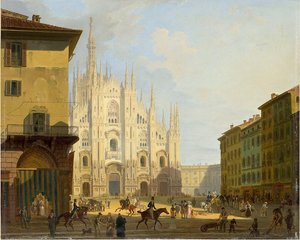
Porträtt av Luca Carlevarijs

Luca Carlevarijss målningar: De 14 mest kända, ur ett galleris perspektiv

Uppdaterad november 2026 · rangordnad efter vår popularitetspoäng (sökningar, besök och beställningar för varje verk) · 15 verk av Luca Carlevarijs i vår katalog

Kortfattat

Ur galleriets perspektiv är Luca Carlevarijss mest kända målning Venice, Doge's Palace (1690). Reception of the Venetian Ambassadors at the Tower in London (1707) och A Caprice Landscape with a Fountain and an Artist Sketching (1704) fullbordar trion som alla känner igen. Av de 15 verk av Luca Carlevarijs i vår katalog presenterar galleriet nedan de 14 mest kända, var och en som ett original med sitt år, sitt museum och vad som gör det unikt.

1663 – 1730, Udine Flest verk: Buckingham Palace

Galleriets 10 främsta målningar av Luca Carlevarijs

Luca Carlevarijss målningar, rankade 11 till 14

Museerna som förvarar Luca Carlevarijss originalverk

De 8 museer som innehar flest av målningarna på denna sida.

Museum Stad Verk av Luca Carlevarijs Målningar från denna lista
Buckingham Palace, LondonBuckingham Palace London 3 A Caprice Landscape with a Fountain and an Artist Sketching, A Caprice View of a Seaport, A Caprice View with a Shipyard
J. Paul Getty Museum, Los AngelesJ. Paul Getty Museum Los Angeles 2 The Bucintoro Departing from the Bacino di San Marco, Regatta on the Grand Canal in Honor of Frederick IV, King of Denmark
Bavarian State Painting Collections, MünchenBavarian State Painting Collections München 1 Reception of the Venetian Ambassadors at the Tower in London
Hampton Court Palace, LondonHampton Court Palace London 1 A Seaport with a Fountain and Ruins
Metropolitan Museum of Art, New YorkMetropolitan Museum of Art New York 1 The Molo, Venice, from the Bacino di San Marco
Royal Collection, LondonRoyal Collection London 1 A Caprice View of a Harbour
Fondazione Cariplo, MilanoFondazione Cariplo Milano 1 Capriccio with Scenes of Life in a Seaport
Ca' Rezzonico – Museum of the 18th Century Venice, VenedigCa' Rezzonico – Museum of the 18th Century Venice Venedig 1 Caprice with an arch

Luca Carlevarijs, ett signaturverk per decennium

Verk per decennium

Välj ett decennium för att se originalverket som definierar det.

Luca Carlevarijss målningar: galleriets svar

Vilken av Luca Carlevarijss målningar är den mest kända av alla?Visa svaret

Venice, Doge's Palace (1690). Därefter följer Reception of the Venetian Ambassadors at the Tower in London (1707) och A Caprice Landscape with a Fountain and an Artist Sketching (1704).

Hur gammal var Luca Carlevarijs när Venice, Doge's Palace färdigställdes?Visa svaret

27 år gammal: Venice, Doge's Palace är från 1690, och Luca Carlevarijs föddes 1663.

Vilka är Luca Carlevarijss 10 främsta målningar?Visa svaret

Venice, Doge's Palace, Reception of the Venetian Ambassadors at the Tower in London, A Caprice Landscape with a Fountain and an Artist Sketching, A Seaport with a Fountain and Ruins, A Caprice View of a Seaport, The Molo, Venice, from the Bacino di San Marco, The Bucintoro Departing from the Bacino di San Marco, A Caprice View with a Shipyard, A Caprice View of a Harbour och Regatta on the Grand Canal in Honor of Frederick IV, King of Denmark. Rankingen ovan visar varje verks årtal och museum.

Hur många verk skapade Luca Carlevarijs?Visa svaret

Vår katalog innehåller 15 verk av Luca Carlevarijs, daterade från 1690 till 1726.

Var hänger Luca Carlevarijss mest kända original?Visa svaret

Främst i Buckingham Palace (London), J. Paul Getty Museum (Los Angeles) och Bavarian State Painting Collections (München). Museitabellen ovan listar alla.

När skapade Luca Carlevarijs sina mest kända målningar?Visa svaret

Under 1700s: 5 av de 14 verk som finns på denna sida skapades då, varav Reception of the Venetian Ambassadors at the Tower in London.

Vilka är Luca Carlevarijss tidigaste och senaste kända verk?Visa svaret

På den här sidan är det tidigaste Venice, Doge's Palace (1690) och det senaste View of Place Saint-Marc with Charlatans (1726).

Vilka original av Luca Carlevarijs finns i Buckingham Palaces samlingar?Visa svaret

A Caprice Landscape with a Fountain and an Artist Sketching, A Caprice View of a Seaport och A Caprice View with a Shipyard: Buckingham Palace, London har 3 av verken på denna sida.

Luca Carlevarijs: konstnären

Luca Casanobrio or Luca di Ca Zenobri: The Pioneer of Venetian Cityscapes

Luca Casanobrio, more commonly known as Luca Carlevarijs or Carlevaris, stands as a pivotal figure in the history of art, particularly renowned for his groundbreaking contributions to the genre of *vedute* – cityscapes – of Venice. Born in Udine, Italy, on January 20, 1663, and passing away in Venice itself in 1730, Carlevaris’s artistic journey was one of meticulous observation, mathematical precision, and a profound appreciation for the unique beauty of his adopted city. His work wasn't merely a depiction of buildings; it was an attempt to capture the very essence of Venetian life, its light, its atmosphere, and its intricate urban fabric – a legacy that profoundly influenced generations of artists, most notably Canaletto and Francesco Guardi.

Early Life and Artistic Foundations

Carlevaris’s early career unfolded within the vibrant artistic milieu of Venice, a city steeped in tradition yet constantly evolving. He began his training immersed in the established Venetian school of painting, absorbing its characteristic emphasis on rich color palettes, dramatic lighting, and a focus on everyday life. However, Carlevaris quickly distinguished himself through an increasingly acute interest in perspective and architectural detail. This fascination stemmed partly from his own mathematical inclinations – a trait that would become central to his artistic approach. He wasn’t simply painting what he saw; he was meticulously reconstructing it within the framework of accurate representation. His early works demonstrate this burgeoning skill, hinting at the groundbreaking *vedute* that were yet to come.

The Development of the Veduta Style

Carlevaris's true artistic breakthrough occurred with his pioneering exploration of the *veduta*, a genre that had roots in earlier Italian landscape painting but was being refined and elevated by him. Unlike previous depictions, Carlevaris’s cityscapes weren’t romanticized or idealized; they were rigorously observed and rendered with an almost photographic precision. He employed techniques borrowed from Dutch perspective painters like Caspar van Wittel, who had established a tradition of meticulously detailed urban views in Rome. This influence is evident in the careful use of linear perspective, the precise rendering of architectural elements, and the inclusion of small details that brought the scenes to life – bustling markets, individual figures going about their daily routines, and the subtle play of light on water and stone. His series of etched views published in 1703 became a seminal work, establishing a new standard for urban landscape painting.

Notable Works and Artistic Achievements

Among Carlevaris’s most celebrated works is “Capriccio with Scenes of Life in a Seaport,” a captivating composition that masterfully balances architectural grandeur with the dynamism of maritime activity. This piece, available to explore on OriginalUniqueArt.com, exemplifies his ability to create a sense of depth and atmosphere through careful use of light, color, and perspective. Other significant works include “The Bucintoro Returning to the Molo on Ascension Day,” offering a vibrant depiction of Venetian life during a religious festival, and numerous views of key landmarks such as the Rialto Bridge and the Doge’s Palace. His meticulous documentation of Venice's architecture and urban landscape has ensured his place in art history. His work is also featured in prestigious institutions like the Fondazione Cariplo in Milan and the National Gallery of Art in Washington, D.C., testament to its enduring value and artistic merit.

Legacy and Influence

Luca Carlevaris’s impact on Venetian art and beyond cannot be overstated. He didn't simply create beautiful cityscapes; he fundamentally altered the way Venice was perceived and represented in art. His rigorous approach to perspective and his commitment to accurate observation paved the way for artists like Canaletto, who built upon his foundation to produce some of the most iconic images of Venice. Francesco Guardi, too, drew inspiration from Carlevaris’s work, adopting a similar style characterized by atmospheric effects and a focus on capturing the mood of the city. Carlevaris's legacy extends far beyond Venice; he is recognized as a key figure in the development of landscape painting across Europe, demonstrating that even seemingly mundane subjects – the streets and buildings of a bustling city – could be rendered with extraordinary beauty and artistic significance. His work continues to inspire artists today, reminding us of the power of observation and the enduring appeal of capturing the essence of a place.