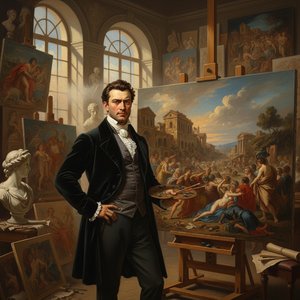
Karl Bryullov: A Life in Romanticism
Karl Pavlovich Bryullov (born Karl Briullo) was born on December 23, 1799, in Saint Petersburg, Russia. His father, Pavel Ivanovich Briullo, was an academician, woodcarver, and engraver of Huguenot descent, who instilled in young Karl a profound appreciation for the arts – a legacy that would shape his entire artistic life. Bryullov’s early education fostered a fascination with classical ideals alongside a yearning for inspiration from distant lands, specifically Italy. This duality proved instrumental in defining his distinctive style and worldview.Early Life and Training
Bryullov's formative years were marked by rigorous training at the Imperial School for the Arts in St. Petersburg. While adhering to the conventions of Neoclassicism – a dominant artistic movement at the time – Bryullov possessed an innate talent that transcended rigid formalism. He recognized the power of emotion and dramatic storytelling, qualities he would champion throughout his career. His father’s influence ensured he received instruction from some of Russia's finest artists and craftsmen, equipping him with invaluable technical skills.Artistic Development and Influences
Bryullov’s artistic sensibilities were profoundly impacted by Italian Renaissance masters like Raphael and Michelangelo. He internalized their masterful use of light and shadow – techniques that would become hallmarks of his oeuvre – and absorbed the grandeur and anatomical precision characteristic of their monumental works. Bryullov's gaze was drawn to Caravaggio’s dramatic chiaroscuro, recognizing its ability to convey intense emotion and psychological depth. This exposure fueled his imagination and propelled him toward a style that prioritized expressive power alongside meticulous detail.Major Achievements and Notable Works
Bryullov achieved international acclaim with “The Last Day of Pompeii” (1830-1833), an ambitious undertaking that cemented his reputation as Russia’s foremost Romantic painter. The colossal canvas depicts the apocalyptic eruption of Mount Vesuvius, capturing the terror and chaos of the event with breathtaking realism and emotional intensity. Critics lauded Bryullov's compositional genius and technical virtuosity, comparing him favorably to Michelangelo – a testament to his artistic ambition and skill. Alongside “The Last Day of Pompeii,” he produced “The Taking of the Life of Tsar Alexander I” (1827), demonstrating his mastery of historical narrative and capturing the solemn grandeur of imperial Russia. "The Defense of the Sepulchre" (1846) showcased Bryullov’s ability to blend emotional resonance with meticulous accuracy, reflecting the spirit of Romantic idealism. Furthermore, he created “Princess Yuliya Pavlovna Samoilova Leaving a Ball with Adopted Daughter Amacilia Pacini” (1832), an exquisite portrait that exemplifies his refined artistic sensibilities and technical prowess. Finally, "Genserich's Invasion of Rome" (1835) stands as another dramatic historical scene infused with Baroque influences.Legacy and Influence
Bryullov’s impact on Russian art extended far beyond his individual masterpieces. He served as a professor at the Imperial Academy of Arts for over two decades, nurturing talent and shaping artistic discourse. His distinctive style – characterized by luminous color palettes and emotionally charged compositions – influenced countless artists who followed him, establishing Bryullov as a cornerstone of Romanticism and securing his place among Russia’s greatest visual creators. He died on June 23, 1852, near Rome, Italy, leaving behind an enduring legacy that continues to inspire admiration for its beauty and expressive power.Frågor och svar
Hur många konstverk av Karl Brjullov finns tillgängliga att bläddra bland?
Du kan bläddra bland 407 konstverk verk av Karl Brjullov på sidan Samtliga konstverk.
Under vilken historisk period verkade Karl Brjullov?
Karl Brjullov verkade under perioden talet, vilket placerar konstnärens gärning i ett historiskt sammanhang.
Kan jag utforska Karl Brjullovs verk via nyckelord?
Utforska Karl Brjullovs verk via nyckelord på artistens Efter nyckelord-sida. Varje nyckelord grupperar de relaterade konstverken.
Kan jag bläddra i Karl Brjullovs verk efter stämning?
Karl Brjullovs verk kan utforskas efter stämning på artistens Känslomässigt rum-sida, där konstverken är sorterade efter deras uttryckta känslor.