Porträtt av Jan Baptist Weenix

De 78 mest kända målningarna av Jan Baptist Weenix, ett galleriselektion

Uppdaterad november 2026 · rangordnad efter vår popularitetspoäng (sökningar, besök och beställningar för varje verk) · 86 verk av Jan Baptist Weenix i vår katalog

Kortfattat

Av alla originalverk som Jan Baptist Weenix lämnade efter sig är det mest kända Tobit, asleep under a vine, is blinded (1642), i samlingen hos Museum Boijmans Van Beuningen, Rotterdam. Tätt efter följer Italian landscape with shelter and antiques ruins (1658) och Still Life with a Dead Swan (1651). Vår katalog innehåller 86 verk av Jan Baptist Weenix; galleriet har bevarat de 78 som världen beundrar mest, var och en presenterad med sitt datum, sitt museum och sin historia.

1621 – 1659, Amsterdam Dutch golden age Flest verk: Bavarian State Painting Collections

Jan Baptist Weenixs 10 främsta målningar: galleriets utvalda verk

1
Tobit, asleep under a vine, is blinded (1642) av Jan Baptist Weenix

Tobit, asleep under a vine, is blinded

1642 · Oil On Canvas · Museum Boijmans Van Beuningen, Rotterdam

A single man reclines in the heavy shade of a vine. He is Tobit, lost to a deep, unsuspecting sleep. The air around him feels thick, weighted by the muted tones of ochre and forest green. Sunlight does not flood this scene; instead, it pierces through the foliage in sharp, controlled beams, illuminating the textures of his slumped posture and the coarse fabric of his clothing. He rests amidst a…

2
Italian landscape with shelter and antiques ruins (1658) av Jan Baptist Weenix

Italian landscape with shelter and antiques ruins

1658 · Oil On Panel · Mauritshuis, Haag

The oil on panel painting titled Italian landscape with shelter and antiques ruins was executed by the artist Jan Baptist Weenix in 1658. This landscape painting depicts a specific pastoral setting within an Italianate environment. The scene is populated by a group of peasants and various livestock, including sheep and goats. These figures are situated near a rustic cottage and several ancient architectural ruins that occupy the landscape.

3
Still Life with a Dead Swan (1651) av Jan Baptist Weenix

Still Life with a Dead Swan

1651 · Oil On Canvas · Detroit Institute of Arts, Detroit

The painting Still Life with a Dead Swan by Jan Baptist Weenix captures a heavy, silent moment of the hunt. Created about 1651, the work presents a collection of fallen game as a trophy of the chase. A white swan rests at the center, its pale plumage a stark contrast to the darker forms surrounding it. This central figure is accompanied by a turkey, two partridges, and a small finch,…

4
Tobit Sleeping Under the Vine (1641) av Jan Baptist Weenix

Tobit Sleeping Under the Vine

1641 · Oil · Museum Catharijneconvent, Utrecht

In this work, titled Tobit Sleeping Under the Vine, we encounter a significant piece by the Dutch Golden Age painter Jan Baptist Weenix. Created around 1642, the painting belongs to the Baroque period, a time when the interplay of light and shadow began to define the dramatic tension of Northern European art. Weenix, born in Amsterdam, Netherlands, brought a disciplined approach to his subjects, often blending meticulous observation with a…

5
The Scissors Grinder (1641) av Jan Baptist Weenix

The Scissors Grinder

1641 · Oil · Bavarian State Painting Collections, München

The air feels heavy with the scent of damp stone and the rhythmic, metallic scrape of steel against stone. Under a vast, expansive sky, a group of figures gathers within the skeletal remains of a classical ruin. A man leans into his work, operating a grinding wheel that cuts through the quietude of the scene. Beside him, a woman sits in repose, while a small child stands close by, watching…

6
Hunters Near Ruins (1648) av Jan Baptist Weenix

Hunters Near Ruins

1648 · Oil On Canvas · Cleveland Museum of Art, Cleveland

Hunters Near Ruins is an oil on canvas painting by Jan Baptist Weenix. The work is dated 1648. This piece belongs to the Dutch Golden Age, a period during which the artist developed a specific approach to landscape and human figures.

7
Portrait of René Descartes (1647) av Jan Baptist Weenix

Portrait of René Descartes

1647 · Oil · Centraal Museum, Utrecht

In this 1647 oil painting, Jan Baptist Weenix captures the French philosopher René Descartes. The subject appears in a medium close-up, his presence defined by a heavy, somber stillness. He is an elderly man, his face marked by the weight of thought and the passage of years. A bright white collar cuts through the darkness of his attire, framing a pale countenance that emerges from a deep, umber shadow.

8
Monument at a Harbour (1648) av Jan Baptist Weenix

Monument at a Harbour

1648 · Oil · Statens Museum for Kunst, Köpenhamn

The composition relies on strong vertical elements, primarily through imposing columns and a central, highly ornate pedestal topped with a large urn. These structures anchor the scene, providing a sense of scale against the scattered human figures in the foreground and middle ground. Through a use of deep recession, the perspective draws the eye past a colonnade toward a distant, hazy horizon where the masts of ships are visible.

9
Harbour with Antique Ruins (1648) av Jan Baptist Weenix

Harbour with Antique Ruins

1648 · Oil On Canvas · Nationalmuseum, Stockholm

The scene unfolds in 1648, a moment captured in the oil on canvas known as Harbour with Antique Ruins. This work belongs to the hand of Jan Baptist Weenix, an artist who brings the weight of history into a living, breathing maritime setting. The painting presents a world where the weathered stone of classical antiquity meets the constant, rhythmic movement of a working harbor. It is a vision of a…

10
The Angel Raphael Leaving Tobias's Family (1648) av Jan Baptist Weenix

The Angel Raphael Leaving Tobias's Family

1648 · Oil · Nationalmuseum, Stockholm

In "The Angel Raphael Leaving Tobias's Family" by Jan Baptist Weenix, a divine departure unfolds with sudden, celestial energy. The scene captures the exact moment the Angel Raphael ascends toward the heavens, leaving the family below in a state of profound awe and reverence. A powerful diagonal movement pulls the eye from the lower left foreground upward toward the upper left, where the angelic figure climbs into a swirling formation…

Urvalet av Jan Baptist Weenix fortsätter, 11 till 78

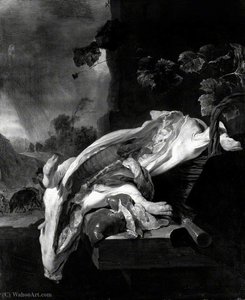
11vegetable-sellers at the house-door, 5 figures (1646) av Jan Baptist Weenixvegetable-sellers at the house-door, 5 figures1646 12caravane near the shore (1646) av Jan Baptist Weenixcaravane near the shore1646 13Mother and Child (1647) av Jan Baptist WeenixMother and Child1647 14Circumcision of Moses' son (1640) av Jan Baptist WeenixCircumcision of Moses' son1640 · Nationalmuseet i Warszawa 15Still Life with Game, Hunter and Two Dogs (1652) av Jan Baptist WeenixStill Life with Game, Hunter and Two Dogs1652 · Bavarian State Painting Collections 16Butterfly Dog and Dead Bird (1649) av Jan Baptist WeenixButterfly Dog and Dead Bird1649 · Museum Mayer van den Bergh 17Pleasure boating (1650) av Jan Baptist WeenixPleasure boating1650 18The Sleeping Shepherdess (1658) av Jan Baptist WeenixThe Sleeping Shepherdess1658 · National Gallery of Ireland 19Roman Tinker (1656) av Jan Baptist WeenixRoman Tinker1656 · Städel Museum 20The love letter (1650) av Jan Baptist WeenixThe love letter1650 · Nationalmuseet i Oslo 21Italian Harbour (1651) av Jan Baptist WeenixItalian Harbour1651 · Ermitaget 22Italian Peasants among Ruins (1650) av Jan Baptist WeenixItalian Peasants among Ruins1650 · Detroit Institute of Arts 23Sleeping girl (1656) av Jan Baptist WeenixSleeping girl1656 · Bavarian State Painting Collections 24Rest on the Flight into Egypt (1657) av Jan Baptist WeenixRest on the Flight into Egypt1657 · Museum Boijmans Van Beuningen 25Merry Company on a Ferry (1649) av Jan Baptist WeenixMerry Company on a Ferry1649 · Museum Gouda 26Battle at the foot of the mountain. (1650) av Jan Baptist WeenixBattle at the foot of the mountain.1650 · Nationalmuseet i Warszawa 27Christina Lepper de Kempenaer and Her Children (1653) av Jan Baptist WeenixChristina Lepper de Kempenaer and Her Children1653 28Italian port scene, 1649 (1649) av Jan Baptist WeenixItalian port scene, 16491649 · Centraal Museum 29Italian Landscape with Horsemen by a Spring (1657) av Jan Baptist WeenixItalian Landscape with Horsemen by a Spring1657 · Centraal Museum 30Before the walls of Rome (1650) av Jan Baptist WeenixBefore the walls of Rome1650 · National Museum in Wrocław 31Portrait of a man with a letter (1650) av Jan Baptist WeenixPortrait of a man with a letter1650 · Agnes Etherington Art Center 32A Landscape with a Ford (1660) av Jan Baptist WeenixA Landscape with a Ford1660 · Regional Gallery in Liberec 33In the Campagna (1669) av Jan Baptist WeenixIn the Campagna1669 · National Gallery of Ireland 34Dead Fowl Being Eaten by a Cat (1653) av Jan Baptist WeenixDead Fowl Being Eaten by a Cat1653 · Städel Museum 35Departure of an Oriental Entourage (1647) av Jan Baptist WeenixDeparture of an Oriental Entourage1647 · Louvre 36Display of Dead Game (1641) av Jan Baptist WeenixDisplay of Dead Game1641 · Petit Palais 37Dead Game (1641) av Jan Baptist WeenixDead Game1641 38River Landscape with a Ferry (1650) av Jan Baptist WeenixRiver Landscape with a Ferry1650 · Montreal Museum of Fine Arts 39Still Life with Dead Game and Poultry (1656) av Jan Baptist WeenixStill Life with Dead Game and Poultry1656 · Centraal Museum 40Still Life with Fowl (1650) av Jan Baptist WeenixStill Life with Fowl1650 · Museum of Fine Arts Ghent (MSK) 41Marine with a Venetian Bucintoro (1650) av Jan Baptist WeenixMarine with a Venetian Bucintoro1650 · Staatliche Kunsthalle Karlsruhe 42The Dutch Ambassador on his Way to Isfahan, Jan Baptist Weenix, 1653 - 1659 (1659) av Jan Baptist WeenixThe Dutch Ambassador on his Way to Isfahan, Jan Baptist Weenix, 1653 - 16591659 · Rijksmuseum 43After the Hunt, Jan Baptist Weenix, c. 1656 (1656) av Jan Baptist WeenixAfter the Hunt, Jan Baptist Weenix, c. 16561656 · Rijksmuseum 44Still Life with White Mouse (1680) av Jan Baptist WeenixStill Life with White Mouse1680 · Ernest Zmeták Art Gallery 45Still Life with Game av Jan Baptist WeenixStill Life with GameHarvard Art Museums 46The Ford in the River (1647) av Jan Baptist WeenixThe Ford in the River1647 · Ermitaget 47Harbor View with Rider in Oriental Dress, av Jan Baptist WeenixHarbor View with Rider in Oriental Dress,Groninger Museum 48The Holy Women at the Tomb av Jan Baptist WeenixThe Holy Women at the TombNational Gallery of Ireland 49An Italian Seaport av Jan Baptist WeenixAn Italian SeaportKoninklijk Museum voor Schone Kunsten Antwerpen 50Architectural interior with foreign shippers, ruins and a shipyard beyond av Jan Baptist WeenixArchitectural interior with foreign shippers, ruins and a shipyard beyond 51Study of a sheep av Jan Baptist WeenixStudy of a sheep 52A pig's carcase av Jan Baptist WeenixA pig's carcase 53The Tinker and His Dog av Jan Baptist WeenixThe Tinker and His Dog 54Landscape with Peasants and Animals av Jan Baptist WeenixLandscape with Peasants and Animals 55Dead Partridge (1650) av Jan Baptist WeenixDead Partridge1650 · Mauritshuis 56Goat Lying Down, Jan Baptist Weenix, 1645 - 1660 (1660) av Jan Baptist WeenixGoat Lying Down, Jan Baptist Weenix, 1645 - 16601660 · Rijksmuseum 57A Dog and a Cat near a partially disembowelled Deer, Jan Baptist Weenix, 1645 - 1660 (1660) av Jan Baptist WeenixA Dog and a Cat near a partially disembowelled Deer, Jan Baptist Weenix, 1645 - 16601660 · Rijksmuseum 58Still Life with Dead Poultry, Lidded Pitcher and Passglas av Jan Baptist WeenixStill Life with Dead Poultry, Lidded Pitcher and PassglasBavarian State Painting Collections 59Game-piece av Jan Baptist WeenixGame-pieceNational Gallery of Ireland 60Dead game and hunting tackle in landscape av Jan Baptist WeenixDead game and hunting tackle in landscape 61Hound with a Joint of Meat and a Cat Looking on av Jan Baptist WeenixHound with a Joint of Meat and a Cat Looking on 62Bouquet of flowers av Jan Baptist WeenixBouquet of flowersGemäldegalerie 63Shipping in Harbour av Jan Baptist WeenixShipping in Harbour 64Herons and Lapwings av Jan Baptist WeenixHerons and Lapwings 65Still Life of Dead Game in a Landscape with a Huntsman av Jan Baptist WeenixStill Life of Dead Game in a Landscape with a Huntsman 66An italian port scene av Jan Baptist WeenixAn italian port scene 67Shepherds and Flocks among Classical Ruins av Jan Baptist WeenixShepherds and Flocks among Classical Ruins 68A Coast Scene with Classical Ruins av Jan Baptist WeenixA Coast Scene with Classical RuinsWallace Collection 69Still Life with Dead Game av Jan Baptist WeenixStill Life with Dead Game 70Hounds and an Owl with Dead Birds and Sculptures in a Landscape av Jan Baptist WeenixHounds and an Owl with Dead Birds and Sculptures in a Landscape 71Still Life with Dead Birds av Jan Baptist WeenixStill Life with Dead Birds 72Family in a Mediterranean Seaport av Jan Baptist WeenixFamily in a Mediterranean Seaport 73Figures near a Seaport av Jan Baptist WeenixFigures near a SeaportScottish National Gallery 74A Huntsman cutting up a Dead Deer, with Two Deerhounds av Jan Baptist WeenixA Huntsman cutting up a Dead Deer, with Two DeerhoundsNational Gallery 75Ancient Ruins av Jan Baptist WeenixAncient RuinsSzépművészeti Múzeum 76Figures among ruins av Jan Baptist WeenixFigures among ruinsThe Kremer Collection 77Ancient Ruins (detail) av Jan Baptist WeenixAncient Ruins (detail)Szépművészeti Múzeum 78Girl as Shepherdess (1650) av Jan Baptist WeenixGirl as Shepherdess1650 · Musée de Picardie

Jan Baptist Weenixs berömda målningar, period för period

Motiven som fångade Jan Baptist Weenixs blick

De fyra motiv som återkommer oftast i dessa originalverk, var och ett med sitt främsta exempel.

Museerna som förvarar Jan Baptist Weenixs originalverk

De 8 museer som innehar flest av målningarna på denna sida.

Museum Stad Verk av Jan Baptist Weenix Målningar från denna lista
Bavarian State Painting Collections, MünchenBavarian State Painting Collections München 4 The Scissors Grinder, Still Life with Game, Hunter and Two Dogs, Sleeping girl
Centraal Museum, UtrechtCentraal Museum Utrecht 4 Portrait of René Descartes, Italian port scene, 1649, Italian Landscape with Horsemen by a Spring
National Gallery of Ireland, DublinNational Gallery of Ireland Dublin 4 The Sleeping Shepherdess, In the Campagna, The Holy Women at the Tomb
Rijksmuseum, AmsterdamRijksmuseum Amsterdam 4 The Dutch Ambassador on his Way to Isfahan, Jan Baptist Weenix, 1653 - 1659, After the Hunt, Jan Baptist Weenix, c. 1656, Goat Lying Down, Jan Baptist Weenix, 1645 - 1660
Museum Boijmans Van Beuningen, RotterdamMuseum Boijmans Van Beuningen Rotterdam 2 Tobit, asleep under a vine, is blinded, Rest on the Flight into Egypt
Mauritshuis, HaagMauritshuis Haag 2 Italian landscape with shelter and antiques ruins, Dead Partridge
Detroit Institute of Arts, DetroitDetroit Institute of Arts Detroit 2 Still Life with a Dead Swan, Italian Peasants among Ruins
Nationalmuseum, StockholmNationalmuseum Stockholm 2 Harbour with Antique Ruins, The Angel Raphael Leaving Tobias's Family

Jan Baptist Weenix år för år: originalen som definierar varje år

Från 1640 till 1659 arbetade Jan Baptist Weenix i 20 år: urvalet följer den långa karriären år för år, genom dess främsta originalverk.

Verk per år

Välj ett år för att se originalen.

Samlarfrågor om Jan Baptist Weenixs målningar

Vilket verk är Jan Baptist Weenix mest känd för?Visa svaret

Tobit, asleep under a vine, is blinded (1642), Museum Boijmans Van Beuningen, Rotterdam. Italian landscape with shelter and antiques ruins (1658) och Still Life with a Dead Swan (1651) följer efter.

Hur gammal var Jan Baptist Weenix när Tobit, asleep under a vine, is blinded skapades?Visa svaret

21 år gammal: Tobit, asleep under a vine, is blinded är från 1642, och Jan Baptist Weenix föddes 1621.

Vilka är de tio mest kända målningarna av Jan Baptist Weenix?Visa svaret

Tobit, asleep under a vine, is blinded, Italian landscape with shelter and antiques ruins, Still Life with a Dead Swan, Tobit Sleeping Under the Vine, The Scissors Grinder, Hunters Near Ruins, Portrait of René Descartes, Monument at a Harbour, Harbour with Antique Ruins och The Angel Raphael Leaving Tobias's Family. Rankingen ovan visar varje verks årtal och museum.

Hur många målningar lämnade Jan Baptist Weenix efter sig?Visa svaret

Vår katalog innehåller 86 verk av Jan Baptist Weenix, daterade från 1640 till 1659.

I vilka museer hänger Jan Baptist Weenixs mästerverk?Visa svaret

Främst i Bavarian State Painting Collections (München), Centraal Museum (Utrecht) och National Gallery of Ireland (Dublin). Museitabellen ovan listar alla.

Under vilka år målade Jan Baptist Weenix sina mest kända verk?Visa svaret

Under 1650: 11 av de 78 verk som finns på denna sida skapades då, varav Pleasure boating.

Vilka är de första och sista kända originalverken av Jan Baptist Weenix?Visa svaret

På den här sidan är det tidigaste Circumcision of Moses' son (1640) och det senaste The Dutch Ambassador on his Way to Isfahan, Jan Baptist Weenix, 1653 - 1659 (1659).

Vilka motiv valde Jan Baptist Weenix oftast?Visa svaret

Landscape (18), Ruins (17) och Sky (13), fördelat på 78 verk på denna sida.

Vilken teknik använde Jan Baptist Weenix mest?Visa svaret

Oil On Canvas, för 30 av de 78 verk som finns på denna sida.

Vilken konstinriktning tillhör Jan Baptist Weenix?Visa svaret

Dutch golden age och Baroque, om man dömer efter originalen på denna sida.

Vilka verk av Jan Baptist Weenix finns utställda på Bavarian State Painting Collections?Visa svaret

The Scissors Grinder, Still Life with Game, Hunter and Two Dogs och Sleeping girl: Bavarian State Painting Collections, München har 4 av verken på denna sida.

Jan Baptist Weenix: liv och verk

Den nederländska guldålderns visionär

Jan Baptist Weenix framstår som en unik gestalt inom den nederländska guldåldern, hyllad för sin särpräglade förmåga att förena minutiös observation med en fantasifull vision. Även om hans konstnärliga produktion var relativt blygsam jämfört med samtida mästare som Rembrandt eller Vermeer, är Weenix bidrag till den nederländska konsthistorien obestridligt – särskilt hans banbrytande utforskande av italienska landskap besjälade med mänskliga gestalter, vilket skapade ett stilistiskt prejudikat som skulle eka genom kommande generationer. Han föddes i Amsterdam 1621 nära den livliga hamnen och härstammade från en familj av arkitekter, en släktlinje som sannolikt formade hans formativa år mitt i epokens intellektuella och strukturella förvandling.

Trots personliga utmaningar – berättelser antyder att han kämpade med talet på grund av ett medicinskt tillstånd – besatt Weenix en brinnande passion för litteratur och konst, en passion som främjades av en mor som proaktivt ordnade hans lärlingsskap under Jan Micker, Rembrandts svåger. Denna tidiga träning gav honom en disciplinerad inställning till tecknande och observation som skulle komma att bli kännetecknande för hela hans livsverk. Han förfinade vidare sina färdigheter i Utrecht under ledning av Abraham Bloemaert och återvände senare till Amsterdam för att studera under Claes Corneliszoon Moeyaert, vilket befäste hans förankring i de rådande konstnärliga strömningarna i Nederländerna.

En resa genom ljus och landskap

Weenix karriärväg förändrades i grunden av hans resor, främst hans färd till Rom 1643 tillsammans med Nicolaes Pieterszoon Berchem. Denna utflykt gav honom möjligheten att möta den livskraftiga intellektuella och konstnärliga miljön inom gillet Bentvueghels, en erfarenhet som drev honom mot en mer expansiv stilistisk räckvidd. I Rom omfamnade han den italianiserande stilen, kännetecknad av ett varmt, gyllene ljus och klassiska landskap som stod i vacker kontrast till de svalare, mer dämpade tonerna i det traditionella nederländska måleriet. Denna period av romerskt inflytande gjorde det möjligt för honom att bemästra konsten med det "italianiserande landskapet", där Sydeuropas karga skönhet återuppfanns genom en nordeuropeisk lins.

Hans verk under denna era sammanvävde ofta det klassiska landskapets storslagenhet med intima, mänskliga element. Oavsett om han avbildade hamnscener som viskade om sjöfartshandel eller vidsträckta vyer som frammanade en känsla av tidlöshet, besatt Weenix en unik förmåga att fånga en plats atmosfär. Hans mästerskap var inte begränsat till vidsträckta horisonter; han var lika skicklig på att fånga livets tysta och ofta påtagliga verklighet genom sina stilleben. Hans skildringar av vilt och djur präglades av en slående realism, där varje textur – från den sträva pälsen hos en jakthund till fjädrarnas delikata lyster – återgavs med en närmast andlöst precision.

Ett arv av realism och konstnärlighet

Jan Baptist Weenix betydelse ligger i hans förmåga att överbrygga klyftan mellan den råa realismen i den nederländska traditionen och den idealiserade skönheten i den italianiserande rörelsen. Hans mångsidighet tillät honom att navigera mellan varierande motiv, från den dramatiska spänningen i verk som Efter jakten till den tysta, nästan melankoliska intensiteten i hans djurstudier. Genom hans pensel bjuds betraktaren in i en värld där gränserna mellan den observerade naturliga världen och det föreställda klassiska förflutna vackert suddas ut.

När vi reflekterar över hans liv och verk är det flera nyckelelement som definierar hans bestående betydelse:

  • Stilistisk innovation: Han var en pionjär i att integrera italianiserande landskapselement i den nederländska traditionen, vilket skapade ett nytt visuellt språk för hans samtida.
  • Teknisk mästerskap: Hans disciplinerade utbildning möjliggjorde en extraordinär detaljrikedom i såväl storskaliga landskap som intima stilleben.
  • Mångsidighet: Hans förmåga att sömlöst röra sig mellan hamnscener, jaktmotiv och djurporträtt uppvisar en sällsynt bredd i hans talang.
  • Historisk påverkan: Som medlem i Bentvueghels bidrog han till att främja det internationella utbytet av konstnärliga idéer som kom att definiera 1600-talets konstvärld.

Trots att hans liv var relativt kort och slutade 1661, förblir avtrycket efter Jan Baptist Weenix synligt i landskapsmåleriets utveckling. Han lärde kommande generationer att betrakta horisonten inte bara som en gräns, utan som en duk för ljus, historia och mänsklig känsla.