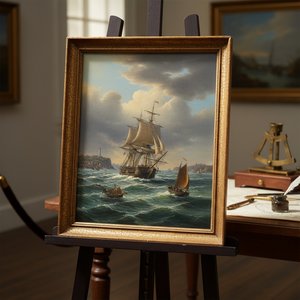
Isaac Walter Jenner: Bridging Art and Observation
Isaac Walter Jenner (1863 – 1950) stands as a singular figure in British maritime art, distinguished by his meticulous approach to landscape painting and his profound connection to scientific observation. Born in Plymouth Sound, Devon, Jenner’s formative years were steeped in the atmosphere of Victorian exploration and burgeoning interest in geology—a passion that would irrevocably shape his artistic vision. Unlike many of his contemporaries who relied on idealized representations of the sea, Jenner sought to capture its essence with uncompromising accuracy, blending topographical detail with subtle tonal harmonies.
Early Life & Influences: The Shaping Hand of Geology
Jenner’s father was a geologist and instilled in him from infancy a fascination for natural history—a formative influence that would permeate his artistic sensibilities. This scientific grounding encouraged him to analyze light, color, and texture not merely aesthetically but with the same rigor he applied to geological specimens. Without formal education beyond basic schooling, Jenner honed his craft through practical experience as an oyster boatman and served in the Royal Navy during the Crimean War—experiences that instilled a deep understanding of maritime conditions and contributed to his artistic perspective. His early exposure to Turner’s dramatic landscapes cemented his stylistic ambitions and fueled his desire to convey both beauty and scientific truth on canvas.
Technique & Style: Encaustic Wax and Venetian Masters
Jenner championed a technique characterized by layered brushstrokes—a method meticulously developed through extensive studies of Venetian masters like Turner and Claude Lorrain. He skillfully built up tonal gradations using encaustic wax alongside oil paint, achieving remarkable luminosity and capturing the atmospheric subtleties of coastal environments—a deliberate choice that mirrored his father’s geological pursuits. This innovative approach allowed him to reproduce textures with unparalleled fidelity and imbue his paintings with a palpable sense of immediacy. Jenner's unwavering dedication to topographical accuracy established a precedent for subsequent generations of landscape painters, influencing artists who sought to capture the sublime beauty of nature with uncompromising realism.
Notable Works: Bosham Harbour and Beyond
Jenner’s oeuvre comprises over 300 paintings predominantly focused on Sussex harbors and coastline scenes—a testament to his lifelong fascination with the English littoral. Among his most celebrated compositions are “The Mill Quay, Bosham,” depicting the tranquil beauty of Bosham Harbour; “The Bridge, Plymouth Sound,” capturing the grandeur of Plymouth Sound at dusk; and “Bambro' Castle, Northumberland,” presenting a dramatic portrayal of Bambro’s imposing silhouette against turbulent skies. These works exemplify Jenner’s masterful blending of topographical detail with tonal harmonies—a stylistic hallmark that distinguishes him from many of his contemporaries. His meticulous rendering of geological formations and atmospheric conditions underscored his conviction that art could illuminate scientific understanding.
Legacy & Influence: A Pioneer in Maritime Impressionism
Isaac Walter Jenner's contribution to British maritime art transcends mere stylistic convention; he embodies a pivotal moment in artistic history—the convergence of scientific observation and aesthetic sensibility. His pioneering technique and unwavering dedication to topographical accuracy established a precedent for subsequent generations of landscape painters, influencing artists who sought to capture the sublime beauty of nature with uncompromising realism. Jenner’s paintings reside primarily within The Walters Art Museum’s collection in Baltimore, Maryland—a testament to his enduring artistic merit and the museum’s commitment to preserving exceptional artworks. Visitors can immerse themselves in Jenner's evocative landscapes and appreciate the meticulous craftsmanship that defines his oeuvre. He remains a celebrated figure in British art history, remembered for bridging the gap between science and beauty—a legacy that continues to inspire artists today.