Porträtt av Giulio Romano

De 100 mest kända Giulio Romano-målningarna, varje ett unikt konstverk

Uppdaterad november 2026 · rangordnad efter vår popularitetspoäng (sökningar, besök och beställningar för varje verk) · 114 verk av Giulio Romano i vår katalog

Kortfattat

Valv: Gudarnas sammankomst kring Jupiters tron (1532) är den målning av Giulio Romano som drar till sig flest blickar. Därefter dras blicken till View of the Sala dei Giganti (vault and south wall) (1526) och Tapestry with Playing Putti (1545). Bland de 114 verk av Giulio Romano i vår katalog är dessa 100 de mest kända, var och en ett unikt original presenterat med sitt år, sitt museum och anledningen till dess tidlösa betydelse.

1499 – 1546, Rom Manierism Flest verk: Palazzo del Tè

Topp 10 målningar av Giulio Romano, ur galleriets perspektiv

1
Valv: Gudarnas sammankomst kring Jupiters tron (1532) av Giulio Romano

Valv: Gudarnas sammankomst kring Jupiters tron

1532 · Fresko

Valv: Gudarnas sammankomst kring Jupiters tron är en betydelsefull fresco av Giulio Romano. Verket, som utfördes år 1532, pryder taket i Sala dei Giganti i Palazzo del Tè i Mantua, Italien. Denna monumentala dekoration speglar konstnärens avvikelse från den klassiska harmonin under högrenässansen mot den expressiva spänningen i manierismen.

2
View of the Sala dei Giganti (vault and south wall) (1526) av Giulio Romano

View of the Sala dei Giganti (vault and south wall)

1526 · Fresco · Palazzo del Tè, Mantua

To gaze upon this magnificent fresco, View of the Sala dei Giganti (vault and south wall), is to step directly into the vibrant heart of the High Renaissance. Painted in 1526 by the masterful hand of Giulio Romano, this work transcends mere decoration; it is a profound narrative tapestry woven from human drama, natural vitality, and divine symbolism. The scene explodes with life, drawing the viewer into a monumental gathering…

3
Tapestry with Playing Putti (1545) av Giulio Romano

Tapestry with Playing Putti

1545 · Tapestry · Museo Poldi Pezzoli, Milano

To gaze upon this depiction of a tapestry with playing putti is to step directly into an idealized moment plucked from the heart of the Italian Renaissance. It is more than just a painting; it is a captured breath of youthful exuberance, rendered with the masterful touch characteristic of Giulio Romano. The scene unfolds as a vibrant pastoral tableau, where several cherubic figures—the beloved putti—engage in playful revelry. Their presence…

4
Allegory of the Virtues of Federico II Gonzaga (1531) av Giulio Romano

Allegory of the Virtues of Federico II Gonzaga

1531 · Fresco · J. Paul Getty Museum, Los Angeles

To stand before an image like the Allegory of the Virtues of Federico II Gonzaga is to step directly into the vibrant, intellectual heart of the Italian High Renaissance transitioning into Mannerism. This monumental work, executed in 1531 by Giulio Romano, is far more than a mere depiction of figures; it is a carefully orchestrated philosophical statement rendered in pigment and plaster. The scene unfolds with an almost theatrical richness,…

5
The Lovers (1525) av Giulio Romano

The Lovers

1525 · Oil On Canvas · Ermitaget, Sankt Petersburg

Giulio Romano’s “The Lovers,” painted around 1525, isn't merely a depiction of intimacy; it’s a meticulously crafted tableau brimming with symbolism and echoing the complex currents of the High Renaissance. Born Giulio Pippi in Rome around 1499, Romano swiftly ascended through the ranks of Raphael’s studio, absorbing the master’s classical ideals while simultaneously forging his own distinctive Mannerist style – a style characterized by heightened emotion, distorted forms, and an…

6
Adoration of the Shepherds (detail) (1535) av Giulio Romano

Adoration of the Shepherds (detail)

1535 · Oil · Louvre, Paris

This detail from 1535 captures a fragment of a larger religious narrative, focusing on the human response to a divine presence. A central figure, distinguished by a large staff topped with a cross, anchors the composition. The arrangement of figures creates a sense of depth through overlapping forms and varying scales, drawing the eye from the immediate foreground into a complex, crowded space. The composition avoids the static balance of…

7
The Birth of Bacchus (1533) av Giulio Romano

The Birth of Bacchus

1533 · Acrylic On Canvas · J. Paul Getty Museum, Los Angeles

Giulio Romano's "The Birth of Bacchus," a monumental charcoal and chalk drawing from 1533, isn’t merely a depiction of a mythological scene; it’s a visceral exploration of human drama, a raw sketch brimming with energy and symbolic weight. Born Giulio Pippi in Rome around 1499, Romano emerged as a pivotal figure within the waning embers of the High Renaissance, swiftly absorbing the influence of Raphael while forging his own distinctive…

8
Flaying of Marsyas (1525) av Giulio Romano

Flaying of Marsyas

1525 · Oil On Canvas · Louvre, Paris

Giulio Romano’s “Flaying of Marsyas” isn't merely a depiction of a mythological punishment; it’s a visceral embodiment of struggle, humiliation, and the brutal intersection of divine power and mortal defiance. Painted in 1525-35 during his tenure as court artist for Duke Federico Gonzaga of Mantua, this monumental fresco – now meticulously reproduced on canvas – plunges the viewer directly into the heart of Ovid’s *Metamorphoses*. The story itself is a…

9
Victory, Janus, Chronos, and Gaea (1532) av Giulio Romano

Victory, Janus, Chronos, and Gaea

1532 · Acrylic On Canvas · J. Paul Getty Museum, Los Angeles

A Tapestry of Time and Transformation: Giulio Romano’s “Victory, Janus, Chronos, and Gaea” Giulio Romano's "Victory, Janus, Chronos, and Gaea," painted in 1532-1534 during his illustrious tenure as court artist for Federico II Gonzaga of Mantua, is more than just a visually arresting fresco; it’s a profound meditation on the cyclical nature of time, the duality of existence, and the very essence of Roman mythology. Born Giulio Pippi in Rome…

10
View of the Palazzo del Tè (1526) av Giulio Romano

View of the Palazzo del Tè

1526 · Acrylic On Canvas · Palazzo del Tè, Mantua

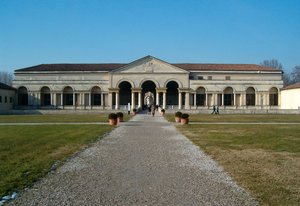
A Vision of Renaissance Grandeur: Exploring Giulio Romano’s Palazzo del Té Giulio Romano's *View of the Palazzo del Té* stands as a testament to the zenith of Mannerist art and architectural ambition—a project conceived by Federico Gonzaga, Duke of Mantua, between 1526 and 1534. More than just a building, it embodies an entire worldview: a deliberate rejection of linear perspective and idealized beauty in favor of dramatic illusionism and psychological…

Giulio Romanos berömda målningar, nummer 11 till 100

11Evangelist symbols (1522) av Giulio RomanoEvangelist symbols1522 · Kunsthistorisches Museum 12View of the Salone dei Cavalli (1526) av Giulio RomanoView of the Salone dei Cavalli1526 13The Old Woman and Vulcan, Tribute to Apollo (1526) av Giulio RomanoThe Old Woman and Vulcan, Tribute to Apollo1526 14Nude Child with Open Arms av Giulio RomanoNude Child with Open ArmsGalleria degli Uffizi 15The Holy Family (1520) av Giulio RomanoThe Holy Family1520 · J. Paul Getty Museum 16An Allegory of Immortality (1540) av Giulio RomanoAn Allegory of Immortality1540 · Detroit Institute of Arts 17The Holy Family, St John with a small Bird in his Hand (1530) av Giulio RomanoThe Holy Family, St John with a small Bird in his Hand1530 · Statens Museum for Kunst 18The Holy Family with the Infant Saint John the Baptist (1520) av Giulio RomanoThe Holy Family with the Infant Saint John the Baptist1520 · Scottish National Gallery 19Madonna and Child with the Infant St. John (1516) av Giulio RomanoMadonna and Child with the Infant St. John1516 20The Virgin and Child (1518) av Giulio RomanoThe Virgin and Child1518 · Apsley House 21Tarquin and Lucretia (1536) av Giulio RomanoTarquin and Lucretia1536 · Palazzo Ducale 22'The Horse ''Morel favorito''' (1526) av Giulio Romano'The Horse ''Morel favorito'''1526 23St. John the Baptist in the Wilderness (1520) av Giulio RomanoSt. John the Baptist in the Wilderness1520 24Nurture of Jupiter (1533) av Giulio RomanoNurture of Jupiter1533 · Blickling Hall 25Group of three lictors (1530) av Giulio RomanoGroup of three lictors1530 · Nationalmuseet i Warszawa 26Tapestry Cartoon: Two Heads from the Massacre of the Innocents (1522) av Giulio RomanoTapestry Cartoon: Two Heads from the Massacre of the Innocents1522 · Scottish National Gallery 27Bacchus and Ariadne (1530) av Giulio RomanoBacchus and Ariadne1530 · Statens Museum for Kunst 28Vertumnus and Pomona (1530) av Giulio RomanoVertumnus and Pomona1530 · Statens Museum for Kunst 29Female nude, half figure (1527) av Giulio RomanoFemale nude, half figure1527 30Vaulted ceiling (8) (1526) av Giulio RomanoVaulted ceiling (8)1526 31Fresco on the east wall (detail) (1532) av Giulio RomanoFresco on the east wall (detail)1532 32View of the Sala di Psiche (west wall) (1526) av Giulio RomanoView of the Sala di Psiche (west wall)1526 33Fresco on the south wall (detail) (9) (1532) av Giulio RomanoFresco on the south wall (detail) (9)1532 34Jupiter Seducing Olympias (1526) av Giulio RomanoJupiter Seducing Olympias1526 35Self-portrait (1540) av Giulio RomanoSelf-portrait1540 36Tomb of Pietro Strozzi (1529) av Giulio RomanoTomb of Pietro Strozzi1529 · Sant'Andrea 37Virgin and Child with the Infant St John (1523) av Giulio RomanoVirgin and Child with the Infant St John1523 · Galleria Borghese 38Façade (1526) av Giulio RomanoFaçade1526 · Palazzo del Tè 39The Madonna and Child with Saint John the Baptist (1522) av Giulio RomanoThe Madonna and Child with Saint John the Baptist1522 · Walters Art Museum 40The Fall of the Gigants from Mount Olympus av Giulio RomanoThe Fall of the Gigants from Mount Olympus 41Chariot of the Sun (1526) av Giulio RomanoChariot of the Sun1526 42Frieze (detail) (1532) av Giulio RomanoFrieze (detail)1532 43Hunting Scene (1527) av Giulio RomanoHunting Scene1527 44Hunting Scene (1527) av Giulio RomanoHunting Scene1527 45Polyphemus (1526) av Giulio RomanoPolyphemus1526 46Ceiling decoration (detail) (12) (1527) av Giulio RomanoCeiling decoration (detail) (12)1527 47View of the Sala di Psiche (north and east walls) (1526) av Giulio RomanoView of the Sala di Psiche (north and east walls)1526 48View of the Sala di Psiche (south wall) (1526) av Giulio RomanoView of the Sala di Psiche (south wall)1526 49Psyche's Second Task (River Deity) (1526) av Giulio RomanoPsyche's Second Task (River Deity)1526 50Vaulted ceiling (detail) (10) (1526) av Giulio RomanoVaulted ceiling (detail) (10)1526 51Vaulted ceiling (detail) (18) (1526) av Giulio RomanoVaulted ceiling (detail) (18)1526 52Psyche Appealing in Vain to Juno (1526) av Giulio RomanoPsyche Appealing in Vain to Juno1526 53Portrait of a Woman (detail) (1531) av Giulio RomanoPortrait of a Woman (detail)1531 · Royal Collection 54View of the Sala dei Giganti (south and west walls) (1532) av Giulio RomanoView of the Sala dei Giganti (south and west walls)1532 55View of the Sala dei Giganti (south wall) (1532) av Giulio RomanoView of the Sala dei Giganti (south wall)1532 56The Prisoners (1527) av Giulio RomanoThe Prisoners1527 57View of the Sala di Psiche (east wall) (1526) av Giulio RomanoView of the Sala di Psiche (east wall)1526 58Vault: The Assembly of Gods around Jupiter's Throne (detail) (1532) av Giulio RomanoVault: The Assembly of Gods around Jupiter's Throne (detail)1532 59Ceiling decoration (detail) (11) (1527) av Giulio RomanoCeiling decoration (detail) (11)1527 60Fresco on the north wall (detail) (1532) av Giulio RomanoFresco on the north wall (detail)1532 61Vaulted ceiling (detail) (17) (1526) av Giulio RomanoVaulted ceiling (detail) (17)1526 62Vaulted ceiling (detail) (19) (1526) av Giulio RomanoVaulted ceiling (detail) (19)1526 63Emperor Alexander (1532) av Giulio RomanoEmperor Alexander1532 64Coat-of-arms (1532) av Giulio RomanoCoat-of-arms1532 65View of the Sala dei Giganti (west wall) (1532) av Giulio RomanoView of the Sala dei Giganti (west wall)1532 66River Landscape with Springs (1526) av Giulio RomanoRiver Landscape with Springs1526 67View of the Salone dei Cavalli (1526) av Giulio RomanoView of the Salone dei Cavalli1526 68Fresco on the south wall (detail) (1532) av Giulio RomanoFresco on the south wall (detail)1532 69Vaulted ceiling (detail) (16) (1526) av Giulio RomanoVaulted ceiling (detail) (16)1526 70Tribute to Apollo (1526) av Giulio RomanoTribute to Apollo1526 71Vaulted ceiling (1526) av Giulio RomanoVaulted ceiling1526 72View of the Sala dei Giganti (north wall) (1532) av Giulio RomanoView of the Sala dei Giganti (north wall)1532 73View of the Sala dei Giganti (east wall) (1532) av Giulio RomanoView of the Sala dei Giganti (east wall)1532 74Ceiling decoration (1527) av Giulio RomanoCeiling decoration1527 75Cupid and Psyche (1526) av Giulio RomanoCupid and Psyche1526 76Design for a Saltcellar (1524) av Giulio RomanoDesign for a Saltcellar1524 77Fresco on the south wall (detail) (12) (1532) av Giulio RomanoFresco on the south wall (detail) (12)1532 78Fresco on the north wall (detail) (1532) av Giulio RomanoFresco on the north wall (detail)1532 79Mars Chasing Adonis from Venus's Pavilion (1526) av Giulio RomanoMars Chasing Adonis from Venus's Pavilion1526 80Vault: The Assembly of Gods around Jupiter's Throne (detail) (1532) av Giulio RomanoVault: The Assembly of Gods around Jupiter's Throne (detail)1532 81Fresco on the south wall (detail) (10) (1532) av Giulio RomanoFresco on the south wall (detail) (10)1532 82The Old Woman and Vulcan (1526) av Giulio RomanoThe Old Woman and Vulcan1526 83Ceiling (detail) (1526) av Giulio RomanoCeiling (detail)1526 84Tribute to Apollo (1526) av Giulio RomanoTribute to Apollo1526 85Ajax Defends Patroclus's Corps (1538) av Giulio RomanoAjax Defends Patroclus's Corps1538 · Palazzo Ducale 86View of the Sala di Troia (10) (1536) av Giulio RomanoView of the Sala di Troia (10)1536 87View of the Sala di Troia (12) (1538) av Giulio RomanoView of the Sala di Troia (12)1538 88Ajax Defends Patroclus's Corps (1538) av Giulio RomanoAjax Defends Patroclus's Corps1538 89View of the Sala di Troia (11) (1536) av Giulio RomanoView of the Sala di Troia (11)1536 90Façade and courtyard view (1526) av Giulio RomanoFaçade and courtyard view1526 · Palazzo del Tè 91Monteluce madonna av Giulio RomanoMonteluce madonna 92Venus and Vulcan av Giulio RomanoVenus and Vulcan 93Satyr and Boy av Giulio RomanoSatyr and Boy 94Copy after Giulio Romano (1536) av Giulio RomanoCopy after Giulio Romano1536 · Cleveland Museum of Art 95Virgin with the Child (1520) av Giulio RomanoVirgin with the Child1520 · Galleria degli Uffizi 96Triumph of Titus and Vespasian (1537) av Giulio RomanoTriumph of Titus and Vespasian1537 · Louvre 97Study for the Holy Family (1518) av Giulio RomanoStudy for the Holy Family1518 · Louvre 98Banquet of Cupid and Psyche av Giulio RomanoBanquet of Cupid and PsychePalazzo del Tè 99Saint Mary Magdalene borne by Angels av Giulio RomanoSaint Mary Magdalene borne by AngelsNational Gallery 100The Circumcision av Giulio RomanoThe CircumcisionLouvre

Giulio Romanos berömda målningar, period för period

Motiven som fångade Giulio Romanos blick

De fyra motiv som återkommer oftast i dessa originalverk, var och ett med sitt främsta exempel.

Museerna som förvarar Giulio Romanos originalverk

De 8 museer som innehar flest av målningarna på denna sida.

Museum Stad Verk av Giulio Romano Målningar från denna lista
Palazzo del Tè, MantuaPalazzo del Tè Mantua 6 View of the Sala dei Giganti (vault and south wall), View of the Palazzo del Tè, Façade
Louvre, ParisLouvre Paris 6 Adoration of the Shepherds (detail), Flaying of Marsyas, Triumph of Titus and Vespasian
J. Paul Getty Museum, Los AngelesJ. Paul Getty Museum Los Angeles 5 Allegory of the Virtues of Federico II Gonzaga, The Birth of Bacchus, Victory, Janus, Chronos, and Gaea
Statens Museum for Kunst, KöpenhamnStatens Museum for Kunst Köpenhamn 3 The Holy Family, St John with a small Bird in his Hand, Bacchus and Ariadne, Vertumnus and Pomona
Galleria degli Uffizi, FlorensGalleria degli Uffizi Florens 2 Nude Child with Open Arms, Virgin with the Child
Scottish National Gallery, EdinburghScottish National Gallery Edinburgh 2 The Holy Family with the Infant Saint John the Baptist, Tapestry Cartoon: Two Heads from the Massacre of the Innocents
Palazzo Ducale, MantuaPalazzo Ducale Mantua 2 Tarquin and Lucretia, Ajax Defends Patroclus's Corps
Royal Collection, LondonRoyal Collection London 2 Portrait of a Woman (detail)

Giulio Romano genom decennierna: ett unikt original för varje era

Verk per decennium

Välj ett decennium för att se originalverket som definierar det.

Giulio Romanos målningar: frågor till galleriet

Vilket är Giulio Romanos mest kända verk?Visa svaret

Valv: Gudarnas sammankomst kring Jupiters tron (1532). Därefter följer View of the Sala dei Giganti (vault and south wall) (1526) och Tapestry with Playing Putti (1545).

Vid vilken ålder skapade Giulio Romano Valv: Gudarnas sammankomst kring Jupiters tron?Visa svaret

33 år gammal: Valv: Gudarnas sammankomst kring Jupiters tron är från 1532, och Giulio Romano föddes 1499.

Vilka tio målningar av Giulio Romano är de mest kända?Visa svaret

Valv: Gudarnas sammankomst kring Jupiters tron, View of the Sala dei Giganti (vault and south wall), Tapestry with Playing Putti, Allegory of the Virtues of Federico II Gonzaga, The Lovers, Adoration of the Shepherds (detail), The Birth of Bacchus, Flaying of Marsyas, Victory, Janus, Chronos, and Gaea och View of the Palazzo del Tè. Rankingen ovan visar varje verks årtal och museum.

Hur många verk av Giulio Romano är kända?Visa svaret

Vår katalog innehåller 114 verk av Giulio Romano, daterade från 1516 till 1545.

Var kan de mest kända originalen av Giulio Romano ses?Visa svaret

Främst i Palazzo del Tè (Mantua), Louvre (Paris) och J. Paul Getty Museum (Los Angeles). Museitabellen ovan listar alla.

Under vilken period skapade Giulio Romano sina mest kända målningar?Visa svaret

Under 1520s: 50 av de 100 verk som finns på denna sida skapades då, varav View of the Sala dei Giganti (vault and south wall).

Vilket av de kända verken av Giulio Romano är det tidigaste respektive det senaste?Visa svaret

På den här sidan är det tidigaste Madonna and Child with the Infant St. John (1516) och det senaste Tapestry with Playing Putti (1545).

Vilka motiv föredrog Giulio Romano?Visa svaret

Figures (28), People (23) och Woman (21), fördelat på 100 verk på denna sida.

Vilka material använde Giulio Romano mest av när hen målade?Visa svaret

Fresco, för 58 av de 100 verk som finns på denna sida.

Vilken konstinriktning tillhör Giulio Romanos verk?Visa svaret

Manierism, om man dömer efter originalen på denna sida.

Vilka original av Giulio Romano kan jag se på Palazzo del Tè?Visa svaret

View of the Sala dei Giganti (vault and south wall), View of the Palazzo del Tè och Façade: Palazzo del Tè, Mantua har 5 av verken på denna sida.

Giulio Romano: ett porträtt av konstnären

A Roman Beginning and Apprenticeship Under a Master

Giulio Romano, född Giulio Pippi omkring 1499 i Rom, steg fram under en period av enorm konstnärlig turbulens. Detaljer kring hans tidiga liv är fortfarande ganska flyktiga, men det är känt att han snabbt kom in i Raphael’s krets, den mest berömda målaren av den höga renässansen. Detta lärlingskap visade sig vara avgörande, inte bara för att forma hans tekniska färdigheter utan också för att lägga grunden för hans framtida stilistiska utforskningar. Han var inte bara en studioassistent; Giulio blev snabbt en ovärderlig samarbetare, som bidrog till betydande projekt som dekorationen av Vatikanens Stanze – de magnifika rummen som beordrades av påvar Julius II och Leo X. Hans hand kan identifieras i den monumentala fresken *The Fire in the Borgo*, där han assisterade Raphael vid skildringen av en dramatisk scen av mirakulös intervention. Efter Raphael’s plötsliga död 1520, ärftes Giulio ansvaret för att slutföra många oavslutade uppdrag, inklusive den ambitiösa dekorationen av Villa Madama för kardinal Giuliano de' Medici. Denna tidiga exponering för storskaliga projekt och de krav som ställdes av aristokratisk beskyddare instället inom honom en självförtroende och ambition som skulle definiera hans senare karriär.

The Birth of Mannerism: A Departure from Classical Harmony

Trots att han var djupt rotad i renässansens tradition, divergerade Giulio Romanos konstnärliga bana snart från den rådande betoningen av klassisk balans och harmoni. Han blev en nyckelperson i utvecklingen av Mannerism – en stil som kännetecknas av dess artificialitet, elegans och ofta störande förvrängningar av form. Influenscerad av Michelangelos kraftfulla figurer och dynamiska kompositioner, samt en bredare klimat av konstnärlig experimentering, började Giulio att omfamna asymmetri, spänning och emotionell intensitet i sitt arbete. Detta var inte ett avslag på renässansidéerna utan snarare en medveten utforskning av deras gränser, pressande bortom de begränsningar som natura ställde. Han experimenterade med att bryta mot traditionella perspektiv och proportioner, vilket ledde till verk som var mer uttrycksfulla och intellektuellt stimulerande. Han modifierade Raphael’s planer i hög grad, och injicerade en ny känsla i romersk konst – ett uttalande om Mannerism på en storskalig nivå. Detta är tydligt synligt i hans skisser, som visar en anmärkningsvärd frihet i linjerna och en benägenhet för dramatiska perspektivförskjutningar.

Mantua’s Master: Palazzo Te and Architectural Innovation

År 1524 accepterade Giulio inbjudan från Federico Gonzaga, hertig av Mantua, att bli hovmålare och arkitekt. Detta markerade en vändpunkt i hans karriär, vilket gav honom obegränsad kreativ frihet och resurser. Han blev i princip ansvarig för all konstnärlig aktivitet inom hertigdömet, övervakande inte bara målningar och fresker utan också arkitektoniska projekt, trädgårdar och till och med teaterproduktioner. Hans mest berömda prestation under denna period är utan tvekan Palazzo Te, en extraordinär suburbanvilla som står som ett testamente till hans innovativa geni. Palatsets interiörer är utsmyckade med illusionistiska fresker av betagande komplexitet och psykologisk djup. *Sala dei Giganti* (Hall of the Giants), till exempel, skildrar en kaotisk strid mellan gudar och jättar, som omsluter betraktaren i en virvelvind av figurer och arkitektoniska fragment. Denna mästarliga manipulation av utrymme och perspektiv skapar en uppslukande upplevelse som är både förundrande och störande. Utöver Palazzo Te genomförde Giulio också betydande renoveringar av hertigens ducala palats och katedral, lämnade ett bestående intryck på staden Mantua’s urbana landskap.

Legacy and Lasting Influence

Giulio Romano dog i Mantua år 1546, lämnandes ett arv som sträckte sig långt bortom Italiens gränser. Hans skisser värderades högt av samlare, och tryck från hans verk – särskilt de av Marcantonio Raimondi – spelade en nyckelroll i att sprida italienska konststilar genom Europa. Han var så känd efter sin död att han är den enda ”moderna” konstnären som nämns av William Shakespeare i ett drama—ett testamente till hans breda berömmelse. Hans inflytande kan ses i verk från många efterföljande konstnärer, som antog hans dynamiska kompositioner, förlängda figurer och uttrycksfulla användning av färg. Medan Mannerism slutligen gav vika för andra stilistiska rörelser, är hans bidrag essentiella för att förstå utvecklingen av västerländsk konst. Han representerar ett avgörande ögonblick – en övergång från de harmoniska idealen i den höga renässansen till den mer komplexa och emotionellt laddade estetiken under det sena 1500-talet. *Hans verk fortsätter att fängsla och utmana betraktare idag, påminnande oss om konstens kraft att både återspegla och forma vår förståelse av världen.*