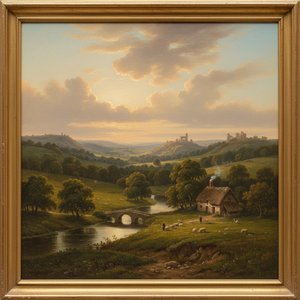
George, the elder Barret

1730 - 1784

George, the elder Barret (1730–1784) är främst känd för The Drive, Norbury Park; katalogen omfattar 122 av konstnärens verk.

Snabbfakta

  • Mediums: olja på duk
  • Top 3 works:
    • The Drive, Norbury Park
    • Wooded Landscape with a Boy and his Dog
    • North Side of Danson
  • Nationality: Irland
  • Typical colors:
    • jordnära
    • neutrala toner
  • Creative periods: mature period
  • Died: 1784
  • Corpus themes:
    • classical landscape influence
    • burke’s philosophy
    • royal academy style
    • classical landscape
    • edmund burke's philosophy
  • Top-ranked work: The Drive, Norbury Park

George Barret Sr.: Life & Legacy

George Barret Sr., born between 1728 and 1732 in Libertyville, Ireland—the son of a cloth merchant—was an Irish landscape artist who achieved considerable renown during the Enlightenment era. His artistic journey began humbly as a staymaker’s apprentice but swiftly blossomed into a vocation for capturing the sublime beauty of the British Isles and establishing himself as one of the founding fathers of British art history.

Early Life and Training

His formative years were marked by rigorous training at Robert West’s Academy in Dublin, generously supported by the Royal Dublin Society. Around 1747, he immersed himself in drawing instruction, demonstrating exceptional talent and skill—a testament to his innate aptitude for visual representation. Notably, a lifelong friendship with Edmund Burke solidified during Burke's academic years at Trinity College, Dublin, fostering intellectual connections that would resonate throughout Barret’s life.

Early Artistic Development & Influences

Barret’s initial paintings leaned heavily into classical landscapes and mythological subjects—a stylistic choice profoundly shaped by the philosophical explorations of Edmund Burke. Specifically, Burke’s *A Philosophical Enquiry into the Origin of Our Ideas of the Sublime and Beautiful* instilled in Barret a deep appreciation for capturing emotions of awe and wonder within his artwork. He skillfully adapted established styles by reworking engravings of Italianate scenes created by artists like Claude Lorrain—a technique indicative of his foundational understanding of artistic conventions. Despite depicting Italian vistas, there’s no documented evidence that Barret ever undertook personal expeditions to Italy itself.

Move to London and Rise to Prominence

Driven by ambition and a desire for greater artistic opportunities, Barret relocated to London in 1762—a pivotal decision that propelled him into the heart of Britain's burgeoning art scene. Within months, he garnered recognition as a leading landscape artist, attracting patronage from influential collectors and securing membership in the Society of Artists of Great Britain. However, Barret’s vision extended beyond mere commercial success; he spearheaded the movement to establish the Royal Academy in 1768—a landmark event that fundamentally reshaped British artistic practice and cemented his legacy as a visionary reformer.

Artistic Style and Themes

Barret's artistic style evolved gracefully over time, transitioning from idealized Italianate landscapes to more nuanced depictions of English and Irish scenery. He undertook extensive travels throughout England, Wales, Scotland, and Ireland—capturing the diverse splendor of each region through meticulous observation and skillful brushwork. Recurring themes in his oeuvre included tranquil vistas bathed in golden light, picturesque countryside dotted with cottages and farms, and dramatic waterfalls like *The Powerscourt Waterfall*, which he rendered with breathtaking accuracy. Furthermore, Barret’s canvases frequently incorporated figures—adding a dimension of human presence to the landscape and conveying narratives of rural life and contemplation. His meticulous attention to detail and masterful use of tonal variation exemplify the Romantic aesthetic—a stylistic hallmark that distinguishes his work from earlier artistic traditions.

Later Life & Patronage

Barret's personal life was marked by both hardship and profound friendship. Suffering from asthma, he sought respite from London’s smog in Westbourne Green in 1772—a move motivated by health concerns rather than mere preference. Despite achieving considerable financial success during his career, Barret struggled with money management—occasionally facing periods of instability. Fortunately, Edmund Burke remained a steadfast ally and provided invaluable support both financially and professionally—a relationship that underscored the importance of intellectual companionship in shaping an artist’s trajectory. In 1782, Burke championed Barret's candidacy for the position of Master Painter at Chelsea Hospital—a role he held until his untimely death in 1784—leaving behind a legacy as both a celebrated artist and a devoted servant to the Crown. His paintings continue to inspire admiration for their beauty and artistic innovation, securing his place among the titans of British landscape painting.

Quiz

Det finns endast ett korrekt svar på varje fråga.

Fråga 1:
Vilken konstnärs filosofiska skrifter särskilt *En filosofisk undersökning om ursprunget till våra idéer om det sublima och vackra* påverkade Barrets konstnärliga metod?
Fråga 2:
Barret arbetade främst med vilken konstnärlig teknik?
Fråga 3:
Vilken prestigefull konstinstitution grundades Barret bland andra år 1768?
Fråga 4:
Vad fick Barret att flytta till Westbourne Green år 1772?
Fråga 5:
Barrets verk representerar en betydande övergång inom brittisk landskapsmålning, vilket innebär att han gick från klassisk efterliknelse till...

Frågor och svar

Vad målade George, the elder Barret först respektive sist?

Bland de daterade verk som listas här är det tidigaste Powerscourt, County Wicklow, Ireland (1760) och det senaste Broodmares and Colts in a Landscape (1783). Se George, the elder Barrets tidslinje över konstverk.

Vilka målningar är George, the elder Barret känd för?

George, the elder Barret är känd för de verk som listas i de mest kända målningarna av George, the elder Barret.

Under vilken historisk period verkade George, the elder Barret?

George, the elder Barret verkade under perioden Tidig modern tid, vilket placerar konstnärens gärning i ett historiskt sammanhang.

Hur populära är George, the elder Barrets konstverk?

Se George, the elder Barret's mest populära målningar, rankade efter antal besök på denna webbplats.

Vilken konstinriktning tillhörde George, the elder Barret?

George, the elder Barret är en av de kända Romantic Landscape Painting-konstnärerna.

Är George, the elder Barrets verk i public domain?

Ja. George, the elder Barret avled 1784, och verken är fria från upphovsrätt.

Var och när föddes George, the elder Barret?

George, the elder Barret föddes i Dublin år 1730.

Vilka material har George, the elder Barret använt?

Verken av George, the elder Barret som listas på denna webbplats är främst olja på duk.

Hur länge levde George, the elder Barret?

George, the elder Barret levde i cirka 54 år, från 1730 till 1784.