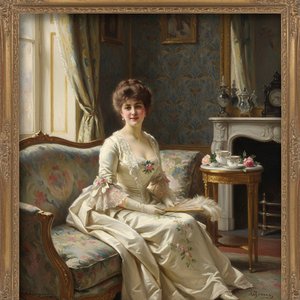
1846 - 1933

Snabbfakta

  • Top 3 works:
    • Portrait of Madame Judic during Act II of "Niniche"
    • Scholar at the Table
    • The Levite of Ephraim and the old man of Gibeah
  • Art period: 19th Century
  • Died: 1933
  • Lifespan: 87 years
  • Works on this site: 7
  • Mediums: oil on canvas
  • Born: 1846, Brussels metropolitan area, Belgium
  • Typical colors: earthy

A Life in Color and History

Emile Wauters was a Belgian painter born in the Brussels metropolitan area. A student of Jean-François Portaels and Jean-Léon Gérôme, he gained early recognition with his 1868 work, The Battle of Hastings: The Finding of the Body of Harold by Edith. His career was marked by significant historical compositions, such as Mary of Burgundy entreating the Sheriffs of Ghent to pardon the Councillors Hugonet and Humbercourt, which caused a sensation in 1870. Other notable large-scale works include The Madness of Hugo van der Goes, Sobieski and his Staff before Besieged Vienna, and the vast panorama Cairo and the Banks of the Nile.

His artistic journey included travels to Italy and Egypt, the latter of which inspired works like The Great Mosque and Serpent Charmers of Sokko. Wauters was also a highly accomplished portraitist, creating over two hundred likenesses of prominent figures from Belgium, France, and America. His portraiture evolved from a sober style to a brilliant, forceful palette, eventually embracing pastel for life-size portraits of ladies.

Accolades and Recognition

Throughout his career, Wauters received numerous prestigious distinctions. His achievements include:

He held honorary memberships in the academies of Vienna, Berlin, and Munich, and served as a corresponding member of the Institut de France and the Madrid academy. His technical execution and ability to capture character and vitality placed him at the front rank of his profession.

Quiz

Det finns endast ett korrekt svar på varje fråga.

Fråga 1:
In which city was Emile Wauters born?
Fråga 2:
Which artist was one of Emile Wauters' teachers?
Fråga 3:
What was the subject of Wauters' 1872 painting exhibited in the Brussels Museum?
Fråga 4:
Which large panorama did Wauters execute in six months and exhibit in Brussels, Munich, and The Hague?
Fråga 5:
In which year did Wauters exhibit his historical picture of Mary of Burgundy entreating the Sheriffs of Ghent?

Frågor och svar

I vilken stad och vilket land föddes Emile Wauters?

Emile Wauters föddes i Brussels metropolitan area, i Belgium.

Var kan jag besöka ett virtuellt 3D-museum med Emile Wauterss konstverk?

Virtuellt 3D-galleri för Emile Wauters är en sida som visar konstnärens verk i ett virtuellt tredimensionellt galleri.

Finns det en kronologisk genomgång av Emile Wauters?

En kronologisk genomgång av Emile Wauterss verk finns tillgänglig på artistens Karriärlinje-sida, där konstverken presenteras i skapelseordning, kapitel för kapitel.

Under vilka andra namn är Emile Wauters känd?

Emile Wauters är även känd som Emile-Charles Wauters, E. Wauters, Wauter, Wauters, エミール・ワウタース.

Hur hittar jag verk av Emile Wauters i en specifik färgpalett?

Sidan Efter färgpalett grupperar Emile Wauterss konstverk efter deras färgpaletter.

Hur populära är Emile Wauterss konstverk?

Statistik om Emile Wauterss verk finns tillgänglig på artistens Besöksstatistik-sida.

Kan jag bläddra i Emile Wauterss verk efter konststil?

De konstinriktningar som Emile Wauters verkade inom kan ses på artistens Alla konststilar-sida, där konstverken är grupperade efter inriktning.

Finns det en tidslinje över Emile Wauterss verk?

Konstnärens Konstverk efter datum sida presenterar Emile Wauterss verk sorterade efter datum, år för år.

Finns det en översikt över alla de motiv som Emile Wauters målade?

Emile Wauterss verk kan utforskas efter motiv på artistens Ämnesindex-sida.