Introduction to Alexander Milne Calder
Alexander Milne Calder (MILL-nee) was a Scottish American sculptor born in Aberdeen, Scotland on August 23, 1846. He is best known for his architectural sculpture of Philadelphia City Hall and both his son, Alexander Stirling Calder, and grandson, Alexander ‘sandy’ Calder, became significant sculptors in the 20th century.Early Life and Education
Calder was born into a family steeped in artistic tradition. His father, Alexander Stirling Calder, was also a sculptor, and his grandfather, Alexander Milne Calder, had immigrated to Philadelphia in 1868 and is renowned for the colossal statue of William Penn atop Philadelphia City Hall’s tower. Calder attended the Royal Academy in Edinburgh and studied with John Rhind, honing his skills in stone carving from a young age. He traveled extensively, immersing himself in Parisian artistic circles and gaining inspiration from Impressionism and Symbolism. His formal education included studies at South Kensington School and the Pennsylvania Academy of Fine Arts where he learned alongside Thomas Eakins, absorbing techniques and perspectives that would inform his later work.Career Highlights
Calder’s breakthrough came with his commission for Philadelphia City Hall in 1872. Recognizing the immense challenge posed by creating over 250 pieces of marble and bronze—a project spanning two decades—he assembled a dedicated team to realize his vision. This monumental undertaking cemented his reputation as an architectural sculptor, demonstrating unparalleled precision and artistic ambition. He continued to sculpt for many years after City Hall, producing works that celebrated both grandeur and subtlety. Calder’s son, Alexander Stirling Calder, followed in his father's footsteps, becoming a prominent sculptor himself, and his grandson, Alexander ‘sandy’ Calder, further expanded the family legacy within the realm of modern art.Legacy and Influence
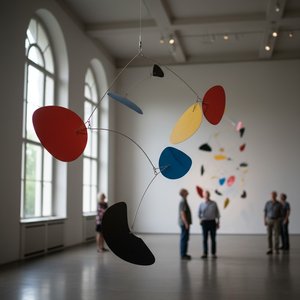
Calder’s sculptures stand as testaments to his unwavering commitment to artistic innovation. His mobiles—kinetic sculptures incorporating suspended metal discs—revolutionized sculpture in the mid-20th century, introducing a dynamic element previously absent from traditional forms. Calder's work profoundly impacted subsequent generations of artists, establishing him as a pivotal figure in the history of abstraction and influencing movements like Surrealism. Today, his creations reside in museums worldwide, ensuring that his artistic vision continues to inspire awe and contemplation.Notable Works
Some of Alexander Milne Calder’s most celebrated pieces include:- Philadelphia City Hall: A commission that demanded meticulous planning and execution, resulting in a breathtaking architectural sculpture featuring 250 bronze and marble elements.
- William Penn Statue: Standing atop Philadelphia City Hall's tower, this monumental statue embodies the spirit of American idealism and commemorates Pennsylvania’s founding father.
- Indian Figure: Calder’s sculptural exploration of indigenous culture reflects his fascination with natural forms and geometric abstraction.
- South Portal and West Portal: Illuminated with colored lights, these portals within City Hall showcase Calder's masterful attention to detail and his ability to transform architectural spaces into immersive artistic experiences.
Frågor och svar
Var kommer Alexander Calder ifrån?
Alexander Calder föddes i USA.
Kan jag studera Alexander Calders färgval genom hela det konstnärliga skapandet?
Alexander Calders färgval i de verk som listas på denna webbplats kan studeras på artistens Palettens genom-sida.
Under vilka andra namn är Alexander Calder känd?
Alexander Calder är även känd under namnen Calder, Sandy Calder.