Early Life & Artistic Awakening: Bremen Roots and Parisian Influences
 Paula Modersohn-Becker
Discover Paula Modersohn-Becker (1876-1907), a pioneering Expressionist renowned for her daring self-portraits & intimate depictions of motherhood, shaping early 20th-century art with emotional depth and innovation.
Paula Modersohn-Becker’s story is one of quiet rebellion, a determined forging of artistic identity against the backdrop of late 19th and early 20th century societal expectations. Born in Dresden in 1876, she wasn't destined for a life of creative expression; rather, a conventional path of domesticity was envisioned for her. Her family, though cultured – her father an engineer, her mother from minor aristocracy – operated within constraints imposed by a past scandal involving a politically motivated act by a relative. This atmosphere fostered a respect for intellectual pursuits but also a pragmatic awareness of societal limitations. Early artistic inclinations were initially nurtured through lessons, yet the prevailing sentiment remained that painting was a pleasant diversion rather than a viable vocation.
A pivotal moment arrived with her time in England at age sixteen, ostensibly to improve her English and acquire domestic skills. However, it was within the walls of St John’s Wood Art School in London that her passion truly ignited. This experience provided not only technical training but also a crucial exposure to artistic possibilities beyond the confines of her upbringing. Upon returning to Bremen, she dutifully completed teacher training, yet the call of the canvas proved too strong to ignore. A modest inheritance allowed her the freedom – and it was indeed a freedom hard-won – to pursue formal art education in Berlin and, crucially, Worpswede.
The subsequent journey to Paris marked another turning point. Unlike the structured academic environment she’d previously known, Paris offered an immersion into the burgeoning avant-garde. She encountered diverse artistic styles and a freedom of expression that profoundly impacted her developing aesthetic. It was here, amidst the vibrant chaos of the French capital, that Modersohn-Becker began to shed the constraints of traditional representation and embrace a more personal, emotionally resonant approach to painting.
The Worpswede Colony: A Crucible of Modernity and Modersohn-Becker’s Emerging Style
Worpswede, a small artists' colony north of Bremen, proved to be the fertile ground where Paula Modersohn-Becker truly blossomed. Founded by artists seeking refuge from urban constraints and academic rigidity, Worpswede offered a community of like-minded individuals dedicated to exploring new artistic avenues. She arrived in 1898 as a pupil of Fritz Mackensen, initially painting landscapes and scenes of peasant life in the established style of the colony. However, Modersohn-Becker quickly began to diverge from this norm.
Her relationships within Worpswede were profoundly influential. The friendship with sculptor Clara Westhoff provided intellectual companionship and artistic encouragement. The complex connection with Otto Modersohn, a fellow painter despite his marital status, became a central theme in her life and work. It was within this environment that she began to develop her distinctive style – characterized by simplified forms, bold colors, and an increasingly introspective focus.
While initially exhibiting alongside her peers, Modersohn-Becker’s work often met with critical indifference or even derision. Reviews were harsh, questioning her technical skill and lack of conventional beauty in her subjects. This rejection, rather than deterring her, fueled a deeper commitment to her own artistic vision – a vision that prioritized emotional truth over superficial aesthetics.
Radical Self-Portraiture: Challenging Conventions and Exploring Identity
 Self-portrait With Red Flower Wreath And Necklace
Explore Paula Modersohn-Becker’s iconic ‘Self-Portrait.’ A hauntingly beautiful early 20th-century realist painting featuring a somber woman & striking red wreath. Discover its symbolism & timeless appeal.
Paula Modersohn-Becker’s most enduring legacy lies in her groundbreaking series of self-portraits. In an era where female artists were often relegated to depicting decorative subjects or portraits of others, she turned the gaze inward, relentlessly examining her own image with unflinching honesty. This act alone was a radical departure from artistic norms.
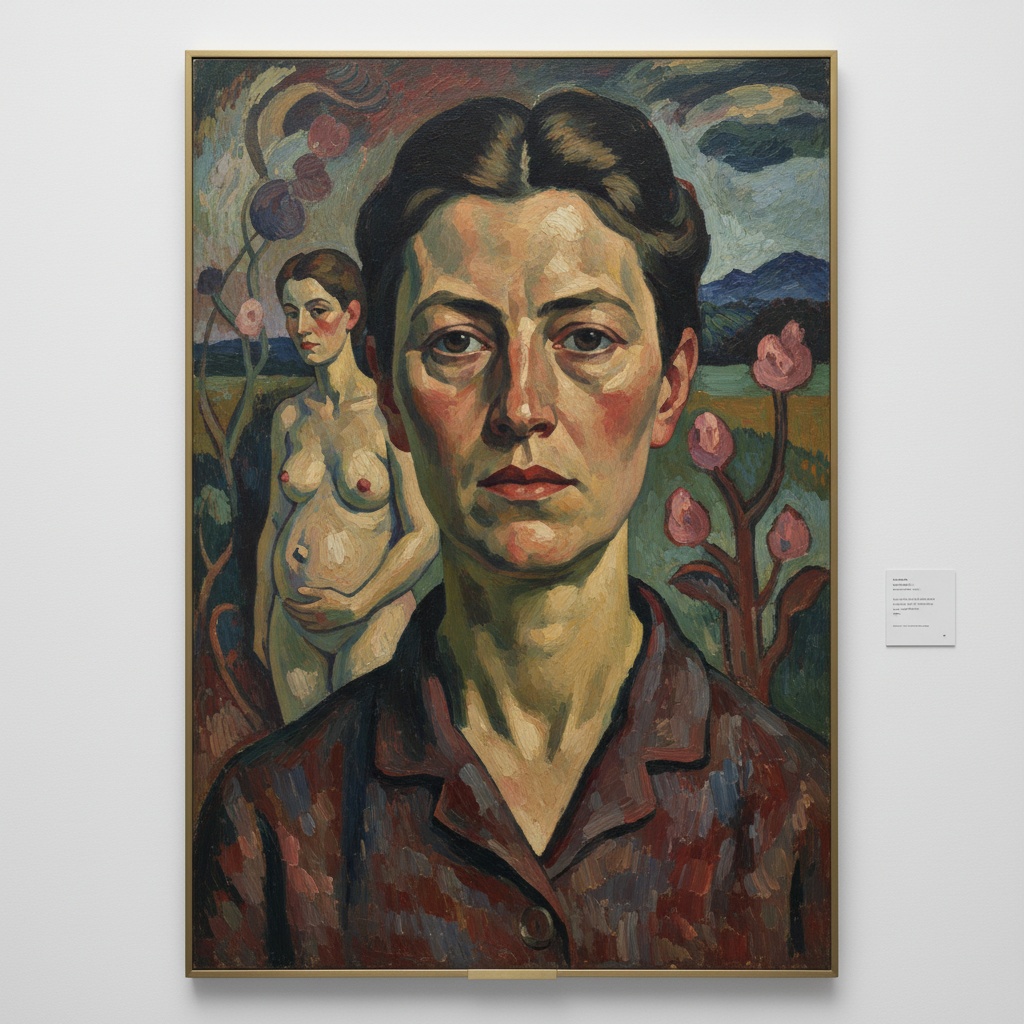
Her self-portraits are not merely representations of physical likeness; they are profound explorations of identity, vulnerability, and the complexities of womanhood. She depicted herself in various states – pensive, melancholic, pregnant, even nude – challenging conventional notions of beauty and societal expectations surrounding female representation. The Self-Portrait with Red Flower Wreath and Necklace, for example, is hauntingly beautiful yet deeply unsettling, the somber expression and striking red wreath hinting at a deeper emotional turmoil.
What sets Modersohn-Becker apart is her willingness to confront uncomfortable truths about the female experience. She rejected idealized portrayals in favor of raw authenticity, capturing not just her physical appearance but also her inner life – her anxieties, her desires, and her evolving sense of self. These portraits were a deliberate act of self-assertion, a reclaiming of agency in a world that often sought to define women by external standards.
Motherhood as Subject: Intimacy, Vulnerability, and the Female Experience
 Children In The Sun
Explore Paula Modersohn-Becker’s ‘Children In The Sun,’ an evocative Impressionistic portrait of motherhood. Discover its muted palette & intimate style – a poignant glimpse into early 20th-century art.
The theme of motherhood permeates much of Modersohn-Becker’s later work, marking another significant departure from artistic convention. Unlike idealized depictions of maternal bliss common in art history, her portrayals of pregnancy and early motherhood are imbued with a sense of intimacy, vulnerability, and even struggle. Children In The Sun, for instance, captures the quiet tenderness of motherhood but also hints at the physical and emotional toll it takes.
Her paintings of mothers and children often feature muted palettes and intimate compositions, drawing viewers into a deeply personal space. She wasn’t interested in portraying idealized figures; instead, she sought to capture the raw reality of maternal experience – the exhaustion, the joy, the anxieties, and the profound sense of transformation.
Modersohn-Becker's willingness to depict herself pregnant was particularly groundbreaking. She became one of the first women artists to openly address this subject matter in her work, challenging societal taboos and paving the way for future generations of female artists to explore themes of fertility and embodiment. Her paintings are not simply depictions of motherhood; they are powerful statements about the complexities of female identity and the often-unacknowledged realities of women’s lives.
A Lasting Legacy: Expressionism, Feminism, and Modersohn-Becker's Enduring Impact
Paula Modersohn-Becker’s tragically short life – she died from postpartum pulmonary embolism at the age of 31 – belies the profound impact her work would have on the development of modern art. Though largely unrecognized during her lifetime, she is now celebrated as a pioneer of Expressionism and a key figure in early 20th-century painting.
Her innovative style – characterized by simplified forms, bold colors, and an emphasis on emotional expression – foreshadowed many of the key tenets of the movement. She rejected traditional academic techniques in favor of a more personal, intuitive approach to painting, prioritizing feeling over representation. Her influence can be seen in the work of later Expressionist artists who sought to capture the inner turmoil and psychological complexities of modern life.
Beyond her artistic contributions, Modersohn-Becker’s legacy extends to the realm of feminism. Her unflinching self-portraits and honest depictions of motherhood challenged societal norms and paved the way for future generations of female artists to explore themes of identity, embodiment, and the female experience. She is recognized as a trailblazer who dared to break with convention and forge her own artistic path, leaving behind a body of work that continues to resonate with audiences today.
Discover more about Paula Modersohn-Becker’s captivating oeuvre at OriginalUniqueArt.com, where you can explore high-quality reproductions and delve deeper into the life and art of this remarkable artist.