Realism
The Reader (Honoré Daumier)
Honoré Daumier (1808–1879) skapade The Reader. Det tillhör Realism-rörelsen. Den är utförd i Oil On Panel. Måtten är 34 × 26 cm.
- Oil On Panel
- 34 × 26 cm

 Förhandsvisa

 Handmålad oljemålning
 Skicka
 Dela
 Guide


 Ladda ner
 Liknande objekt
 Röntgen
 Bildspel
 Frågor och svar

 Statistik
The Reader: det viktigaste
- Titel
- The Reader
- Konstnär
- Honoré Daumier (1808–1879)
- Konstnär född i
- Marseille, Frankrike
- Material
- Oil On Panel
- Mått
- 34 × 26 cm
- Rörelse
- Realism
- Tidsperiod
- 19th Century
- Motiv
- man, book, reading, brown, ochre, red
Vad föreställer The Reader?
Identification of The Reader by Honoré Daumier
The quiet intensity of The Reader meets the viewer through the focused gaze of its subject. Painted by Honoré Daumier, this work captures a moment of profound stillness. The piece emerges from around c. 1857, a time when the artist's hand moved with a particular sense of purpose and weight. It exists as a painting, a physical presence that holds the light and shadow of a private, contemplative world.
Honoré Daumier brings a sense of lived experience to this study. The figure remains lost in the pages of a book, oblivious to the world outside the frame. There is a weight to the atmosphere, a feeling of solitude that settles over the scene. The work carries the mark of its creation, a tangible connection to the era of its origin.
This specific painting, The Reader, remains a significant part of the artist's visual language. It avoids the distractions of a grand setting to focus entirely on the human condition in a state of deep engagement. Through this work, the act of reading becomes a heavy, significant event, frozen in time for those who stop to look.
Composition and Visual Elements
The composition follows a vertical orientation, drawing the eye immediately to the man positioned slightly off-center. He sits in a moment of profound stillness, his gaze directed steadily downwards toward the open book held in his hands. This downward focus creates a tight, intimate space around his head and shoulders. Behind him, a blurred object, perhaps a cushion or a potted plant, rests in the background, providing a sense of depth without pulling attention away from the central figure.
Soft, diffused light falls from an unseen source above and to the left, casting gentle shadows across the man's face. This lighting emphasizes his features and the texture of the pages before him, while the shallow perspective keeps the viewer's focus firmly on the interaction between the reader and his text. The atmosphere feels quiet and heavy with contemplation.
The color palette relies on a somber arrangement of earthy tones. Deep browns, ochres, and muted reds dominate the scene, grounding the subject in a warm but melancholic environment. These colors wrap around the figure, reinforcing the sense of solitude and the weight of the thoughts contained within the book.
Technique and Physical Materials
The oil paint clings to the panel with a palpable, heavy presence. Each stroke carries the weight of the artist's hand, applied with a loose and expressive energy that refuses to settle into stillness. You can see the evidence of layering, where colors are built upon one another to create a sense of depth and substance. These layers blend into one another, creating soft transitions that suggest the subtle shifts of light across a surface.
A visible roughness defines the texture of the work. The brushstrokes remain unpolished and direct, leaving a tactile quality that speaks to the immediacy of the moment. This ruggedness gives the surface a physical life, where the paint does not merely sit upon the panel but seems to emerge from it. The interplay of these thick applications and the careful blending of tones creates a surface that feels both spontaneous and deeply considered.
The Reader i hög upplösning

Allmän egendom: konstnären avled 1879.
Fler storlekar, beskärningar och källhänvisning →Honoré Daumier, The Reader. Allmän egendom
En digital expert kontrollerar färgerna mot originalmålningen och retuscherar filen så att den är trogen konstnärens penseldrag.
Köp högupplöst bildFrågor om The Reader
Var kan jag hitta statistik för "The Reader" av Honoré Daumier?
Statistik för "The Reader" av Honoré Daumier finns på verkets Besöksstatistik-sida: månatliga besök för verket, besök för konstnärens verk samt en uppdelning av nyligen anlända besökare per land och språk.
Hur hög är kontrasten i "The Reader" av Honoré Daumier?
Ljus-mörker-kontrasten i "The Reader" är registrerad som Serene. Kontrast beskriver hur starkt ljusa och mörka partier skiljer sig åt.
Vilken konststil tillhör "The Reader" av Honoré Daumier?
"The Reader" är ett verk inom Realism. Denna stilriktning anger den konstnärliga tradition som verket tillhör.
Vilken konstnär och vilken stil ligger bakom "The Reader"?
Honoré Daumier skapade "The Reader" inom Realism-rörelsen.
Kan jag se en röntgenbild av "The Reader" av Honoré Daumier?
Röntgenanalys-sidan för "The Reader" av Honoré Daumier är en interaktiv visare som låter dig bläddra genom elva optiska lager av konstverkets bild, inklusive en vy i röntgenstil.
Vilken är den dominerande färgen i "The Reader" av Honoré Daumier?
Den dominerande färgen i "The Reader" av Honoré Daumier är Walnut (#714229).
Hur förhåller sig "The Reader" till Honoré Daumiers återkommande motiv?
"The Reader" skildrar man, book, reading, brown, ochre, red, shoulders, face, medan Honoré Daumiers dokumenterade teman är rubens' chiaroscuro, realism, social and political critique, lithography and painting, human condition. En jämförelse mellan dessa visar hur verket förhåller sig till konstnärens vanliga motiv.
Finns det verk som liknar "The Reader"?
Hitta verk som liknar "The Reader" på verkets sida Liknande verk.
Hur mycket ljus verkar färgerna i "The Reader" reflektera?
Luminansen som registrerats för "The Reader" av Honoré Daumier är Dark.
Om konstnären, Honoré Daumier

1808–1879, Frankrike
Honoré Daumier
En Liv Etched i Satire: Honoré Daumiers Värld Honoré-Victorin Daumier, född 1808 i Marseille och död 1879 i Paris, var en fransk litograf, målare och skulptör vars konstverk präglades av realism och en skarp satirisk blick mot det 19:a århundradets Frankrike. Hans liv var djupt sammanflätat med de turbulenta tiderna då han levde, och hans konst blev ett kraftfullt verktyg för att ifrågasätta maktens korruption och samhällets orättvisor. Daumier var inte bara en konstnär; han var en observatör, en kritiker och en skildrare av sin tids ande. Hans tidiga liv, präglat av hans fars poetiska ambitioner och den senare flytten till Paris 1814, gav honom direkt tillgång till en stad full av konstnärlig energi.
Andra verk av Honoré Daumier
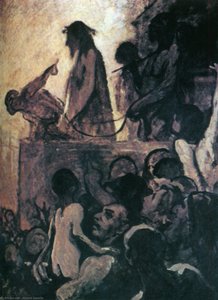 Vi vill Barabbas (Ecce Homo)1852
 The Third-class Carriage1860
 Unknown, maybe Hippolyte Lucien-Joseph Lucas (1807-1878), a Journalist, maybe P.Mendez de Vigo (1790-1860) a Spanish General, but Most Probably the Count Pelet de la Lozere (1785-1871), a Politician1833
 Ratapoil (front view)1850

Essäer om The Reader
 The Art of the Gaze: A Collector's Guide to Mastering Portrait Composition and Emotional DepthMaster the nuances of portrait composition with our expert guide for collectors. Discover how light, gaze, and texture create emotional dep…
 Spontaneity and Matter: Distinguishing CoBrA from Art InformelMaster the differences between CoBrA and Art Informel with our expert guide. Learn to identify these post-war movements today.
 Ink and Light: How Impressionist Painters Captured the Act of ReadingExplore how masters like Renoir and Vermeer captured the intimacy of reading. Discover the profound link between literature and fine art.