Cubism · 1924
Three Characters (Fernand Léger, 1924)
Three Characters är ett verk av Fernand Léger (1881–1955). Den är från 1924. Det tillhör Cubism-rörelsen. Den är utförd i Acrylic On Canvas.
- 1924
- Acrylic On Canvas

 Förhandsvisa

 Handmålad oljemålning
 Skicka
 Dela
 Guide


 Ladda ner
 Liknande objekt
 Röntgen
 Bildspel
 Frågor och svar

 Statistik
Three Characters: the essentials
- Titel
- Three Characters
- Konstnär
- Fernand Léger (1881–1955)
- Konstnär född i
- Argentan, Frankrike
- Datum
- 1924
- Medium
- Acrylic On Canvas
- Rörelse
- Cubism
- Period
- Modern
- Motiv
- geometric figures, modern composition, cubist style art, human interaction, bold color palette, everyday objects
Looking at Three Characters
A Symphony of Form and Feeling: Exploring Fernand Léger’s “Three Characters”
Fernand Léger's 1924 painting, *“Three Characters,”* is a pivotal work exemplifying his distinctive contribution to Cubism – a style he uniquely evolved into what became known as ‘Tubism.’ More than just an exercise in geometric abstraction, this piece offers a compelling glimpse into the artist’s vision of modern life and human connection amidst industrialization.Deconstructing the Composition: Style & Technique
Léger masterfully employs simplified, cylindrical forms to depict three figures positioned closely together. This isn't about realistic representation; it’s a deliberate fragmentation and reassembly of reality through a Cubist lens. The painting eschews traditional perspective, presenting multiple viewpoints simultaneously within a flattened picture plane. The technique is characterized by smooth brushstrokes and carefully blended colors, creating a polished surface despite the angularity of the forms. This creates a sense of solidity and monumentality, grounding the abstracted figures.A Palette of Modernity: Color & Symbolism
While rooted in Cubism’s analytical approach, *“Three Characters”* distinguishes itself through its vibrant color palette. Léger moves beyond the muted tones often associated with early Cubism, embracing bold hues that inject energy and warmth into the composition. The inclusion of symbolic objects – a baseball bat and a book – adds layers of meaning. These aren’t merely decorative elements; they represent facets of everyday life, leisure, and intellectual pursuit, hinting at Léger's interest in portraying the modern individual within their environment. The figures themselves are not portraits but archetypes, representing universal aspects of human experience.Historical Context: Cubism & Beyond
Created in the aftermath of World War I, *“Three Characters”* reflects a broader cultural shift towards embracing modernity and industrialization. Léger, alongside Picasso and Braque, was at the forefront of the Cubist revolution, challenging traditional artistic conventions. However, he diverged from his peers by incorporating elements of machine aesthetics and popular culture into his work. His style evolved toward “Crystal Cubism,” emphasizing large, overlapping geometric planes and a strong focus on surface activity. This painting stands as a testament to that evolution, bridging the gap between abstract experimentation and representational form.Emotional Resonance & Lasting Influence
*“Three Characters”* evokes a sense of quiet contemplation and interconnectedness. Despite their abstracted forms, the figures possess a palpable presence, suggesting a shared experience or unspoken dialogue. The painting’s enduring appeal lies in its ability to resonate with viewers on an emotional level, prompting reflection on themes of identity, community, and the human condition. Léger's work profoundly influenced subsequent art movements, including Futurism, Abstract Art, and Surrealism, solidifying his legacy as a visionary artist who redefined the possibilities of painting in the 20th century.Collecting & Interior Design Considerations
- Style Compatibility: This artwork complements modern, minimalist, or Art Deco interiors. Its geometric forms and bold colors create a striking focal point.
- Color Palette Integration: The painting’s color scheme can be echoed in accent furniture, textiles, or wall colors to create a cohesive design aesthetic.
- Placement Suggestions: Ideal for living rooms, dining areas, or home offices. Consider pairing it with contemporary sculptures or abstract artwork.
- Investment Potential: As a seminal work by a highly influential artist, a high-quality reproduction of *“Three Characters”* represents not only an aesthetic addition but also a potential investment in art history.
Three Characters in high resolution

Fernand Léger, Three Characters (1924). Allmän egendom
En digital expert kontrollerar färgerna mot originalmålningen och retuscherar filen så att den är trogen konstnärens penseldrag.
Buy the high-resolution imageQuestions about Three Characters
Vilken är den rekommenderade tryckstorleken för "Three Characters" av Fernand Léger?
Rekommenderad tryckstorlek för "Three Characters" av Fernand Léger är Large.
När skapades "Three Characters" av Fernand Léger och vilken stil tillhör det?
"Three Characters" skapades år 1924 inom Cubism-rörelsen.
Upplevs färgerna i "Three Characters" som starka eller mjuka?
Färgerna i "Three Characters" av Fernand Léger har en Monochromatic intensitet.
Varför är upphovsrättsläget för "Three Characters" som det är?
"Three Characters" av Fernand Léger är allmän egendom – upphovsrätten har löpt ut. Upphovsrätten löper från konstnärens dödsår, vilket var 1955.
Vilken underliggande nyans genomsyrar "Three Characters" av Fernand Léger?
"Three Characters" lutar åt en Ochre to Sepia ton.
Var kan jag ladda ner "Three Characters" av Fernand Léger?
"Three Characters" av Fernand Léger kan laddas ner som en högupplöst digital bildnedladdning via verkets sida för Ladda ner digital bild.
Hur förhåller sig "Three Characters" till Fernand Légers återkommande motiv?
Fernand Légers återkommande teman inkluderar exploration of flat planes, expansion of color usage, cubism's geometric forms, early 20th-century modernism, urban life & modernity, human connection & interaction; "Three Characters" fokuserar på geometric figures, modern composition, cubist style art, human interaction, bold color palette, everyday objects, abstract forms.
Kan jag undersöka "Three Characters" mer i detalj?
Röntgenanalys-sidan för "Three Characters" av Fernand Léger är en interaktiv visare som låter dig bläddra genom elva optiska lager av konstverkets bild, inklusive en vy i röntgenstil.
Vilken historisk plats har "Three Characters" i konsthistorien?
Historiskt sett är "Three Characters" ett Cubism-verk från den bredare Modern-eran.
About the artist, Fernand Léger

1881–1955, Frankrike
Fernand Léger
Fernand Légers liv Berättelsen om Fernand Léger tar sin början i den lilla byn Argentan, belägen i Orne-regionen i Nedre Normandie. Han föddes den 4 februari 1881 som enda son. Hans tidiga år formades av den franska landsbygdens stillhet och närvaron av hans mor, Marie-Adèle Daunou. Hans far, en man som försörjde sig som boskapshandlare, gick bort när Fernand fortfarande var en liten pojke, vilket lämnade barnet att fostras av sin mor i ett hem präglat av hennes fromhet och en viss ödmjuk natur.
Also by Fernand Léger
 Staden1919
 Arbetaren1920
 Tre kvinnor1921
 Nattbilder i skogen1910

Essays around Three Characters
 Fernand Léger: Topp 25 mästerverk – Modernismens färgstarka visionärer | OriginalUniqueArtUtforska Fernand Légers 25 mest ikoniska målningar! Fördjupa dig i kubismens värld, maskinålderns färgstarka estetik och tidlösa konstverk.…
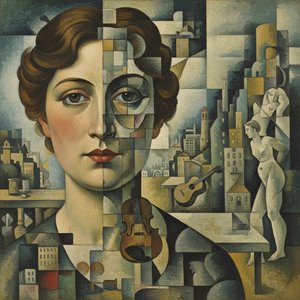 Deconstructing Reality: Cubism's Revolutionary Impact on 20th-Century ArtExplore the revolutionary world of Cubism with OriginalUniqueArt. Discover Picasso & Braque's groundbreaking techniques, its philosophical …
 Industriell Estetik i Konsten: Topp 10 Verk för Hemmet & InspirationUtforska 10 ikoniska konstverk som fångar industriell estetik – från Munchs dramatik till Turners stormar. Lär känna historien bakom mäster…