Expressionism
Marsh bridge (Emil Nolde)
Emil Nolde (1867–1956) skapade Marsh bridge. Det tillhör Expressionism-rörelsen. Den är utförd i Oil On Canvas.
- Oil On Canvas

 Förhandsvisa

 Handmålad oljemålning
 Skicka
 Dela
 Faktablad för elever


 Ladda ner
 Liknande objekt
 Röntgen
 Bildspel
 Frågor och svar

 Statistik
Marsh bridge i korthet
- Titel
- Marsh bridge
- Konstnär
- Emil Nolde (1867–1956)
- Konstnär född i
- Nolde, Danmark
- Material
- Oil On Canvas
- Rörelse
- Expressionism
- Tidsperiod
- Modern
- Motiv
- bridge, marsh, water, sky, trees, blue
Vad föreställer Marsh bridge?
Identification of the Artwork and Artist
The artwork titled Marsh bridge is a painting by the artist Emil Nolde. This piece depicts a marsh landscape where a wooden bridge serves as the central subject. The composition focuses on the intersection of the man-made structure and the organic forms of the surrounding wetlands.
Emil Nolde, born in Nolde, Denmark, was a figure associated with the Expressionist movement. His approach to this subject matter is characterized by a style strongly influenced by Expressionism, prioritizing subjective experience through the application of paint. The work utilizes an impasto technique, where thick layers of oil paint create a palpable surface relief on the canvas.
Composition and Visual Elements
The composition is organized around a wooden bridge that traverses the canvas diagonally from the lower right toward the upper left. This diagonal movement provides a sense of direction through the landscape. The structure of the bridge is defined by a series of short, choppy lines that form the railings. A body of water occupies much of the background, reflecting the sky and the surrounding vegetation. On the horizon line, distant buildings and trees are visible, though they appear flattened due to a lack of clear atmospheric perspective.
Horizontal elements dominate the arrangement, specifically the water line, the bridge’s railings, and the distant treeline. These lines create a sense of expansive space across the marsh. The bridge is positioned in the foreground, appearing closer to the viewer than the trees in the distance. While the bridge provides a geometric contrast to the organic and irregular shapes of the marsh, its structure remains somewhat distorted by the application of the paint.
Technique and Material Application
The work is executed in oil paint on canvas. The artist employs an impasto technique, characterized by a thick application of paint across the surface. This method results in a palpable sense of surface relief, where the physical weight of the medium is evident. The paint is not applied in thin, translucent glazes but in heavy, substantial layers that create a tactile topography on the canvas.
The brushwork is highly visible throughout the composition. Rather than being blended into smooth transitions, the colors are applied in thick, distinct strokes. These marks are short and choppy, particularly where the railings of the bridge are defined. The application of the pigment is energetic, with the texture of the brushstrokes contributing directly to the visual impact of the landscape. The uneven surface created by these strokes catches the light, emphasizing the physical presence of the material.
Color and Lighting Details
The color palette is dominated by shades of blue, green, and white. These tones establish the primary visual field of the marsh and the sky. Along the path, the application of paint introduces areas of muted yellow and ochre. In the distance, the color scheme shifts to include touches of brown and red, which provide a subtle contrast to the cooler tones of the foreground and midground.
The lighting in the scene is diffused, suggesting the conditions of an overcast day. This lack of direct sunlight results in an even distribution of light across the landscape. There are no strong highlights or deep shadows present in the composition. The light does not create sharp edges or high-contrast points, maintaining a consistent luminosity across the water, the bridge, and the horizon.
Artistic Style and Subject Matter
The subject matter consists of a marsh landscape where a wooden bridge serves as the central focus. This structure traverses the canvas diagonally from the lower right toward the upper left. The bridge's railings are defined by short, choppy lines, while the surrounding water is suggested through wavy, broken strokes. The shapes within the scene are largely organic and irregular, reflecting the natural forms of the marshland. Perspective is not rendered realistically; objects in the distance appear flattened and lack clear depth cues, which emphasizes the expressive nature of the work over a faithful representation of reality.
The style is characterized by Expressionism, prioritizing subjective experience and emotional expression. The application of paint through the impasto technique creates a palpable surface relief, where thick, distinct strokes contribute to an energetic feel. This approach, combined with a muted color palette of blues, greens, and whites, contributes to a mood of solitude and melancholy. The bridge itself functions as a symbol of transition or connection within this quiet, atmospheric setting. The composition relies on horizontal elements—the water line, the railings, and the distant treeline—to create a sense of expansive space despite the flattened perspective.
Related Works by Emil Nolde
The artist's exploration of landscape and atmosphere extends to several other compositions. He painted Marshy Landscape under the Evening Sky, a work that captures a quiet moment where the land meets a heavy sky. His interest in maritime and elemental themes is further seen in Autumn Sea, created about 1908. These works demonstrate a recurring focus on the interaction between terrain and the shifting light of the sky.
Beyond landscape subjects, the artist's output includes more figurative and symbolic imagery. He produced The Mocking of Christ in 1909. Additionally, he created Masks around 1906-1907, which lean into the expressive power of primitive forms. These pieces reflect the breadth of his subject matter, moving from the wide expanse of a marsh to specific religious and formal studies.
Högupplösta bilder av Marsh bridge
Allmän egendom: konstnären avled 1956.
Emil Nolde, Marsh bridge. Allmän egendom
Frågor om Marsh bridge besvarade
Vilken teknik har använts för "Marsh bridge"?
"Marsh bridge" är utförd i Oil On Canvas.
Vad föreställer "Marsh bridge"?
Motiven i "Marsh bridge" är bridge, marsh, water, sky, trees, blue, green, brown.
Är "Marsh bridge" av Emil Nolde fri från upphovsrätt?
När det gäller upphovsrätt är "Marsh bridge" allmän egendom – upphovsrätten har löpt ut.
Vem har skapat "Marsh bridge"?
"Marsh bridge" skapades av Emil Nolde. Informationen på denna sida beskriver Emil Noldes originalverk.
Vilken stil tillhör "Marsh bridge"?
"Marsh bridge" av Emil Nolde tillhör Expressionism-rörelsen. Denna rörelse ger det stilistiska sammanhanget för verket.
Vad förklarar upphovsrättssituationen för "Marsh bridge" av Emil Nolde?
"Marsh bridge" av Emil Nolde är allmän egendom – upphovsrätten har löpt ut. Upphovsrätten löper från konstnärens dödsår, vilket var 1956.
Hur passar "Marsh bridge" in i Emil Noldes teman och stil?
"Marsh bridge" delar med Emil Noldes övriga verk sin Expressionism-stil och de återkommande temana: post-impressionism, die brücke, expressionism, subjective experience, nature and color.
Är "Marsh bridge" typisk för vad Emil Nolde vanligtvis skapade?
Bland Emil Noldes dokumenterade teman – post-impressionism, die brücke, expressionism, subjective experience, nature and color – har "Marsh bridge" ett eget fokus på bridge, marsh, water, sky, trees, blue, green, brown.
Om konstnären, Emil Nolde
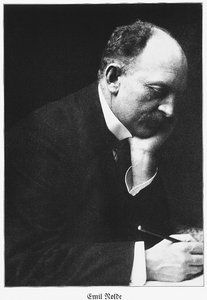
1867–1956, Danmark
Emil Nolde
Emil Noldes liv och identitet Född som Hans Emil Hansen den 7 augusti 1867, växte mannen som senare skulle bli känd som Emil Nolde upp nära byn Nolde i hertigdömet Schleswig. Hans tidiga år präglades av familjens lantliga och agrara livsstil. Han valde dock så småningom att lämna denna bana och arbetade istället som träsnidare och möbeldekorerare. Detta taktila och fysiska arbete föregick hans skifte mot måleri och grafik.
Andra verk av Emil Nolde
 Sunset
 Sea with Red Sky
 Sea and ship in the sunset
 Couple on the beach1903
Essäer om Marsh bridge
 20th century Norwegian painters20th-century Norwegian painters like Edvard Munch, Nikolai Astrup, and Christian Krohg define an era. Find museum-quality reproductions on …
 Emil Nolde: The Top 25 Masterpieces of an Expressionist IconExplore 25 iconic Emil Nolde masterpieces. Discover the soul of Expressionism and find museum-quality art at OriginalUniqueArt.com.
 Danish artworks of the 1900sDanish art from the 1900s featuring Vilhelm Hammershøi, Anna Ancher, and Michael Ancher. View the full collection online at OriginalUniqueA…