Symbolist Painting · 1879
Spring Evening (Arnold Böcklin, 1879)
Arnold Böcklin (1827–1901) skapade Spring Evening. Den är från 1879. Det tillhör Symbolist Painting-rörelsen. Den är utförd i Oil On Panel. Verket finns bevarat på Szépművészeti Múzeum i Budapest, Ungern. Måtten är 67 × 129 cm.
- 1879
- Oil On Panel
- 67 × 129 cm
- Szépművészeti Múzeum, Budapest

 Förhandsvisa

 Handmålad oljemålning
 Skicka
 Dela
 Faktablad


 Ladda ner
 Liknande objekt
 Röntgen
 Bildspel
 Frågor och svar

 Statistik
Spring Evening i korthet
- Titel
- Spring Evening
- Konstnär
- Arnold Böcklin (1827–1901)
- Konstnär född i
- Basel, Schweiz
- Datum
- 1879
- Material
- Oil On Panel
- Mått
- 67 × 129 cm
- Utställningsplats
- Szépművészeti Múzeum, Budapest, Ungern
- Rörelse
- Symbolist Painting
- Motiv
- mythology, nymphs, pan, forest, evening, landscape
Vad föreställer Spring Evening?
The Ethereal Embrace of Spring Evening
Arnold Böcklin’s “Spring Evening,” painted in 1879, isn't merely a depiction of a woodland scene; it’s an immersion into a realm of melancholic beauty and profound symbolism. Created during his time in Florence – a city that profoundly shaped his artistic vision – the painting captures a fleeting moment of enchantment, steeped in the atmosphere of late Romanticism and foreshadowing the rise of Symbolism. The canvas breathes with a quiet intensity, dominated by muted greens, blues, and browns, creating an almost dreamlike quality that immediately draws the viewer into its hushed world.
At the heart of the composition stands a woman, her posture suggesting both contemplation and vulnerability. Her hand gently resting on her head is a gesture simultaneously of yielding and quiet strength – she’s not passively observing but actively engaged with the scene unfolding before her. Beside her sits a man, seemingly lost in thought as he peruses a book, his presence offering a grounding element to the ethereal atmosphere. A bear, rendered with surprising tenderness, interacts playfully with both figures, blurring the lines between human and animal, nature and civilization. This carefully orchestrated tableau speaks of harmony, connection, and the delicate balance of the natural world.
A Symphony of Symbolism
Böcklin’s work is deeply rooted in mythology and folklore, drawing heavily on ancient Greek and Roman traditions. The central figure, often interpreted as Pan – the god of nature, shepherds, and wild music – plays his pipes, summoning a chorus of unseen nymphs from the surrounding forest. These dryads, with their flowing hair and graceful movements, represent the spirit of the woods, embodying both beauty and danger. The bear itself is a potent symbol, frequently associated with strength, wisdom, and primal instincts—a reminder of humanity’s connection to the earth.
The painting's muted palette contributes significantly to its symbolic weight. The cool blues and greens evoke a sense of melancholy and introspection, while the browns ground the scene in the tangible reality of the forest floor. The lighting is soft and diffused, creating an atmosphere of twilight—a liminal space between day and night, representing transition, mystery, and perhaps even mortality. Böcklin masterfully uses color not to simply depict a landscape but to convey complex emotions and ideas.
Technique and Artistic Influences
“Spring Evening” exemplifies Böcklin’s distinctive artistic style, characterized by meticulous detail, rich textures, and an almost obsessive attention to the natural world. He employed a technique of layering thin glazes of oil paint, building up color gradually to achieve remarkable depth and luminosity. The brushwork is subtle yet expressive, conveying both the smoothness of the forest floor and the intricate details of the foliage.
Böcklin’s artistic journey was profoundly influenced by his time in Düsseldorf, where he studied under Schirmer and became associated with the Düsseldorf School of Painting. However, it was in Florence that he truly developed his unique Symbolist vision, drawing inspiration from the city's rich cultural heritage and its connection to antiquity. The painting also reflects the influence of Romanticism, particularly the emphasis on emotion, imagination, and the sublime beauty of nature—themes central to the movement.
A Timeless Resonance
“Spring Evening” continues to resonate with viewers today because it taps into universal themes of longing, connection, and the search for meaning. Its evocative atmosphere and symbolic richness invite contemplation and offer a glimpse into the artist’s deeply personal vision. The painting's enduring appeal lies in its ability to transport us to another time and place—a world where myth and reality intertwine, and where the beauty of nature is inextricably linked to the mysteries of the human soul.
Vilket museum har Spring Evening?
Szépművészeti Múzeum
Budapest, Ungern
Ursprung och historia till Szépművészeti Múzeum Grundandet av Szépművészeti Múzeum formaliserades genom millennielagen från 1896. Detta lagstiftande beslut syftade till att skapa en dedikerad institution för de sköna konsterna i Budapest, Ungern. Den plats som valdes för detta ändamål var den som tidigare upptagits av Rotunda-paviljongen, en struktur uppförd för att visa Feszty-körkép.


Högupplösta bilder av Spring Evening

Allmän egendom: konstnären avled 1901.
Andra storlekar, beskärningar och citering →Arnold Böcklin, Spring Evening (1879), Szépművészeti Múzeum. Allmän egendom
Frågor om Spring Evening besvarade
Var kan jag se originalet av "Spring Evening" av Arnold Böcklin?
Originalet av "Spring Evening" av Arnold Böcklin finns på Szépművészeti Múzeum, Budapest, Ungern. En reproduktion gör det möjligt att visa verket i hemmet.
Vilket år skapades "Spring Evening" av Arnold Böcklin?
"Spring Evening" dateras till 1879. Datumet placerar verket inom Arnold Böcklins karriär och dess epok.
Vilken teknik har använts för "Spring Evening"?
"Spring Evening" är utförd i Oil On Panel.
Vilka är måtten på originalet av "Spring Evening"?
Originalet av "Spring Evening" av Arnold Böcklin mäter 67 x 129 cm.
Vad föreställer "Spring Evening" av Arnold Böcklin?
Motiven i "Spring Evening" är mythology, nymphs, pan, forest, evening, landscape, symbolism, böcklin.
Är bilden av "Spring Evening" av Arnold Böcklin fri att återge?
Upphovsrättslig status för "Spring Evening" av Arnold Böcklin: verket är allmän egendom – upphovsrätten har löpt ut. Detta avgör om reproduktioner av bilden får framställas fritt.
Vilken konstnär tillskrivs "Spring Evening"?
"Spring Evening" tillskrivs Arnold Böcklin.
Vilken konstnärlig inriktning tillhör "Spring Evening" av Arnold Böcklin?
Konststilen som förknippas med "Spring Evening" av Arnold Böcklin är Symbolist Painting. Denna klassificering placerar verket bland relaterade konstnärer och konstverk.
Var i Arnold Böcklins karriär placerar sig "Spring Evening"?
Inom Arnold Böcklins karriär tillhör "Spring Evening" perioden Late Period. Denna fas underlättar jämförelser med konstnärens övriga verk.
Om konstnären, Arnold Böcklin
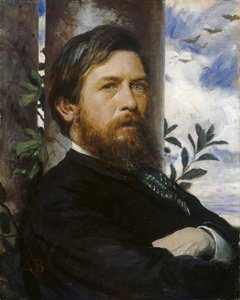
1827–1901, Schweiz
Arnold Böcklin
Öns öns skugga Basel, Schweiz, utgör startpunkten för ett liv definierat av spänningen mellan det påtagliga och det spektrala. Den unge mannen, född den 16 oktober 1827 av Christian Frederick Böcklin och Ursula Lippe, skulle slutligen röra sig bortom sin fars sidentrad och in i Düsseldorfakademins stränga salar. Under Schirmers vägledning började han absorbera landskapets språk, en färdighet som senare skulle användas för att kartlägga den mänskliga själens geografi. Han målade inte bara vackra vyer; han konstruerade riken där det klassiska och det makabra kolliderar.
Andra verk av Arnold Böcklin
 Dödens ö (Första versionen)1880
 Självporträtt med döden spelande fiol
 Kriget1896
 De dödas ö (Version 5)1886

Essäer om Spring Evening
 French artworks of the 1880sFrench Impressionist masterpieces by Claude Monet, Pierre-Auguste Renoir, and Georges Seurat. Find museum-quality reproductions on Original…
 Symphony of Sunlight: The Luminous Legacy of Pine Tree Landscapes in Art HistoryExplore the luminous history of pine landscapes through Sorolla and Shishkin. Discover the magic of forest art today.
 En Plein Air Serenity: Exploring the Luminous Beauty of Impressionist Garden ArtExplore the luminous history of Impressionist garden art through Monet and Van Gogh. Discover the magic of plein air painting today.