Art Nouveau
Muse (Alfons Mucha)
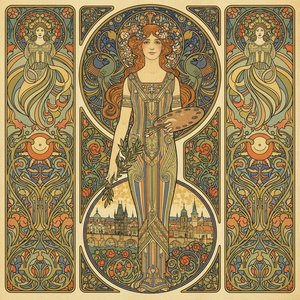
Alfons Mucha (1860–1939) skapade Muse. Det tillhör Art Nouveau-rörelsen. Den är utförd i Oil On Canvas.
- Oil On Canvas

 Förhandsvisa

 Handmålad oljemålning
 Skicka
 Dela
 Faktablad


 Ladda ner
 Liknande objekt
 Röntgen
 Bildspel
 Frågor och svar

 Statistik
Muse i korthet
- Titel
- Muse
- Konstnär
- Alfons Mucha (1860–1939)
- Konstnär född i
- Ivančice, Tjeckien
- Material
- Oil On Canvas
- Rörelse
- Art Nouveau
- Tidsperiod
- 19th Century
- Motiv
- portrait, muse, artnouveau, floral, melancholy, woman
Vad föreställer Muse?
A Whisper of Inspiration: Exploring Alphonse Mucha’s “Muse”
Alphonse Maria Mucha's "Muse" is more than just a portrait; it’s an immersion into the heart of Art Nouveau, a testament to the movement’s obsession with beauty, nature, and the idealized feminine form. Executed in Mucha’s signature style – characterized by sinuous lines, delicate ornamentation, and a profound sense of serenity – this artwork captures a moment of quiet contemplation, inviting the viewer to step into a world of graceful elegance and subtle emotion. The piece speaks volumes about Mucha's influence, his ability to translate decorative fantasy into enduring artistic statements.
Decoding the Visual Language: Composition & Technique
The composition immediately draws the eye towards the central figure, seated with an almost languid grace. Mucha employs a pyramidal structure, anchoring the viewer’s gaze to her head – framed by a breathtaking headdress overflowing with blossoms. This deliberate arrangement echoes classical portraiture while simultaneously embracing the Art Nouveau preference for organic forms. The artist's masterful technique is evident in the layering of colors and the seamless blending of tones, creating a luminous effect that seems to emanate from within. Notice the meticulous detail applied to her drapery and facial features – a hallmark of Mucha’s dedication to realism within his stylized aesthetic. The use of oil or pastel on canvas (or perhaps paper) allows for this incredible level of nuance, capturing both light and shadow with remarkable sensitivity.
A Symphony of Color & Symbolism
The color palette – a harmonious blend of creams, beiges, pale yellows, and muted oranges – evokes a sense of timelessness and tranquility. The strategic use of red-brown accents in the drapery adds depth and richness, while subtle blues and greens within the floral motifs subtly connect the figure to the natural world, a recurring theme in Mucha’s work. Beyond mere aesthetics, the headdress itself is laden with symbolism. Flowers have long represented beauty, fertility, and the influence of nature – concepts central to Art Nouveau's celebration of the organic. The woman’s direct gaze, imbued with a touch of melancholy, invites introspection and suggests a connection to the timeless themes explored by artists throughout history.
Contextualizing the Masterpiece: Mucha & the Art Nouveau Movement
Created during Mucha’s most prolific period (1887-1939), “Muse” exemplifies his pivotal role in shaping the Art Nouveau style. Born in Brno, Czech Republic, Mucha initially studied at the Academy of Fine Arts in Prague but quickly rejected its academic constraints, seeking a more expressive and decorative approach. He found success in Paris, creating iconic posters and illustrations for prominent clients like Sarah Bernhardt. His work reflects influences from artists such as Pierre-Auguste Renoir and Gustave Moreau, yet he forged his own distinct path – one defined by flowing lines, intricate patterns, and an unwavering commitment to portraying idealized female figures. “Muse” stands as a prime example of this legacy, solidifying Mucha’s place as one of the most significant artists of the Art Nouveau movement.
Högupplösta bilder av Muse
Allmän egendom: konstnären avled 1939.
Alfons Mucha, Muse. Allmän egendom
Färgerna är matchade mot originalet av en digital expert och filen är noggrant retuscherad för att vara trogen konstnärens penseldrag.
Köp högupplöst filFrågor om Muse besvarade
Vilken teknik har använts för "Muse"?
Alfons Mucha använde tekniken Oil On Canvas för "Muse". Tekniken definierar det ursprungliga verkets materiella karaktär.
Vad föreställer "Muse" av Alfons Mucha?
"Muse" av Alfons Mucha föreställer: portrait, muse, artnouveau, floral, melancholy, woman, decorative.
Är "Muse" av Alfons Mucha fri från upphovsrätt?
"Muse" av Alfons Mucha är allmän egendom – upphovsrätten har löpt ut. Denna status avgör hur bilden av verket får återges.
Vilken konstnär tillskrivs "Muse"?
Konstnären bakom "Muse" är Alfons Mucha. Verket är katalogiserat under Alfons Muchas namn.
Vilken konstnärlig inriktning tillhör "Muse" av Alfons Mucha?
"Muse" av Alfons Mucha tillhör Art Nouveau-rörelsen. Denna rörelse ger det stilistiska sammanhanget för verket.
Vilken period av Alfons Muchas karriär tillhör "Muse"?
Inom Alfons Muchas karriär tillhör "Muse" perioden Mature Period. Denna fas underlättar jämförelser med konstnärens övriga verk.
Varför är upphovsrättsläget för "Muse" som det är?
"Muse" av Alfons Mucha är allmän egendom – upphovsrätten har löpt ut. Upphovsrätten löper från konstnärens dödsår, vilket var 1939.
Hur passar "Muse" in i Alfons Muchas teman och stil?
Inom Alfons Muchas produktion är "Muse" skapad i Art Nouveau-stil, med de återkommande temana renoir, moreau influences, czech motifs, idealized beauty, feminine grace, symbolic nature, decorative art, mucha’s signature style established”.
Hur förhåller sig motivet i "Muse" till Alfons Muchas vanliga teman?
Bland Alfons Muchas dokumenterade teman – renoir, moreau influences, czech motifs, idealized beauty, feminine grace, symbolic nature, decorative art, mucha’s signature style established” – har "Muse" ett eget fokus på portrait, muse, artnouveau, floral, melancholy, woman, decorative.
Om konstnären, Alfons Mucha

1860–1939, Tjeckien
Alfons Mucha
Early Life and Artistic Beginnings Alphonse Maria Mucha, född den 15 juli 1860 i den lilla byn Ivančice i Mähren – en region som idag tillhör Tjeckien – var redan i ung ålder tydligt markerad av ett konstnärligt talent. Hans förmåga att sjunga lockade honom till en musikskola, men det var dock måleriet som verkligen fängslade hans hjärta och sinne. Han började tidigt experimentera med olika tekniker och stilar, och hans tidiga verk vittnar om en stark fascination för traditionella motiv och den lokala konsttraditionen i Mähren. Hans utbildning tog honom först till Brno, huvudstaden i Mähren, där han studerade vid den lokala gymnasiet.
Andra verk av Alfons Mucha
 The Moon
 Nude
 The Apotheosis of the Slavs1926
 Stained-Glass Window in St. Vitus Cathedral
Essäer om Muse
 Alphonse Mucha: A Comprehensive Exploration of Art Nouveau's Master of Decorative SymbolismExplore the life & art of Alphonse Mucha, master of Art Nouveau! Discover his iconic posters, stunning illustrations, and the monumental Sl…
 The Elegance of Art Nouveau: Embracing Nature's Fluid Beauty and the Belle Époque SpiritDiscover the enchanting world of Art Nouveau. Explore the organic beauty, flowing lines, and Belle Époque elegance that defined an era of u…
 The Language of Brushstrokes: How Texture and Technique Reveal the Soul of ArtDiscover the profound connection between texture and emotion in Impressionist art. Explore how masterful brushstrokes by Renoir and Monet c…