Porträtt av Franz von Stuck

De 100 mest kända målningarna av Franz von Stuck, ett galleriselektion

Uppdaterad november 2026 · rangordnad efter vår popularitetspoäng (sökningar, besök och beställningar för varje verk) · 259 verk av Franz von Stuck i vår katalog

Kortfattat

Av alla originalverk som Franz von Stuck lämnade efter sig är det mest kända Synden (1893), i samlingen hos Bavarian State Painting Collections, München. Tätt efter följer Lucifer (1890) och Wounded Amazon (1904). Vår katalog innehåller 259 verk av Franz von Stuck; galleriet har bevarat de 100 som världen beundrar mest, var och en presenterad med sitt datum, sitt museum och sin historia.

1863 – 1928, Tettenweis Symbolism Flest verk: Bavarian State Painting Collections

Franz von Stucks 10 främsta målningar: galleriets utvalda verk

1
Synden (1893) av Franz von Stuck

Synden

1893 · Olja på duk · Bavarian State Painting Collections, München

Synden är en målning från 1893 av den tyske konstnären Franz von Stuck. I detta verk presenterar konstnären gestalten Eva, avbildad naken och sammanflätad med en stor orm som slingrar sig runt hennes kropp. Detta specifika motiv växte fram ur en tidigare utforskning av ämnet, och utvecklades särskilt ur Stucks målning från 1889, Sensuality (Die Sinnlichkeit).

2
Lucifer (1890) av Franz von Stuck

Lucifer

1890 · Olja på duk · National Gallery of Bulgaria, Sofia

År 1890 skapade Franz von Stuck Lucifer som en oljemålning på duk, ett verk som utgör en hörnsten i hans "mörka monumentala" period. Gestalten framträder ur ett tomrum, en sittande man-demon fångad i ett ögonblick av tung, grublande stillhet. Han är en varelse av muskelmassa och skugga, vars form definieras av spänningen i en kropp som är både mänsklig och något betydligt mer uråldrigt. Hans blick är fixerad och genomtränger…

3
Wounded Amazon (1904) av Franz von Stuck

Wounded Amazon

1904 · Oil On Canvas

In the hauntingly evocative Wounded Amazon, created in 1904, Franz Ritter von Stuck invites us into a moment of profound vulnerability and raw conflict. The painting presents a nude female figure, an Amazon, captured in a state of intense distress. She is positioned kneeling upon the ground, her body bearing the mark of battle with a visible wound beneath her breast. As she shields herself from unseen threats, her arms…

4
Sin (1893) av Franz von Stuck

Sin

1893 · Oil On Canvas · Neue Pinakothek, München

Franz Ritter von Stuck: The Sin The dark, decadent art of Franz Ritter von Stuck is ushered into the light for its first American retrospective. Jo-Ann Birnie Danzker, curator at the Frye Art Museum, hopes that it will lead to a reevaluation of Stuck’s importance as an artist in his own right – his work seemed old-fashioned and irrelevant to a generation that had endured World War I. Stuck's reputation…

5
Lucifer av Franz von Stuck

Lucifer

Oil On Canvas

Franz von Stuck presents the fallen angel in Lucifer, an oil on canvas executed between 1890 and 1891. The figure is rendered as a seated, naked, and brooding presence within an undefined dark space. This depiction of a central figure from Christian mythology emphasizes an intense, muscular physicality. The subject's posture is heavy, conveying a sense of profound melancholy and internal struggle.

6
Wine (1889) av Franz von Stuck

Wine

1889 · Oil On Canvas · Kunsthaus Zürich, Zürich

To stand before Franz Ritter von Stuck’s Wine is to step directly into the charged, evocative atmosphere of late 19th-century German Symbolism. This piece from 1889 is far more than a mere depiction; it is an emotional tableau, a meditation on human connection, nature's embrace, and perhaps, the intoxicating mystery of desire itself. The composition immediately draws the eye to the central drama: a nude male figure clinging with desperate…

7
The Sin (1912) av Franz von Stuck

The Sin

1912 · Oil On Canvas · Alte Nationalgalerie, Berlin

, also known as Die Sünde, is an oil on canvas work by the German artist Franz von Stuck. Created in 1912, this piece represents one of several versions of this specific theme developed by the artist. The work is a significant example of the Symbolist movement, focusing on psychological depth and dramatic tension.

8
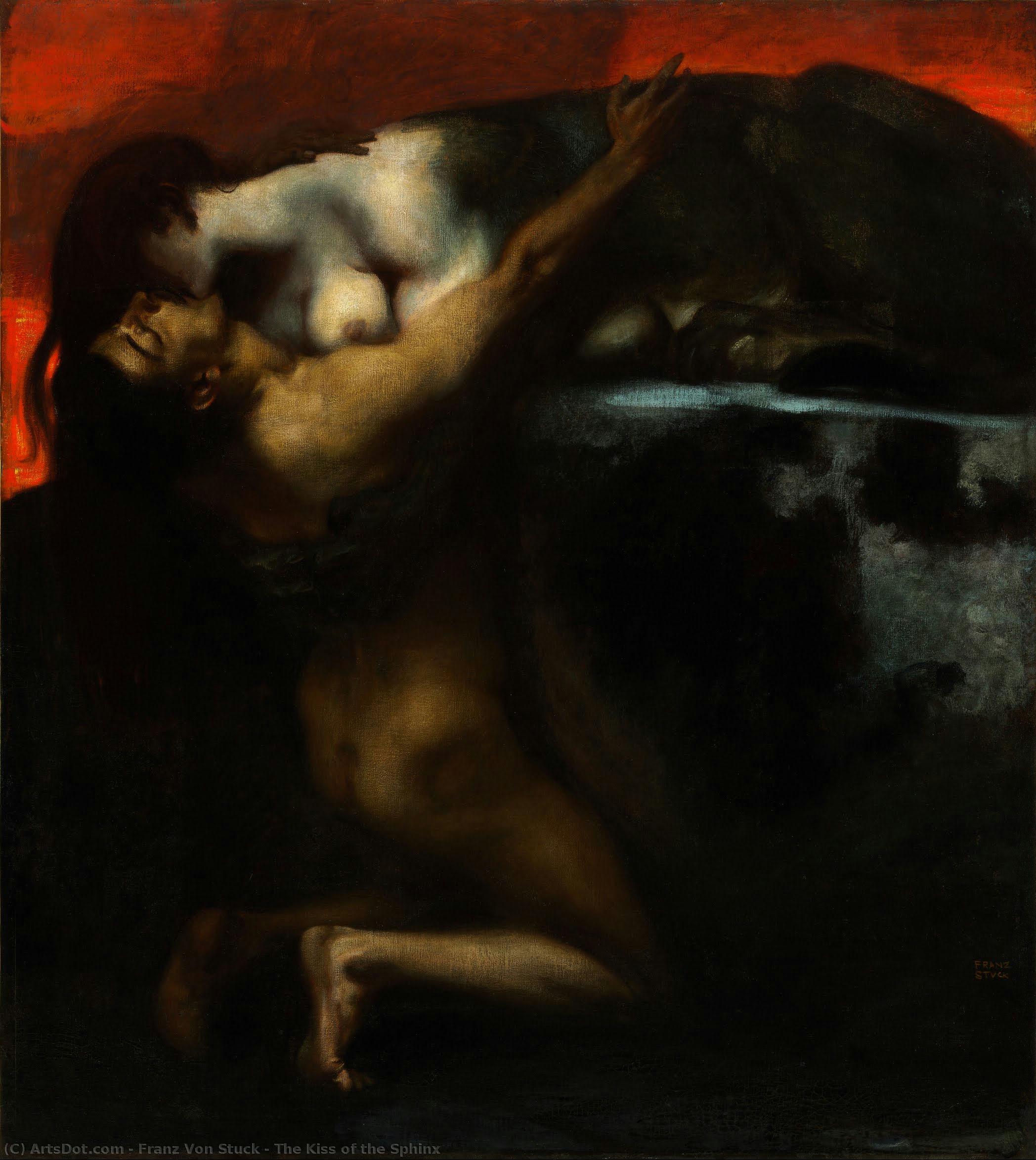
The Kiss of the Sphinx (1895) av Franz von Stuck

The Kiss of the Sphinx

1895 · Oil On Canvas · Szépművészeti Múzeum, Budapest

In the twilight of the nineteenth century, few images captured the psychological tremors of the era as profoundly as Franz Ritter von Stuck’s "The Kiss of the Sphinx." Completed in 1895, this masterpiece serves as a haunting cornerstone of German Symbolism, inviting the viewer into a realm where the boundaries between the physical and the metaphysical dissolve. The painting presents a dramatic tableau of a sensual encounter, set against the…

9
Sisyphus (1920) av Franz von Stuck

Sisyphus

1920 · Oil

In the 1920 painting titled Sisyphus, the artist Franz von Stuck depicts a man engaged in a repetitive physical struggle. The subject is shown in the process of pushing a large boulder up a steep incline. The man is positioned with the weight of the rock resting directly upon his back. He wears a simple loincloth, leaving his muscular form exposed as he labors against the terrain. One hand is…

10
Glow Worms (1898) av Franz von Stuck

Glow Worms

1898 · Oil On Canvas

In this work, titled Glow Worms, we encounter a piece from 1898 by the German artist Franz von Stuck. It is a quiet moment captured in oil on canvas, reflecting the specific sensibilities of the late nineteenth century. The artist, who was born in Tettenweis, Germany, brings a particular sense of atmosphere to this nocturnal scene, moving away from the rigid academicism of his era toward something more personal and…

Urvalet av Franz von Stuck fortsätter, 11 till 100

11Wild Chase (1889) av Franz von StuckWild Chase1889 · Lenbachhaus 12Inferno (1908) av Franz von StuckInferno1908 · Metropolitan Museum of Art 13Portrait of Frau Feez av Franz von StuckPortrait of Frau Feez 14The Guardian of Paradise (1889) av Franz von StuckThe Guardian of Paradise1889 · Museum Villa Stuck 15von Lucifer av Franz von Stuckvon Lucifer 16Gertrud Littmann (1911) av Franz von StuckGertrud Littmann1911 · Bavarian State Painting Collections 17Amazon and Centaur av Franz von StuckAmazon and Centaur 18Faun and Nymph (Teasing) (1892) av Franz von StuckFaun and Nymph (Teasing)1892 · National Gallery Prague 19Florentine Lady (1901) av Franz von StuckFlorentine Lady1901 20Professor Lujo Brentano (1914) av Franz von StuckProfessor Lujo Brentano1914 · Bavarian State Painting Collections 21The Murderer (1891) av Franz von StuckThe Murderer1891 22Sin (1893) av Franz von StuckSin1893 23Junge av Franz von StuckJunge 24Crucifixion (1913) av Franz von StuckCrucifixion1913 · Museum der bildenden Künste 25Salome (1906) av Franz von StuckSalome1906 · Lenbachhaus 26The Architect Max Littmann (1903) av Franz von StuckThe Architect Max Littmann1903 · Bavarian State Painting Collections 27Young Girl with Wreath (Bust, octagonal) (1862) av Franz von StuckYoung Girl with Wreath (Bust, octagonal)1862 28a Lady Monna Vanna (1879) av Franz von Stucka Lady Monna Vanna1879 · Stadtisches Museum 29Portrait of the Artist's Wife (1888) av Franz von StuckPortrait of the Artist's Wife1888 30Children Sledding (1888) av Franz von StuckChildren Sledding1888 31Double Portrait of Two Girls (1888) av Franz von StuckDouble Portrait of Two Girls1888 32Portrait of a Lady in Profile (1888) av Franz von StuckPortrait of a Lady in Profile1888 33Female Portrait (Back View and Profile) (1888) av Franz von StuckFemale Portrait (Back View and Profile)1888 34Female Portrait (1888) av Franz von StuckFemale Portrait1888 35Female Nude, Venus (1888) av Franz von StuckFemale Nude, Venus1888 36Self-Portrait in Profile (1888) av Franz von StuckSelf-Portrait in Profile1888 · Stadtisches Museum 37Sphinx (1892) av Franz von StuckSphinx1892 38Lost (1891) av Franz von StuckLost1891 39bathing nymph + looking Satyr (1888) av Franz von Stuckbathing nymph + looking Satyr1888 40portrait of Tilla Durieux as line (1888) av Franz von Stuckportrait of Tilla Durieux as line1888 41Susanna and the two eldermen (1888) av Franz von StuckSusanna and the two eldermen1888 42Helios (1888) av Franz von StuckHelios1888 43girl with wreath of violets (1888) av Franz von Stuckgirl with wreath of violets1888 44Portrait of a man (1888) av Franz von StuckPortrait of a man1888 45Female head (1888) av Franz von StuckFemale head1888 46A crying nix - woman (1888) av Franz von StuckA crying nix - woman1888 47Head of Medusa (1892) av Franz von StuckHead of Medusa1892 48Portrait of Beethoven av Franz von StuckPortrait of Beethoven 49Drunken Cantaur (1889) av Franz von StuckDrunken Cantaur1889 50Boy Bacchus Riding on a Panther av Franz von StuckBoy Bacchus Riding on a Panther 51Innocentia (1889) av Franz von StuckInnocentia1889 52Sensuality (1897) av Franz von StuckSensuality1897 53Franz and Mary Stock in the Studio (1902) av Franz von StuckFranz and Mary Stock in the Studio1902 54Portrait of a Girl (1899) av Franz von StuckPortrait of a Girl1899 55Portrait of the Artist's Daughter (1903) av Franz von StuckPortrait of the Artist's Daughter1903 56Portrait of His Wife (1903) av Franz von StuckPortrait of His Wife1903 57Portrait of a Woman (Wife of the Artist) (1903) av Franz von StuckPortrait of a Woman (Wife of the Artist)1903 58Runner (1903) av Franz von StuckRunner1903 59Portrait of a Woman (his wife) (Lady's Portrait) (1903) av Franz von StuckPortrait of a Woman (his wife) (Lady's Portrait)1903 60Portrait of a lady (1902) av Franz von StuckPortrait of a lady1902 61Head of a girl (1903) av Franz von StuckHead of a girl1903 62Portr. of a lady (1903) av Franz von StuckPortr. of a lady1903 63Half-length. ............ (1903) av Franz von StuckHalf-length. ............1903 64dancers (1903) av Franz von Stuckdancers1903 65Lady with head-dress (1903) av Franz von StuckLady with head-dress1903 66Wind + wave (1903) av Franz von StuckWind + wave1903 67The see - saw (1903) av Franz von StuckThe see - saw1903 68Rape of a maremaid (1902) av Franz von StuckRape of a maremaid1902 69head of a girl (1903) av Franz von Stuckhead of a girl1903 70Susanna in the bath (1904) av Franz von StuckSusanna in the bath1904 · Kunstmuseum 71Bacchanal (1905) av Franz von StuckBacchanal1905 72The Ride (1903) av Franz von StuckThe Ride1903 73The Kiss of the Sphinx (1905) av Franz von StuckThe Kiss of the Sphinx1905 74The Artist's Daughter with Cornflowers in Her Hair (1909) av Franz von StuckThe Artist's Daughter with Cornflowers in Her Hair1909 · Westfälisches Landesmuseum 75"The swing of love" (1909) av Franz von Stuck"The swing of love"1909 76Portrait of a girl (1907) av Franz von StuckPortrait of a girl1907 77Portrait of lady between Doric columns (1906) av Franz von StuckPortrait of lady between Doric columns1906 78Bathsheba (1912) av Franz von StuckBathsheba1912 · National Museum of Fine Arts 79Phryne (1917) av Franz von StuckPhryne1917 · Portland Art Museum 80Spanish duel "the deal" (1917) av Franz von StuckSpanish duel "the deal"1917 81Pygmalion (1926) av Franz von StuckPygmalion1926 82Wind and Waves (unfinished) (1928) av Franz von StuckWind and Waves (unfinished)1928 83The Struggle for Woman av Franz von StuckThe Struggle for Woman 84Pietà (1891) av Franz von StuckPietà1891 · Städel Museum 85Fighting Centaurs (1894) av Franz von StuckFighting Centaurs1894 · Städel Museum 86Fighting Fauns (1889) av Franz von StuckFighting Fauns1889 · Bayerische Staatsgemäldesammlungen 87Encounter (1921) av Franz von StuckEncounter1921 · Bavarian State Painting Collections 88The Spring (1902) av Franz von StuckThe Spring1902 · Szépművészeti Múzeum 89Mary with a red hat (1902) av Franz von StuckMary with a red hat1902 90War (1894) av Franz von StuckWar1894 · Bavarian State Painting Collections 91Ostrich Hunt (1919) av Franz von StuckOstrich Hunt1919 · Bavarian State Painting Collections 92The Diner av Franz von StuckThe DinerBavarian State Painting Collections 93Evening Star av Franz von StuckEvening Star 94Portrait of Marie Stuck av Franz von StuckPortrait of Marie Stuck 95The Wild Hunt (1899) av Franz von StuckThe Wild Hunt1899 · Musée d'Orsay 96Pallas Athene (1898) av Franz von StuckPallas Athene1898 97children on sledges (1888) av Franz von Stuckchildren on sledges1888 98Landscape with Waterfall (1896) av Franz von StuckLandscape with Waterfall1896 · Bavarian State Painting Collections 99Dancers (1896) av Franz von StuckDancers1896 100Fighting Amazon (1897) av Franz von StuckFighting Amazon1897 · Lenbachhaus

Motiven som fångade Franz von Stucks blick

De fyra motiv som återkommer oftast i dessa originalverk, var och ett med sitt främsta exempel.

Museerna som förvarar Franz von Stucks originalverk

De 8 museer som innehar flest av målningarna på denna sida.

Museum Stad Verk av Franz von Stuck Målningar från denna lista
Bavarian State Painting Collections, MünchenBavarian State Painting Collections München 9 Synden, Gertrud Littmann, Professor Lujo Brentano
Lenbachhaus, MünchenLenbachhaus München 4 Wild Chase, Salome, Fighting Amazon
Szépművészeti Múzeum, BudapestSzépművészeti Múzeum Budapest 2 The Kiss of the Sphinx, The Spring
Stadtisches Museum, GelsenkirchenStadtisches Museum Gelsenkirchen 2 a Lady Monna Vanna, Self-Portrait in Profile
Städel Museum, FrankfurtStädel Museum Frankfurt 2 Pietà, Fighting Centaurs
Alte Nationalgalerie, BerlinAlte Nationalgalerie Berlin 4 The Sin
Museum Villa Stuck, MünchenMuseum Villa Stuck München 3 The Guardian of Paradise
National Gallery of Bulgaria, SofiaNational Gallery of Bulgaria Sofia 1 Lucifer

Franz von Stuck decennium för decennium: originalen som definierar varje era

Verk per decennium

Välj ett decennium för att se originalverket som definierar det.

Samlarfrågor om Franz von Stucks målningar

Vilket verk är Franz von Stuck mest känd för?Visa svaret

Synden (1893), Bavarian State Painting Collections, München. Lucifer (1890) och Wounded Amazon (1904) följer efter.

Hur gammal var Franz von Stuck när Synden skapades?Visa svaret

30 år gammal: Synden är från 1893, och Franz von Stuck föddes 1863.

Vilka är de tio mest kända målningarna av Franz von Stuck?Visa svaret

Synden, Lucifer, Wounded Amazon, Sin, Lucifer, Wine, The Sin, The Kiss of the Sphinx, Sisyphus och Glow Worms. Rankingen ovan visar varje verks årtal och museum.

Hur många målningar lämnade Franz von Stuck efter sig?Visa svaret

Vår katalog innehåller 259 verk av Franz von Stuck, daterade från 1879 till 1928.

I vilka museer hänger Franz von Stucks mästerverk?Visa svaret

Främst i Bavarian State Painting Collections (München), Lenbachhaus (München) och Szépművészeti Múzeum (Budapest). Museitabellen ovan listar alla.

Under vilka år målade Franz von Stuck sina mest kända verk?Visa svaret

Under 1900s: 31 av de 100 verk som finns på denna sida skapades då, varav Wounded Amazon.

Vilka är de första och sista kända originalverken av Franz von Stuck?Visa svaret

På den här sidan är det tidigaste a Lady Monna Vanna (1879) och det senaste Wind and Waves (unfinished) (1928).

Vilka motiv valde Franz von Stuck oftast?Visa svaret

Man (11), Woman (11) och Mythology (8), fördelat på 100 verk på denna sida.

Vilken teknik använde Franz von Stuck mest?Visa svaret

Oil On Canvas, för 27 av de 100 verk som finns på denna sida.

Vilken konstinriktning tillhör Franz von Stuck?Visa svaret

Symbolism, om man dömer efter originalen på denna sida.

Vilka verk av Franz von Stuck finns utställda på Bavarian State Painting Collections?Visa svaret

Synden, Gertrud Littmann och Professor Lujo Brentano: Bavarian State Painting Collections, München har 9 av verken på denna sida.

Franz von Stuck: liv och verk

A Life Steeped in Myth and Symbol

Franz Ritter von Stuck, a name inextricably linked to the evocative power of German Symbolism, emerged from the verdant landscapes of Bavaria in 1863 – a young man destined for a life far removed from his family’s humble roots as millers. Initially, fate seemed to have charted a course for him as a forester, following in the footsteps of his father. However, an undeniable artistic inclination ignited within him, a burning passion that irrevocably altered his trajectory and propelled him towards Munich, the heart of Bavaria's burgeoning art scene. This early, fervent dedication led him first to the School of Applied Arts in 1878, followed by formal training at the prestigious Academy of Fine Arts from 1882-1884, where he became utterly captivated by Arnold Böcklin’s hauntingly beautiful mythological scenes – a formative influence that would profoundly shape his artistic vision and inform his unique approach to storytelling. Stuck wasn't merely an artist; he was a cultural phenomenon, a “Prince of Art” as he came to be known during his lifetime, skillfully bridging the gap between the established traditions of 19th-century academic art and the exciting, nascent currents of modernism.

The Rise of a Symbolist Master

Stuck’s ascent to prominence was remarkably swift and dramatic. His breakthrough arrived in 1889 with *The Guardian of Paradise*, an arresting painting exhibited at the Munich Glass Palace. The artwork immediately captivated critics and audiences alike, earning him a gold medal and establishing him as a major force within the German art world. It wasn’t simply a display of technical prowess; *The Guardian of Paradise* announced a new artistic voice – one that masterfully blended the precision and formality of classical tradition with mythological subject matter and an underlying current of Symbolist mystery, creating a visual language both familiar and profoundly unsettling. He quickly became a central figure in challenging the conservative norms of the time, co-founding the Munich Secession in 1892 alongside like-minded artists who were determined to break free from the constraints of academic art and champion innovative artistic expression. This act of artistic rebellion coincided with his exploration into sculpture, culminating in *Athlete* (1892), a striking bronze figure that demonstrated his remarkable versatility as an artist – showcasing not only technical skill but also a keen understanding of form and movement. However, it was *The Sin* (1893) that truly cemented his reputation as a master of Symbolist painting, captivating audiences with its dramatic intensity, psychological depth, and the palpable sense of moral ambiguity at its core. This period marked the full flowering of Stuck’s unique style – a potent combination of sensuality, classical form, and symbolic resonance, setting him apart from his contemporaries.

Themes and Influences: A World of Desire and Myth

The artistic universe of Franz von Stuck is richly layered with recurring motifs that reveal his profound engagement with timeless themes. Mythology served as a constant source of inspiration, drawing upon the narratives of ancient Greece, Rome, and the Bible – stories he reimagined through a distinctly personal lens, imbuing them with his own unique sensibilities and emotional intensity. These weren’t mere retellings; they were explorations of the human condition filtered through the prism of these enduring myths. Equally prominent was his fascination with sensuality and the *femme fatale*, powerfully embodied in his numerous depictions of Salome – a figure representing desire, danger, and moral ambiguity. These paintings weren't simply about physical beauty; they delved into the psychological complexities of female power and its potential for both allure and destruction. Underlying all this was a deep reverence for classical art, evident in his meticulous technique, anatomical accuracy, and compositional rigor. Beyond Arnold Böcklin, Stuck acknowledged influences from the Pre-Raphaelites and Gustave Moreau, but he wasn’t merely an imitator; he synthesized these diverse influences into something uniquely his own, profoundly impacting subsequent generations of artists. His work often felt like a dreamscape, blending reality with fantasy, inviting viewers to contemplate the hidden depths of the human psyche.

Major Works and Enduring Significance

Throughout his career, Franz von Stuck produced a vast and varied body of work that continues to fascinate and inspire. Some of his most celebrated pieces include:
  • The Spring (1886): A vibrant depiction showcasing his early mastery of color and composition, capturing the exuberance of nature with bold brushstrokes and luminous hues.
  • Dissonance (1893): An unsettling portrayal embodying emotional turmoil through a woman playing the violin – a poignant exploration of inner conflict and artistic expression.
  • Salome (various versions): Perhaps his most iconic work, depicting the biblical story with striking sensuality and psychological depth, exploring themes of desire, betrayal, and the consequences of unchecked ambition.
  • Athlete (1892): A powerful bronze sculpture demonstrating his skill in three-dimensional form – a dynamic representation of human strength and athleticism.
  • Lucifer (1890): A dramatic depiction of the fallen angel, embodying both power and despair, showcasing Stuck’s ability to convey intense emotion through visual imagery.
Franz von Stuck's contributions to art history are undeniable. He played a pivotal role in shaping the Symbolist movement in Germany, bridging the gap between academic tradition and modern artistic experimentation. His work continues to captivate audiences with its dramatic intensity, mythological richness, and psychological depth. He remains a vital figure for understanding the transition from 19th-century historicism to the innovative spirit of the 20th century, an artist whose influence can still be felt in contemporary art today.

Legacy and Influence

Beyond his artistic achievements, Franz von Stuck left a lasting legacy as a teacher and a cultural icon. In 1895, he took on another crucial role – that of instructor at the Munich Academy, where he mentored a generation of young artists, fostering their individual talents and encouraging them to explore new creative horizons. Among those who benefited from his guidance were luminaries such as Paul Klee, Hans Purrmann, and Josef Albers, demonstrating the breadth of his influence. His dedication to art was further recognized in 1905 when he was ennobled, becoming “Ritter von Stuck” – a testament to his growing prestige and contribution to German culture. He continued to receive accolades throughout Europe during the remainder of his life, solidifying his position as one of the leading artists of his time. His Villa Stuck in Munich, now a museum, stands as a lasting monument to his life and work, offering invaluable insights into his artistic vision and the cultural milieu of late 19th and early 20th-century Germany.