Porträtt av Denys van Alsloot

De 28 mest kända målningarna av Denys van Alsloot, ett galleriselektion

Uppdaterad november 2026 · rangordnad efter vår popularitetspoäng (sökningar, besök och beställningar för varje verk) · 29 verk av Denys van Alsloot i vår katalog

Kortfattat

Av alla originalverk som Denys van Alsloot lämnade efter sig är det mest kända Landscape with Castle and Hunting Scene (1608), i samlingen hos Bonnefanten Museum, Maastricht. Tätt efter följer Forest Landscape with the Rest on the Return from Egypt (1608) och Diana discovers the pregnancy of Callisto (1610). Vår katalog innehåller 29 verk av Denys van Alsloot; galleriet har bevarat de 28 som världen beundrar mest, var och en presenterad med sitt datum, sitt museum och sin historia.

1570 – 1626, Mechelen Flest verk: Museo del Prado

Denys van Alsloots 10 främsta målningar: galleriets utvalda verk

1
Landscape with Castle and Hunting Scene (1608) av Denys van Alsloot

Landscape with Castle and Hunting Scene

1608 · Oil On Panel · Bonnefanten Museum, Maastricht

Sunlight breaks through a heavy canopy of leaves, spilling into a central valley where the air feels thick with the scent of damp earth and pine. In this lush, panoramic landscape, the eye is immediately drawn through a dark frame of towering trees, a technique that pulls the viewer deep into the heart of the Flemish wilderness. The scene is alive with a quiet, rhythmic movement; a fox hunt is…

3
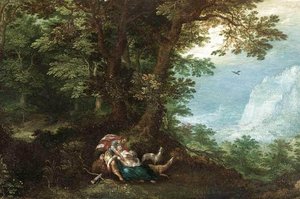
Diana discovers the pregnancy of Callisto (1610) av Denys van Alsloot

Diana discovers the pregnancy of Callisto

1610 · Oil On Canvas · Staatliche Kunsthalle Karlsruhe, Karlsruhe

In the lush, shadowed depths of a dense forest, a moment of profound revelation unfolds within Diana discovers the pregnancy of Callisto. Painted by Denis van Alsloot between 1614 and 1620, the scene captures the sudden, silent tension of a divine secret being brought to light. The goddess Diana, the huntress, finds herself amidst a gathering of nymphs, her presence marking a shift from the tranquil rhythms of the woods…

4
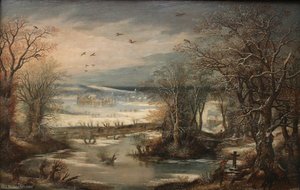
Winter Landscape (1610) av Denys van Alsloot

Winter Landscape

1610 · Acrylic On Canvas · Louvre, Paris

A Winter’s Embrace: Denijs van Alsloot's Tranquil Landscape Denijs van Alsloot stands as a pivotal figure in the burgeoning artistic landscape of the early 17th century, embodying the delicate transition from Mannerist formalism to the radiant optimism of the Dutch Baroque. Born around 1570 – though precise biographical details remain elusive – his formative years were inextricably linked to the craft of tapestry weaving, a profession that instilled within him…

5
Winter landscape with masked ice skaters (1599) av Denys van Alsloot

Winter landscape with masked ice skaters

1599 · Oil On Panel · Bavarian State Painting Collections, München

In "Winter landscape with masked ice skaters" by Denis van Alsloot, a wide and panoramic view unfolds across a frozen expanse. The eye travels through a deep perspective, moving from the immediate activity on the ice toward a distant, fortified structure. On the left, the intricate silhouettes of leafless trees reach upward, framing the scene and grounding the composition. Far in the distance, the architectural contours of the ramparts rise…

6
A wooded landscape with an amorous couple seated by a tree and elegant company strolling on a path near a river (1605) av Denys van Alsloot

A wooded landscape with an amorous couple seated by a tree and elegant company strolling on a path near a river

1605 · Oil

The composition is structured around a verticality established by large, mature trees that frame a lush, wooded area. A winding path leads the eye through the landscape, passing near a river that flows through the scene. In the foreground, an amorous couple is seated by the base of a tree, while further along the path, a group of elegantly dressed figures strolls through the greenery. Small figures are scattered throughout…

8
Chateau de Mariemont (1620) av Denys van Alsloot

Chateau de Mariemont

1620 · Oil On Canvas · Kungliga museerna för sköna konster i Belgien, Bryssel

The eye meets the expansive grounds of the Chateau de Mariemont, a grand estate captured by the hand of Denis van Alsloot. This view presents the sprawling landscape of a royal residence that once served the governors of the Habsburg Netherlands. The scene unfolds across the village of Morlanwelz in Belgium, where the architecture and the surrounding greenery meet under a clear, daylight sky. It is a moment frozen in…

9
The Ommegang in Brussels: Part 1: Procession of Guilds (1616) av Denys van Alsloot

The Ommegang in Brussels: Part 1: Procession of Guilds

1616 · Oil · Museo del Prado, Madrid

The streets of Brussels swell with a rhythmic, organized energy as the procession moves through the city. Under an even, diffused light that suggests a quiet, overcast day, a vast multitude of figures marches in disciplined rows, creating long horizontal bands that stretch across the wide composition. There is a profound sense of order here, a visual manifestation of civic pride and social hierarchy. The marchers, dressed in deep blacks…

10
Winter landscape (1610) av Denys van Alsloot

Winter landscape

1610 · Oil · Bavarian State Painting Collections, München

The scene unfolds within Winter landscape, a work that captures a quiet, frozen moment in time. This landscape painting, created by the Flemish artist Denis van Alsloot, presents a world hushed by frost and shadow. The air feels heavy with the stillness of a season held in suspension, inviting a sense of wonder at the quietude of the natural world.

Urvalet av Denys van Alsloot fortsätter, 11 till 28

Motiven som fångade Denys van Alsloots blick

De fyra motiv som återkommer oftast i dessa originalverk, var och ett med sitt främsta exempel.

Museerna som förvarar Denys van Alsloots originalverk

De 8 museer som innehar flest av målningarna på denna sida.

Museum Stad Verk av Denys van Alsloot Målningar från denna lista
Museo del Prado, MadridMuseo del Prado Madrid 3 The Ommegang in Brussels: Part 1: Procession of Guilds, The Festival of the Ommegang in Brussels: the procession of Our Lady of Sablon, Skating during Carnival
Bonnefanten Museum, MaastrichtBonnefanten Museum Maastricht 2 Landscape with Castle and Hunting Scene, Winter masquerade with skaters
Bavarian State Painting Collections, MünchenBavarian State Painting Collections München 2 Winter landscape with masked ice skaters, Winter landscape
Israel Museum, JerusalemIsrael Museum Jerusalem 1 Forest Landscape with the Rest on the Return from Egypt
Staatliche Kunsthalle Karlsruhe, KarlsruheStaatliche Kunsthalle Karlsruhe Karlsruhe 1 Diana discovers the pregnancy of Callisto
Louvre, ParisLouvre Paris 1 Winter Landscape
Kungliga museerna för sköna konster i Belgien, BrysselKungliga museerna för sköna konster i Belgien Bryssel 1 Chateau de Mariemont
Koninklijk Museum voor Schone Kunsten Antwerpen, AntwerpenKoninklijk Museum voor Schone Kunsten Antwerpen Antwerpen 1 Garden Festival at Diesdelle

Denys van Alsloot decennium för decennium: originalen som definierar varje era

Verk per decennium

Välj ett decennium för att se originalverket som definierar det.

Samlarfrågor om Denys van Alsloots målningar

Vilket verk är Denys van Alsloot mest känd för?Visa svaret

Landscape with Castle and Hunting Scene (1608), Bonnefanten Museum, Maastricht. Forest Landscape with the Rest on the Return from Egypt (1608) och Diana discovers the pregnancy of Callisto (1610) följer efter.

Hur gammal var Denys van Alsloot när Landscape with Castle and Hunting Scene skapades?Visa svaret

38 år gammal: Landscape with Castle and Hunting Scene är från 1608, och Denys van Alsloot föddes 1570.

Vilka är de tio mest kända målningarna av Denys van Alsloot?Visa svaret

Landscape with Castle and Hunting Scene, Forest Landscape with the Rest on the Return from Egypt, Diana discovers the pregnancy of Callisto, Winter Landscape, Winter landscape with masked ice skaters, A wooded landscape with an amorous couple seated by a tree and elegant company strolling on a path near a river, A winter carnival with figures on the ice before the Kipdorppoort Bastion in Antwerp, Chateau de Mariemont, The Ommegang in Brussels: Part 1: Procession of Guilds och Winter landscape. Rankingen ovan visar varje verks årtal och museum.

Hur många målningar lämnade Denys van Alsloot efter sig?Visa svaret

Vår katalog innehåller 29 verk av Denys van Alsloot, daterade från 1599 till 1624.

I vilka museer hänger Denys van Alsloots mästerverk?Visa svaret

Främst i Museo del Prado (Madrid), Bonnefanten Museum (Maastricht) och Bavarian State Painting Collections (München). Museitabellen ovan listar alla.

Under vilka år målade Denys van Alsloot sina mest kända verk?Visa svaret

Under 1610s: 7 av de 28 verk som finns på denna sida skapades då, varav Diana discovers the pregnancy of Callisto.

Vilka är de första och sista kända originalverken av Denys van Alsloot?Visa svaret

På den här sidan är det tidigaste Winter landscape with masked ice skaters (1599) och det senaste winter landscape (1624).

Vilka motiv valde Denys van Alsloot oftast?Visa svaret

Trees (10), Forest (7) och People (7), fördelat på 28 verk på denna sida.

Vilken teknik använde Denys van Alsloot mest?Visa svaret

Oil On Panel, för 6 av de 28 verk som finns på denna sida.

Vilka verk av Denys van Alsloot finns utställda på Museo del Prado?Visa svaret

The Ommegang in Brussels: Part 1: Procession of Guilds, The Festival of the Ommegang in Brussels: the procession of Our Lady of Sablon och Skating during Carnival: Museo del Prado, Madrid har 3 av verken på denna sida.

Denys van Alsloot: liv och verk

A Life Woven in Landscape: The World of Denijs van Alsloot

Denijs van Alsloot, a name resonating softly through the annals of Flemish art, occupies a fascinating transitional space between the established traditions of the 16th century and the burgeoning Baroque dynamism of the 17th. Born around 1570 in either Mechelen or Brussels, Belgium, his origins were steeped in the craft of tapestry – his father’s profession providing an early immersion into design and visual composition. Though details surrounding his formal artistic training remain elusive, it's clear that this familial connection to textile arts laid a foundational aesthetic sensibility for the young Alsloot. He entered the Brussels Guild of St Luke in 1599 as a tapestry designer, initially focusing on this craft before gradually shifting towards painting, taking on his first pupil the same year and continuing to mentor apprentices until 1625. This period suggests a deliberate evolution, a honing of skills that would eventually blossom into a distinctive landscape style.

Courtly Commissions and Artistic Flourishing

A pivotal moment arrived around 1606 with Alsloot’s appointment as court painter to Albert and Isabella, the Archdukes who governed the Spanish Netherlands. This prestigious position not only provided financial stability but also thrust him into a world of influential patrons and significant commissions. The court became his canvas, demanding depictions of both grandeur and everyday life. He excelled at capturing scenes of civil processions, local festivals, and ceremonial events – vibrant snapshots of 17th-century Brussels society. Perhaps the most notable commission came from Archduchess Isabella herself: a request to paint eight panels commemorating the Ommegang procession of 1615, for which he was handsomely rewarded with 10,000 guilders. These works weren’t merely decorative; they were historical documents, preserving the spectacle and social fabric of the time. Alsloot's meticulous attention to detail—the costumes, the architecture, the expressions on the faces of participants—transformed these panels into powerful representations of Habsburg rule and civic pride. His landscapes often blended topographical accuracy with imaginative flourishes, creating a unique aesthetic that resonated with his aristocratic clientele. He became particularly renowned for his realistic winter landscapes, frequently featuring the abbey of Groenendael in varying seasonal conditions – scenes commissioned by Archduke Albert himself, demonstrating the court’s appreciation for his skill and vision.

The Sonian Forest School and Collaborative Spirit

Van Alsloot is often associated with the Sonian Forest school of landscape painters, a group who found inspiration in the sprawling woodlands surrounding Brussels. This association isn't merely geographical; it reflects a shared aesthetic preference for depicting scenes from this particular environment – its dense forests, tranquil abbeys, and atmospheric perspectives. His series of views of abbeys within the Sonian Forest exemplifies this connection, showcasing his ability to capture both the natural beauty and spiritual significance of these locations. He skillfully blended elements from earlier landscape traditions with emerging Baroque techniques—particularly a softer palette and greater emphasis on light and shadow—establishing himself as a pioneer in this influential movement. However, Alsloot rarely worked in complete isolation. A fruitful collaboration with Hendrick de Clerck, a painter specializing in *staffage* – the figures populating landscapes – became a hallmark of his style. De Clerck’s vividly colored figures brought life and narrative to Alsloot's meticulously rendered backgrounds, creating dynamic compositions that captivated viewers. This partnership demonstrates a willingness to embrace collaborative artistry, enhancing the overall impact of their combined talents.

Influences and a Developing Vision

Tracing Alsloot’s artistic lineage reveals a fascinating synthesis of influences. Early works demonstrate an affinity with 16th-century landscape painting, suggesting he studied the masters who came before him. The style of Gillis van Coninxloo is particularly evident, yet Alsloot's work generally possesses a calmer, more static quality, employing a softer palette and exhibiting greater precision in detail. He also absorbed elements from Jan Brueghel the Elder, skillfully blending these influences into his own distinctive approach. His artistic journey wasn’t simply imitation; it was an evolution. Starting with tapestry design, he gradually expanded his creative scope, embracing independent landscape painting and refining his technique over time. This progression demonstrates a commitment to growth and innovation, solidifying his position as a significant figure in the development of Flemish art.

Legacy: A Window into 17th-Century Brussels

Though he passed away around 1626, likely before 1628, Denijs van Alsloot’s artistic legacy endures. His paintings are now held in esteemed museums worldwide, including the Museo Nacional del Prado in Madrid and the Victoria and Albert Museum in London, ensuring his work continues to inspire and captivate audiences centuries later. He is remembered not only for his technical skill – his topographical accuracy, atmospheric perspective, and meticulous detail – but also for his ability to document 17th-century life in Brussels. His depictions of festivals, processions, and landscapes offer invaluable insights into the social customs, architectural features, and natural beauty of the era. As a key representative of the Sonian Forest school and a transitional figure bridging earlier landscape traditions with the emerging Baroque style, Van Alsloot remains a significant subject for scholars studying Flemish landscape painting and the rich artistic culture of the Spanish Netherlands – a testament to his enduring contribution to the world of art.