Porträtt av Ando Hiroshige

Ando Hiroshiges målningar: De 100 mest kända, ur ett galleris perspektiv

Uppdaterad oktober 2026 · rangordnad efter vår popularitetspoäng (sökningar, besök och beställningar för varje verk) · 353 verk av Ando Hiroshige i vår katalog

Kortfattat

Ur galleriets perspektiv är Ando Hiroshiges mest kända målning Early Department from a Daimyo, vars original hänger på Nakagawa-machi Bato Hiroshige Museum of Art i Nagasaki. The maple leaves of Mama, Tekona shrine and Tsugi bridge (1857) och Hakone (1834) fullbordar trion som alla känner igen. Av de 353 verk av Ando Hiroshige i vår katalog presenterar galleriet nedan de 100 mest kända, var och en som ett original med sitt år, sitt museum och vad som gör det unikt.

1797 – 1858, Edo Japanese landscape painting Flest verk: Nakagawa-machi Bato Hiroshige Museum of Art

Galleriets 10 främsta målningar av Ando Hiroshige

1
Early Department from a Daimyo av Ando Hiroshige

Early Department from a Daimyo

Woodblock Print · Nakagawa-machi Bato Hiroshige Museum of Art, Nagasaki

In the delicate dance of lines and muted pigments, Utagawa Hiroshige’s Early Department from a Daimyo invites us to step through a portal into the heart of Edo-period Japan. This exquisite woodblock print captures a moment of vibrant communal life along a bustling riverside, where the rigid structures of social hierarchy melt into the shared leisure of a sunny afternoon. As we gaze upon the scene, we are not merely…

2
The maple leaves of Mama, Tekona shrine and Tsugi bridge (1857) av Ando Hiroshige

The maple leaves of Mama, Tekona shrine and Tsugi bridge

1857 · Woodblock Print · Van Gogh-museet, Amsterdam

Utagawa Hiroshige (1797-1858), arguably the last titan of *ukiyo-e*, didn't merely depict landscapes; he crafted them into meditations on beauty and impermanence. “The Maple Leaves of Mama, Tekona Shrine and Tsugi Bridge,” created in 1857 during a period of significant societal transformation—the waning influence of feudal Japan as Western ideas crept in—stands as a testament to his enduring artistic legacy. More than just a visual record, it’s an embodiment of…

3
Hakone (1834) av Ando Hiroshige

Hakone

1834 · Woodblock Print · Indianapolis konstmuseum, Indianapolis

Utagawa Hiroshige’s “Hakone,” created in 1834, is more than just a landscape; it's a poetic meditation on the beauty and transience of nature within Edo-period Japan. This woodblock print, part of his renowned series "The Fifty-three Stations of the Tōkaidō," captures a specific moment along the vital trade route connecting Tokyo (then Edo) with Kyoto. However, Hiroshige elevates this seemingly simple depiction of a mountain pass into something profoundly evocative,…

4
Station 36, Goyu; Kyoka Tokaido Series (1855) av Ando Hiroshige

Station 36, Goyu; Kyoka Tokaido Series

1855 · Woodblock Print · Indianapolis konstmuseum, Indianapolis

In the delicate interplay of ink and paper, Utagawa Hiroshige’s "Station 36, Goyu; Kyoka Tokaido Series" offers much more than a mere topographical record of a journey. Completed in 1855, this exquisite woodblock print serves as a profound distillation of Edo-period sensibilities, capturing a yearning for tranquility amidst the burgeoning dynamism of a Japan in transition. As the nation stood at a pivotal crossroads between ancient feudal traditions and the…

5
Fushimi Station #51 (1842) av Ando Hiroshige

Fushimi Station #51

1842 · Akryl på duk · Indianapolis konstmuseum, Indianapolis

Fushimi Station #51 – En Poetisk Ögonblicksbild av Edo Japans Första Hälft Utagawa Hiroshige är en namn som väcker upp känslan av japansk konsthistoria och särskilt inom *ukiyo-e*, eller ”bilder från den flytande världen”. Detta mästerverk från 1842 är inte bara ett fantastiskt landskap utan också ett perfekt exempel på Hiroshiges förmåga att fånga essensen av sin tid – en period präglad av både stabilitet och förändring, vilket manifesteras i…

6
Ichikoku Bridge in the Eastern Capital (Tōto: Ichikoku bashi) (1858) av Ando Hiroshige

Ichikoku Bridge in the Eastern Capital (Tōto: Ichikoku bashi)

1858 · Woodblock Print · Indianapolis konstmuseum, Indianapolis

The Ichikoku Bridge spans a quiet stretch of water in the Eastern Capital. Beneath its wooden arch, two boats drift through the current. People move across the structure, some carrying backpacks and others clutching small handbags. A mountain rises in the distance, watching over the scene. Trees frame the edges of the view, their leaves casting shadows near the water's edge.

7
Shinagawa Sunrise from the series Fifty-three Stations on the Tokaido Road (1834) av Ando Hiroshige

Shinagawa Sunrise from the series Fifty-three Stations on the Tokaido Road

1834 · Woodblock Print · Hill-Stead Museum, Farmington

In the soft, burgeoning light of a nineteenth-century morning, Utagawa Hiroshige invites us to witness a moment of profound stillness along the Tōkaidō road. Shinagawa Sunrise is not merely a depiction of a coastal village; it is a masterclass in the art of atmosphere. As the sun begins its ascent, the boundary between the heavens and the earth dissolves into a luminous haze. The water of the bay reflects a…

8
The Rokugo River Ferry, Kawasaki, from the series the Fifty-three Stations of the Tokaido (Hoeido edition ) av Ando Hiroshige

The Rokugo River Ferry, Kawasaki, from the series the Fifty-three Stations of the Tokaido (Hoeido edition )

Woodblock Print · Nakagawa-machi Bato Hiroshige Museum of Art, Nagasaki

In the delicate dance of woodblock printing, few masters captured the ephemeral beauty of Japanese life as profoundly as Utagawa Hiroshige. His masterpiece, The Rokugo River Ferry, Kawasaki, serves as a breathtaking window into the Edo period, inviting the viewer to step onto the bustling banks of one of the most vital crossings on the Tokaido road. This evocative scene from his legendary series, The Fifty-three Stations of the Tokaido,…

9
Itsukushima in Aki Province (1858) av Ando Hiroshige

Itsukushima in Aki Province

1858 · Woodblock Print · Brooklyn Museum, Brooklyn

In the delicate interplay of mist and water, Itsukushima in Aki Province offers more than a mere glimpse of a Japanese landmark; it provides a profound meditation on the ephemeral nature of existence. Created by the legendary ukiyo-e master Ando Hiroshige in 1858, this woodcut print captures the spiritual essence of the Itsukushima shrine area with a poetic sensitivity that remains unparalleled. As one gazes upon the composition, the eye…

10
Tenryu River Ferry Crossing, Mitsuke, from the series The Fifty-three Stations of the Tokaido (Gyosho Edition) av Ando Hiroshige

Tenryu River Ferry Crossing, Mitsuke, from the series The Fifty-three Stations of the Tokaido (Gyosho Edition)

Woodblock Print · Nakagawa-machi Bato Hiroshige Museum of Art, Nagasaki

The woodblock print depicts a section of the Tenryu River near the station of Mitsuke. In the center of the composition, a large sandbank divides the water into two distinct currents. Several small wooden boats occupy the river, with figures positioned within them to manage the crossing. Some vessels are moored directly against the central sandbank, while others navigate the moving water. The far shore is visible in the distance,…

Ando Hiroshiges målningar, rankade 11 till 100

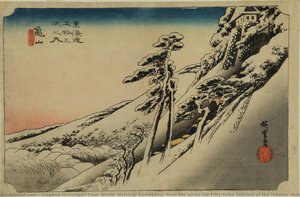
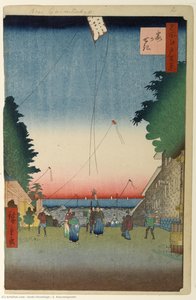
11Påpel och vinrankor (1800) av Ando HiroshigePåpel och vinrankor1800 · Indianapolis konstmuseum 12The Pine Woods of Miho in Suruga Province (Suruga Miho no matsubara) (1858) av Ando HiroshigeThe Pine Woods of Miho in Suruga Province (Suruga Miho no matsubara)1858 · Indianapolis konstmuseum 1362 (55) Komakata Hall and Azuma Bridge (1857) av Ando Hiroshige62 (55) Komakata Hall and Azuma Bridge1857 · Brooklyn Museum 14Evening Snow at Kanbara (1834) av Ando HiroshigeEvening Snow at Kanbara1834 · Los Angeles County Museum of Art 15Dawn in the licensed quarters (1857) av Ando HiroshigeDawn in the licensed quarters1857 · Art Gallery of New South Wales 16Night View of Saruwakacho av Ando HiroshigeNight View of Saruwakacho 17Station 28, Fukuroi (1855) av Ando HiroshigeStation 28, Fukuroi1855 · Indianapolis konstmuseum 18Evening Snow at Asakusa or Woman with Umbrella from the series Eight Views of the Environs of Edo (1800) av Ando HiroshigeEvening Snow at Asakusa or Woman with Umbrella from the series Eight Views of the Environs of Edo1800 · Hill-Stead Museum 19Keishi (Kyoto), Capital (1834) av Ando HiroshigeKeishi (Kyoto), Capital1834 · Indianapolis konstmuseum 20Hara: View of Ashitakayama and Fuji (1855) av Ando HiroshigeHara: View of Ashitakayama and Fuji1855 · Indianapolis konstmuseum 21Yokkaichi (Station #44) (1834) av Ando HiroshigeYokkaichi (Station #44)1834 · Indianapolis konstmuseum 22Desolate Wintry Scene, Hamamatsu, from the series the Fifty-three Stations of the Tokaido (Hoeido edition) av Ando HiroshigeDesolate Wintry Scene, Hamamatsu, from the series the Fifty-three Stations of the Tokaido (Hoeido edition)Nakagawa-machi Bato Hiroshige Museum of Art 23Noge and Yokohama in Musashi Province (Musashi, Noge, Yokohama) (1858) av Ando HiroshigeNoge and Yokohama in Musashi Province (Musashi, Noge, Yokohama)1858 · Indianapolis konstmuseum 24Wild sea breaking on the rocks (1856) av Ando HiroshigeWild sea breaking on the rocks1856 25Shirasuga, Shiomi-zaka zu (Vy av Shioma Slutt) (1833) av Ando HiroshigeShirasuga, Shiomi-zaka zu (Vy av Shioma Slutt)1833 · Indianapolis konstmuseum 26Mt.Fuji on the Left, Yoshiwara, from the series the Fifty-three Stations of the Tokaido (Hoeido edition) av Ando HiroshigeMt.Fuji on the Left, Yoshiwara, from the series the Fifty-three Stations of the Tokaido (Hoeido edition)Nakagawa-machi Bato Hiroshige Museum of Art 27Tsukuda Offing in the Eastern Capital (Tōto: Tsukuda oki) (1858) av Ando HiroshigeTsukuda Offing in the Eastern Capital (Tōto: Tsukuda oki)1858 · Indianapolis konstmuseum 28Kawachi (1853) av Ando HiroshigeKawachi1853 · Indianapolis konstmuseum 29The Dye Craft Shops of Arimatsu, Narumi, from the series The Fifty-three Stations of the Tokaido (Gyosho edition) av Ando HiroshigeThe Dye Craft Shops of Arimatsu, Narumi, from the series The Fifty-three Stations of the Tokaido (Gyosho edition)Nakagawa-machi Bato Hiroshige Museum of Art 30View of Shiomi Slope, Shirasuka, from the series The Fifty-three Stations of the Tokaido (Gyosho edition) av Ando HiroshigeView of Shiomi Slope, Shirasuka, from the series The Fifty-three Stations of the Tokaido (Gyosho edition)Nakagawa-machi Bato Hiroshige Museum of Art 31Entrance to Enoshima in Sagami Province (Sagami Enoshima iriguchi) (1858) av Ando HiroshigeEntrance to Enoshima in Sagami Province (Sagami Enoshima iriguchi)1858 · Indianapolis konstmuseum 32Morning Mist, Mishima, from the series the Fifty-three Stations of the Tokaido (Hoeido edition ) av Ando HiroshigeMorning Mist, Mishima, from the series the Fifty-three Stations of the Tokaido (Hoeido edition )Nakagawa-machi Bato Hiroshige Museum of Art 33The Imagire Sea Ferry, Maisaka, from the series The Fifty-three Stations of the Tokaido (Gyosho edition) av Ando HiroshigeThe Imagire Sea Ferry, Maisaka, from the series The Fifty-three Stations of the Tokaido (Gyosho edition)Nakagawa-machi Bato Hiroshige Museum of Art 34Sukiya Riverbank in the Eastern Capital (Tōto sukiya kaigan) (1858) av Ando HiroshigeSukiya Riverbank in the Eastern Capital (Tōto sukiya kaigan)1858 · Indianapolis konstmuseum 35Satta Pass, Yui, from the series the Fifty-three Stations of the Tokaido (Hoeido edition) av Ando HiroshigeSatta Pass, Yui, from the series the Fifty-three Stations of the Tokaido (Hoeido edition)Nakagawa-machi Bato Hiroshige Museum of Art 36True View of Imagire, Maisaka, from the series the Fifty-three Stations of the Tokaido (Hoeido edition) av Ando HiroshigeTrue View of Imagire, Maisaka, from the series the Fifty-three Stations of the Tokaido (Hoeido edition)Nakagawa-machi Bato Hiroshige Museum of Art 37Clear Winter Morning, Kameyama, from the series the Fifty-three Stations of the Tokaido (Hoeido edition) av Ando HiroshigeClear Winter Morning, Kameyama, from the series the Fifty-three Stations of the Tokaido (Hoeido edition)Nakagawa-machi Bato Hiroshige Museum of Art 38The Tenryu River, Mitsuke, from the series the Fifty-three Stations of the Tokaido (Hoeido edition) av Ando HiroshigeThe Tenryu River, Mitsuke, from the series the Fifty-three Stations of the Tokaido (Hoeido edition)Nakagawa-machi Bato Hiroshige Museum of Art 39The Seven-ri Ferry Crossing, Kuwana, from the series the Fifty-three Stations of the Tokaido (Hoeido edition) av Ando HiroshigeThe Seven-ri Ferry Crossing, Kuwana, from the series the Fifty-three Stations of the Tokaido (Hoeido edition)Nakagawa-machi Bato Hiroshige Museum of Art 40Aronia and Bullfinch av Ando HiroshigeAronia and Bullfinch 41Änder som återvänder till Katata (1834) av Ando HiroshigeÄnder som återvänder till Katata1834 · Indianapolis konstmuseum 42Yugyoji Temple, Fujisawa, from the series the Fifty-three Stations of the Tokaido (Hoeido edition) av Ando HiroshigeYugyoji Temple, Fujisawa, from the series the Fifty-three Stations of the Tokaido (Hoeido edition)Nakagawa-machi Bato Hiroshige Museum of Art 43Travellers and Soliciting Women, Goyu, from the series the Fifty-three Stations of the Tokaido (Hoeido edition) av Ando HiroshigeTravellers and Soliciting Women, Goyu, from the series the Fifty-three Stations of the Tokaido (Hoeido edition)Nakagawa-machi Bato Hiroshige Museum of Art 44The Totoumi Bank of the Oi River, Kanaya, from the series the Fifty-three Stations of the Tokaido (Hoeido edition) av Ando HiroshigeThe Totoumi Bank of the Oi River, Kanaya, from the series the Fifty-three Stations of the Tokaido (Hoeido edition)Nakagawa-machi Bato Hiroshige Museum of Art 45The Suruga Bank of the Oi River, Shimada, from the series the Fifty-three Stations of the Tokaido (Hoeido edition) av Ando HiroshigeThe Suruga Bank of the Oi River, Shimada, from the series the Fifty-three Stations of the Tokaido (Hoeido edition)Nakagawa-machi Bato Hiroshige Museum of Art 46Kyoka Tokaido Series, Kanagawa (Yokohama) av Ando HiroshigeKyoka Tokaido Series, Kanagawa (Yokohama)Indianapolis konstmuseum 47Distant View of Miho, Ejiri, from the series the Fifty-three Stations of the Tokaido (Hoeido edition) av Ando HiroshigeDistant View of Miho, Ejiri, from the series the Fifty-three Stations of the Tokaido (Hoeido edition)Nakagawa-machi Bato Hiroshige Museum of Art 48Mt. Fuji in the Morning, Hara, from the series the Fifty-three Stations of the Tokaido (Hoeido edition) av Ando HiroshigeMt. Fuji in the Morning, Hara, from the series the Fifty-three Stations of the Tokaido (Hoeido edition)Nakagawa-machi Bato Hiroshige Museum of Art 49A Horse Fair, Chiriu, from the series the Fifty-three Stations of the Tokaido (Hoeido edition) av Ando HiroshigeA Horse Fair, Chiriu, from the series the Fifty-three Stations of the Tokaido (Hoeido edition)Nakagawa-machi Bato Hiroshige Museum of Art 50Wakasa (1853) av Ando HiroshigeWakasa1853 · Indianapolis konstmuseum 51Distant View of Mt.Akiba, Kakegawa, from the series the Fifty-three Stations of the Tokaido (Hoeido edition) av Ando HiroshigeDistant View of Mt.Akiba, Kakegawa, from the series the Fifty-three Stations of the Tokaido (Hoeido edition)Nakagawa-machi Bato Hiroshige Museum of Art 52The Ichiri-Han Sea Ferry, Arai, from the series The Fifty-three Stations of the Tokaido (Gyosho edition) av Ando HiroshigeThe Ichiri-Han Sea Ferry, Arai, from the series The Fifty-three Stations of the Tokaido (Gyosho edition)Nakagawa-machi Bato Hiroshige Museum of Art 53Gateway Entrance to the Atsuta Shrine on the Beach, Miya, from the series The Fifty-three Stations of the Tokaido (Gyosho edition) av Ando HiroshigeGateway Entrance to the Atsuta Shrine on the Beach, Miya, from the series The Fifty-three Stations of the Tokaido (Gyosho edition)Nakagawa-machi Bato Hiroshige Museum of Art 54Akasaka, from the series The Fifty-three Stations of the Tokaido (Gyosho edition) av Ando HiroshigeAkasaka, from the series The Fifty-three Stations of the Tokaido (Gyosho edition)Nakagawa-machi Bato Hiroshige Museum of Art 55The Sakawa River, Odawara, from the series the Fifty-three Stations of the Tokaido (Hoeido edition) av Ando HiroshigeThe Sakawa River, Odawara, from the series the Fifty-three Stations of the Tokaido (Hoeido edition)Nakagawa-machi Bato Hiroshige Museum of Art 56A Footpath between Ricefield, Hiratsuka, from the series the Fifty-three Stations of the Tokaido (Hoeido edition) av Ando HiroshigeA Footpath between Ricefield, Hiratsuka, from the series the Fifty-three Stations of the Tokaido (Hoeido edition)Nakagawa-machi Bato Hiroshige Museum of Art 57Awa Province: Whirlpool at Naruto (1853) av Ando HiroshigeAwa Province: Whirlpool at Naruto1853 5873 The City Flourishing, the Tanabata Festival (1857) av Ando Hiroshige73 The City Flourishing, the Tanabata Festival1857 59Sarugababa Plain, Futagawa, from the series the Fifty-three Stations of the Tokaido (Hoeido edition) av Ando HiroshigeSarugababa Plain, Futagawa, from the series the Fifty-three Stations of the Tokaido (Hoeido edition)Nakagawa-machi Bato Hiroshige Museum of Art 60Local Specialty Teahouse, Mariko, from the series the Fifty-three Stations of the Tokaido (Hoeido edition) av Ando HiroshigeLocal Specialty Teahouse, Mariko, from the series the Fifty-three Stations of the Tokaido (Hoeido edition)Nakagawa-machi Bato Hiroshige Museum of Art 61Sakanoshita av Ando HiroshigeSakanoshitaIndianapolis konstmuseum 62Station 23, Fujieda av Ando HiroshigeStation 23, FujiedaIndianapolis konstmuseum 63Marsh Grasses and Mandarin Ducks av Ando HiroshigeMarsh Grasses and Mandarin Ducks 6450th station, Minakuchi av Ando Hiroshige50th station, Minakuchi 65Sakanoshita: the Throwing Away the Brush Peak (1834) av Ando HiroshigeSakanoshita: the Throwing Away the Brush Peak1834 · Brooklyn Museum 66Shibaura Bay of Musashi Province (801) av Ando HiroshigeShibaura Bay of Musashi Province801 · Metropolitan Museum of Art 67Koyurugi Beach of Sagami Province (801) av Ando HiroshigeKoyurugi Beach of Sagami Province801 · Metropolitan Museum of Art 68Honmoku Bay of Musashi Province (801) av Ando HiroshigeHonmoku Bay of Musashi Province801 · Metropolitan Museum of Art 69Untitled (Two Rabbits, Pampas Grass, and Full Moon) (1851) av Ando HiroshigeUntitled (Two Rabbits, Pampas Grass, and Full Moon)1851 7011. Kiyomizu Hall and Shinobazu Pond at Ueno (1857) av Ando Hiroshige11. Kiyomizu Hall and Shinobazu Pond at Ueno1857 7185. Kinokuni Hill and Distant View of Akasaka and the Tameike Pond (1857) av Ando Hiroshige85. Kinokuni Hill and Distant View of Akasaka and the Tameike Pond1857 7276 Bamboo Quay by Kyōbashi Bridge (1857) av Ando Hiroshige76 Bamboo Quay by Kyōbashi Bridge1857 7358 (52) Sudden Shower over Shin-Ōhashi bridge and Atake (1857) av Ando Hiroshige58 (52) Sudden Shower over Shin-Ōhashi bridge and Atake1857 · Tokyo Fuji Art Museum 74103. Senju Great Bridge (1857) av Ando Hiroshige103. Senju Great Bridge1857 7518. The Ōji Inari Shrine (1857) av Ando Hiroshige18. The Ōji Inari Shrine1857 76113. Aoi Slope Outside Toranomon Gate (1857) av Ando Hiroshige113. Aoi Slope Outside Toranomon Gate1857 77114. Bikuni Bridge in Snow (1857) av Ando Hiroshige114. Bikuni Bridge in Snow1857 7870 (60) The Mouth of the Nakagawa River (1857) av Ando Hiroshige70 (60) The Mouth of the Nakagawa River1857 792. Kasumigaseki (1857) av Ando Hiroshige2. Kasumigaseki1857 8015. Suwa Bluff in Nippori (1857) av Ando Hiroshige15. Suwa Bluff in Nippori1857 8163 (69) The Ayase River and Kanegafuchi (1857) av Ando Hiroshige63 (69) The Ayase River and Kanegafuchi1857 82115. The Takata Riding Grounds (1857) av Ando Hiroshige115. The Takata Riding Grounds1857 8386. Naitō Shinjuku in Yotsuya (1857) av Ando Hiroshige86. Naitō Shinjuku in Yotsuya1857 8416. Flower Park and Dangozaka Slope in Sendagi (1857) av Ando Hiroshige16. Flower Park and Dangozaka Slope in Sendagi1857 8568 (59) Open Garden at the Hachiman Shrine in Fukagawa (1857) av Ando Hiroshige68 (59) Open Garden at the Hachiman Shrine in Fukagawa1857 8610. Sunrise at Kanda Myōjin Shrine (1857) av Ando Hiroshige10. Sunrise at Kanda Myōjin Shrine1857 87Peach and Long-tailed Bird av Ando HiroshigePeach and Long-tailed Bird 88Golden Pheasant in Bracken av Ando HiroshigeGolden Pheasant in Bracken 89The Imado Bridge at the Foot of Mount Matsuchi (801) av Ando HiroshigeThe Imado Bridge at the Foot of Mount Matsuchi801 · Metropolitan Museum of Art 90Dog (1858) av Ando HiroshigeDog1858 · Indianapolis konstmuseum 91118. Kitsunebi on New Year's Night Under the Enoki Tree near Ōji (1857) av Ando Hiroshige118. Kitsunebi on New Year's Night Under the Enoki Tree near Ōji1857 92109. Minami Shinagawa and Samezu Coast (1857) av Ando Hiroshige109. Minami Shinagawa and Samezu Coast1857 93Night View of Matsuchiyama and the San (1857) av Ando HiroshigeNight View of Matsuchiyama and the San1857 · Los Angeles County Museum of Art 94Akasaka av Ando HiroshigeAkasakaIndianapolis konstmuseum 95Shiojiri Pass in Shinano Province (Shinano Shiojiritōge) (1858) av Ando HiroshigeShiojiri Pass in Shinano Province (Shinano Shiojiritōge)1858 · Indianapolis konstmuseum 96Yoshiwara av Ando HiroshigeYoshiwaraIndianapolis konstmuseum 97Fuchu, No. 20 av Ando HiroshigeFuchu, No. 20Indianapolis konstmuseum 98Woman Walking in the Snow (1850) av Ando HiroshigeWoman Walking in the Snow1850 · Metropolitan Museum of Art 9982. Moon Viewing (1857) av Ando Hiroshige82. Moon Viewing1857 100Station 27, Kakegawa (1855) av Ando HiroshigeStation 27, Kakegawa1855 · Indianapolis konstmuseum

Ando Hiroshiges berömda målningar, period för period

Motiven som fångade Ando Hiroshiges blick

De fyra motiv som återkommer oftast i dessa originalverk, var och ett med sitt främsta exempel.

Museerna som förvarar Ando Hiroshiges originalverk

De 8 museer som innehar flest av målningarna på denna sida.

Museum Stad Verk av Ando Hiroshige Målningar från denna lista
Nakagawa-machi Bato Hiroshige Museum of Art, NagasakiNakagawa-machi Bato Hiroshige Museum of Art Nagasaki 30 Early Department from a Daimyo, The Rokugo River Ferry, Kawasaki, from the series the Fifty-three Stations of the Tokaido (Hoeido edition ), Tenryu River Ferry Crossing, Mitsuke, from the series The Fifty-three Stations of the Tokaido (Gyosho Edition)
Indianapolis konstmuseum, IndianapolisIndianapolis konstmuseum Indianapolis 35 Hakone, Station 36, Goyu; Kyoka Tokaido Series, Fushimi Station #51
Metropolitan Museum of Art, New YorkMetropolitan Museum of Art New York 8 Shibaura Bay of Musashi Province, Koyurugi Beach of Sagami Province, Honmoku Bay of Musashi Province
Brooklyn Museum, BrooklynBrooklyn Museum Brooklyn 4 Itsukushima in Aki Province, 62 (55) Komakata Hall and Azuma Bridge, Sakanoshita: the Throwing Away the Brush Peak
Hill-Stead Museum, FarmingtonHill-Stead Museum Farmington 3 Shinagawa Sunrise from the series Fifty-three Stations on the Tokaido Road, Evening Snow at Asakusa or Woman with Umbrella from the series Eight Views of the Environs of Edo
Los Angeles County Museum of Art, Los AngelesLos Angeles County Museum of Art Los Angeles 2 Evening Snow at Kanbara, Night View of Matsuchiyama and the San
Van Gogh-museet, AmsterdamVan Gogh-museet Amsterdam 1 The maple leaves of Mama, Tekona shrine and Tsugi bridge
Art Gallery of New South Wales, SydneyArt Gallery of New South Wales Sydney 1 Dawn in the licensed quarters

Ando Hiroshige, ett signaturverk per decennium

Verk per decennium

Välj ett decennium för att se originalverket som definierar det.

Ando Hiroshiges målningar: galleriets svar

Vilken av Ando Hiroshiges målningar är den mest kända av alla?Visa svaret

Early Department from a Daimyo, Nakagawa-machi Bato Hiroshige Museum of Art, Nagasaki. The maple leaves of Mama, Tekona shrine and Tsugi bridge (1857) och Hakone (1834) följer efter.

Vilka är Ando Hiroshiges 10 främsta målningar?Visa svaret

Early Department from a Daimyo, The maple leaves of Mama, Tekona shrine and Tsugi bridge, Hakone, Station 36, Goyu; Kyoka Tokaido Series, Fushimi Station #51, Ichikoku Bridge in the Eastern Capital (Tōto: Ichikoku bashi), Shinagawa Sunrise from the series Fifty-three Stations on the Tokaido Road, The Rokugo River Ferry, Kawasaki, from the series the Fifty-three Stations of the Tokaido (Hoeido edition ), Itsukushima in Aki Province och Tenryu River Ferry Crossing, Mitsuke, from the series The Fifty-three Stations of the Tokaido (Gyosho Edition). Rankingen ovan visar varje verks årtal och museum.

Hur många verk skapade Ando Hiroshige?Visa svaret

Vår katalog innehåller 353 verk av Ando Hiroshige, daterade från 1833 till 1858.

Var hänger Ando Hiroshiges mest kända original?Visa svaret

Främst i Nakagawa-machi Bato Hiroshige Museum of Art (Nagasaki), Indianapolis konstmuseum (Indianapolis) och Metropolitan Museum of Art (New York). Museitabellen ovan listar alla.

När skapade Ando Hiroshige sina mest kända målningar?Visa svaret

Under 1850s: 44 av de 100 verk som finns på denna sida skapades då, varav The maple leaves of Mama, Tekona shrine and Tsugi bridge.

Vilka är Ando Hiroshiges tidigaste och senaste kända verk?Visa svaret

På den här sidan är det tidigaste Shirasuga, Shiomi-zaka zu (Vy av Shioma Slutt) (1833) och det senaste Ichikoku Bridge in the Eastern Capital (Tōto: Ichikoku bashi) (1858).

Vilka motiv återkom Ando Hiroshige till mest?Visa svaret

Edo period (32), Ukiyo-e (23) och Woodblock print (20), fördelat på 100 verk på denna sida.

Vilket medium arbetade Ando Hiroshige främst med?Visa svaret

Woodblock Print, för 62 av de 100 verk som finns på denna sida.

Vilken konstinriktning förknippas Ando Hiroshige med?Visa svaret

Japanese landscape painting, om man dömer efter originalen på denna sida.

Vilka original av Ando Hiroshige finns i Nakagawa-machi Bato Hiroshige Museum of Arts samlingar?Visa svaret

Early Department from a Daimyo, The Rokugo River Ferry, Kawasaki, from the series the Fifty-three Stations of the Tokaido (Hoeido edition ) och Tenryu River Ferry Crossing, Mitsuke, from the series The Fifty-three Stations of the Tokaido (Gyosho Edition): Nakagawa-machi Bato Hiroshige Museum of Art, Nagasaki har 29 av verken på denna sida.

Ando Hiroshige: konstnären

A Poetic Vision of Edo Japan: The Life and Art of Utagawa Hiroshige

Utagawa Hiroshige, född Andō Tokutarō 1797 i den pulserande staden Edo (modern Tokyo), står som en central figur i världen av *ukiyo-e*, eller ”bilder från det flytande världens” konst. Trots att han var djupt rotad i traditionerna inom japansk träsnitt, överträffade Hiroshige enkel kopiering och infogade sin poetiska känsla i landskap som resonerade djupt både inom Japan och senare, över hela den västerländska konstvärlden. Hans liv utspelades under en period av relativt fred och välstånd under Tokugawa-shogunatet, men också en tid präglad av ökande social förändring och slutligen västerländisering – krafter som bidrog till *ukiyo-e*:s nedgång även om de förstärkte Hiroshiges bestående arv. Initialt var han tänkt att följa en mer konventionell väg inom en samurajfamilj – hans far tjänstgjorde som brandvakt i Edo – men hans konstnärliga ambitioner ledde honom till lärlingskap under Utagawa Toyohiro, en mästare inom Utagawas skola. Detta blev en avgörande vändpunkt, som styrde honom bort från de populära representationerna av kurtisaner och skådespelare som många *ukiyo-e*-konstnärer föredrog, mot ett fokus på landskap – ett genre han skulle slutligen omdefiniera.

From Genre Scenes to Evocative Landscapes

Hiroshiges tidiga verk följde skolans konventioner, med porträtt och scener från vardagslivet. Men det var hans omfamning av landskapet som verkligen skiljde honom ut. Påverkade av tidigare mästare som Hokusai – vars *Trettiosex vyder av Fuji* redan hade fångat publikens intresse – utvecklade Hiroshige en unik stil präglad av atmosfärisk perspektiv, subtila färgpaletter och en djup känsla för årstidernas skiftningar. Han porträtterade inte bara platser; han evokerade deras stämning, fångade essensen av ett specifikt ögonblick i tiden. Serien *Femtio-tre stationer på Tōkaidō* (1833–1834), kanske hans mest kända prestation, dokumenterade resan längs Tōkaidō-vägen – den huvudsakliga vägen som förband Edo med Kyoto – inte som en enkel reseberättelse utan som en serie suggestiva vignetter – ett plötsligt regn i Shono, en avlägsen vy av Fuji från Kanaya, den livliga aktiviteten vid Odawara. Varje tryck är fyllt av en känsla av flyktighet och stillhet, inbjudande tittaren att uppleva resan tillsammans med resenärerna. Han behärskade *bokashi*, en teknik som involverar flera intryck för att skapa subtila graderingar av färg, vilket ökade djupet och atmosfären i sina kompositioner.

A Master of Atmosphere and Technique

Hiroshiges tekniska skicklighet var lika beundransvärd som hans konstnärliga vision. Han var inte bara intresserad av korrekt representation; han sökte att fånga *känslan* av en plats. Hans användning av färg, även om den ofta var mer restriktiv än hos vissa av sina samtida, var avgörande för att uppnå detta mål. Han använde frekvent flera block för en enda färg, vilket tillät honom att skapa nyanserade skuggor och atmosfäriska effekter som var svåra att återskapa. De delikata blåtonerna i hans representationer av regn eller dimma, de varma tonerna av höstlöven – dessa var inte oavsiktliga; de var noggrant övervägda element designade för att väcka specifika känslor och sensationer. Utöver *bokashi* var Hiroshige skicklig på att använda tomrum – *ma*, ett koncept centralt i japansk estetik, vilket tillät områden i trycket att ”andas” och förstärka den övergripande känslan av fridfullhet. Hans serie *Ett hundra berömda vyer av Edo* (1856–1858) visade ytterligare hans beherskelse, erbjöd intima glimtar in i livet och landskapen i hans älskade stad.

The Enduring Legacy: Japonisme and Beyond

Även om *ukiyo-e*-traditionen började avta efter Hiroshiges död 1858 – en nedgång som accelererades av Meiji-restaureringen och den efterföljande strömmen av västerländsk kultur – bevisade hans inflytande världen över att vara anmärkningsvärt bestående. Under sen Victoriansk tid flödade japanska tryck till Europa, vilket utlöste ett fenomen känt som *Japonisme*. Konstnärer som Édouard Manet, Claude Monet och Edgar Degas blev förtrollade av *ukiyo-e*:s djärva kompositioner, platta perspektiv och ovanliga färgskalor, och införde dessa element i sitt eget arbete. Vincent van Gogh var särskilt fascinerad av Hiroshiges tryck, skapade kopior av flera, inklusive ”Blommande Plommonträd efter Hiroshige”, vilket visade hans djupa beundran för den japanska mästarens användning av färg och komposition. Hiroshiges inflytande sträckte sig bortom måleriet; det kan ses i arkitektur, design och till och med litteratur. Idag minns Utagawa Hiroshige inte bara som en briljant konstnär utan också som en kulturell ambassadör som hjälpte till att överbrygga klyftan mellan öst och väst, lämnade ett bestående avtryck på konsthistorien. *Hans stilla landskap inspirerar fortfarande förundran och eftertanke, påminner oss om skönheten och flyktigheten i den naturliga världen.*

Notable Works

  • Femtio-tre stationer på Tōkaidō: Hiroshiges mest kända serie, som porträtterar resan längs Tōkaidō-vägen.
  • Ett hundra berömda vyer av Edo: En suggestiv skildring av livet och landskapen i hans älskade stad.
  • Inflytande på Vincent van Goghs Japonaiserie-serie: Inklusive ”Blommande Plommonträd efter Hiroshige”, vilket visar Van Goghs djupa beundran för den japanska mästaren.