Albanian Soldier
The artwork titled Albanian Soldier is a painting by Jean Baptiste Vanmour. This specific work is attributed to the workshop of Jean Baptiste Vanmour. It belongs to a period of production spanning from 1700 to 1737.
Ukratko
Za ljubitelje galerije, najpoznatije delo umetnika Žan Baptist Vanmur je Albanian Soldier (1718), čiji se original nalazi u muzeju Rijksmuseum, Amsterdam. The Capoudgi Bachi, Grand-master of the Seraglio (1718) i A Jewish Money-Changer (1718) čine triju koju svako oko prepoznaje. Od 162 dela umetnika Žan Baptist Vanmur u našem katalogu, galerija u nastavku predstavlja 100 najpoznatijih dela, od kojih je svako originalno, sa navedenom godinom nastanka, muzejom i onim što ga čini jedinstvenim.
The artwork titled Albanian Soldier is a painting by Jean Baptiste Vanmour. This specific work is attributed to the workshop of Jean Baptiste Vanmour. It belongs to a period of production spanning from 1700 to 1737.
In this 1718 portrait, we encounter the Capoudgi Bachi, the Grand-master of the Seraglio, captured in a moment of quiet authority. He stands alone against a dark, atmospheric background, a choice that pushes his figure forward and creates a profound sense of depth through the use of chiaroscuro. The light, appearing to descend from the upper left, catches the stark white of his tall turban and the crispness of his…
A single figure occupies the center of this oil on canvas, a man caught in a moment of quietude. He is a Jewish money-changer, his presence defined by the weight of his garments and the stillness of his posture. A white turban crowns his head, its folds catching a light that seems to descend from an unseen source above the left. Beneath this, a dark, heavy cloak falls in deep,…
A single figure stands against a wall of weathered stone. She is a woman from the island of Mykonos, captured in a moment of poised, quiet dignity. Her presence is defined by the weight of her attire and the stillness of her gaze. A white veil rests upon her, catching the soft, diffused light that enters from the left. In her right hand, she holds a single rose, a small,…
A single male figure dominates this vertical composition, positioned slightly off-center within a dark, architectural alcove. He is rendered in a realistic 18th-century European style, characterized by smooth brushwork and fine detail in the facial features and the heavy folds of his drapery. The subject wears a tall, distinctive white headpiece with a brimmed edge, and his voluminous white robes contrast sharply against the deep browns and earthy ochre of…
A single figure occupies the space, poised and still. She is draped in heavy teal silk that catches a light source from the upper left, casting the deep folds of her gown into soft, dark shadows. A red headpiece rests upon her, providing a sharp contrast to the muted, earthy tones of the background. Around her neck, the white softness of ermine fur offers a tactile counterpoint to the sheen…
A woman stands poised against a rugged, textured stone wall, her silhouette defined by the soft, directional light spilling from the upper left. She holds a small cluster of flowers in her hand, a delicate touch of nature against the heavy masonry behind her. Her attire speaks of a specific, lived reality; a white chemise meets a patterned skirt of pink and cream, while a long, flowing outer robe drapes…
The artwork is a full-length portrait of a man, depicted standing in front of a ruin. The subject is positioned with a staff resting over his left shoulder. He is shown from head to toe, wearing a red robe and white leggings. The composition features the central figure against a rugged architectural backdrop.
In this portrait from 1718, we encounter a man who seems to exist in a moment of profound stillness. He is positioned on a wooden pier, his figure slightly off-center, looking directly at us with a stoic, steady gaze. He wears a dark blue tunic layered beneath a heavy, hooded brown cloak, with a white sash providing a sharp point of contrast against the deeper tones of his attire. The…
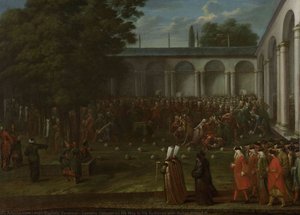
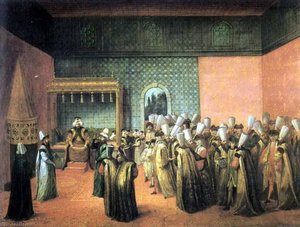
The air in the second courtyard of the Topkapı Palace feels heavy with the weight of ceremony. Sultan Ahmed III sits at the center of this unfolding drama, a figure of quiet authority amidst the rustle of silk and the soft movement of his attendants. He is draped in a fur-lined kaftan, the texture of the garment suggesting a warmth that contrasts with the formal stillness of the scene. Upon…
Četiri teme koje se najčešće ponavljaju u ovim originalima, svaka sa svojim vrhunskim primerom.
4 muzeja u kojima se nalazi najviše slika sa ove stranice.
| Muzeji | Grad | Radovi umetnika Žan Baptist Vanmur | Slike iz ovog spiska |
|---|---|---|---|
| Amsterdam | 59 | Albanian Soldier, The Capoudgi Bachi, Grand-master of the Seraglio, A Jewish Money-Changer | |
| 70 | Benbouk chef de cuisine du Grand Seigneur, Femme Tourquoise qui se repose sortant du bain, Derviche qui donne l’eau par charité | ||
| Istanbul | 7 | Dinner at the Palace in Honour of an Ambassador | |
| Bordo | 1 | Français Réception de l'Ambassadeur de France, le vicomte d'Andrezel, par le Sultan Ahmed III, le 17 octobre 1724, à Constantinople le dîner offert par le Grand Vizir Ibrahim Pacha Deutsch Empfang des französischen Gesandten le Vicompte D'Andrezel du.... |
Izaberite deceniju da biste videli original koji je definiše.
In this 1699 portrait, we find ourselves observing a group of men gathered in a moment of quiet camaraderie. They are dressed in elaborate costumes, suggesting a scene from the late 17th century, perhaps as musicians or soldiers. There is a certain weight to their presence, a sense of unity as they face the viewer directly. The composition is structured around their standing figures, creating a formal yet intimate atmosphere.…
The artwork titled Albanian Soldier is a painting by Jean Baptiste Vanmour. This specific work is attributed to the workshop of Jean Baptiste Vanmour. It belongs to a period of production spanning from 1700 to 1737.
A single figure occupies the space, poised and still. She is draped in heavy teal silk that catches a light source from the upper left, casting the deep folds of her gown into soft, dark shadows. A red headpiece rests upon her, providing a sharp contrast to the muted, earthy tones of the background. Around her neck, the white softness of ermine fur offers a tactile counterpoint to the sheen…
The air in the second courtyard of the Topkapı Palace feels heavy with the weight of ceremony. Sultan Ahmed III sits at the center of this unfolding drama, a figure of quiet authority amidst the rustle of silk and the soft movement of his attendants. He is draped in a fur-lined kaftan, the texture of the garment suggesting a warmth that contrasts with the formal stillness of the scene. Upon…
Albanian Soldier (1718), Rijksmuseum, Amsterdam. Slede The Capoudgi Bachi, Grand-master of the Seraglio (1718) i A Jewish Money-Changer (1718).
47 godina: Albanian Soldier datira iz 1718, a Žan Baptist Vanmur je rođen/a 1671.
Albanian Soldier, The Capoudgi Bachi, Grand-master of the Seraglio, A Jewish Money-Changer, Woman from the Island of Mykonos, Grand Vizier, A Turkish Woman, Woman from the Island of Tinos, Man from the Bulgarian Coast, Man from the Island of Patmos i Sultan Ahmed III, Jean Baptiste Vanmour, c. 1727 - c. 1730. Gornji rang pokazuje godinu i muzej za svako od njih.
Naš katalog sadrži 162 dela umetnika Žan Baptist Vanmur, datiranih od 1699 do 1737.
Većinom u Rijksmuseum (Amsterdam), Sissinghurst Castle i Pera Museum (Istanbul). Tabela muzeja iznad sadrži njih sve.
U 1730s: 33 od 100 dela na ovoj stranici nastalo je tada, od čega je Sultan Ahmed III, Jean Baptiste Vanmour, c. 1727 - c. 1730.
Na ovoj stranici, najstarije delo je iz Untitled (AQQNMG) (1699), a najnovije iz Man from the Island of Tinos, Jean Baptiste Vanmour (workshop of), 1700 - 1737 (1737).
Man (54), Turban (28) i Woman (20), kroz svih 100 dela na ovoj stranici.
Oil On Canvas, za 89 od 100 dela na ovoj stranici.
Baroque, sudeći po originalima na ovoj stranici.
Albanian Soldier, The Capoudgi Bachi, Grand-master of the Seraglio i A Jewish Money-Changer: Rijksmuseum, Amsterdam čuva 51 dela sa ove stranice.
Rođen u Valensijenu u Francuskoj 1671. godine, Žan-Batist Vanmur započeo je putovanje koje će neizbrisivo povezati njegovo ime sa živopisnim tapiserijama otomanskog života tokom čuvene Era tulipana. Iako je svoje rane umetničke nadam ispoljio pod mentorstvom Žaka Alberta Žerina, Vanmurov početni potencijal nije odmah nagoveštavao jedinstven put kojim će biti sudbinski vođen. Sudbina je intervenisala putem pokroviteljstva markiza Šarla de Ferola, istaknute ličnosti u francuskoj diplomatiji. Kada je De Ferol 1699. godine preuzeo funkciju francuskog ambasadora u Carigradu, Vanmur ga je ispratio, što se pokazalo kao preobražajni trenutak i za samog umetnika i za carstvo. Ovaj odlazak nije bio samo promena okruženja; bilo je to uranjanje u svet prepun egzotičnog običaja, raskošnih dvora i kulture koja je bila duboko drugačija od svega što je Vanmur do tada poznavao. Dobio je zadatak da kreira preko sto uljanih slika koje dokumentuju lokalno stanovništvo i dvorski život – zadatak koji će definisati njegov umetnički opus i osigurati mu mesto u istoriji.
Vanmurove skoro četiri decenije provedene u Carigradu (od ablo 1700. do njegove smrti 1737. godine) bile su izuzetno produktivne, omogućavajući mu da postane duboko integrisan u otomansko društvo. On nije samo posmatrao sa distance; dobio je pristup – izvanrednu privilegiju za zapadnog umetnika – unutrašnjim svetinjama sultanskog dvora. Ova bliskost omogućila mu je da pedantno dokumentuje audijencije kod Ahmeda III i njegovih naslednika, vešto prilagođavajući ambijente i lica uz zadržavanje doslednog umetničkog stila. Njegova dela nisu bila samo portreti; bila su to vizuelna narativa koja su nudila neprocenjive uvide u otomanske običaje, odeću i složene rituale dvorskog života evropskoj publici koja je bila uglavnom nepoznata ovom svetu. Čak i nakon De Ferolova povratka u Francusku 1711. godine, Vanmur je nastavio da napreduje, radeći za razne diplomate i učvršćujući svoju reputaciju umetnika koji poseduje i značajnu veštinu i retko kulturno razumevanje. Objavljivanje „Zbirke stotinu litografija koje predstavljaju različite narode Levanta“ 1714. godine, serije gravura zasnovanih na njegovim portretima, bio je prekretnica koja je značajno proširila njegovu prepoznatljivost širom Zapadne Evrope i uticala na umetničke percepcije otomanskog sveta.
Vanmurov umetnički stil je odmah prepoznatljiv po pedantnom detalju, živopisnoj paleti boja i nepokolebljivom oku za zapažanje. Nije ga zanimalo romantizovanje ili idealizovanje svojih subjekata; umesto toga, nastojao je da uhvati nijanse svakodnevnog života uporedo sa veličanstvenim sjajem otomanskog dvora. Njegovo delo odražava baroknu estetiku koja je bila prisutna u to vreme, sa naglaskom na realizam i dramatičnu kompoziciju, ali prožetu jedinstvenom senzibilitetnošću prema kulturnom kontekstu koji je prikazivao. Portretao je scene koje su se kretale od raskošnih turskih venčanja i užurbanih kafića do intimnih portreta pojedinaca koji predstavljaju različite društvene slojeve. To nisu bile puke etnografske studije; bila su to umetnička dostignuća koja su spojila dokumentarnu preciznost sa estetskom lepotom. Ključna dela poput „Ambasadora Kornelija Kalkoena na audijenciji kod sultana Ahmeda III“ i prikazi otomanskih ceremonija pokazuju ovu majstorsku ravnotežu, nudeći uvid u dinamiku moći i ceremonijalni sjaj tog doba. Njegova dela se danas čuvaju u prestižnim kolekcijama širom sveta, uključujući Rijksmuseum, Metropolitan Museum of Art i Louvre – kao svedočanstva njihove trajnog umetničkog i istorijskog značaja.
Godine 1725, Vanmuru je dodeljena titula Peintre Ordinaire du Roy en Levant, što je bilo priznanje ne samo njegovog umetničkog talenta, već i njegovog značaja francuskoj vladi u podsticanju razumevanja otomanskog sveta. Njegove slike služe kao neuporedivo prozora u kulturu i običaje Osmanskog carstva tokom ERE tulipana (1718–1730), perioda obeleženog značajnom kulturnom razmenom između Evrope i Istoka. Odigrao je ključnu ulogu u oblikovanju evropskih percepcija o Osmancima, pružajući detaljne vizuelne zapise koji su se široko širili putem gravura i publikacija. Vanmurov rad nije se samo odnosio na prikazivanje onoga što je video; radilo se o prevođenju drugačijeg pogleda na svet zapadnoj publici. Njegovo nasleđe prevazilazi njegova umetnička dostignuća; pamti se kao jedan od najvažnijih umetnika koji su povezali kulture kroz umetnost, nudeći nijansiran i pun poštovanja prikaz civilizacije koja je često bila obavijena misterijom i zabludama. On ostaje vitalna karika u razumevanju ključnog trenutka u istoriji – vremena kada su se Istok i Zapad sreli, a umetnikovo oštro oko uhvatilo suštinu oba.