Portret Wolfgang Laib

7 najpoznatijih slika umetnika Wolfgang Laib, izbor iz galerije

Ažurirano: новембар 2026 · rangirano prema našem koeficijentu popularnosti (pretrage, posete i porudžbine za svako delo) · 7 dela Wolfgang Laib u našem katalogu

Ukratko

Od svih originala koje je Wolfgang Laib ostavio, najpoznatiji je Milkstone (1987), koji se nalazi u kolekciji MoMA - Muzej moderne umetnosti, New York City. Odmah za njima slede Milk Stone (1978) i Untitled (1983). Naš katalog sadrži 7 dela umetnika Wolfgang Laib; galerija je čuvala 7 dela koja svet najviše admira, od kojih je svako prikazano sa svojim datumom, muzejom i pričom.

rođen 1950, Metzingen Minimalism Najviše dela: MoMA - Muzej moderne umetnosti

Top 10 slika umetnika Wolfgang Laib: izbor galerije

1
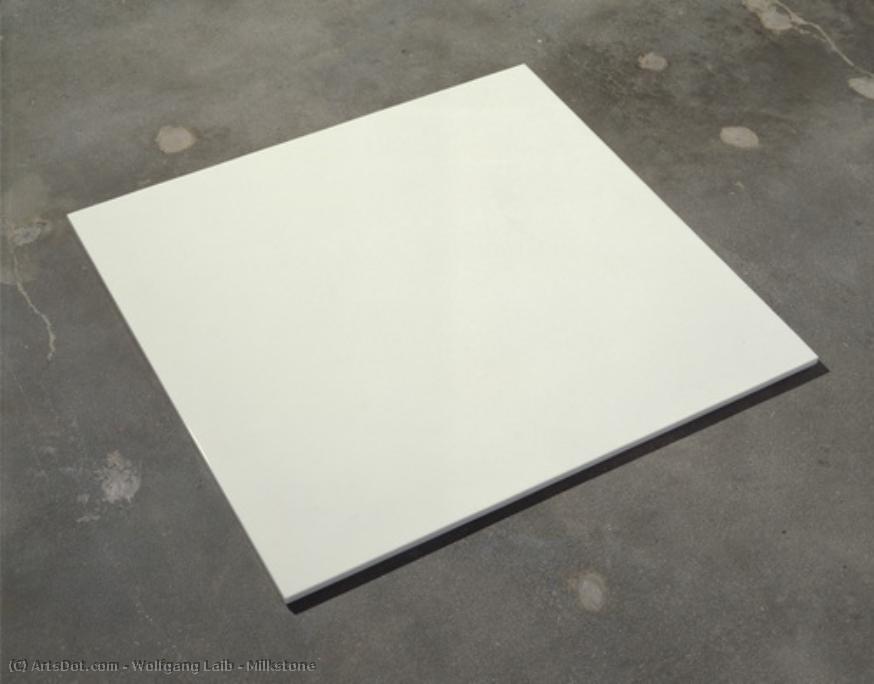
Milkstone (1987) čiji je Wolfgang Laib

Milkstone

1987 · Photography · MoMA - Muzej moderne umetnosti, New York City

In the quietude of a darkened gallery space, Wolfgang Laib’s Milkstone emerges not merely as an object, but as a profound encounter with the elemental. Created in 1987, this sculptural installation—captured here through a striking photographic lens—commands the viewer's attention through its stark, minimalist presence. At first glance, one is met with a monolithic rectangular prism of luminous white, a crystalline form that seems to glow against the deep, obsidian…

2
Milk Stone (1978) čiji je Wolfgang Laib

Milk Stone

1978 · Photography · MoMA - Muzej moderne umetnosti, New York City

To stand before Wolfgang Laib’s Milk Stone is not merely to observe an object; it is to enter a state of quiet contemplation. This piece, dating from 1978, strips away the superfluous until only the essential remains: a perfect square of luminous white resting upon the warm, grounding expanse of aged wood. The composition itself is deceptively simple, yet its power lies in the profound dialogue between its constituent parts.…

3
Untitled (1983) čiji je Wolfgang Laib

Untitled

1983 · Ink On Paper · MoMA - Muzej moderne umetnosti, New York City

To stand before this untitled work by Wolfgang Laib is to enter a space of profound stillness. It is not an image that shouts for attention; rather, it whispers secrets drawn from the quiet corners of nature and deep contemplation. The composition itself—a delicate interplay of reddish-orange markings against a vast expanse of white—immediately draws the eye into its minimalist embrace. One perceives not merely pigment on paper, but the…

Motivi koji su privlačili pažnju Wolfgang Laib

Četiri teme koje se najčešće ponavljaju u ovim originalima, svaka sa svojim vrhunskim primerom.

Muzeji u kojima se čuvaju originalna dela umetnika Wolfgang Laib

1 muzeja u kojima se nalazi najviše slika sa ove stranice.

Muzej Grad Radovi umetnika Wolfgang Laib Slike iz ovog spiska
MoMA - Muzej moderne umetnosti, New York CityMoMA - Muzej moderne umetnosti New York City 6 Milkstone, Milk Stone, Untitled

Wolfgang Laib deceniju po deceniju: original koji definiše svaku od njih

Radovi po decenijama

Izaberite deceniju da biste videli original koji je definiše.

Pitanja kolekcionara o slikama umetnika Wolfgang Laib

Po kojem delu je Wolfgang Laib najpoznatiji/a?Otkrij odgovor

Milkstone (1987), MoMA - Muzej moderne umetnosti, New York City. Slede Milk Stone (1978) i Untitled (1983).

Koliko je godina imao/la Wolfgang Laib kada je nastalo delo Milkstone?Otkrij odgovor

37 godina: Milkstone datira iz 1987, a Wolfgang Laib je rođen/a 1950.

Koliko je slika ostavio Wolfgang Laib?Otkrij odgovor

Naš katalog sadrži 7 dela umetnika Wolfgang Laib, datiranih od 1978 do 2008.

U kojim muzejima se nalaze remek-dela umetnika Wolfgang Laib?Otkrij odgovor

Većinom u MoMA - Muzej moderne umetnosti (New York City). Tabela muzeja iznad sadrži njih sve.

U kojim godinama je Wolfgang Laib naslikao svoja najpoznatija dela?Otkrij odgovor

U 1980s: 2 od 7 dela na ovoj stranici nastalo je tada, od čega je Milkstone.

Koja su prva i poslednja čuvena originalna dela umetnika Wolfgang Laib?Otkrij odgovor

Na ovoj stranici, najstarije delo je iz Milk Stone (1978), a najnovije iz Rice House (2008).

Koje je motive Wolfgang Laib najčešće birao/la?Otkrij odgovor

Geometry (3), Silence (3) i Geometric (3), kroz svih 7 dela na ovoj stranici.

Koju je tehniku najčešće koristio/la Wolfgang Laib?Otkrij odgovor

Photography, za 3 od 7 dela na ovoj stranici.

Kojem umetničkom pravcu pripada Wolfgang Laib?Otkrij odgovor

Minimalism, sudeći po originalima na ovoj stranici.

Čija se dela umetnika Wolfgang Laib nalaze u MoMA - Muzej moderne umetnosti?Otkrij odgovor

Milkstone, Milk Stone i Untitled: MoMA - Muzej moderne umetnosti, New York City čuva 6 dela sa ove stranice.

Wolfgang Laib: život i delo

The Sculptor of Silence and Elemental Essence

Born in Metzingen, Germany, in 1950, Wolfgang Laib has cultivated an artistic practice that transcends the boundaries of traditional sculpture, moving instead into the realm of pure, meditative experience. His work does not merely occupy space; it breathes with the rhythms of the natural world. Operating from a tranquil village in southern Germany while maintaining studios in New York City and South India, Laib’s life is a testament to the pursuit of stillness. This unique geographical duality—the structured precision of Europe meeting the spiritual depth of India—informs an aesthetic that seeks to find the eternal within the ephemeral.

Laib’s artistic journey was profoundly shaped by his early immersion in the philosophies of Taoism and Zen Buddhism. These ancient traditions provided him with a lens through which to view the universe, emphasizing simplicity, the beauty of natural forms, and the profound power of emptiness. Rather than imposing a human will upon his materials, Laib seeks a state of harmony, where the artist acts as a facilitator for the inherent qualities of the earth itself. This spiritual foundation is evident in every meticulously placed grain of pollen and every drop of milk that graces his monumental works.

Materiality and the Poetry of Nature

The hallmark of Laib’s oeuvre is his radical use of elemental, organic materials that challenge the conventional permanence of sculpture. He is perhaps most celebrated for his milkstones—monumental blocks of white marble that serve as a canvas for a single, delicate drop of milk. In these pieces, the cold, enduring weight of the stone meets the fragile, life-giving essence of the liquid, creating an evocative juxtaposition of purity and vulnerability. This subtle interplay serves as a meditation on nourishment, renewal, and the delicate balance of existence.

Beyond the marble, Laib’s use of pollen has become one of the most iconic expressions of contemporary Land Art. By collecting vast quantities of pollen and arranging them into precise, geometric fields, he creates installations that feel both cosmic and deeply terrestrial. These golden, velvety surfaces possess a luminous quality that seems to vibrate with life. A defining moment in his career was the presentation of his colossal pollen installation at the Museum of Modern Art (MoMA) in 2013, an achievement that showcased his ability to transform a museum's white cube into a sacred, breathing landscape.

Legacy and Global Recognition

Laib’s contribution to the contemporary art canon is marked by his ability to bridge the gap between the physical and the metaphysical. His participation in the prestigious Documenta 7 (1982) and Documenta 8 (1987) established him as a pivotal figure within the German Land Art movement, proving that sculpture could be found not just in earthworks, but in the very substances of life itself. His work has been recognized on the highest international stages, including representing Germany at the Venice Biennale.

The historical significance of Wolfgang Laib lies in his refusal to participate in the noise of the modern era, choosing instead to champion a quiet, profound minimalism. For his immense contributions to the arts, he has been honored with the Praemium Imperiale, one of the highest honors in the art world. His legacy continues to inspire those who seek meaning in the subtle textures of the natural world, reminding us that true greatness often resides in the most delicate and silent of gestures.