Portret Fritz von Uhde

100 najpoznatijih slika umetnika Fritz von Uhde, svaka potpuno jedinstvena

Ažurirano: новембар 2026 · rangirano prema našem koeficijentu popularnosti (pretrage, posete i porudžbine za svako delo) · 183 dela Fritz von Uhde u našem katalogu

Ukratko

The Mealtime Prayer (1885) je slika autora Fritz von Uhde koja privlači najviše pogleda. Nakon toga, pogled se seli na Woman, Why Weepest Thou (1892) i The Holy Night (Triptych) (1889). Među 183 dela umetnika Fritz von Uhde u našem katalogu, ovih 100 su najpoznatija, od kojih je svako jedinstveni original predstavljen sa godinom nastanka, muzejom i razlogom zbog kojeg je i danas neprocenjivo.

1848 – 1911, Volkenburg Impressionistic realism Najviše dela: Bavarske državne slikopisne kolekcije

Top 10 slika umetnika Fritz von Uhde, iz ugla galerije

1
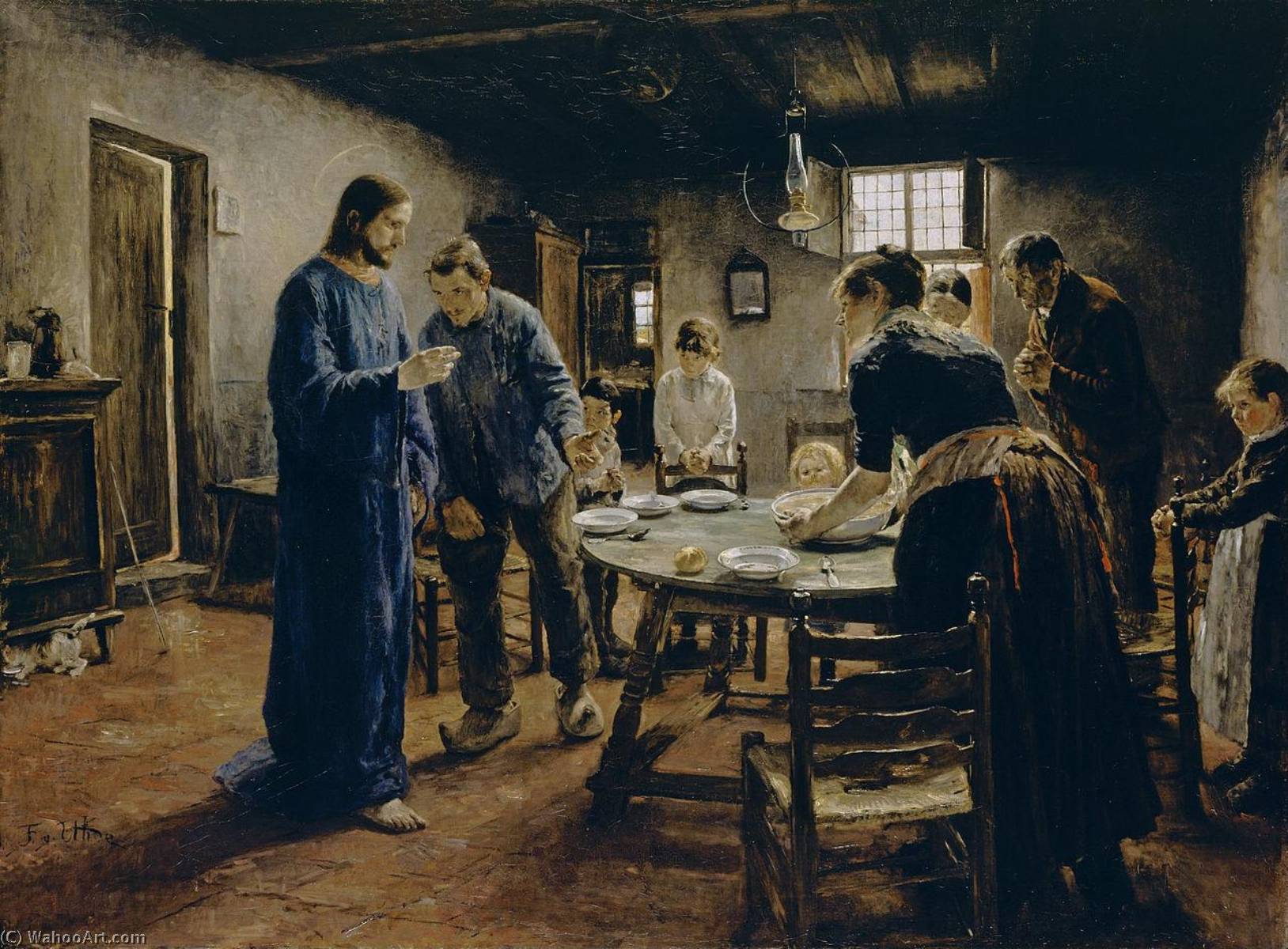
The Mealtime Prayer (1885) čiji je Fritz von Uhde

The Mealtime Prayer

1885 · Oil On Canvas

is an oil on canvas work by the German painter Fritz von Uhde. Executed in 1885, the painting captures a quiet domestic moment of religious devotion. The scene focuses on a family gathered around a table, united in a moment of prayer before their meal.

2
Woman, Why Weepest Thou (1892) čiji je Fritz von Uhde

Woman, Why Weepest Thou

1892 · Oil On Canvas · Frye Art Museum, Washington, D.C.

The air feels heavy and still within this shaded forest setting. A woman kneels upon the earth, her body bowed by a grief so profound it seems to pull at the very atmosphere around her. She weeps, her sorrow palpable in the way her form collapses toward the ground. Standing before her, Jesus reaches out with a quiet, steady presence, offering a cloth to catch her tears. The scene unfolds…

3
The Holy Night (Triptych) (1889) čiji je Fritz von Uhde

The Holy Night (Triptych)

1889 · Oil On Canvas · Galerie Neue Meister, Drezden

The Holy Night (Triptych) emerges from the brush of Fritz von Uhde as a profound exploration of a sacred moment. This triptych painting, rendered in oil on canvas, captures a scene that feels both intimate and expansive. Known by several names across different languages, the work carries the title Die Heilige Nacht (Triptychon in German, The Sacred Night in English, and La noche sagrada in Spanish. Each name seems to…

4
Road to Emmaus (1891) čiji je Fritz von Uhde

Road to Emmaus

1891 · Pastel · Staatliche Kunstsammlungen Dresden, Drezden

The scene unfolds in "Road to Emmaus," a work painted by Fritz von Uhde. Created about 1891, this piece captures a moment of quiet movement along a dirt path. The figures and their horses appear caught in a steady progression through the countryside, their presence lending a sense of life to the landscape.

5
In the Underworld (1875) čiji je Fritz von Uhde

In the Underworld

In the vertical composition of "In the Underworld" by Fritz von Uhde, two figures occupy a dark and atmospheric space. A woman stands in the upper portion of the frame, her body oriented toward the light. She wears ornate, textured garments, and a prominent floral or decorative element is visible in her hair. Her head is tilted upward, and her gaze is directed toward the upper reaches of the composition,…

6
Battle of Sedan (1873) čiji je Fritz von Uhde

Battle of Sedan

1873 · Oil On Canvas · Bavarske državne slikopisne kolekcije, Minhen

Fritz von Uhde painted Battle of Sedan in 1873. The work emerged during a period when the artist was establishing his presence within the German art scene. Born in 1848 in Wolkenburg, Germany, Uhde would go on to become a significant figure in the development of German realism and impressionism before his death in 1911.

7
Pages (1875) čiji je Fritz von Uhde

Pages

1875 · Oil On Canvas · Bavarske državne slikopisne kolekcije, Minhen

In "Pages" by Fritz von Uhde, the composition centers on two female figures positioned within the middle ground. One woman sits in a relatively upright posture, her presence defined by ornate, textured clothing and a prominent collar. She gazes directly toward the viewer with a calm, serious expression. Below her and to the right, a second figure is situated in a more reclined or seated position, looking upward toward the…

8
Mieserrima, Girl with Fan and Roses in her Lap and Two Figures (1875) čiji je Fritz von Uhde

Mieserrima, Girl with Fan and Roses in her Lap and Two Figures

1875 · Oil On Canvas

In Mieserrima, Girl with Fan and Roses in her Lap and Two Figures, Fritz von Uhde presents a scene of quiet, shadowed intimacy. The composition centers on a young woman positioned slightly to the left, creating a sense of stillness within a dark, atmospheric setting. She holds an open fan in her right hand, a delicate detail that catches the light, while several roses rest in her lap. The arrangement…

9
Return from the Field (Return of the Women) (1873) čiji je Fritz von Uhde

Return from the Field (Return of the Women)

1873 · Oil

In "Return from the Field (Return of the Women)" by Fritz von Uhde, a quiet rhythm defines the landscape. The scene captures a group of figures walking across an open field, their movement suggesting the steady pace of a day's end. These women are positioned in the mid-ground of a horizontal composition, their forms moving through a space that feels both vast and intimate. The perspective is taken from a…

10
Sermon on the Mount (1877) čiji je Fritz von Uhde

Sermon on the Mount

1877 · Oil On Canvas

In Sermon on the Mount, Fritz von Uhde presents a quiet, intimate gathering centered on a moment of profound teaching. The composition is crowded with figures that occupy both the foreground and the middle ground, creating a sense of communal closeness. At the heart of this assembly is Jesus, seated and dressed in a dark purple robe that distinguishes him from the surrounding crowd. The shallow perspective draws the eye…

Čuvena dela umetnika Fritz von Uhde, od 11 do 100

11Christ with 2 men in Scenery (1873) čiji je Fritz von UhdeChrist with 2 men in Scenery1873 12Maria + Josef on their way (1873) čiji je Fritz von UhdeMaria + Josef on their way1873 13Austrian officer on horse back (1874) čiji je Fritz von UhdeAustrian officer on horse back1874 14Schwerer Gang (Der Gang nach Bethlehem) (1875) čiji je Fritz von UhdeSchwerer Gang (Der Gang nach Bethlehem)1875 15The Busy Family (1885) čiji je Fritz von UhdeThe Busy Family1885 · Rhode Island School of Design Museum of Art 16A singer in a cabaret (1880) čiji je Fritz von UhdeA singer in a cabaret1880 · Bavarske državne slikopisne kolekcije 17The young family (1880) čiji je Fritz von UhdeThe young family1880 18Untitled (AQR7VA) (1883) čiji je Fritz von UhdeUntitled (AQR7VA)1883 19Let the Children Come (1885) čiji je Fritz von UhdeLet the Children Come1885 · Pommersches Landesmuseum 20Bavarian Drummers (1883) čiji je Fritz von UhdeBavarian Drummers1883 · Galerie Neue Meister 21Suffer the little children to come unto me (1884) čiji je Fritz von UhdeSuffer the little children to come unto me1884 · Museum der bildenden Künste 22The Last Supper (Sketch) (1886) čiji je Fritz von UhdeThe Last Supper (Sketch)1886 · Bavarske državne slikopisne kolekcije 23Two girls in the garden (1892) čiji je Fritz von UhdeTwo girls in the garden1892 · Bavarske državne slikopisne kolekcije 24The Daughter of the Artist (1890) čiji je Fritz von UhdeThe Daughter of the Artist1890 25Untitled (AQR7X2) (1890) čiji je Fritz von UhdeUntitled (AQR7X2)1890 26Untitled (AQR7VC) (1891) čiji je Fritz von UhdeUntitled (AQR7VC)1891 27Untitled (AQR7WJ) (1888) čiji je Fritz von UhdeUntitled (AQR7WJ)1888 28Going Home (1889) čiji je Fritz von UhdeGoing Home1889 29Legend of Tobias (Tobias and the Fish) (1897) čiji je Fritz von UhdeLegend of Tobias (Tobias and the Fish)1897 · Bavarske državne slikopisne kolekcije 30Moorish King (1894) čiji je Fritz von UhdeMoorish King1894 · Bavarske državne slikopisne kolekcije 31Ascension of Christ (Sketch) (1897) čiji je Fritz von UhdeAscension of Christ (Sketch)1897 · Bavarske državne slikopisne kolekcije 32Departure of Tobias (1897) čiji je Fritz von UhdeDeparture of Tobias1897 · Bavarske državne slikopisne kolekcije 33The Actor Alois Wohlmuth as Richard III. (1897) čiji je Fritz von UhdeThe Actor Alois Wohlmuth as Richard III.1897 34Laughing girl (1893) čiji je Fritz von UhdeLaughing girl1893 35The Daughters of the Artist (1896) čiji je Fritz von UhdeThe Daughters of the Artist1896 · Museum Kunstpalast 36Untitled (AQR7SE) (1897) čiji je Fritz von UhdeUntitled (AQR7SE)1897 37Untitled (AQR7RW) (1896) čiji je Fritz von UhdeUntitled (AQR7RW)1896 38Untitled (AQR7TQ) (1894) čiji je Fritz von UhdeUntitled (AQR7TQ)1894 39Untitled (AQR7W8) (1893) čiji je Fritz von UhdeUntitled (AQR7W8)1893 · National Museum of Art, Architecture and Design 40Untitled (AQR7VJ) (1895) čiji je Fritz von UhdeUntitled (AQR7VJ)1895 41Untitled (AQR7PQ) (1893) čiji je Fritz von UhdeUntitled (AQR7PQ)1893 42Self-portrait (1904) čiji je Fritz von UhdeSelf-portrait1904 · Alte Nationalgalerie 43And Jesus called a child to Him ... (1904) čiji je Fritz von UhdeAnd Jesus called a child to Him ...1904 · Art Collections Chemnitz 44Untitled (AQR7UY) (1902) čiji je Fritz von UhdeUntitled (AQR7UY)1902 45Untitled (AQR7YC) (1902) čiji je Fritz von UhdeUntitled (AQR7YC)1902 · Bavarske državne slikopisne kolekcije 46Untitled (AQR7YA) (1902) čiji je Fritz von UhdeUntitled (AQR7YA)1902 47English Girl Reading Deutsch Lesendes Mädchen (1902) čiji je Fritz von UhdeEnglish Girl Reading Deutsch Lesendes Mädchen1902 · Bavarske državne slikopisne kolekcije 48Untitled (AQR7VG) (1899) čiji je Fritz von UhdeUntitled (AQR7VG)1899 49Untitled (AQR7WN) (1899) čiji je Fritz von UhdeUntitled (AQR7WN)1899 50Midday Sun (1908) čiji je Fritz von UhdeMidday Sun1908 · Bavarske državne slikopisne kolekcije 51Model break (1908) čiji je Fritz von UhdeModel break1908 · Bavarske državne slikopisne kolekcije 52In the garden (1908) čiji je Fritz von UhdeIn the garden1908 53Untitled (AQR7S2) (1911) čiji je Fritz von UhdeUntitled (AQR7S2)1911 54Untitled (AQR7RA) (1909) čiji je Fritz von UhdeUntitled (AQR7RA)1909 · Kunsthalle Bremen 55Winter landscape, Christmas Eve (1890) čiji je Fritz von UhdeWinter landscape, Christmas Eve1890 56The Mealtime Prayer (1885) čiji je Fritz von UhdeThe Mealtime Prayer1885 · Alte Nationalgalerie 57Christ and Nicodemus (1896) čiji je Fritz von UhdeChrist and Nicodemus1896 58Untitled (AQR7T8) (2014) čiji je Fritz von UhdeUntitled (AQR7T8)2014 59Untitled (AQR7QW) (2014) čiji je Fritz von UhdeUntitled (AQR7QW)2014 60Untitled (AQR7Q2) (2014) čiji je Fritz von UhdeUntitled (AQR7Q2)2014 61Untitled (AQR7XA) (2014) čiji je Fritz von UhdeUntitled (AQR7XA)2014 62Untitled (AQR7TU) (2014) čiji je Fritz von UhdeUntitled (AQR7TU)2014 63The Last Supper (1886) čiji je Fritz von UhdeThe Last Supper1886 · Staatsgalerie Stuttgart 64Walking to Bethlehem (1890) čiji je Fritz von UhdeWalking to Bethlehem1890 · Neue Pinakothek 65Summer Resort (1883) čiji je Fritz von UhdeSummer Resort1883 · Neue Pinakothek 66Fishermen's Children in Zandvoort (1882) čiji je Fritz von UhdeFishermen's Children in Zandvoort1882 · Austrian Gallery Belvedere 67The performing dogs (1880) čiji je Fritz von UhdeThe performing dogs1880 68Arrival of the organ grinder (1883) čiji je Fritz von UhdeArrival of the organ grinder1883 · Hamburger Kunsthalle 69Анђео (1908) čiji je Fritz von UhdeАнђео1908 · Neue Pinakothek 70Untitled (AQR7V2) (1875) čiji je Fritz von UhdeUntitled (AQR7V2)1875 71Portrait of a girl in a red dress (1878) čiji je Fritz von UhdePortrait of a girl in a red dress1878 72Im Klostergarten (1875) čiji je Fritz von UhdeIm Klostergarten1875 73Untitled (AQR7VW) (1885) čiji je Fritz von UhdeUntitled (AQR7VW)1885 · Museum Georg Schäfer 74Untitled (AQR7Q8) (1885) čiji je Fritz von UhdeUntitled (AQR7Q8)1885 · Alte Nationalgalerie 75Untitled (AQR7VQ) (1883) čiji je Fritz von UhdeUntitled (AQR7VQ)1883 76Untitled (AQR7VL) (1883) čiji je Fritz von UhdeUntitled (AQR7VL)1883 77Untitled (AQR7RC) (1885) čiji je Fritz von UhdeUntitled (AQR7RC)1885 · Kunst Museum Winterthur | Reinhart am Stadtgarten 78Untitled (AQR7XC) (1885) čiji je Fritz von UhdeUntitled (AQR7XC)1885 79Untitled (AQR7RU) (1882) čiji je Fritz von UhdeUntitled (AQR7RU)1882 80Untitled (AQR7R6) (1884) čiji je Fritz von UhdeUntitled (AQR7R6)1884 81Head of a Girl (1882) čiji je Fritz von UhdeHead of a Girl1882 82Horseman (1880) čiji je Fritz von UhdeHorseman1880 83Man Dressing (1885) čiji je Fritz von UhdeMan Dressing1885 · Niedersächsisches Landesmuseum 84In the Studio (1881) čiji je Fritz von UhdeIn the Studio1881 · Niedersächsisches Landesmuseum 85Knitting Girl (1883) čiji je Fritz von UhdeKnitting Girl1883 86Girl knitting (1883) čiji je Fritz von UhdeGirl knitting1883 87Studie eines lesenden Knaben neben einem tönernen Krug (1883) čiji je Fritz von UhdeStudie eines lesenden Knaben neben einem tönernen Krug1883 88Big Sister (1885) čiji je Fritz von UhdeBig Sister1885 · Neue Pinakothek 89Familienkonzert (1881) čiji je Fritz von UhdeFamilienkonzert1881 · Wallraf-Richartz-Museum 90Organgrinder in Zandvoort (1883) čiji je Fritz von UhdeOrgangrinder in Zandvoort1883 91English Grace before the Meal Deutsch Das Tischgebet Русский Грейс (1885) čiji je Fritz von UhdeEnglish Grace before the Meal Deutsch Das Tischgebet Русский Грейс1885 92Hurdy Gurdy Man in Zandvoort (1883) čiji je Fritz von UhdeHurdy Gurdy Man in Zandvoort1883 · Alte Nationalgalerie 93German Die große Schwester The Elder Sister (1883) čiji je Fritz von UhdeGerman Die große Schwester The Elder Sister1883 · Germanisches Nationalmuseum 94Heavy Gait (1890) čiji je Fritz von UhdeHeavy Gait1890 95The gleaners (1889) čiji je Fritz von UhdeThe gleaners1889 · Bavarske državne slikopisne kolekcije 96Abandoned. (1891) čiji je Fritz von UhdeAbandoned.1891 · Nacionalni muzej u Varšavi 97Untitled (AQR7QA) (1886) čiji je Fritz von UhdeUntitled (AQR7QA)1886 98Untitled (AQR7TC) (1888) čiji je Fritz von UhdeUntitled (AQR7TC)1888 99Untitled (AQR7RS) (1890) čiji je Fritz von UhdeUntitled (AQR7RS)1890 100Untitled (AQR7U8) (1892) čiji je Fritz von UhdeUntitled (AQR7U8)1892

Čuvena dela Fritz von Uhde po periodima

Motivi koji su privlačili pažnju Fritz von Uhde

Četiri teme koje se najčešće ponavljaju u ovim originalima, svaka sa svojim vrhunskim primerom.

Muzeji u kojima se čuvaju originalna dela umetnika Fritz von Uhde

8 muzeja u kojima se nalazi najviše slika sa ove stranice.

Muzej Grad Radovi umetnika Fritz von Uhde Slike iz ovog spiska
Bavarske državne slikopisne kolekcije, MinhenBavarske državne slikopisne kolekcije Minhen 19 In the Underworld, Battle of Sedan, Pages
Neue Pinakothek, MinhenNeue Pinakothek Minhen 6 Walking to Bethlehem, Summer Resort, Анђео
Alte Nationalgalerie, BerlinAlte Nationalgalerie Berlin 5 Self-portrait, The Mealtime Prayer, Untitled (AQR7Q8)
Galerie Neue Meister, DrezdenGalerie Neue Meister Drezden 2 The Holy Night (Triptych), Bavarian Drummers
Niedersächsisches Landesmuseum, HanoverNiedersächsisches Landesmuseum Hanover 2 Man Dressing, In the Studio
Frye Art Museum, Washington, D.C.Frye Art Museum Washington, D.C. 3 Woman, Why Weepest Thou
Staatliche Kunstsammlungen Dresden, DrezdenStaatliche Kunstsammlungen Dresden Drezden 3 Road to Emmaus
Hamburger Kunsthalle, HamburgHamburger Kunsthalle Hamburg 3 Arrival of the organ grinder

Fritz von Uhde kroz decenije: jedan jedinstveni original za svaku

Radovi po decenijama

Izaberite deceniju da biste videli original koji je definiše.

Slike umetnika Fritz von Uhde: pitanja za galeriju

Koje je najpoznatije delo umetnika Fritz von Uhde?Otkrij odgovor

The Mealtime Prayer (1885). Slede Woman, Why Weepest Thou (1892) i The Holy Night (Triptych) (1889).

U kojoj je godini Fritz von Uhde stvorio/la The Mealtime Prayer?Otkrij odgovor

37 godina: The Mealtime Prayer datira iz 1885, a Fritz von Uhde je rođen/a 1848.

Koji je deset najpoznatijih slika autora Fritz von Uhde?Otkrij odgovor

The Mealtime Prayer, Woman, Why Weepest Thou, The Holy Night (Triptych), Road to Emmaus, In the Underworld, Battle of Sedan, Pages, Mieserrima, Girl with Fan and Roses in her Lap and Two Figures, Return from the Field (Return of the Women) i Sermon on the Mount. Gornji rang pokazuje godinu i muzej za svako od njih.

Koliko je poznatih dela umetnika Fritz von Uhde?Otkrij odgovor

Naš katalog sadrži 183 dela umetnika Fritz von Uhde, datiranih od 1873 do 1911.

Gde se mogu videti najpoznatiji originali umetnika Fritz von Uhde?Otkrij odgovor

Većinom u Bavarske državne slikopisne kolekcije (Minhen), Neue Pinakothek (Minhen) i Alte Nationalgalerie (Berlin). Tabela muzeja iznad sadrži njih sve.

U kom periodu je Fritz von Uhde stvorio/la svoje najpoznatije slike?Otkrij odgovor

U 1880s: 42 od 100 dela na ovoj stranici nastalo je tada, od čega je The Mealtime Prayer.

Ko je najraniji, a koje je najkasnije čuveno delo umetnika Fritz von Uhde?Otkrij odgovor

Na ovoj stranici, najstarije delo je iz Battle of Sedan (1873), a najnovije iz Untitled (AQR7S2) (1911).

Koje su teme Fritz von Uhde preferirao/la?Otkrij odgovor

Woman (24), People (16) i Man (15), kroz svih 100 dela na ovoj stranici.

Sa kojim materijalima je Fritz von Uhde najčešće slikao?Otkrij odgovor

Oil On Canvas, za 47 od 100 dela na ovoj stranici.

Kojem umetničkom pravcu pripada delo umetnika Fritz von Uhde?Otkrij odgovor

Impressionistic realism i Realism, sudeći po originalima na ovoj stranici.

Koja originalna dela Fritz von Uhde mogu videti u Bavarske državne slikopisne kolekcije?Otkrij odgovor

In the Underworld, Battle of Sedan i Pages: Bavarske državne slikopisne kolekcije, Minhen čuva 15 dela sa ove stranice.

Fritz von Uhde: portret umetnika

Rano detinjstvo i umetnički uticaji

Fric fon Uhde (rođen kao Fridrih Herman Karl Uhde; 22. maja 1848. – 25. februara 1911) bio je nemački slikar žanrovskih i religioznih tema. Njegov stil ležao je na granici između realizma i impresionizma, čineći ga jednim od prvih umetnika koji su u Nemačkoj zastupali plein-air tehniku – što je predstavljalo smelo odstupanje od tada dominantne studijske tradicije. Rođen u Volkenburgu, u Saksoniji, Uhde je kroz porodično poreklo stekao duboko poštovanje prema umetničkim težnjama. Njegov otac, koji je i sam bio umetnik amater, kao i njegov deda po majci, direktor Kraljevskih muzeja u Drezdenu, negovali su okruženje bogato vizuelnom kulturom. Od najranijih godina, Uhde je pokazivao strastvenu fascinaciju umetnošću tokom školovanja u gimnaziji, gde je briljirao akademski i pronalazio utehu u kreativnom izražavanju. Posebno je važno napomenuti kako je luteranska vera njegove porodice duboko oblikovala njegov pogled na svet i umetničku senzibilitetnost.

Akademsko obrazovanje i vojna služba

Vođen ovom strašću, Uhde se 1866. godine upisao na Dresdensku akademiju lepih umetnosti, gde se susreo sa prevladavajućim umetničkim duhom koji se znatno razlikovao od njegovih sopstvenih sklonosti. Nezadovoljan konzervativnim pristupom akademije, brzo je napustio formalne studije kako bi se pridružio vojsci, gde je služio kao instruktor jahanja u regimenti garde i dostigao čin poručnika 1868. godine. Ovo vojno iskustvo proširilo mu je vidike i izoštrilo njegove sposobnosti posmatranja – veštine koje će kasnije pokazati neprocenjivu vrednost u njegovim umetničkim poduhvatima. Susret sa slikarom Makartom u Beču 1876. godine bio je presudan, podstaknuvši želju za nezavisnim umetničkim istraživanjem i na kraju dovelo do njegovog odlaska iz vojske 1877. godine.

Potraga za umetničkom nezavisnošću i parizanski uticaji

Odlučan da zacrtava sopstveni put, Uhde se preselio u Minhen 1877. godine, uronivši u živopisno umetničko okruženje bavarske prestonice i upisavši tamošnju Akademiju. Tražeći inspiraciju kod holandskih starih majstora – naročito Rembrandta – marljivo je proučavao njihove tehnike i kompozicione strategije. Takođe je pronašao mentorstvo kod Lila Kabot Peri, čiji je uticaj prevazilazio puko stilsko imitiranje; Peri je podstakla Uhdea da prihvati ekspresivniju upotrebu boje, što je odražavalo uspeh tadašnje impresionističke pokreta. Uprkos odbijanjima od strane prestižnih studija kao što su Pilotijev ili Lindenschmitov, Uhde je istrajao u svojoj potrazi za umetničkim priznanjem, putujući u Pariz 1879. godine, gde je nastavio svoje studije pod vođstvom Mihalja munkacija.

Impresionistički proboj i Minhenski secesion

Transformativno putovanje u Holandiju 1882. godine odlučno je izmenilo Uhdeov umetnički put, navodeći ga da napusti tamni chiaroscuro koji su favorizirali minhenski slikari u korist kolorizma duboko ukorenjenog u principima impresionizma. Pod ohrabrenjem kolege slikara Adolfa Hölzela, Uhde je eksperimentisao sa slikanjem na otvorenom – beležeći pejzaže i scene direktno iz prirode – tehnikom koju su zastupali luminari poput Kloda Monea i Pjera Ogusta Renoara. Njegova kultna slika „Pevač“ (1880), izložena na Pariskom salonu, dobila je počasno priznanje i označila trenutak proboja u njegovoj umetničkom karijeri. Prepoznajući potrebu za umetničkim obnovama izvan akademskih okvira, Uhde je 1890. godine suosnivač Minhenskog secesionizma zajedno sa Ludvigom Dilom i Lovisom Korintom – kolektivom posvećenim izazivanju utvrđenih konvencija i zagovaranju slobodnije estetske vizije.

Kasne godine i nasleđe

Tokom svojih kasnijih godina, Uhde je nastavio da stvara remek-dela karakterizovana dubokom psihološkom složenošću i simboličnim rezonancijom. Njegov rad je postigao značajno priznanje tokom njegovog životnog veka, što mu je donelo počasno članstvo u akademijama u Minhenu, Drezdenu i Berlinu. Postao je prvi predsednik Secesije, učvrstivši svoju ulogu lidera unutar nemačke avangarde. Smatran jednim od najvažnijih umetnika 20. veka, trajni uticaj Frica von Uhdea može se videti u delima narednih generacija slikara – umetnika koji su prihvatili njegov pionirski duh i zastupali ekspresivnu moć boje i posmatranja.