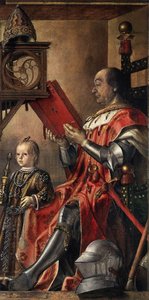
Portret Педро Беругете

37 najpoznatijih slika umetnika Педро Беругете, svaka potpuno jedinstvena

Ažurirano: новембар 2026 · rangirano prema našem koeficijentu popularnosti (pretrage, posete i porudžbine za svako delo) · 37 dela Педро Беругете u našem katalogu

Ukratko

Doors of an altarpiece with scenes of saint Catherine (1495) je slika autora Педро Беругете koja privlači najviše pažnje; original se nalazi u muzeju Museu Nacional d'Art de Catalunya, Barselona. Nakon toga, pogled se seli na Saint Peter (1493) i Saint Peter Martyr (1493). Među 37 dela umetnika Педро Беругете u našem katalogu, ovih 37 su najpoznatija, od kojih je svako jedinstveni original predstavljen sa godinom nastanka, muzejom i razlogom zbog kojeg je i danas neprocenjivo.

1450 – 1504, Paredes de Nava Renaissance Najviše dela: Музеј Прадо

Top 10 slika umetnika Педро Беругете, iz ugla galerije

1
Doors of an altarpiece with scenes of saint Catherine (1495) čiji je Педро Беругете

Doors of an altarpiece with scenes of saint Catherine

1495 · Tempera · Museu Nacional d'Art de Catalunya, Barselona

The Doors of an altarpiece with scenes of saint Catherine consists of six distinct panels arranged in a grid format. Each panel illustrates a different event from the life of Saint Catherine of Alexandria, including a procession, a meeting with Christ, an audience with Emperor Trajan, a scene with her mother Alexandra, a depiction of Catherine presenting the wheel to Trajan, and her martyrdom.

2
Saint Peter (1493) čiji je Педро Беругете

Saint Peter

1493 · Oil On Panel · Музеј Прадо, Мадрид

This religious work, titled Saint Peter, was painted by Pedro Berruguete around 1493. The subject is Saint Peter, depicted with the solemnity characteristic of the artist's approach to sacred figures. It is a significant example of the transition occurring in Spanish art during this period.

3
Saint Peter Martyr (1493) čiji je Педро Беругете

Saint Peter Martyr

1493 · Oil On Panel · Музеј Прадо, Мадрид

In this 1493 oil on panel, we encounter Saint Peter Martyr in a moment of profound, solitary stillness. The figure is positioned within a narrow architectural niche, a structural choice that creates a sense of shallow, intimate space. He stands with a solemnity that commands the viewer's attention, his form defined by the heavy, sculptural folds of his dark habit. The palette is restrained, relying on deep blacks and blues…

4
Saint Ambrose and Saint Augustine (1500) čiji je Педро Беругете

Saint Ambrose and Saint Augustine

1500 · Oil · Музеј Прадо, Мадрид

The air within the architectural space feels heavy with the weight of ancient parchment and the scent of incense. Two figures, Saint Ambrose and Saint Augustine, occupy a shared realm of intellectual and spiritual intensity. They sit framed by a central classical column, an Ionic pillar that slices the composition into two balanced halves. On the left, Saint Ambrose gestures toward an open manuscript, his hands raised in a movement…

5
The Ordeal by Fire (Saint Dominic and the Albigensians) (1500) čiji je Педро Беругете

The Ordeal by Fire (Saint Dominic and the Albigensians)

1500 · Tempera On Panel · Музеј Прадо, Мадрид

The air within the vaulted stone chamber feels heavy, thick with the tension of a divine judgment about to unfold. In this sacred space, Saint Dominic stands as a pillar of certainty, his presence marked by a deep red robe that pulls the eye through the crowded composition. He is locked in a profound dialogue, his gaze and gestures directed toward a learned companion who holds an open book, their…

6
Saint Gregory the Great and Saint Jerome (1500) čiji je Педро Беругете

Saint Gregory the Great and Saint Jerome

1500 · Oil On Panel · Музеј Прадо, Мадрид

The oil on panel work titled Saint Gregory the Great and Saint Jerome was executed by the Spanish artist Pedro Berruguete. Created around 1500, the painting captures a moment of quiet spiritual authority. It brings together two figures of profound theological weight within a structured, architectural space.

7
Portrait of Pope Sixtus IV della Rovere (1479) čiji je Педро Беругете

Portrait of Pope Sixtus IV della Rovere

1479 · Oil On Panel · Cleveland Museum of Art, Klivlend

The Portrait of Pope Sixtus IV della Rovere is a formal, dignified portrait of an elderly man depicted from the waist up in a three-quarter view, facing slightly to the viewer's left. He is shown wearing an ornate, jewel-encrusted papal tiara and a heavy, richly decorated cope or mantle in shades of gold and deep brown, which is embellished with large gemstones. Beneath this mantle, he wears a white alb…

8
Seneca (1476) čiji je Педро Беругете

Seneca

1476 · Oil On Panel

In this medium close-up of Seneca, Pedro Berruguete captures a moment of heavy stillness. The subject is an elderly man with a weathered face, his features carved by time. Deep-set eyes cast a somber gaze slightly downward toward a book. He is draped in layers of heavy fabric: a white wimple rests upon his head, while a pinkish-red mantle covers his shoulders. Beneath this, a green tunic meets the deep…

9
The Virgin and Child Enthroned (1475) čiji je Педро Беругете

The Virgin and Child Enthroned

1475 · Oil On Panel · Gemäldegalerie, Berlin

In this 1475 oil on panel, we find a moment of profound stillness. The Virgin Mary is seated upon an elaborate throne, her presence defined by a deep crimson gown that carries a significant visual weight. She holds the Christ Child, creating a central focus that is both intimate and regal. The composition is structured through a classical architectural framework, using rounded arches and receding layers to create a sense…

10
Apparition of the Virgin to a Community of Dominicans (1493) čiji je Педро Беругете

Apparition of the Virgin to a Community of Dominicans

1493 · Oil On Panel · Музеј Прадо, Мадрид

The work before us is titled Apparition of the Virgin to a Community of Dominicans, a significant piece by the Spanish painter Pedro Berruguete. Created between 1493 and 1499, this painting captures a specific moment of divine manifestation. It depicts a community of Dominicans engaged in prayer at the very instant the Virgin Mary appears to them. The scene is characterized by a quiet, spiritual intensity as the monks witness…

Čuvena dela umetnika Педро Беругете, od 11 do 37

Čuvena dela Педро Беругете po periodima

Motivi koji su privlačili pažnju Педро Беругете

Četiri teme koje se najčešće ponavljaju u ovim originalima, svaka sa svojim vrhunskim primerom.

Muzeji u kojima se čuvaju originalna dela umetnika Педро Беругете

8 muzeja u kojima se nalazi najviše slika sa ove stranice.

Muzej Grad Radovi umetnika Педро Беругете Slike iz ovog spiska
Музеј Прадо, МадридМузеј Прадо Мадрид 20 Saint Peter, Saint Peter Martyr, Saint Ambrose and Saint Augustine
Santa Eulalia, Nava de ParedesSanta Eulalia Nava de Paredes 3 David, Ezekiel, Salomon
Museu Nacional d'Art de Catalunya, BarselonaMuseu Nacional d'Art de Catalunya Barselona 2 Doors of an altarpiece with scenes of saint Catherine, Saint Gregory the Pope
Cleveland Museum of Art, KlivlendCleveland Museum of Art Klivlend 1 Portrait of Pope Sixtus IV della Rovere
Gemäldegalerie, BerlinGemäldegalerie Berlin 1 The Virgin and Child Enthroned
Luvr, ParizLuvr Pariz 1 Plato
Private collection, Nava de ParedesPrivate collection Nava de Paredes 1 Holy Family
Municipal Museum, MadridMunicipal Museum Madrid 1 Virgin and Child

Педро Беругете kroz decenije: jedan jedinstveni original za svaku

Radovi po decenijama

Izaberite deceniju da biste videli original koji je definiše.

Slike umetnika Педро Беругете: pitanja za galeriju

Koje je najpoznatije delo umetnika Педро Беругете?Otkrij odgovor

Doors of an altarpiece with scenes of saint Catherine (1495), Museu Nacional d'Art de Catalunya, Barselona. Slede Saint Peter (1493) i Saint Peter Martyr (1493).

U kojoj je godini Педро Беругете stvorio/la Doors of an altarpiece with scenes of saint Catherine?Otkrij odgovor

45 godina: Doors of an altarpiece with scenes of saint Catherine datira iz 1495, a Педро Беругете je rođen/a 1450.

Koji je deset najpoznatijih slika autora Педро Беругете?Otkrij odgovor

Doors of an altarpiece with scenes of saint Catherine, Saint Peter, Saint Peter Martyr, Saint Ambrose and Saint Augustine, The Ordeal by Fire (Saint Dominic and the Albigensians), Saint Gregory the Great and Saint Jerome, Portrait of Pope Sixtus IV della Rovere, Seneca, The Virgin and Child Enthroned i Apparition of the Virgin to a Community of Dominicans. Gornji rang pokazuje godinu i muzej za svako od njih.

Koliko je poznatih dela umetnika Педро Беругете?Otkrij odgovor

Naš katalog sadrži 37 dela umetnika Педро Беругете, datiranih od 1475 do 1500.

Gde se mogu videti najpoznatiji originali umetnika Педро Беругете?Otkrij odgovor

Većinom u Музеј Прадо (Мадрид), Santa Eulalia (Nava de Paredes) i Museu Nacional d'Art de Catalunya (Barselona). Tabela muzeja iznad sadrži njih sve.

U kom periodu je Педро Беругете stvorio/la svoje najpoznatije slike?Otkrij odgovor

U 1490s: 15 od 37 dela na ovoj stranici nastalo je tada, od čega je Doors of an altarpiece with scenes of saint Catherine.

Ko je najraniji, a koje je najkasnije čuveno delo umetnika Педро Беругете?Otkrij odgovor

Na ovoj stranici, najstarije delo je iz The Virgin and Child Enthroned (1475), a najnovije iz Saint Ambrose and Saint Augustine (1500).

Koje su teme Педро Беругете preferirao/la?Otkrij odgovor

Book (10), Man (9) i Architecture (6), kroz svih 37 dela na ovoj stranici.

Sa kojim materijalima je Педро Беругете najčešće slikao?Otkrij odgovor

Oil On Panel, za 17 od 37 dela na ovoj stranici.

Kojem umetničkom pravcu pripada delo umetnika Педро Беругете?Otkrij odgovor

Renaissance i Spanish renaissance, sudeći po originalima na ovoj stranici.

Koja originalna dela Педро Беругете mogu videti u Музеј Прадо?Otkrij odgovor

Saint Peter, Saint Peter Martyr i Saint Ambrose and Saint Augustine: Музеј Прадо, Мадрид čuva 20 dela sa ove stranice.

Педро Беругете: portret umetnika

The Bridge Between Two Worlds

Pedro Berruguete stands as a pivotal figure in the annals of Spanish art history, serving as the essential conduit between the solemn grandeur of the Gothic tradition and the burgeoning optimism of the Italian Renaissance. Born in Paredes de Nava, Castile, his life unfolded during a transformative era when the visual language of Europe was undergoing a profound metamorphosis. While the exact details of his early years remain somewhat shrouded in the vagueness characteristic of many artists of his time, his lineage traced back to noble families, providing him with a foundation that would eventually allow him to reshape the artistic landscape of Spain.

His artistic journey is defined by a remarkable duality. Berruguete emerged from the shadow of Gothic painting, absorbing its expressive fervor, meticulous detail, and spiritual intensity. Yet, he was simultaneously captivated by the humanist ideals and geometric precision championed by the Florentine masters. This synthesis created an eclectic style that was uniquely his own—a mixture of Flemish techniques, Spanish Gothic elements, and the light and space mastered in Italy. In his hands, stylized figures and heavy drapery coexisted with a new, sophisticated understanding of atmosphere and architectural framing.

A Journey Through Italy and Castile

The trajectory of Berruguete’s career was significantly altered by his travels to Italy, most notably around 1480. Evidence suggests he spent time within the vibrant artistic environment of Federico III da Montefeltro's court in Urbino. It was here that the influence of the Italian Renaissance truly permeated his technique. Immersed in a world of classical models and the works of masters like Melozzo da Forlì, Berruguete learned to manipulate light and space with newfound grace. Though he retained his Flemish training—evident in his use of tempera grassa and an exquisite attention to texture—his work began to reflect the structural clarity and humanistic depth found in the Italian peninsula.

Upon returning to Spain around 1482, Berruguete established himself as a leading master in cities such as Toledo and Ávila. He became a sought-after creator of breathtaking retablo panels for Castilian churches, demonstrating a technical prowess that could convey profound spiritual narratives to the faithful. His commissions were not merely decorative but served as monumental religious landmarks. Whether working on the walls of the Toledo Cathedral or the altarpieces in his native Paredes de Nava, he brought a sense of dignity and elegance to every surface, often utilizing brocadeado and gold decoration to elevate the sacred subjects he depicted.

Legacy and Artistic Significance

Beyond his individual canvases, Berruguete’s historical significance is cemented by his role as a patriarch of Spanish art. He was the father of Alonso Berruguete, who would go on to become arguably Spain’s greatest sculptor of the Renaissance. This familial connection established a powerful tradition of artistic innovation within Castile, where the mastery of the father nurtured the revolutionary talent of the son. The distinction between Berruguete el Viejo and his son reflects the broader cultural shift occurring in Spain, as older masters provided the foundation upon which new, more dynamic styles could be built.

The attribution of his works remains a complex task for historians due to the absence of signatures, yet his unmistakable style—characterized by unique facial features, focused gazes, and a masterful use of architectural depth—links him to numerous masterpieces. His oeuvre captures the very essence of an era marked by religious upheaval and intellectual rebirth. From the dramatic tension in his depictions of the early Inquisition to the serene majesty of his religious imagery, Pedro Berruguete remains a beacon of artistic transition, embodying a nation that was learning to embrace new horizons while deeply honoring its venerable past.