A Kaleidoscope of Dots: The World of Noriko Suzuki Bosco
Noriko Suzuki Bosco is an artist whose work immediately captivates, drawing the viewer into a vibrant world built from seemingly simple elements – dots. But to categorize her art as merely “dot art” would be a profound understatement. Her canvases pulse with life, offering serene landscapes and evocative cityscapes rendered in a unique visual language that speaks of both meticulous control and joyful spontaneity. While relatively recent in establishing a wider public profile through platforms like OriginalUniqueArt, Suzuki Bosco’s artistic journey is rooted in a deep engagement with painting and an evolving exploration of interdisciplinary practices. Her story isn't one of overnight success but rather a gradual unfolding of vision honed through dedicated study and experimentation.
Early Influences & Academic Foundations
Suzuki Bosco’s background lies firmly within the realm of Fine Art, providing her with a robust technical foundation that underpins the seemingly free-flowing nature of her dot compositions. Details regarding her early life remain somewhat private; however, it is clear that she embarked on an ambitious academic path culminating in a PhD (practice-based) at Winchester School of Art, University of Southampton. This period proved pivotal, pushing her beyond traditional painting boundaries and into the realm of social practice and collaborative art. A blog post from 2018 highlights her participation in “Turn the Page,” an artists’ book fair in Norwich, where she presented work that explored the intersection of artistic creation and community engagement. This foray into socially-minded projects demonstrates a willingness to engage with broader cultural conversations beyond the confines of the studio. Her academic pursuits have clearly informed her approach, fostering a critical awareness of power dynamics within art and society—a theme subtly woven into the seemingly optimistic aesthetic of her dot paintings.
The Emergence of a Distinct Style
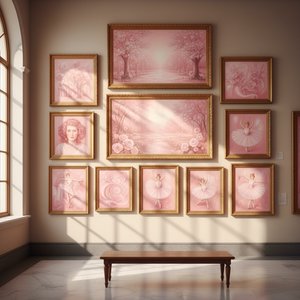
The signature style for which Suzuki Bosco is becoming known – the use of densely packed pink dots to create luminous images – didn’t emerge fully formed. It represents an evolution, a distillation of years spent experimenting with form and color. The choice of pink itself is significant; it's a hue often associated with femininity, playfulness, and even fragility, yet Suzuki Bosco employs it with a strength and boldness that subverts these conventional associations. Her landscapes aren’t idyllic representations but rather emotional responses to place—evocations of atmosphere and memory. Similarly, her cityscapes are not precise renderings of architectural detail but impressions of urban energy, the bustling rhythm of life captured in a shimmering field of color. Works like “Sakana” (1998), with its striking red shapes and geometric design, offer an early glimpse into this developing aesthetic, showcasing a fascination with abstraction and bold visual impact. The pieces "Asakusa" and "Balance", while lacking detailed descriptions, suggest a continued exploration of composition and color harmony within her signature style.
Themes & Historical Context
Suzuki Bosco’s work exists at an interesting intersection of contemporary art trends. While rooted in painting traditions, it also resonates with elements of Pop Art – the use of bold color, repetition, and a focus on visual impact. However, unlike the often-ironic detachment of Pop Art, Suzuki Bosco's work feels deeply personal and emotionally resonant. Her paintings can be seen as a response to the increasingly fragmented nature of modern life, offering moments of calm and contemplation within a chaotic world. The emphasis on meticulous detail—each dot painstakingly applied—suggests a meditative process, a deliberate act of creation in contrast to the speed and superficiality of digital culture. Furthermore, her exploration of spatial knowledge and collaborative practices, as evidenced by her PhD research and participation in artist residencies, positions her within a broader context of artists engaging with social and political issues through their work. Her art isn’t simply about *what* is depicted but *how* it's depicted—the process itself becoming a form of commentary on the nature of perception and representation.
Looking Ahead
Although still developing her wider public recognition, Noriko Suzuki Bosco has established herself as a unique voice in contemporary art. Her work offers a compelling blend of technical skill, emotional depth, and intellectual curiosity. Based in Bologna, Italy, she continues to explore the possibilities of painting, pushing the boundaries of her signature style while remaining true to her core artistic vision. As her body of work expands, it will be fascinating to see how she further integrates her academic research into her practice, continuing to challenge conventional notions of art and its role within society. Her paintings are not merely decorative objects but invitations—invitations to slow down, contemplate, and find beauty in the seemingly simple act of looking.