Portret Ludwig Meidner

19 najpoznatijih slika umetnika Ludwig Meidner, svaka potpuno jedinstvena

Ažurirano: новембар 2026 · rangirano prema našem koeficijentu popularnosti (pretrage, posete i porudžbine za svako delo) · 22 dela Ludwig Meidner u našem katalogu

Ukratko

Max Herrmann-Neisse (1913) je slika autora Ludwig Meidner koja privlači najviše pažnje; original se nalazi u muzeju Art Institute of Chicago, Čikago. Nakon toga, pogled se seli na Despair (III) (1914) i Blowing the Shofar (1937). Među 22 dela umetnika Ludwig Meidner u našem katalogu, ovih 19 su najpoznatija, od kojih je svako jedinstveni original predstavljen sa godinom nastanka, muzejom i razlogom zbog kojeg je i danas neprocenjivo.

1884 – 1966 Expressionism Najviše dela: Jewish Museum Frankfurt

Top 10 slika umetnika Ludwig Meidner, iz ugla galerije

1
Max Herrmann-Neisse (1913) čiji je autor Ludwig Meidner

Max Herrmann-Neisse

1913 · Oil On Canvas · Art Institute of Chicago, Čikago

The gaze of the subject meets us in this 1913 portrait, a moment frozen in oil by the hand of Ludwig Meidner. This work captures Max Herrmann-Neisse, a figure who moved through the intellectual circles of Berlin as a poet and theater critic. The artist, Ludwig Meidner, finds his way into the inner lives of the city's literati, and here he settles upon the face of this specific writer. There…

2
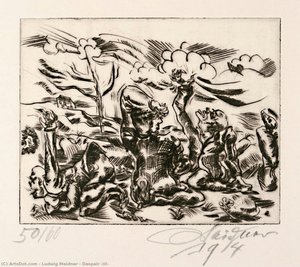
Despair (III) (1914) čiji je autor Ludwig Meidner

Despair (III)

1914 · Woodcut · Jewish Museum Frankfurt, Frankfurt

Despair (III) by Ludwig Meidner is a monochromatic woodcut print created about 1914. The composition is tightly cropped, focusing the viewer's attention on a central group of figures situated within a desolate landscape. These figures are depicted in a state of distress, their forms conveying a sense of suffering or abandonment. In the background, a small building is visible, providing a solitary point of reference within the empty surroundings. The…

3
Blowing the Shofar (1937) čiji je autor Ludwig Meidner

Blowing the Shofar

1937 · Drawing · Jewish Museum Frankfurt, Frankfurt

In the evocative depths of Ludwig Meidner’s 1937 work, Blowing the Shofar, we are transported to a moment of profound spiritual and auditory intensity. This striking black and white drawing captures more than just a ritualistic act; it captures the very breath of a culture. The subject, a man draped in a heavy, hooded robe, is caught in the visceral moment of exhaling into the shofar—a ram’s horn instrument central…

4
Gas Chamber (1945) čiji je autor Ludwig Meidner

Gas Chamber

1945 · Jewish Museum Frankfurt, Frankfurt

Meidner’s charcoal drawing of a gas chamber was probably produced prior to the spring of 1945. Following the liberation of the extermination camps, numerous photos and eyewitness accounts circulated documenting the fact that in the majority of the death camps the gas chambers were disguised as shower blocks, complete with shower heads, in order to prevent panic among those being sent to their deaths. This detail, intriguing in its perfidy,…

Čuvena dela umetnika Ludwig Meidner, od 11 do 19

Motivi koji su privlačili pažnju Ludwig Meidner

Četiri teme koje se najčešće ponavljaju u ovim originalima, svaka sa svojim vrhunskim primerom.

Muzeji u kojima se čuvaju originalna dela umetnika Ludwig Meidner

2 muzeja u kojima se nalazi najviše slika sa ove stranice.

Muzeji Grad Radovi umetnika Ludwig Meidner Slike iz ovog spiska
Jewish Museum Frankfurt, FrankfurtJewish Museum Frankfurt Frankfurt 13 Despair (III), Blowing the Shofar, Gas Chamber
Art Institute of Chicago, ČikagoArt Institute of Chicago Čikago 1 Max Herrmann-Neisse

Ludwig Meidner kroz decenije: jedan jedinstveni original za svaku

Radovi po decenijama

Izaberite deceniju da biste videli original koji je definiše.

Slike umetnika Ludwig Meidner: pitanja za galeriju

Koje je najpoznatije delo umetnika Ludwig Meidner?Otkrij odgovor

Max Herrmann-Neisse (1913), Art Institute of Chicago, Čikago. Slede Despair (III) (1914) i Blowing the Shofar (1937).

U kojoj je godini Ludwig Meidner stvorio/la Max Herrmann-Neisse?Otkrij odgovor

29 godina: Max Herrmann-Neisse datira iz 1913, a Ludwig Meidner je rođen/a 1884.

Koji je deset najpoznatijih slika autora Ludwig Meidner?Otkrij odgovor

Max Herrmann-Neisse, Despair (III), Blowing the Shofar, Gas Chamber, Untitled (327), Ecstatic Figure, Male Head, Male Head with Kippah and Tallit, Male Portrait with Kippah i Two Praying Jews. Gornji rang pokazuje godinu i muzej za svako od njih.

Koliko je poznatih dela umetnika Ludwig Meidner?Otkrij odgovor

Naš katalog sadrži 22 dela umetnika Ludwig Meidner, datiranih od 1913 do 1950.

Gde se mogu videti najpoznatiji originali umetnika Ludwig Meidner?Otkrij odgovor

Većinom u Jewish Museum Frankfurt (Frankfurt) i Art Institute of Chicago (Čikago). Tabela muzeja iznad sadrži njih sve.

U kom periodu je Ludwig Meidner stvorio/la svoje najpoznatije slike?Otkrij odgovor

U 1930s: 5 od 19 dela na ovoj stranici nastalo je tada, od čega je Blowing the Shofar.

Ko je najraniji, a koje je najkasnije čuveno delo umetnika Ludwig Meidner?Otkrij odgovor

Na ovoj stranici, najstarije delo je iz Max Herrmann-Neisse (1913), a najnovije iz The Sacrifice of Manoah (1950).

Koje su teme Ludwig Meidner preferirao/la?Otkrij odgovor

Portrait (3), Man (2) i Tallit (2), kroz svih 19 dela na ovoj stranici.

Sa kojim materijalima je Ludwig Meidner najčešće slikao?Otkrij odgovor

Drawing, za 5 od 19 dela na ovoj stranici.

Kojem umetničkom pravcu pripada delo umetnika Ludwig Meidner?Otkrij odgovor

Expressionism, sudeći po originalima na ovoj stranici.

Koja originalna dela Ludwig Meidner mogu videti u Jewish Museum Frankfurt?Otkrij odgovor

Despair (III), Blowing the Shofar i Gas Chamber: Jewish Museum Frankfurt, Frankfurt čuva 13 dela sa ove stranice.

Ludwig Meidner: portret umetnika

A Life Shaped by Change

Born in Bernstadt, Germany, in 1884, Ludwig Meidner began his adult life far from the canvas. He first followed his parents' wishes by taking up an apprenticeship as a stonemason, though he did not complete this training. His path eventually led him to the Royal School of Art in Breslau and later to Paris, where he studied at the Académie Julian and Cormon Academies. During these years in Paris, he met Amedeo Modigliani, a connection that placed him at the center of a changing artistic landscape. After returning to Berlin, he worked as a fashion illustrator and draftsman, finding his footing within the city's growing avant-garde circles.

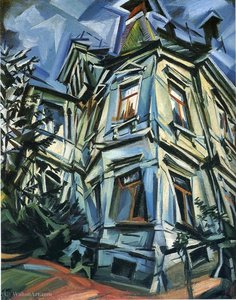
The years leading up to the First World War brought a profound shift in his vision. In 1912, he began creating what are often called his apocalyptic landscapes. These works featured chaotic scenes of urban life, with comets crossing skies like shells and buildings appearing on the verge of collapse. While some saw these images as predictions of the coming war, they were also reflections of the intense energy and social unrest present in the modern metropolis. His involvement with the Die Pathetiker group further solidified his place in the German expressionist movement.

Faith and Displacement

The devastation of the First World War changed Meidner deeply. Having served in the German military as an infantry soldier and a French interpreter, he emerged from the conflict with a different perspective on life and art. He turned toward Orthodox Judaism, finding a new source of meaning through religious themes. His work began to include portraits of prophets and scenes of Jewish ritual, such as his 1937 drawing, Blowing the Shofar. This period saw him moving away from pure expressionist chaos toward more structured, religious imagery that explored the inner experience of faith.

The rise of the Nazi party forced another period of movement and hardship. In 1935, Meidner moved to Cologne to teach at a Jewish school, but the increasing pressure in Germany became impossible to ignore. His work was included in the 1937 Degenerate Art exhibition in Munich, an event that marked him as a target of the regime. In August 1939, he and his wife, Else Meidner, fled to England. Life in London was difficult; he was interned at Huyton Camp and later on the Isle of Man. During these years of exile, he lived in near poverty, often relying on the support of the local Jewish community while continuing to draw and paint from his observations of the world around him.

A Return to Germany

After many years in England, Meidner chose to return to Germany in 1953. He settled in Frankfurt, a city that offered him both a sense of stability and a connection to his heritage. This later period of his life was marked by a renewed recognition within the German art scene. In 1964, he received the Order of Merit of the Federal Republic of Germany and became a member of the Berlin Academy of Fine Arts. His late works continued to reflect his lifelong engagement with both the physical world and the spiritual realm.

Meidner passed away in Darmstadt in 1966. His legacy remains visible in major institutions such as the Jewish Museum Frankfurt, the Museum of Modern Art in New York, and the Metropolitan Museum of Art. Through his varied roles as a painter, printmaker, and writer, he left behind a body of work that documented the turbulent transitions of the twentieth century.