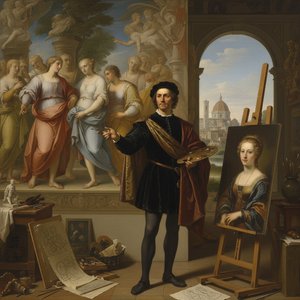
The Florentine Shadow: The Life and Legacy of Lippo d'Andrea
In the vibrant, sun-drenched era of the early Italian Renaissance, where the shadows of Giotto still lingered and the dawn of new humanism was breaking, there existed a painter whose identity was once shrouded in the mystery of attribution. Lippo d'Andrea di Lippo, a master whose name has emerged from the historical fog to reclaim his place in the Florentine canon, represents a fascinating bridge between the late Gothic tradition and the burgeoning naturalism of the Quattrocento. Born around 1370 in the cradle of Florence, his early years were steeped in the rich, devotional atmosphere of a city on the precipice of artistic revolution. For many years, his hand was known only through the pseudonym Pseudo-Ambrogio di Baldese, a testament to how deeply his style was woven into the collective fabric of Florentine workshop traditions.
The trajectory of Lippo’s career is marked by significant institutional milestones that anchor him firmly within the prestigious artistic circles of his time. In 1411, he formally joined the Compagnia di San Luca, the guild of Saint Luke, a move that signaled his established status among the professional painters of Florence. This period was one of intense productivity and collaborative grandeur. Alongside notable contemporaries such as Niccolò di Pietro Gerini and Ambrogio di Baldese, Lippo was entrusted with the monumental task of decorating the facade of the Palazzo del Ceppo in Prato. Such commissions were not merely artistic endeavors but civic duties, requiring a mastery of fresco technique that could withstand the elements while conveying profound religious narratives to the passing public.
A Tapestry of Influence and Devotion
To understand the aesthetic soul of Lippo d'Andrea, one must look toward the stylistic currents that flowed through Florence during his formative decades. His work embodies a delicate synthesis of the decorative elegance found in the late Gothic period and the burgeoning interest in structural clarity. While some historical accounts suggest a connection to the Bolognese school—noted for its sensitivity to color and texture—his primary identity remains inextricably linked to the Florentine tradition. The echoes of masters like Lorenzo Monaco can be felt in the rhythmic grace of his compositions, yet there is an underlying strength in his figures that hints at the approaching era of greater anatomical realism.
His artistic reach extended into the most sacred spaces of Florence, where his presence is felt through both documented commissions and scholarly speculation. The Nerli Chapel at Santa Maria del Carmine stands as a site of great intrigue, where the appearance of a painter named 'Lippo' in records from 1402 has led historians to believe that his creative spirit was active even in the final decade of the fourteenth century. This period of his development shows an artist navigating the transition from the stylized, symbolic language of the Middle Ages toward a more palpable, humanized divinity.
The Grandeur of the Apostles and Final Years
One of the most significant achievements in Lippo’s storied career occurred during the mid-1430s, a time of immense architectural and religious celebration in Florence. In 1435-36, he was selected as part of an elite group of painters—including Bicci di Lorenzo and Giovanni dal Ponte—to execute the frescoes of the apostles within the tribune chapels of the Florence Cathedral. This task, undertaken to celebrate the consecration of the newly completed dome by Pope Eugene IV, placed Lippo at the very heart of the Florentine Renaissance's most prestigious project. To contribute to the Duomo was to participate in the visual manifestation of the city's glory and spiritual devotion.
Though his life remains partially obscured by the passage of centuries, the historical record confirms that Lippo d'Andrea was active until at least the mid-15th century. His legacy is not found merely in individual canvases, but in the way he helped sustain the continuity of Florentine excellence during a period of profound change. Through his frescoes and devotional works, he contributed to a visual language that prepared the world for the giants of the High Renaissance, ensuring that the spiritual depth of the past was carried forward into the light of a new age.