Portret Јозеф Брандт

85 najpoznatijih slika umetnika Јозеф Брандт, svaka potpuno jedinstvena

Ažurirano: новембар 2026 · rangirano prema našem koeficijentu popularnosti (pretrage, posete i porudžbine za svako delo) · 87 dela Јозеф Брандт u našem katalogu

Ukratko

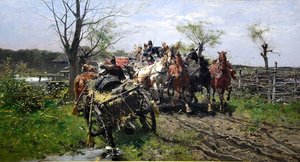
Jews were leading the horses on the market (1865) je slika autora Јозеф Брандт koja privlači najviše pažnje; original se nalazi u muzeju Nacionalni muzej u Varšavi, Varšava. Nakon toga, pogled se seli na Farewell (1867) i Defense of a manor (Bar Confederates). (1875). Među 87 dela umetnika Јозеф Брандт u našem katalogu, ovih 85 su najpoznatija, od kojih je svako jedinstveni original predstavljen sa godinom nastanka, muzejom i razlogom zbog kojeg je i danas neprocenjivo.

1841 – 1915, Щебжешин Romanticism Najviše dela: Nacionalni muzej u Varšavi

Top 10 slika umetnika Јозеф Брандт, iz ugla galerije

2
Farewell (1867) čiji je Јозеф Брандт

Farewell

1867 · Oil

In this 1867 oil painting, a somber scene of separation unfolds within a rural setting. The composition is divided by a sharp contrast between light and shadow. On the right, a dark, shadowed foreground contains a woman dressed in traditional folk attire. She stands near a wooden structure, her gaze directed toward the left side of the canvas. To the left, a group of men and horses are positioned under…

3
Defense of a manor (Bar Confederates). (1875) čiji je Јозеф Брандт

Defense of a manor (Bar Confederates).

1875 · Oil On Canvas · Nacionalni muzej u Varšavi, Varšava

A chaotic military engagement unfolds within a desolate, snow-covered landscape. Figures move through deep, uneven drifts toward a wooden fortification, their forms cutting through the heavy, wintry atmosphere. The composition relies on energetic, diagonal lines to convey the tension of the movement, particularly in the strained postures of the men and the sloping, snow-laden roofs of the structures. Muted tones of white, gray, and dark brown dominate the scene, punctuated…

4
Courtship (1874) čiji je Јозеф Брандт

Courtship

1874 · Oil On Canvas · Nacionalni muzej u Varšavi, Varšava

Józef Brandt’s Courtship, created about 1874, presents a social encounter set within a rustic, rural courtyard. The composition utilizes a diagonal arrangement to direct the viewer's gaze from the horses positioned in the foreground toward the human figures situated in the midground. A man wearing ornate attire, possibly military or folk in style, approaches a woman standing within a doorway. This interaction establishes a narrative of courtship through their proximity…

5
Cossack on Horseback (1881) čiji je Јозеф Брандт

Cossack on Horseback

1881 · Oil On Canvas

In "Cossack on Horseback" by Józef Brandt, we find ourselves observing a solitary figure set against a vast, open landscape. The rider, a Cossack, is mounted upon a deep chestnut brown horse with a dark mane. Positioned slightly to the left of the center, the rider commands the space, creating a sense of quiet presence within the immense environment. He is dressed in a traditional military uniform, rendered in shades…

6
Lisowczycy - Archery Shooting (1885) čiji je Јозеф Брандт

Lisowczycy - Archery Shooting

1885 · Oil On Canvas

A sudden surge of muscle and hoofbeat breaks the stillness of the field. The Lisowczycy cavalrymen move in a sharp, diagonal rush, their horses galloping from left to right with a heavy, rhythmic momentum. There is a tension in the air, held tight by the curve of a drawn bow. The riders are caught in a singular moment of focus, their bodies leaning into the wind of their own speed.…

7
Chat with Young Washerwomen (1882) čiji je Јозеф Брандт

Chat with Young Washerwomen

1882 · Oil On Canvas

Chat with Young Washerwomen by Józef Brandt depicts a rural scene from about 1882. In the foreground, a group of washerwomen is gathered together. The subject matter focuses on the daily labor of common people. This group occupies the lower portion of the canvas, positioned near the viewer's eye-level perspective.

8
Fair in Balta, Podolia region (1885) čiji je Јозеф Брандт

Fair in Balta, Podolia region

1885 · Oil On Panel · Nacionalni muzej u Varšavi, Varšava

The oil painting titled Fair in Balta, Podolia region was executed by the artist Józef Brandt. Created in 1885, this work depicts a scene centered on the daily life of a rural market. The setting is located in the Podolia region, a territory situated in the west-central and southwestern parts of Ukraine and northeastern Moldova.

9
Portrait of the painter Zenon Łęski (1900) čiji je Јозеф Брандт

Portrait of the painter Zenon Łęski

1900 · Oil On Canvas

The artwork is the Portrait of the painter Zenon Łęski, a work executed by the artist Józef Brandt. This oil painting depicts Zenon Łęski, who was a student of Józef Brandt. The subject of the portrait is the painter himself, captured in a bust-length composition. The relationship between the artist and the sitter is established through their shared history in the Munich art circles, where Łęski studied under the guidance…

10
Keeping watch (1902) čiji je Јозеф Брандт

Keeping watch

1902 · Oil · Nacionalni muzej u Varšavi, Varšava

A lone rider moves through a landscape that feels heavy with the weight of an overcast sky. The air seems thick, damp with the breath of a muted, grey heavens that press down upon the rolling hills. Beneath the horse's hooves, the grass is a textured sea of ochre and deep green, rendered with thick, visible strokes that suggest the unevenness of the earth. The chestnut horse carries its rider…

Čuvena dela umetnika Јозеф Брандт, od 11 do 85

11The Capture Of A Caucasian Chief čiji je Јозеф БрандтThe Capture Of A Caucasian ChiefNacionalni muzej u Varšavi 12Zaporizhians čiji je Јозеф БрандтZaporizhians 13Leaving Vienna čiji je Јозеф БрандтLeaving Vienna 14Horsemen in the woods, sketch (1876) čiji je Јозеф БрандтHorsemen in the woods, sketch1876 · Nacionalni muzej u Varšavi 15The steppe farm (1876) čiji je Јозеф БрандтThe steppe farm1876 · Polish Museum 16Defense of a manor (Bar Confederates) (1875) čiji je Јозеф БрандтDefense of a manor (Bar Confederates)1875 17Prayer in the steppe (Our Lady of Pochayiv) (1890) čiji je Јозеф БрандтPrayer in the steppe (Our Lady of Pochayiv)1890 · Nacionalni muzej u Varšavi 18Departure from Wilanów of John III Sobieski and Marysieńka (1887) čiji je Јозеф БрандтDeparture from Wilanów of John III Sobieski and Marysieńka1887 · Nacionalni muzej u Varšavi 19Backyard (1898) čiji je Јозеф БрандтBackyard1898 · Nacionalni muzej u Varšavi 20Farmyards (1898) čiji je Јозеф БрандтFarmyards1898 · Nacionalni muzej u Varšavi 21Sketch for “Our Lady of Armenia” (1893) čiji je Јозеф БрандтSketch for “Our Lady of Armenia”1893 · Nacionalni muzej u Varšavi 22Hunt (1900) čiji je Јозеф БрандтHunt1900 · Poljski muzej u Rapperswilu 23Portrait of Artur Potocki [?] čiji je Јозеф БрандтPortrait of Artur Potocki [?]Nacionalni muzej u Varšavi 24Ein Siegeslied čiji je Јозеф БрандтEin Siegeslied 25Schlittenfahrt Zur Zeit Des Königs Sobieski čiji je Јозеф БрандтSchlittenfahrt Zur Zeit Des Königs Sobieski 26Ein Gefecht čiji je Јозеф БрандтEin Gefecht 27Aufbruch Zur Jagd čiji je Јозеф БрандтAufbruch Zur Jagd 28A Steppe Stud čiji je Јозеф БрандтA Steppe Stud 29Militia At The Ford čiji je Јозеф БрандтMilitia At The Ford 30Odbicie Jasyru čiji je Јозеф БрандтOdbicie Jasyru 31Wyjazd Z Wilanowa Jana Iii Sobieskiego čiji je Јозеф БрандтWyjazd Z Wilanowa Jana Iii Sobieskiego 32Czarniecki Na Tarancie čiji je Јозеф БрандтCzarniecki Na Tarancie 33Fair in Białka (1885) čiji je Јозеф БрандтFair in Białka1885 34Call to arms (1880) čiji je Јозеф БрандтCall to arms1880 · Nacionalni muzej u Varšavi 35Zaporizhian Camp (1880) čiji je Јозеф БрандтZaporizhian Camp1880 · Nacionalni muzej u Varšavi 36Cossacks Fording čiji je Јозеф БрандтCossacks Fording 37After The Battle čiji je Јозеф БрандтAfter The Battle 38On The Move čiji je Јозеф БрандтOn The Move 39On Reconnaissance čiji je Јозеф БрандтOn ReconnaissanceWalters Art Museum 40Battle Of Chocimem čiji je Јозеф БрандтBattle Of Chocimem 41Cossacks At Play čiji je Јозеф БрандтCossacks At Play 42The Flight čiji je Јозеф БрандтThe Flight 43Czarniecki Under Koldynga čiji je Јозеф БрандтCzarniecki Under Koldynga 44Bunczuczny čiji je Јозеф БрандтBunczuczny 45The Oriental Market čiji je Јозеф БрандтThe Oriental Market 46Jarmark Na Podolu čiji je Јозеф БрандтJarmark Na Podolu 47Cossack Watchman čiji je Јозеф БрандтCossack Watchman 48Haymaking čiji je Јозеф БрандтHaymaking 49Bryczka Tatarska čiji je Јозеф БрандтBryczka Tatarska 50Battle Of Vienna čiji je Јозеф БрандтBattle Of Vienna 51The Caravan čiji je Јозеф БрандтThe Caravan 52Prayer In The Steppe čiji je Јозеф БрандтPrayer In The Steppe 53Speeding Chariot čiji je Јозеф БрандтSpeeding Chariot 54A Cavalry Assault čiji je Јозеф БрандтA Cavalry Assault 55Halt In A Small Town čiji je Јозеф БрандтHalt In A Small Town 56Chorazy Królewski čiji je Јозеф БрандтChorazy Królewski 57Attack Of The Cavalry čiji je Јозеф БрандтAttack Of The Cavalry 58Konfederacja Barska čiji je Јозеф БрандтKonfederacja Barska 59Signature Of The Polish Painter čiji je Јозеф БрандтSignature Of The Polish Painter 60Do Widzenia čiji je Јозеф БрандтDo Widzenia 61Hussar čiji je Јозеф БрандтHussar 62Meeting On The Bridge čiji je Јозеф БрандтMeeting On The BridgeNacionalni muzej u Krakovu 63Battle Over The Turkish Banner čiji je Јозеф БрандтBattle Over The Turkish BannerNacionalni muzej u Krakovu 64Song Of The Cossack Victors čiji je Јозеф БрандтSong Of The Cossack Victors 65Skladanie Sztandarow čiji je Јозеф БрандтSkladanie Sztandarow 66Cossack And A Girl At The Well čiji je Јозеф БрандтCossack And A Girl At The Well 67Before Lisowczycy Gospoda čiji je Јозеф БрандтBefore Lisowczycy Gospoda 68A Cavalry Skirmish On The Outskirts Of A Town čiji je Јозеф БрандтA Cavalry Skirmish On The Outskirts Of A Town 69The March Of Swedes For Kiejdany čiji je Јозеф БрандтThe March Of Swedes For Kiejdany 70Horse čiji je Јозеф БрандтHorse 71Towarzysz Pancerny čiji je Јозеф БрандтTowarzysz Pancerny 72Horses Bolted čiji je Јозеф БрандтHorses Bolted 73Battle Against Tatars čiji je Јозеф БрандтBattle Against Tatars 74On The Move čiji je Јозеф БрандтOn The Move 75Pospolite Ruszenie U Brodu čiji je Јозеф БрандтPospolite Ruszenie U Brodu 76Chwytanie Konia Na Arkan čiji je Јозеф БрандтChwytanie Konia Na Arkan 77The Runaway Cart čiji je Јозеф БрандтThe Runaway Cart 78Untitled (AQQPKU) čiji je Јозеф БрандтUntitled (AQQPKU) 79Battle of Khotyn (1621) (1867) čiji je Јозеф БрандтBattle of Khotyn (1621)1867 · Nacionalni muzej u Varšavi 80Czarniecki at Kolding (1870) čiji je Јозеф БрандтCzarniecki at Kolding1870 · Nacionalni muzej u Varšavi 81Dangerous crossing (1909) čiji je Јозеф БрандтDangerous crossing1909 · Silesian Museum in Katowice 82Recapture of prisoners (1878) čiji je Јозеф БрандтRecapture of prisoners1878 · Nacionalni muzej u Varšavi 83On the Dniester River (1875) čiji je Јозеф БрандтOn the Dniester River1875 · Nacionalni muzej u Krakovu 84Portrait Of The Painter Józef Brandt čiji je Јозеф БрандтPortrait Of The Painter Józef BrandtNacionalni muzej u Varšavi 85Cossacks čiji je Јозеф БрандтCossacksNational Museum in Wrocław

Motivi koji su privlačili pažnju Јозеф Брандт

Četiri teme koje se najčešće ponavljaju u ovim originalima, svaka sa svojim vrhunskim primerom.

Muzeji u kojima se čuvaju originalna dela umetnika Јозеф Брандт

7 muzeja u kojima se nalazi najviše slika sa ove stranice.

Muzej Grad Radovi umetnika Јозеф Брандт Slike iz ovog spiska
Nacionalni muzej u Varšavi, VaršavaNacionalni muzej u Varšavi Varšava 19 Jews were leading the horses on the market, Defense of a manor (Bar Confederates)., Courtship
Nacionalni muzej u Krakovu, KrakovNacionalni muzej u Krakovu Krakov 3 Meeting On The Bridge, Battle Over The Turkish Banner, On the Dniester River
Polish Museum, Rapperswil-sur-RippePolish Museum Rapperswil-sur-Rippe 1 The steppe farm
Poljski muzej u Rapperswilu, Rapersvil-sur-RippePoljski muzej u Rapperswilu Rapersvil-sur-Rippe 1 Hunt
Walters Art Museum, BaltimoreWalters Art Museum Baltimore 1 On Reconnaissance
Silesian Museum in Katowice, KatowiceSilesian Museum in Katowice Katowice 1 Dangerous crossing
National Museum in Wrocław, WrocławNational Museum in Wrocław Wrocław 1 Cossacks

Јозеф Брандт kroz decenije: jedan jedinstveni original za svaku

Radovi po decenijama

Izaberite deceniju da biste videli original koji je definiše.

Slike umetnika Јозеф Брандт: pitanja za galeriju

Koje je najpoznatije delo umetnika Јозеф Брандт?Otkrij odgovor

Jews were leading the horses on the market (1865), Nacionalni muzej u Varšavi, Varšava. Slede Farewell (1867) i Defense of a manor (Bar Confederates). (1875).

U kojoj je godini Јозеф Брандт stvorio/la Jews were leading the horses on the market?Otkrij odgovor

24 godina: Jews were leading the horses on the market datira iz 1865, a Јозеф Брандт je rođen/a 1841.

Koji je deset najpoznatijih slika autora Јозеф Брандт?Otkrij odgovor

Jews were leading the horses on the market, Farewell, Defense of a manor (Bar Confederates)., Courtship, Cossack on Horseback, Lisowczycy - Archery Shooting, Chat with Young Washerwomen, Fair in Balta, Podolia region, Portrait of the painter Zenon Łęski i Keeping watch. Gornji rang pokazuje godinu i muzej za svako od njih.

Koliko je poznatih dela umetnika Јозеф Брандт?Otkrij odgovor

Naš katalog sadrži 87 dela umetnika Јозеф Брандт, datiranih od 1865 do 1909.

Gde se mogu videti najpoznatiji originali umetnika Јозеф Брандт?Otkrij odgovor

Većinom u Nacionalni muzej u Varšavi (Varšava), Nacionalni muzej u Krakovu (Krakov) i Polish Museum (Rapperswil-sur-Rippe). Tabela muzeja iznad sadrži njih sve.

U kom periodu je Јозеф Брандт stvorio/la svoje najpoznatije slike?Otkrij odgovor

U 1870s: 8 od 85 dela na ovoj stranici nastalo je tada, od čega je Defense of a manor (Bar Confederates)..

Ko je najraniji, a koje je najkasnije čuveno delo umetnika Јозеф Брандт?Otkrij odgovor

Na ovoj stranici, najstarije delo je iz Jews were leading the horses on the market (1865), a najnovije iz Dangerous crossing (1909).

Koje su teme Јозеф Брандт preferirao/la?Otkrij odgovor

Horse (7), Sky (6) i Wars (6), kroz svih 85 dela na ovoj stranici.

Sa kojim materijalima je Јозеф Брандт najčešće slikao?Otkrij odgovor

Oil On Canvas, za 7 od 85 dela na ovoj stranici.

Kojem umetničkom pravcu pripada delo umetnika Јозеф Брандт?Otkrij odgovor

Romanticism, sudeći po originalima na ovoj stranici.

Koja originalna dela Јозеф Брандт mogu videti u Nacionalni muzej u Varšavi?Otkrij odgovor

Jews were leading the horses on the market, Defense of a manor (Bar Confederates). i Courtship: Nacionalni muzej u Varšavi, Varšava čuva 19 dela sa ove stranice.

Јозеф Брандт: portret umetnika

A Life Immersed in Polish Valor: The World of Józef von Brandt

Józef von Brandt, born in the small Polish town of Szczebrzeszyn in 1841 and passing away in Radom in 1915, was more than just a painter; he was a chronicler of a nation’s spirit. His canvases breathe with the drama of 17th-century battles, the vibrant energy of Cossack life, and an unwavering dedication to Polish history and cultural identity. Brandt's artistic journey began not in the studio but in the classrooms of Warsaw’s school of J.N. Leszczynski and the Noblemen's Institute, a path seemingly destined for engineering when he moved to Paris in 1858 to study at the Ecole centrale. However, fate – or perhaps a keen eye for talent – intervened in the form of Juliusz Kossak, who recognized Brandt’s true calling and steered him away from blueprints towards brushes and pigments. This pivotal moment redirected his life toward an artistic pursuit that would immortalize Poland's past.

From Munich to Mastery: The Shaping of a Historical Painter

The move to Munich in 1863 proved transformative. Under the tutelage of Franz Adam and Karl Piloty at the Academy of Fine Arts, Brandt honed his skills, absorbing techniques that would become hallmarks of his style. He wasn’t merely learning to paint; he was learning to narrate history visually. The influence of Theodor Horschelt, a specialist in battle scenes who had accompanied the Russian army, further refined his understanding of military life and composition. By 1867, Brandt established his own studio, becoming a central figure within the thriving Polish artistic community in Munich – a haven for artists displaced by political turmoil. He quickly became a mentor to many aspiring Polish painters, fostering a sense of national pride through art. His early works, while conventional, laid the foundation for the dramatic and emotionally charged scenes that would define his career.

The Essence of 17th-Century Poland: Themes and Techniques

Brandt’s paintings are not simply depictions of battles; they are immersive experiences. He focused intently on the military life of the 17th century, a period steeped in Polish glory and conflict. However, he didn't limit himself to warfare. Scenes of Polish peasant life also found their way onto his canvases, offering glimpses into the everyday existence that underpinned the nation’s heroic narratives. His most celebrated works center around the *hussars*, those iconic winged cavalrymen, and the fierce Cossack warriors, rendered with meticulous detail in their elaborate uniforms and dynamic poses. Brandt possessed an exceptional ability to capture movement and energy, bringing a sense of immediacy to his large-scale compositions. He masterfully combined realism with symbolic depth, using color, light, and shadow to evoke emotion and convey historical significance. While adhering to academic standards through studio work, he also undertook field studies in Poland and Ukraine, ensuring the authenticity of his landscapes and figures.

Notable Works and Lasting Legacy

Several paintings stand as testaments to Brandt’s artistic prowess. “Battle of Vienna” is a sweeping panorama of conflict, capturing the intensity and chaos of this pivotal historical moment. "Jan Karol Chodkiewicz during the Battle of Khotyn" exemplifies his skill in portraying individual heroism within a larger military context. And “Polish Hussar,” perhaps his most iconic work, embodies the spirit of Polish valor and national pride. These paintings, along with others like “Zaporozhian Camp” and "Call to Arms", are not merely historical records; they are powerful statements about identity, courage, and resilience. Today, Brandt’s works grace the walls of prestigious institutions such as the National Museum in Warsaw and the Museum Pomorskie in Danzig (Gdansk), serving as enduring reminders of Poland's rich cultural heritage. His legacy extends beyond museums, with reproductions available through platforms like OriginalUniqueArt.com and OriginalUniqueArt.com, allowing a wider audience to experience the grandeur and emotional depth of his masterpieces. He remains a pivotal figure in Polish art history, celebrated for his ability to transform historical events into captivating visual narratives that continue to resonate with audiences today.