Portret Joseph Walter

25 najpoznatijih slika umetnika Joseph Walter, svaka potpuno jedinstvena

Ažurirano: новембар 2026 · rangirano prema našem koeficijentu popularnosti (pretrage, posete i porudžbine za svako delo) · 25 dela Joseph Walter u našem katalogu

Ukratko

Bristol Harbour (1837) je slika autora Joseph Walter koja privlači najviše pažnje; original se nalazi u muzeju Bristol Museum - Art Gallery, Bristol. Nakon toga, pogled se seli na The SS 'Great Western' (1843) i The 'Great Western' off Portishead, April 1838, on Her First Voyage (1838). Među 25 dela umetnika Joseph Walter u našem katalogu, ovih 25 su najpoznatija, od kojih je svako jedinstveni original predstavljen sa godinom nastanka, muzejom i razlogom zbog kojeg je i danas neprocenjivo.

1783 – 1856, Bristol Najviše dela: Bristol Museum - Art Gallery

Top 10 slika umetnika Joseph Walter, iz ugla galerije

1
Bristol Harbour (1837) čiji je autor Joseph Walter

Bristol Harbour

1837 · Oil On Canvas · Bristol Museum - Art Gallery, Bristol

The harbor scene captures a moment of quiet industry within the Bristol docks. Various vessels, ranging from large, imposing boats to smaller craft, occupy the water, their forms scattered across the foreground and middle distance. Figures move through the scene, their presence grounding the maritime activity in human scale. One individual is positioned near the center-left, while others are situated toward the right and the far left, suggesting the continuous,…

2
The SS 'Great Western' (1843) čiji je autor Joseph Walter

The SS 'Great Western'

1843 · Oil On Canvas · The British Postal Museum - Archive, London

The sea is a heavy, churning presence in this 1843 oil on canvas. A large sailing ship cuts through rough waters, its hull meeting the resistance of a restless ocean. Smaller boats surround the vessel, appearing fragile against the swell. Above, the sky is a mass of dramatic clouds, casting a restless light over the scene. Two figures lean into the movement on the main boat, their hands likely gripped…

3
The 'Great Western' off Portishead, April 1838, on Her First Voyage (1838) čiji je autor Joseph Walter

The 'Great Western' off Portishead, April 1838, on Her First Voyage

1838 · Oil On Canvas · Bristol Museum - Art Gallery, Bristol

The oil on canvas painting titled The 'Great Western' off Portishead, April 1838, on Her First Voyage was executed by the artist Joseph Walter. This work, created in 1838, captures a specific moment in maritime history involving the 236-foot wooden-hulled steamer. The subject is depicted navigating the waters of the Bristol Channel during its maiden voyage. The vessel is shown operating under both sail and steam propulsion.

4
Kingroad and the Mouth of the Avon (1837) čiji je autor Joseph Walter

Kingroad and the Mouth of the Avon

1837 · Oil · Bristol Museum - Art Gallery, Bristol

In Kingroad and the Mouth of the Avon, Joseph Walter captures a lively maritime scene set against the open ocean. Painted about 1837, the work places the viewer directly amidst a gathering of sailing ships navigating the waters. A single large ship dominates the composition, its massive form commanding the attention of the sea around it. This central vessel anchors the scene, providing a sense of scale against the vastness…

5
Bristol Harbour with St Mary Redcliffe (1835) čiji je autor Joseph Walter

Bristol Harbour with St Mary Redcliffe

1835 · Oil · Merchants Hall, Bristol

The scene unfolds in the bustling waters of Bristol Harbour with St Mary Redcliffe, a work that captures a specific moment in the maritime life of the United Kingdom. Joseph Walter, an artist deeply immersed in the rhythms of the sea, brings this harbor to life through his careful observation of the water and the vessels that navigate it. The painting, dated about 1835, presents a view of the port…

6
The Ship 'Severn' (1835) čiji je autor Joseph Walter

The Ship 'Severn'

1835 · Oil · Bristol Museum - Art Gallery, Bristol

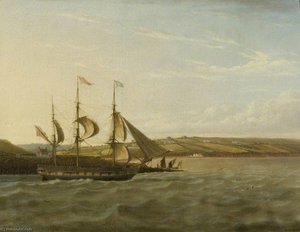
The painting depicts a large sailing ship with multiple sails navigating through the water. This central vessel is surrounded by other boats in the background, which serves to create a sense of scale and depth within the maritime scene. Several people are visible on the boat, appearing to be either crew members or passengers enjoying their time at sea.

7
The West Indiaman 'Britannia' (1838) čiji je autor Joseph Walter

The West Indiaman 'Britannia'

1838 · Oil On Canvas · National Maritime Museum, London

The West Indiaman 'Britannia' emerges from the canvas as a detailed oil painting, capturing a specific moment in maritime history. Joseph Walter, an artist deeply immersed in the life of the sea, brings this vessel to life through his careful application of oil. The work dates to 1838, a period when the bustling activity of the docks and the heavy presence of merchant ships defined the coastal landscape.

8
A Trading Brig Entering the Bristol Avon (1838) čiji je autor Joseph Walter

A Trading Brig Entering the Bristol Avon

1838 · Oil · National Maritime Museum, London

The painting depicts a scene of sailboats on the water with one large boat in the foreground and several smaller boats scattered around it. The main ship is yellow and has a red flag flying from its mast. There are at least six people visible on the larger boat, possibly enjoying their time out on the water or attending to various tasks related to sailing. The painting captures the essence…

9
Shipping in the Bristol Channel (1837) čiji je autor Joseph Walter

Shipping in the Bristol Channel

1837 · Oil On Canvas · National Maritime Museum, London

The sea air seems to linger around Shipping in the Bristol Channel, a work that captures a specific moment in the maritime history of the United Kingdom. Joseph Walter, an artist born in Bristol in 1783, brings his intimate knowledge of these waters to the canvas. The scene unfolds from 1837, a time when the rhythms of sail and the movement of trade defined the coastal existence. Every line and…

Čuvena dela umetnika Joseph Walter, od 11 do 25

Čuvena dela Joseph Walter po periodima

Motivi koji su privlačili pažnju Joseph Walter

Četiri teme koje se najčešće ponavljaju u ovim originalima, svaka sa svojim vrhunskim primerom.

Muzeji u kojima se čuvaju originalna dela umetnika Joseph Walter

4 muzeja u kojima se nalazi najviše slika sa ove stranice.

Muzeji Grad Radovi umetnika Joseph Walter Slike iz ovog spiska
Bristol Museum - Art Gallery, BristolBristol Museum - Art Gallery Bristol 14 Bristol Harbour, The 'Great Western' off Portishead, April 1838, on Her First Voyage, Kingroad and the Mouth of the Avon
National Maritime Museum, LondonNational Maritime Museum London 6 The West Indiaman 'Britannia', A Trading Brig Entering the Bristol Avon, Shipping in the Bristol Channel
The British Postal Museum - Archive, LondonThe British Postal Museum - Archive London 2 The SS 'Great Western', RMS 'Severn' in the Bristol Channel
Merchants Hall, BristolMerchants Hall Bristol 1 Bristol Harbour with St Mary Redcliffe

Joseph Walter kroz decenije: jedan jedinstveni original za svaku

Radovi po decenijama

Izaberite deceniju da biste videli original koji je definiše.

Slike umetnika Joseph Walter: pitanja za galeriju

Koje je najpoznatije delo umetnika Joseph Walter?Otkrij odgovor

Bristol Harbour (1837), Bristol Museum - Art Gallery, Bristol. Slede The SS 'Great Western' (1843) i The 'Great Western' off Portishead, April 1838, on Her First Voyage (1838).

U kojoj je godini Joseph Walter stvorio/la Bristol Harbour?Otkrij odgovor

54 godina: Bristol Harbour datira iz 1837, a Joseph Walter je rođen/a 1783.

Koji je deset najpoznatijih slika autora Joseph Walter?Otkrij odgovor

Bristol Harbour, The SS 'Great Western', The 'Great Western' off Portishead, April 1838, on Her First Voyage, Kingroad and the Mouth of the Avon, Bristol Harbour with St Mary Redcliffe, The Ship 'Severn', The West Indiaman 'Britannia', A Trading Brig Entering the Bristol Avon, Shipping in the Bristol Channel i A View from Portishead towards Wales. Gornji rang pokazuje godinu i muzej za svako od njih.

Koliko je poznatih dela umetnika Joseph Walter?Otkrij odgovor

Naš katalog sadrži 25 dela umetnika Joseph Walter, datiranih od 1832 do 1852.

Gde se mogu videti najpoznatiji originali umetnika Joseph Walter?Otkrij odgovor

Većinom u Bristol Museum - Art Gallery (Bristol), National Maritime Museum (London) i The British Postal Museum - Archive (London). Tabela muzeja iznad sadrži njih sve.

U kom periodu je Joseph Walter stvorio/la svoje najpoznatije slike?Otkrij odgovor

U 1830s: 11 od 25 dela na ovoj stranici nastalo je tada, od čega je Bristol Harbour.

Ko je najraniji, a koje je najkasnije čuveno delo umetnika Joseph Walter?Otkrij odgovor

Na ovoj stranici, najstarije delo je iz A View from Portishead towards Wales (1832), a najnovije iz SS 'Great Britain' (1852).

Koje su teme Joseph Walter preferirao/la?Otkrij odgovor

Water (14), People (12) i Sea (9), kroz svih 25 dela na ovoj stranici.

Sa kojim materijalima je Joseph Walter najčešće slikao?Otkrij odgovor

Oil On Canvas, za 11 od 25 dela na ovoj stranici.

Koja originalna dela Joseph Walter mogu videti u Bristol Museum - Art Gallery?Otkrij odgovor

Bristol Harbour, The 'Great Western' off Portishead, April 1838, on Her First Voyage i Kingroad and the Mouth of the Avon: Bristol Museum - Art Gallery, Bristol čuva 14 dela sa ove stranice.

Joseph Walter: portret umetnika

The Maritime Vision of Joseph Walter (1783–1856)

Joseph Walter, a name perhaps less familiar than some of his contemporaries, nevertheless holds a significant place in the history of 19th-century British art. Born in Bristol in 1783, he dedicated his life to capturing the dynamism and beauty of the maritime world – specifically, the bustling port city and the ships that connected it to distant lands. Walter’s career unfolded against a backdrop of rapid industrialization and technological innovation, most notably the rise of steam power, and his paintings offer a compelling visual record of this transformative era. He wasn't merely a recorder of scenes; he possessed a keen eye for detail, an understanding of light and atmosphere, and a subtle yet powerful ability to convey emotion through his compositions. Walter’s early life remains somewhat shrouded in mystery, though it is known that he received some formal artistic training. However, unlike many artists who benefited from privileged backgrounds, Walter's education was largely self-directed, fueled by an intense fascination with the sea and its associated trades. He spent much of his youth observing ships arriving and departing from Bristol’s docks, meticulously studying their forms, rigging, and the ever-changing conditions of the harbor. This immersive experience profoundly shaped his artistic vision, informing his meticulous attention to detail and his ability to render the textures of wood, water, and sail with remarkable accuracy. His work is often described as “realistic,” but it’s more accurately a carefully observed and skillfully rendered depiction of life at sea.

A Master of West Painting and Historical Scenes

Walter's artistic style can be categorized as "West painting," a genre that flourished in Bristol during the early 19th century. This style emphasized dramatic lighting, dynamic compositions, and often featured historical or mythological subjects set against evocative landscapes. Walter’s paintings frequently depicted scenes of maritime activity – ships battling storms, sailors engaged in their daily routines, and bustling harbor life. He was particularly renowned for his depictions of Brunel's revolutionary steamships, the *Great Western* and the *Great Britain*. These works are not simply technical illustrations; they capture the excitement and sense of possibility associated with these groundbreaking vessels. His painting “The Great Western passing Portishead on her maiden voyage to New York” (c. 1839) is a prime example, showcasing his ability to convey both the scale of the ship and the drama of the moment.

Technique and Influences

Walter’s technique was characterized by a meticulous attention to detail and a skillful use of color. He employed a palette dominated by muted tones – grays, blues, and browns – which effectively captured the atmospheric conditions of the Bristol coast. His brushwork was generally smooth and controlled, but he wasn't afraid to introduce subtle variations in texture to suggest the roughness of wood or the fluidity of water. While his work is often compared to that of Nicholas Pocock, another prominent Bristol artist, Walter developed a distinct style characterized by a greater sense of dynamism and drama. He also drew inspiration from Dutch marine painters like Van de Velde, particularly in his depictions of ships at sea. The influence of these masters can be seen in his careful attention to the rigging and the way he rendered the effects of light on the water.

Key Works and Legacy

Among Walter’s most celebrated works are “The Pillion” (c. 1840), a romantic depiction of a couple riding horseback through a misty landscape, and his series of paintings depicting Brunel's steamships. These works demonstrate his versatility as an artist and his ability to capture both the beauty of the natural world and the excitement of technological progress. Walter’s legacy extends beyond his individual paintings; he played a significant role in the revival of Bristol’s artistic community, mentoring younger artists and contributing to the city's growing reputation as a center for maritime art. His work is now held in several important collections, including the National Museum of Scotland and the collection of OriginalUniqueArt.

A Sailor’s Eye on Victorian Britain

Joseph Walter’s paintings offer a unique window into 19th-century Britain – a nation undergoing rapid transformation as it embraced industrialization and expanded its global reach. His depictions of Bristol's harbor, the ships that sailed from its docks, and the lives of the sailors who manned them provide valuable insights into this pivotal period in British history. Walter’s art is not merely aesthetically pleasing; it is historically significant, offering a compelling visual narrative of a nation on the move. He remains an important figure in the story of British art, a testament to the power of observation and skill.