Portret Jan Wyck

Slike umetnika Jan Wyck: Najpoznatijih 45 kroz oči galerije

Ažurirano: новембар 2026 · rangirano prema našem koeficijentu popularnosti (pretrage, posete i porudžbine za svako delo) · 45 dela Jan Wyck u našem katalogu

Ukratko

Za ljubitelje galerije, najpoznatije delo umetnika Jan Wyck je William III (1650-1702) on Horseback (1695), čiji se original nalazi u muzeju Royal Collection, London. Hare Hunting (1690) i King William III (1650–1702) (1700) čine triju koju svako oko prepoznaje. Od 45 dela umetnika Jan Wyck u našem katalogu, galerija u nastavku predstavlja 45 najpoznatijih dela, od kojih je svako originalno, sa navedenom godinom nastanka, muzejom i onim što ga čini jedinstvenim.

1640 – 1700, Haarlem Baroque Najviše dela: National Gallery of Ireland

Top 10 slika umetnika Jan Wyck u galeriji

1
William III (1650-1702) on Horseback (1695) čiji je autor Jan Wyck

William III (1650-1702) on Horseback

1695 · Oil On Canvas · Royal Collection, London

The air feels heavy with the scent of damp earth and the metallic tang of impending conflict. High above, a turbulent sky churns with bruised, heavy clouds, casting a dramatic light that slices through the gloom to illuminate a singular, powerful figure. William III sits atop a massive white horse, its muscles coiled and straining in a dynamic levade. The animal’s strength is palpable, a living force of nature caught…

2
Hare Hunting (1690) čiji je autor Jan Wyck

Hare Hunting

1690 · Oil On Canvas · Yale Center for British Art, New Haven

The chase unfolds in Hare Hunting, a work that captures the sudden, frantic energy of a pursuit. Painted by Jan Wyck, the scene places the viewer directly into a landscape where the nobility of the hunt meets the raw movement of the chase. The air feels thick with the urgency of the moment, as horses and hounds push through the terrain in pursuit of their quarry.

3
King William III (1650–1702) (1700) čiji je autor Jan Wyck

King William III (1650–1702)

1700 · Oil On Canvas · Castle Ward

A single figure commands the space, anchored by the heavy stillness of polished steel. King William III stands in a confident contrapposto pose, his body a pillar of authority amidst a sea of shadow. The light catches the sharp, metallic edges of his plate armor, casting a bright sheen across his chest and the delicate, intricate folds of a white lace cravat. A red sash cuts through the darkness, a…

4
William III Landing at Brixham, Torbay (1688) čiji je autor Jan Wyck

William III Landing at Brixham, Torbay

1688 · Oil On Canvas · National Maritime Museum, London

The scene unfolds in the immediate aftermath of a monumental arrival. In "William III Landing at Brixham, Torbay," Jan Wyck captures the precise moment of Prince William of Orange's landing in Torbay on 5 November 1688. The air feels heavy with the weight of impending change as the Prince descends toward the English shore. He does not arrive in quiet solitude; instead, he brings with him a massive force of…

6
Landscape with a Stag Hunt (1674) čiji je autor Jan Wyck

Landscape with a Stag Hunt

1674 · Oil On Canvas · Royal Collection, London

Landscape with a Stag Hunt is an oil painting by Jan Wyck, created about 1674. The canvas captures a dramatic hunting scene set within a vast, atmospheric wilderness. In the lower left, small figures of hunters on horseback move through the terrain. The mid-ground holds animals in motion, caught in the sudden energy of the chase.

7
The French Army crossing the Rhine, 12 June 1672 (1685) čiji je autor Jan Wyck

The French Army crossing the Rhine, 12 June 1672

1685 · Oil On Canvas · Royal Collection, London

The painting titled The French Army crossing the Rhine, 12 June 1672 is a work by the artist Jan Wyck. This large-scale composition depicts a specific historical military event involving the movement of French troops. The canvas captures the scale of the army as it maneuvers through a landscape, focusing on the organized passage of soldiers and cavalry.

8
The Battle of the Boyne (1693) čiji je autor Jan Wyck

The Battle of the Boyne

1693 · Oil On Canvas · National Gallery of Ireland, Dublin

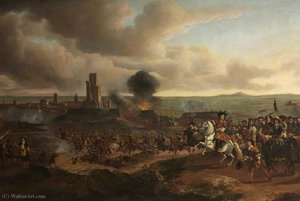
The air thickens with the scent of gunpowder and the heavy musk of horses in The Battle of the Boyne. This expansive oil on canvas, painted by Jan Wyck, captures a moment of immense scale and historical weight. The work stretches across a vast surface, measuring 223.0 x 386.5cm, pulling the viewer into a wide, panoramic landscape where the chaos of war unfolds. It is a scene of movement and…

9
A Hawking Party (1690) čiji je autor Jan Wyck

A Hawking Party

1690 · Oil On Canvas · Yale Center for British Art, New Haven

The scene unfolds in A Hawking Party, a lively composition by the Dutch painter Jan Wyck. Created about 1690, the work captures a moment of aristocratic pursuit amidst an expansive, atmospheric countryside. We find ourselves watching a dynamic gathering where riders and dogs move through a landscape of earthy ochre and deep greens, all set under a vast, shifting sky. The air feels heavy with the soft light of a…

10
Extensive Landscape (1694) čiji je autor Jan Wyck

Extensive Landscape

1694 · Oil

The oil painting titled Extensive Landscape was executed by the artist Jan Wyck. This work dates from about 1694. The composition presents a large-scale view of a natural environment, featuring a river, various trees, and mountains situated in the background. In the foreground, several figures are depicted engaging in activities such as riding horses and interacting with one another.

Slike umetnika Jan Wyck, rangirane od 11 do 45

11King William III at the Siege of Namur čiji je autor Jan WyckKing William III at the Siege of NamurNational Gallery of Ireland 12King William III (William of Orange) (1650–1702) at the Second Seige of Namur, 2 July – 1 September 1695 čiji je autor Jan WyckKing William III (William of Orange) (1650–1702) at the Second Seige of Namur, 2 July – 1 September 1695Mount Stewart 13Equestrian Portrait of King William III čiji je autor Jan WyckEquestrian Portrait of King William III 14A battle scene čiji je autor Jan WyckA battle sceneNacionalni muzej u Varšavi 15The Battle of the Boyne čiji je autor Jan WyckThe Battle of the Boyne 16Battle scene čiji je autor Jan WyckBattle scene 17Major-General Randolph Egerton čiji je autor Jan WyckMajor-General Randolph Egerton 18Portrait of a Gentleman with a Roan Charger čiji je autor Jan WyckPortrait of a Gentleman with a Roan Charger 19After the Combat čiji je autor Jan WyckAfter the CombatNational Gallery of Ireland 20Cavalry Combat čiji je autor Jan WyckCavalry CombatNational Gallery of Ireland 21Stag Hunt čiji je autor Jan WyckStag HuntTe Whare O Rehua Sarjeant Gallery 22A cavalry skirmish čiji je autor Jan WyckA cavalry skirmish 23Landscape with Haymakers čiji je autor Jan WyckLandscape with Haymakers 24The Battle of Lepanto, 7 October (1571) čiji je autor Jan WyckThe Battle of Lepanto, 7 October (1571) 25William III (1650–1702), and His Army at the Siege of Namur, 1695 čiji je autor Jan WyckWilliam III (1650–1702), and His Army at the Siege of Namur, 1695 26View of Windsor Castle from the South čiji je autor Jan WyckView of Windsor Castle from the SouthAnglesey Abbey 27A Pointer in a Landscape čiji je autor Jan WyckA Pointer in a Landscape 28A Battlepiece, of Christians against Turks čiji je autor Jan WyckA Battlepiece, of Christians against TurksHam House 29William III Landing at Brixham, Torbay, 5 November čiji je autor Jan WyckWilliam III Landing at Brixham, Torbay, 5 NovemberNational Maritime Museum 30King William III čiji je autor Jan WyckKing William III 31A stag hunt čiji je autor Jan WyckA stag hunt 32James Scott, Duke of Monmouth and Buccleuch čiji je autor Jan WyckJames Scott, Duke of Monmouth and BuccleuchNational Portrait Gallery 33Hawking party čiji je autor Jan WyckHawking party 34A stag hunt čiji je autor Jan WyckA stag hunt 35King William III (1650–1702) giving Orders in the Field čiji je autor Jan WyckKing William III (1650–1702) giving Orders in the Field 36William III and Prince George of Denmark at the Battle of the Boyne čiji je autor Jan WyckWilliam III and Prince George of Denmark at the Battle of the Boyne 37A Landscape with Horsemen, Including a Falconer čiji je autor Jan WyckA Landscape with Horsemen, Including a FalconerLytes Cary 38Gilbert Coventry, Later 4th Earl of Coventry, in the Hunting Field čiji je autor Jan WyckGilbert Coventry, Later 4th Earl of Coventry, in the Hunting FieldAntony House 39An Imaginary Winter Scene with People Amusing Themselves upon a Frozen River with Tents and a Sleigh čiji je autor Jan WyckAn Imaginary Winter Scene with People Amusing Themselves upon a Frozen River with Tents and a Sleigh 40A Dutch Mastiff with Dunham Massey in the Background čiji je autor Jan WyckA Dutch Mastiff with Dunham Massey in the BackgroundDunham Massey Hall 41Hunting Scene čiji je autor Jan WyckHunting Scene 42A Cavalry Battle Scene čiji je autor Jan WyckA Cavalry Battle Scene 43Prince rupert čiji je autor Jan WyckPrince rupert 44'Swallow' and Old William, Groom to Sir T. S. Bonnet čiji je autor Jan Wyck'Swallow' and Old William, Groom to Sir T. S. Bonnet 45King William III čiji je autor Jan WyckKing William III

Čuvena dela Jan Wyck po periodima

Motivi koji su privlačili pažnju Jan Wyck

Četiri teme koje se najčešće ponavljaju u ovim originalima, svaka sa svojim vrhunskim primerom.

Muzeji u kojima se čuvaju originalna dela umetnika Jan Wyck

8 muzeja u kojima se nalazi najviše slika sa ove stranice.

Muzeji Grad Radovi umetnika Jan Wyck Slike iz ovog spiska
National Gallery of Ireland, DublinNational Gallery of Ireland Dublin 4 The Battle of the Boyne, King William III at the Siege of Namur, After the Combat
Royal Collection, LondonRoyal Collection London 3 William III (1650-1702) on Horseback, Landscape with a Stag Hunt, The French Army crossing the Rhine, 12 June 1672
Yale Center for British Art, New HavenYale Center for British Art New Haven 3 Hare Hunting, Heron Hawking below Stirling Castle, A Hawking Party
National Maritime Museum, LondonNational Maritime Museum London 2 William III Landing at Brixham, Torbay, William III Landing at Brixham, Torbay, 5 November
Castle WardCastle Ward 1 King William III (1650–1702)
Mount Stewart, NewtownardsMount Stewart Newtownards 1 King William III (William of Orange) (1650–1702) at the Second Seige of Namur, 2 July – 1 September 1695
Nacionalni muzej u Varšavi, VaršavaNacionalni muzej u Varšavi Varšava 1 A battle scene
Te Whare O Rehua Sarjeant GalleryTe Whare O Rehua Sarjeant Gallery 1 Stag Hunt

Jan Wyck, jedno autentično delo po deceniji

Radovi po decenijama

Izaberite deceniju da biste videli original koji je definiše.

Slike umetnika Jan Wyck: odgovori galerije

Koja je najpoznatija slika umetnika Jan Wyck?Otkrij odgovor

William III (1650-1702) on Horseback (1695), Royal Collection, London. Slede Hare Hunting (1690) i King William III (1650–1702) (1700).

Koliko je godina imao/la Jan Wyck kada je dovršio/la William III (1650-1702) on Horseback?Otkrij odgovor

55 godina: William III (1650-1702) on Horseback datira iz 1695, a Jan Wyck je rođen/a 1640.

Koja su najbolja 10 dela umetnika Jan Wyck?Otkrij odgovor

William III (1650-1702) on Horseback, Hare Hunting, King William III (1650–1702), William III Landing at Brixham, Torbay, Heron Hawking below Stirling Castle, Landscape with a Stag Hunt, The French Army crossing the Rhine, 12 June 1672, The Battle of the Boyne, A Hawking Party i Extensive Landscape. Gornji rang pokazuje godinu i muzej za svako od njih.

Koliko je dela stvorio/la Jan Wyck?Otkrij odgovor

Naš katalog sadrži 45 dela umetnika Jan Wyck, datiranih od 1674 do 1700.

Gde se nalaze najpoznatiji originali umetnika Jan Wyck?Otkrij odgovor

Većinom u National Gallery of Ireland (Dublin), Royal Collection (London) i Yale Center for British Art (New Haven). Tabela muzeja iznad sadrži njih sve.

Kada je Jan Wyck stvorio svoje najpoznatije slike?Otkrij odgovor

U 1690s: 6 od 45 dela na ovoj stranici nastalo je tada, od čega je William III (1650-1702) on Horseback.

Koja su najranija i najkasnija poznata dela umetnika Jan Wyck?Otkrij odgovor

Na ovoj stranici, najstarije delo je iz Landscape with a Stag Hunt (1674), a najnovije iz King William III (1650–1702) (1700).

Kojim se motivima Jan Wyck najčešće bavio?Otkrij odgovor

Horse (12), Sky (11) i Man (9), kroz svih 45 dela na ovoj stranici.

U kojoj je tehnici najviše radio/la Jan Wyck?Otkrij odgovor

Oil On Canvas, za 22 od 45 dela na ovoj stranici.

Sa kojim umetničkim pravcem je Jan Wyck povezan/a?Otkrij odgovor

Baroque, sudeći po originalima na ovoj stranici.

Koje originale umetnika Jan Wyck poseduje National Gallery of Ireland?Otkrij odgovor

The Battle of the Boyne, King William III at the Siege of Namur i After the Combat: National Gallery of Ireland, Dublin čuva 4 dela sa ove stranice.

Jan Wyck: umetnik

Jan Wyck: The Painter Who Brought Battle to Life

Born in Haarlem, Netherlands, in 1652, Jan Wyck emerged as a pivotal figure in the burgeoning world of European art during the late 17th century. His legacy isn’t defined by grand, solitary masterpieces but rather by an astonishing body of over 150 works—primarily dynamic military scenes, evocative landscapes, and striking equestrian portraits—that fundamentally shifted the way warfare was depicted on canvas. Wyck's influence extended far beyond his native Netherlands; he played a crucial role in establishing British art as a force to be reckoned with, introducing a distinctly Dutch sensibility that profoundly impacted generations of British artists.

Wyck’s early life remains somewhat shrouded in mystery, largely due to the limited documentation available. He was the son of Thomas Wyck, another painter who had spent considerable time honing his craft in Italy, absorbing the influence of the Italianate style evident in some of his father's works. It is believed that Jan received his initial artistic training from his father, though precise details are scarce. The family’s relocation to England during the reign of Charles II—likely around 1664—marked a turning point, setting the stage for Wyck’s enduring contribution to British art history. This move coincided with a period of significant cultural exchange between Britain and the Low Countries, fueled by the Restoration and a renewed interest in classical learning and artistic styles.

A Royal Patron and Continental Influence

Wyck's arrival in England proved remarkably fortuitous. He quickly gained recognition for his skill and versatility, securing patronage from influential figures like the Duke of Ormond and, later, William III himself. His ability to capture the chaos and drama of battle—a subject largely dominated by French artists at the time—was particularly valued. Wyck’s work wasn't simply a record of military events; he imbued his scenes with a palpable sense of immediacy and realism, drawing inspiration from both Dutch and Flemish traditions. He skillfully blended elements of Baroque dynamism with a keen eye for detail, meticulously rendering the textures of armor, the glint of steel, and the expressions of soldiers caught in the heat of conflict.

The influence of Dirk Maas, another prominent Low Countries artist working in England, is readily apparent in Wyck’s early work. However, Wyck quickly developed his own distinctive style—characterized by a vibrant palette, dramatic lighting, and an unparalleled ability to capture the energy and movement of his subjects. He wasn't content with simply depicting battles from a distant perspective; instead, he sought to immerse the viewer directly into the fray, highlighting individual soldiers, their weapons, and the unfolding drama with remarkable precision.

The Battle Painter’s Vision

Wyck’s most significant contribution lies in his innovative approach to battlefield depictions. While many artists of the era favored a bird's-eye view, offering a strategic overview of troop formations, Wyck chose to focus on the individual experiences of soldiers—their bravery, their fear, and their desperate struggle for survival. He meticulously rendered details such as flourishing sabres, firing muskets, flaring horses’ nostrils, and the billowing smoke from cannons, creating a visceral sense of realism that was unprecedented in military art. This shift towards a more intimate and emotionally resonant portrayal of battle profoundly influenced subsequent generations of British artists.

His work on the Battle of the Boyne, for example, stands as a testament to his artistic vision. While accounts of the battle itself are plentiful, Wyck’s painting captures not just the tactical maneuvers but also the human cost—the exhausted faces of soldiers, the fallen comrades, and the palpable sense of uncertainty that permeated the ranks. Similarly, his depictions of the siege of Derry vividly convey the resilience of the besieged city and the determination of its defenders.

A Family Man and a Lasting Legacy

Beyond his artistic achievements, Wyck’s personal life offers glimpses into the realities of 17th-century England. He married twice—first to an unknown woman, then to Anne Skinner in 1676, with whom he had four children who tragically all died young. His third marriage brought him a Dutch wife, Elizabeth Holomberg, and two sons and a daughter, further solidifying his family life in Mortlake. Despite the personal tragedies that punctuated his life, Wyck remained dedicated to his craft, continuing to produce works under royal patronage until his death in 1702.

Jan Wyck’s legacy extends far beyond the individual paintings he created. He played a crucial role in fostering artistic exchange between Britain and the Low Countries, introducing new techniques and perspectives that enriched British art history. His innovative approach to battlefield depictions—his focus on individual soldiers and his masterful rendering of detail—established him as a pioneer in military art, leaving an indelible mark on the development of both Dutch and British painting traditions. Today, his works are treasured for their historical significance, artistic merit, and the captivating stories they tell of courage, conflict, and the human spirit.