Portret Henry Mark Anthony

Slike umetnika Henry Mark Anthony: Najpoznatijih 27 kroz oči galerije

Ažurirano: новембар 2026 · rangirano prema našem koeficijentu popularnosti (pretrage, posete i porudžbine za svako delo) · 30 dela Henry Mark Anthony u našem katalogu

Ukratko

Iz perspektive galerije, najpoznatije delo umetnika Henry Mark Anthony je Thinking of the Future, an Irish Sketch (1845). The Harvest Festival (1847) i The Village Church (1842) čine triju koju svako oko prepoznaje. Od 30 dela umetnika Henry Mark Anthony u našem katalogu, galerija u nastavku predstavlja 27 najpoznatijih dela, od kojih je svako originalno, sa navedenom godinom nastanka, muzejom i onim što ga čini jedinstvenim.

1817 – 1886, Rusholme Najviše dela: Wolverhampton Art Gallery

Top 10 slika umetnika Henry Mark Anthony u galeriji

1
Thinking of the Future, an Irish Sketch (1845) čiji je autor Henry Mark Anthony

Thinking of the Future, an Irish Sketch

1845 · Oil

Thinking of the Future, an Irish Sketch is an oil painting by the English landscape artist Henry Mark Anthony. Created about 1845, the work captures a quiet moment within a wooded clearing. The scene rests upon the canvas with the weight of the natural world, anchored by the presence of a small campsite and a traveling animal.

2
The Harvest Festival (1847) čiji je autor Henry Mark Anthony

The Harvest Festival

1847 · Oil On Canvas · Salford Museum - Art Gallery, Greater Manchester

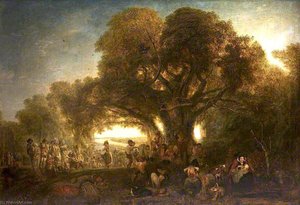
In The Harvest Festival by Henry Mark Anthony, the composition is centered upon a massive tree that dominates the vertical space of the large-scale oil painting. The expansive branches of this central tree extend across the upper portion of the frame, creating a canopy that anchors the scene. Beneath these branches, various figures are arranged in distinct groups around the base of the trunk. These figures are positioned in a…

3
The Village Church (1842) čiji je autor Henry Mark Anthony

The Village Church

1842 · Oil On Canvas

Henry Mark Anthony captured a quiet moment of rural life in 1842. The painting, titled The Village Church, measures 51 x 76 cm. It presents a scene where the rhythm of the farm meets the stillness of the landscape. A cow stands centered in a field, its presence anchoring the meadow. Nearby, horses and other cattle move through the grass. People are scattered across the terrain, some tending to duties…

4
The Old Churchyard (1846) čiji je autor Henry Mark Anthony

The Old Churchyard

1846 · Oil · Walker Art Gallery, Liverpud

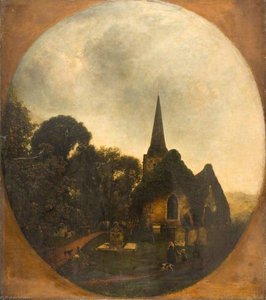
In this 1846 work, we find ourselves in a secluded churchyard, a place where the weight of memory meets the stillness of the earth. A woman sits upon the ground, her black dress a dark silhouette against the weathered stone of an old building. Her head is bowed in a gesture of profound contemplation, her presence anchored by a handbag resting nearby on the soil. Around her, the yard is…

5
The Harvest Festival (1847) čiji je autor Henry Mark Anthony

The Harvest Festival

1847 · Oil On Canvas

The Harvest Festival is an oil painting by Henry Mark Anthony, dating from 1847. This work captures a communal gathering set within a rural landscape, focusing on a moment of shared experience in the countryside. It portrays a harvest festival, where figures come together amidst the natural world to mark the season.

6
Evensong (1873) čiji je autor Henry Mark Anthony

Evensong

1873 · Oil On Canvas

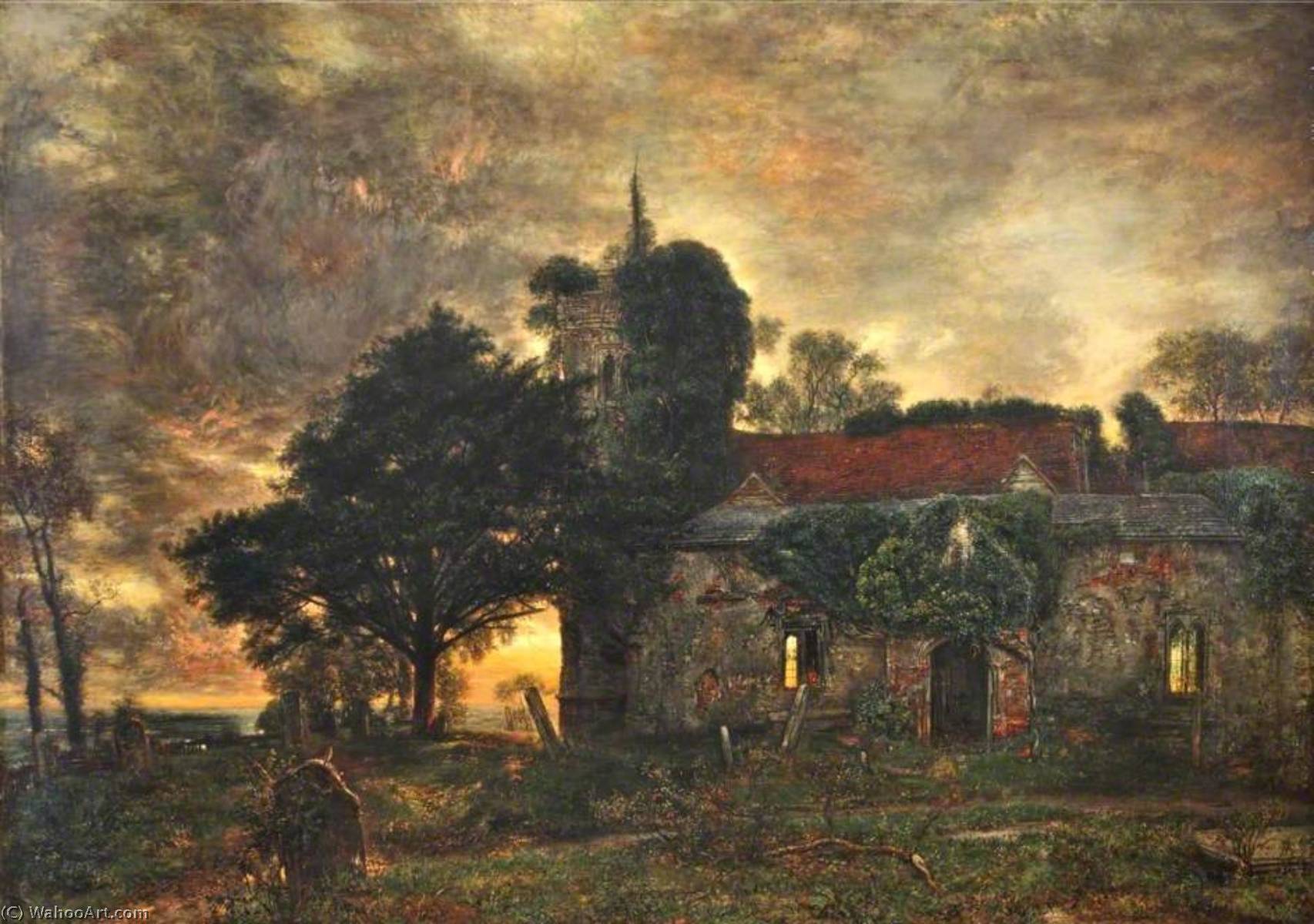
The oil on canvas known as Evensong by Henry Mark Anthony captures a moment of profound stillness. Created in 1873, the work presents a scene where time seems to pause. A church sits quietly within the landscape, its presence anchored by a large tree that stands prominently in the foreground. This composition invites a sense of peace and tranquility into the viewer's space, as if the very air around the…

7
The Old Water Mill and the Old Corn Mill čiji je autor Henry Mark Anthony

The Old Water Mill and the Old Corn Mill

Oil

The Old Water Mill and the Old Corn Mill is an oil painting by the English landscape artist Henry Mark Anthony. Born in 1817 at Rusholme Lane, Manchester, Anthony developed a practice centered on the direct observation of the natural world. His career spanned much of the nineteenth century, during which he moved from his origins in the United Kingdom to study the traditions of the European continent.

8
An Old Country Churchyard čiji je autor Henry Mark Anthony

An Old Country Churchyard

Oil On Canvas

An Old Country Churchyard is a painting by Henry Mark Anthony. Created about 1846, the work captures a quiet moment within a stone-walled cemetery. A single woman sits by a grave, her presence anchored amidst the weathered architecture of the churchyard.

9
Huge Oak that O'ershadows the Mill čiji je autor Henry Mark Anthony

Huge Oak that O'ershadows the Mill

Oil On Canvas · Gallery Oldham, Oldham

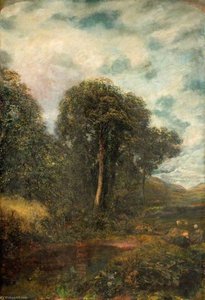
In this composition, titled Huge Oak that O'ershadows the Mill, we encounter the hand of Henry Mark Anthony. The work belongs to the same body of work as The Harvest Festival, sharing a common focus on the weight and presence of the natural environment. It is a significant example of the artist's specific approach to large-scale natural subjects, where the scale of the flora dictates the rhythm of the entire…

10
Evensong (1873) čiji je autor Henry Mark Anthony

Evensong

1873 · Walker Art Gallery, Liverpud

The painting Evensong by Henry Mark Anthony is a masterpiece that exudes peace and tranquility. Created in 1873, this oil on canvas work of art measures 146 x 213 cm and is currently housed at the Walker Art Gallery in Liverpool, United Kingdom. The scene depicts a church with a large tree in front of it, set against a dramatic cloudy sky. Several people are scattered throughout the scene, adding…

Slike umetnika Henry Mark Anthony, rangirane od 11 do 27

Motivi koji su privlačili pažnju Henry Mark Anthony

Četiri teme koje se najčešće ponavljaju u ovim originalima, svaka sa svojim vrhunskim primerom.

Muzeji u kojima se čuvaju originalna dela umetnika Henry Mark Anthony

8 muzeja u kojima se nalazi najviše slika sa ove stranice.

Muzeji Grad Radovi umetnika Henry Mark Anthony Slike iz ovog spiska
Wolverhampton Art Gallery, WolverhamptonWolverhampton Art Gallery Wolverhampton 10 A Larch Forest, Stonehenge, The Silver Spring
Walker Art Gallery, LiverpudWalker Art Gallery Liverpud 2 The Old Churchyard, Evensong
Maidstone Museum - Bentlif Art Gallery, MaidstoneMaidstone Museum - Bentlif Art Gallery Maidstone 2 A Funeral Procession near Lake Killarney, County Kerry, A Mill on the Hague
Salford Museum - Art Gallery, Greater ManchesterSalford Museum - Art Gallery Greater Manchester 1 The Harvest Festival
Gallery Oldham, OldhamGallery Oldham Oldham 1 Huge Oak that O'ershadows the Mill
Royal Collection, LondonRoyal Collection London 1 Killarney: a View of the Lower Lake
University of Cambridge, KembridžUniversity of Cambridge Kembridž 1 The Interior of a Church in Paris
Government Art Collection, LondonGovernment Art Collection London 1 Rachel at the Well

Henry Mark Anthony, najprepoznatljivija dela svake godine

32 godina umetnosti umetnika Henry Mark Anthony, od 1842 do 1873: galerija ih prati godinu za godinom, kroz njihova najpoznatija originalna dela.

Radovi po godinama

Izaberite godinu da biste videli originalna dela.

Slike umetnika Henry Mark Anthony: odgovori galerije

Koja je najpoznatija slika umetnika Henry Mark Anthony?Otkrij odgovor

Thinking of the Future, an Irish Sketch (1845). Slede The Harvest Festival (1847) i The Village Church (1842).

Koliko je godina imao/la Henry Mark Anthony kada je dovršio/la Thinking of the Future, an Irish Sketch?Otkrij odgovor

28 godina: Thinking of the Future, an Irish Sketch datira iz 1845, a Henry Mark Anthony je rođen/a 1817.

Koja su najbolja 10 dela umetnika Henry Mark Anthony?Otkrij odgovor

Thinking of the Future, an Irish Sketch, The Harvest Festival, The Village Church, The Old Churchyard, The Harvest Festival, Evensong, The Old Water Mill and the Old Corn Mill, An Old Country Churchyard, Huge Oak that O'ershadows the Mill i Evensong. Gornji rang pokazuje godinu i muzej za svako od njih.

Koliko je dela stvorio/la Henry Mark Anthony?Otkrij odgovor

Naš katalog sadrži 30 dela umetnika Henry Mark Anthony, datiranih od 1842 do 1873.

Gde se nalaze najpoznatiji originali umetnika Henry Mark Anthony?Otkrij odgovor

Većinom u Wolverhampton Art Gallery (Wolverhampton), Walker Art Gallery (Liverpud) i Maidstone Museum - Bentlif Art Gallery (Maidstone). Tabela muzeja iznad sadrži njih sve.

Kada je Henry Mark Anthony stvorio svoje najpoznatije slike?Otkrij odgovor

U 1847: 2 od 27 dela na ovoj stranici nastalo je tada, od čega je The Harvest Festival.

Koja su najranija i najkasnija poznata dela umetnika Henry Mark Anthony?Otkrij odgovor

Na ovoj stranici, najstarije delo je iz The Village Church (1842), a najnovije iz Evensong (1873).

Kojim se motivima Henry Mark Anthony najčešće bavio?Otkrij odgovor

People (5), Tree (4) i Landscape (4), kroz svih 27 dela na ovoj stranici.

U kojoj je tehnici najviše radio/la Henry Mark Anthony?Otkrij odgovor

Oil On Canvas, za 6 od 27 dela na ovoj stranici.

Koje originale umetnika Henry Mark Anthony poseduje Wolverhampton Art Gallery?Otkrij odgovor

A Larch Forest, Stonehenge i The Silver Spring: Wolverhampton Art Gallery, Wolverhampton čuva 10 dela sa ove stranice.

Henry Mark Anthony: umetnik

The Pioneer of the Open Air: The Life and Legacy of Henry Mark Anthony

In the grand tapestry of Victorian British art, few threads are as vital yet subtly woven as that of Henry Mark Anthony. A master of light and atmosphere, Anthony stands as a transformative figure who bridged the gap between traditional studio landscapes and the revolutionary en plein air movement. Born in 1817 at Rusholme Lane, Manchester, his early years were shaped by a blend of Welsh heritage and an burgeoning artistic curiosity. Following his family's move to Cowbridge, Glamorgan, his initial creative sparks were fanned by an apprenticeship under Dr. Harrison, an amateur artist who recognized the young boy's innate sensitivity to the natural world. This early foundation in meticulous observation would later become the hallmark of his mature style.

The trajectory of Anthony’s career took a decisive turn when he moved to London around 1833. It was during this period of profound exploration that his artistic identity truly began to coalesce. Supported by newfound patronage, he embarked on extensive travels across the European continent, venturing through the Netherlands, France, Ireland, and Spain. These journeys were far more than mere sightseeing; they were rigorous academic pursuits. At the Hague and within the prestigious Académie des Beaux-Arts in Paris, Anthony immersed himself in the techniques of masters such as Paul Delaroche, Ary Scheffer, and Horace Vernet. However, it was his time in Fontainebleau in 1837 that would forever alter his brushwork. Immersed in the ethos of the Barbizon School, he drew deep inspiration from the works of Jean-Baptiste-Camille Corot and Jules Dupré, learning to capture not just the geography of a place, but its very soul through direct engagement with the elements.

A Revolution of Light and Technique

What set Henry Mark Anthony apart from his contemporaries was his courageous rejection of the static, controlled environment of the studio in favor of the unpredictable beauty of the outdoors. He is widely credited with being among the first British artists to introduce the French plein-air style to the London art scene. This method required a radical shift in technique—a need for speed, spontaneity, and an acute awareness of fleeting atmospheric effects. His canvases began to breathe with the moisture of English mist and the warmth of Mediterranean sun, capturing textural nuances that had previously been lost in more formal compositions.

Critics of his era often drew favorable comparisons between Anthony and the legendary John Constable, noting a shared devotion to the sublime beauty of the landscape. His ability to render the ephemeral—the way light filters through a canopy of trees or how shadows stretch across a meadow—gave his work an emotional resonance that captivated audiences. This mastery of atmosphere was not merely a technical feat but a poetic one, as he sought to translate the transient moments of nature into permanent visual poetry. His frequent exhibitions at prestigious institutions such as the Royal Academy, the British Institution, and the Society of British Artists solidified his reputation as a leading voice in the Romantic movement.

Historical Significance and Lasting Influence

The impact of Henry Mark Anthony extended far beyond his own canvases. By bringing the sensibilities of the Barbizon School to Britain, he helped pave the way for subsequent generations of landscape painters. His commitment to the careful observation of nature resonated deeply with the Pre-Raphaelite Brotherhood; he maintained a close friendship with Ford Madox Brown and earned the admiration of artists who sought a similar truth in their depictions of the natural world. His work served as a vital link between the classical traditions of the early 19th century and the more modern, impressionistic approaches that would follow.

Throughout his life, Anthony’s achievements were marked by both critical acclaim and institutional recognition. Notable milestones include:

  • Membership in the Society of British Artists: Elected in 1845, a testament to his standing among his peers.
  • Award-Winning Artistry: Winning the prestigious £50 prize in 1854 for his evocative work Nature's Mirror.
  • A Global Perspective: The integration of diverse European landscapes—from the rugged coasts of Wales to the plains of Spain—into a unified British aesthetic.
  • Legacy in Museums: His works are now preserved in esteemed collections, including the National Museum of Wales, the Walker Art Gallery, and the Manchester Art Gallery.

When Henry Mark Anthony passed away in Hampstead in 1886, he left behind a transformed landscape painting tradition. He had successfully taught the British eye to look closer at the world, to find the extraordinary within the ordinary, and to appreciate the profound beauty found in a single, sun-drenched moment captured directly from the earth.