Portret Чарлс Демут

Slike umetnika Чарлс Демут: Najpoznatijih 100 kroz oči galerije

Ažurirano: новембар 2026 · rangirano prema našem koeficijentu popularnosti (pretrage, posete i porudžbine za svako delo) · 277 dela Чарлс Демут u našem katalogu

Ukratko

Iz perspektive galerije, najpoznatije delo umetnika Чарлс Демут je Four male figures. Sailor, Soldier, and Policeman (1916) i Man Standing On Dunes Verso Landscape, Maine (1910) čine triju koju svako oko prepoznaje. Od 277 dela umetnika Чарлс Демут u našem katalogu, galerija u nastavku predstavlja 100 najpoznatijih dela, od kojih je svako originalno, sa navedenom godinom nastanka, muzejom i onim što ga čini jedinstvenim.

1883 – 1935, Ланкастер Precisionism Najviše dela: Barnes Foundation

Top 10 slika umetnika Чарлс Демут u galeriji

1
Four male figures čiji je Чарлс Демут

Four male figures

Watercolor

The air feels heavy with the scent of damp earth and sun-warmed leaves as four men gather within a wooded clearing. They stand in a loose, intimate circle, their bodies angled toward one another in a moment of shared confidence or perhaps a casual pause in a summer afternoon. Sunlight filters through the canopy, casting soft light upon their forms. They wear shorts, a detail that suggests the heat of…

2
Sailor, Soldier, and Policeman (1916) čiji je Чарлс Демут

Sailor, Soldier, and Policeman

1916 · Watercolor

Three uniforms lean into a shared confidence on a Greenwich Village street corner. The air feels heavy with the scent of cinnamon and sepia, blooming like cigarette smoke in a dim saloon. A policeman turns his back to the viewer, his slate gray greatcoat bleeding into indigo at the belt where two pale buttons blink like eyes. He is authority posing as a question. Beside him, a sailor tips his…

3
Man Standing On Dunes Verso Landscape, Maine (1910) čiji je Чарлс Демут

Man Standing On Dunes Verso Landscape, Maine

1910 · Watercolor

The scene unfolds within the quietude of Man Standing On Dunes Verso Landscape, Maine, a work that captures a singular moment of stillness. Created by the American artist Charles Demuth, this piece invites a close gaze into a world of soft edges and contemplative solitude. The work dates to about 1910, a period when the artist's hand began to navigate the delicate balance between observation and the structured essence of…

4
Two Acrobats in Red Tights (1917) čiji je Чарлс Демут

Two Acrobats in Red Tights

1917 · Watercolor · Barnes Foundation, Filadelfija

A vertical composition captures two acrobats engaged in a feat of physical equilibrium. The figures are stacked, creating a central axis that draws the eye upward through a celestial, star-filled void. Warm yellows and golds radiate from a central point behind the upper figure, creating a halo effect that pushes the surrounding space into deep indigo and blue shadows. The lower figure is anchored by the bold red of their…

5
Dancing sailors čiji je Чарлс Демут

Dancing sailors

Watercolor

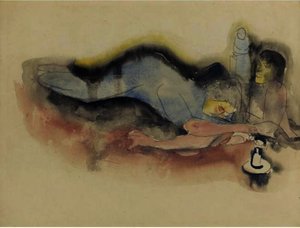
Dancing sailors is a watercolor by Charles Demuth. The work focuses on a group of nude male figures caught in an intimate embrace. Their bodies are clustered and interwoven, creating a sense of closeness and shared experience. This arrangement emphasizes themes of human connection and vulnerability.

6
Pansies (1915) čiji je Чарлс Демут

Pansies

1915 · Watercolor

Charles Demuth produced Pansies in 1915. This watercolor and graphite work on paper functions as an example of Expressionism. The artist utilized the medium to capture the essence of the delicate flowers through a specific application of color and line. The piece reflects the stylistic developments occurring in the early twentieth century as the artist explored the expressive potential of his chosen materials.

7
The Girl with the Golden Eyes (La Fille aux yeux d'or) (1916) čiji je Чарлс Демут

The Girl with the Golden Eyes (La Fille aux yeux d'or)

1916 · Watercolor · Barnes Foundation, Filadelfija

In "The Girl with the Golden Eyes (La Fille aux yeux d'or)" by Charles Demuth, a sense of sudden movement hangs in the air. A large, dark, silhouetted male figure dominates the foreground, his back turned to the viewer. He stands in a wide, tense stance that suggests he is caught mid-stride or perhaps bracing himself. This heavy, dark presence acts as a gateway into the scene, pulling the eye…

9
Nana and Count Muffat (1916) čiji je Чарлс Демут

Nana and Count Muffat

1916 · Watercolor · Barnes Foundation, Filadelfija

In Nana and Count Muffat, Charles Demuth presents a composition defined by a swirling, circular arrangement of figures. The central focus is a nude female figure seen from behind, her form rendered in warm ochre and golden tones. She reaches upward and outward with her arms, creating a sense of rhythmic movement. To her right, a second, smaller figure—a man's head with dark hair and a beard—appears to float within…

10
Count Muffat's First View of Nana at the Theatre (1916) čiji je Чарлс Демут

Count Muffat's First View of Nana at the Theatre

1916 · Watercolor · Barnes Foundation, Filadelfija

In Count Muffat's First View of Nana at the Theatre, Charles Demuth centers the composition around a large, pale, nude figure seen from behind. The figure's head is tilted back, and the hands are raised toward the hair. This central figure dominates the vertical axis of the work. Surrounding this primary subject are smaller figures that appear to be dancing or gesturing within a space that suggests a theatrical or…

Slike umetnika Чарлс Демут, rangirane od 11 do 100

11Three Figures in Water (1916) čiji je Чарлс ДемутThree Figures in Water1916 · Barnes Foundation 12The Death of Nana (1915) čiji je Чарлс ДемутThe Death of Nana1915 · Barnes Foundation 13Nana Visiting her Friend Satin (1915) čiji je Чарлс ДемутNana Visiting her Friend Satin1915 · Barnes Foundation 14Count Muffat Discovers Nana with the Marquis de Chouard (1915) čiji je Чарлс ДемутCount Muffat Discovers Nana with the Marquis de Chouard1915 · Barnes Foundation 15Vaudeville Many Brave Hearts Are Asleep in the Deep (1916) čiji je Чарлс ДемутVaudeville Many Brave Hearts Are Asleep in the Deep1916 16Bathers (1916) čiji je Чарлс ДемутBathers1916 17In Vaudeville: Acrobatic Male Dancer with Top Hat (1920) čiji je Чарлс ДемутIn Vaudeville: Acrobatic Male Dancer with Top Hat1920 · Barnes Foundation 18Musician (1918) čiji je Чарлс ДемутMusician1918 · Barnes Foundation 19Lula and Alva Schön (1918) čiji je Чарлс ДемутLula and Alva Schön1918 · Barnes Foundation 20The Death of Countess Geschwitz (1918) čiji je Чарлс ДемутThe Death of Countess Geschwitz1918 · Barnes Foundation 21Lulu and Alva Schön at Lunch (1918) čiji je Чарлс ДемутLulu and Alva Schön at Lunch1918 · Barnes Foundation 22Longhi on Broadway (1928) čiji je Чарлс ДемутLonghi on Broadway1928 · Muzej finih umetnosti u Bostonu 23The Purple Pup čiji je Чарлс ДемутThe Purple Pup 24Bathers Viewing the Sea (1917) čiji je Чарлс ДемутBathers Viewing the Sea1917 · Boca Raton Museum of Art 25Love, Love, Love. Homage to Gertrude Stein (1928) čiji je Чарлс ДемутLove, Love, Love. Homage to Gertrude Stein1928 · Музеј Тисен-Борнемиза 26Modern Conveniences (1921) čiji je Чарлс ДемутModern Conveniences1921 27Untitled (580) čiji je Чарлс ДемутUntitled (580) 28Charles Demuth - Tree Forms 1916 - Approximate čiji je Чарлс ДемутCharles Demuth - Tree Forms 1916 - Approximate 29Poppies čiji je Чарлс ДемутPoppies 30Roofs and Steeple čiji je Чарлс ДемутRoofs and Steeple 31Incense of a New Church čiji je Чарлс ДемутIncense of a New Church 32Papa Demuth čiji je Чарлс ДемутPapa Demuth 33The Real Thing čiji je Чарлс ДемутThe Real Thing 34Augusta Wills Buckius Demuth čiji je Чарлс ДемутAugusta Wills Buckius Demuth 35The Conversation čiji je Чарлс ДемутThe Conversation 36Review in Paris čiji je Чарлс ДемутReview in Paris 37The Artist on the Beach at Provincetown čiji je Чарлс ДемутThe Artist on the Beach at Provincetown 38ERDGEIST (WEDEKIND) čiji je Чарлс ДемутERDGEIST (WEDEKIND) 39Three Plays Stockbridge čiji je Чарлс ДемутThree Plays Stockbridge 40Waiters at the Brevoort čiji je Чарлс ДемутWaiters at the Brevoort 41Two Sailors čiji je Чарлс ДемутTwo Sailors 42Mann in Blazer čiji je Чарлс ДемутMann in Blazer 43In Vaudeville. Man and Woman with Chorus čiji je Чарлс ДемутIn Vaudeville. Man and Woman with Chorus 44Bermuda, Masts and Foliage (1917) čiji je Чарлс ДемутBermuda, Masts and Foliage1917 · Barnes Foundation 45Bermuda: Stairway (1917) čiji je Чарлс ДемутBermuda: Stairway1917 · Barnes Foundation 46Bermuda: Tree (1917) čiji je Чарлс ДемутBermuda: Tree1917 · Barnes Foundation 47Bermuda Landscape No. 2 (1917) čiji je Чарлс ДемутBermuda Landscape No. 21917 · Barnes Foundation 48Two Women Acrobats (1916) čiji je Чарлс ДемутTwo Women Acrobats1916 · Barnes Foundation 49Two Women and Child on Beach (1916) čiji je Чарлс ДемутTwo Women and Child on Beach1916 · Barnes Foundation 50Artists Sketching (1916) čiji je Чарлс ДемутArtists Sketching1916 · Barnes Foundation 51Narcissi (1917) čiji je Чарлс ДемутNarcissi1917 · Metropoliten музеј у Њујорку 52Landscape No. 4 (1914) čiji je Чарлс ДемутLandscape No. 41914 53Vaudeville (1917) čiji je Чарлс ДемутVaudeville1917 54Girl in Red (1912) čiji je Чарлс ДемутGirl in Red1912 55Беჭвди Нюде Виथ Бэк Туर्नेд (1913) čiji je Чарлс ДемутБеჭвди Нюде Виथ Бэк Туर्नेд1913 · Boca Raton Museum of Art 56Bermuda Landscape (1917) čiji je Чарлс ДемутBermuda Landscape1917 57Strawflowers (also known as Flowers -2) (1915) čiji je Чарлс ДемутStrawflowers (also known as Flowers -2)1915 58Men at a Bar (1912) čiji je Чарлс ДемутMen at a Bar1912 59Mt. Gilboa 5 (1915) čiji je Чарлс ДемутMt. Gilboa 51915 60Lancaster (1921) čiji je Чарлс ДемутLancaster1921 · Buffalo AKG Art Museum 61Piano Mover's Holiday (1919) čiji je Чарлс ДемутPiano Mover's Holiday1919 · Barnes Foundation 62zinnias (1921) čiji je Чарлс Демутzinnias1921 63delphinium (1918) čiji je Чарлс Демутdelphinium1918 64Welcome to Our City (1921) čiji je Чарлс ДемутWelcome to Our City1921 65Red Chimneys (1918) čiji je Чарлс ДемутRed Chimneys1918 · The Phillips Collection 66cineraria (1923) čiji je Чарлс Демутcineraria1923 67amaryllis (1923) čiji je Чарлс Демутamaryllis1923 68african daisies (1925) čiji je Чарлс Демутafrican daisies1925 69zinnias larkspur and daisies (1928) čiji je Чарлс Демутzinnias larkspur and daisies1928 70gladiolus (1923) čiji je Чарлс Демутgladiolus1923 71flower study no 1 (cyclamen and hyacinth) (1923) čiji je Чарлс Демутflower study no 1 (cyclamen and hyacinth)1923 72Plums (1925) čiji je Чарлс ДемутPlums1925 73gladiolus (1928) čiji je Чарлс Демутgladiolus1928 74red and yellow gladioli (1928) čiji je Чарлс Демутred and yellow gladioli1928 75flowers - irises (1925) čiji je Чарлс Демутflowers - irises1925 76Eggplant (1923) čiji je Чарлс ДемутEggplant1923 77Red Cabbages, Rhubarb and Orange (1929) čiji je Чарлс ДемутRed Cabbages, Rhubarb and Orange1929 · Metropoliten музеј у Њујорку 78Three Pears (1933) čiji je Чарлс ДемутThree Pears1933 79Nospmas, M. Egiap Nospmas, M. (1921) čiji je Чарлс ДемутNospmas, M. Egiap Nospmas, M.1921 80Still Life with Spoon (1927) čiji je Чарлс ДемутStill Life with Spoon1927 · Georgia Museum of Art 81Buildings Abstraction, Lancaster (1931) čiji je Чарлс ДемутBuildings Abstraction, Lancaster1931 · Detroit Institute of Arts 82Chimney and Water Tower (1931) čiji je Чарлс ДемутChimney and Water Tower1931 · Amon Carter Museum of American Art 83Architecture čiji je Чарлс ДемутArchitecture 84Red Cabbage, Rhubarb and Orange čiji je Чарлс ДемутRed Cabbage, Rhubarb and Orange 85Bermuda Number 2, The Schooner čiji je Чарлс ДемутBermuda Number 2, The Schooner 86Bermuda Number 1, Tree and House čiji je Чарлс ДемутBermuda Number 1, Tree and House 87Tulips čiji je Чарлс ДемутTulipsMetropoliten музеј у Њујорку 88Bermuda No.3 - The Tower čiji je Чарлс ДемутBermuda No.3 - The Tower 89Monument, Bermuda čiji je Чарлс ДемутMonument, BermudaThe Phillips Collection 90Trees čiji je Чарлс ДемутTrees 91Lancaster County Courthouse čiji je Чарлс ДемутLancaster County Courthouse 92Nosegay čiji je Чарлс ДемутNosegay 93Flowers And Cucumbers čiji je Чарлс ДемутFlowers And Cucumbers 94Floral Still Life čiji je Чарлс ДемутFloral Still Life 95Grapes and Turnips čiji je Чарлс ДемутGrapes and Turnips 96Roses čiji je Чарлс ДемутRoses 97Mermaid on Dome čiji je Чарлс ДемутMermaid on Dome 98Irises čiji je Чарлс ДемутIrises 99Boats and Sea čiji je Чарлс ДемутBoats and Sea 100Three Men čiji je Чарлс ДемутThree Men

Čuvena dela Чарлс Демут po periodima

Motivi koji su privlačili pažnju Чарлс Демут

Četiri teme koje se najčešće ponavljaju u ovim originalima, svaka sa svojim vrhunskim primerom.

Muzeji u kojima se čuvaju originalna dela umetnika Чарлс Демут

8 muzeja u kojima se nalazi najviše slika sa ove stranice.

Muzej Grad Radovi umetnika Чарлс Демут Slike iz ovog spiska
Barnes Foundation, FiladelfijaBarnes Foundation Filadelfija 22 Two Acrobats in Red Tights, The Girl with the Golden Eyes (La Fille aux yeux d'or), Scene after Georges Stabs Himself with the Scissors
Metropoliten музеј у Њујорку, ЊујоркMetropoliten музеј у Њујорку Њујорк 7 Narcissi, Red Cabbages, Rhubarb and Orange, Tulips
Boca Raton Museum of Art, Boca RatonBoca Raton Museum of Art Boca Raton 4 Bathers Viewing the Sea, Беჭвди Нюде Виथ Бэк Туर्नेд
The Phillips Collection, Vašington, D.C.The Phillips Collection Vašington, D.C. 2 Red Chimneys, Monument, Bermuda
Muzej finih umetnosti u Bostonu, BostonMuzej finih umetnosti u Bostonu Boston 1 Longhi on Broadway
Музеј Тисен-Борнемиза, MadridМузеј Тисен-Борнемиза Madrid 1 Love, Love, Love. Homage to Gertrude Stein
Buffalo AKG Art Museum, BuffaloBuffalo AKG Art Museum Buffalo 1 Lancaster
Georgia Museum of Art, AtinaGeorgia Museum of Art Atina 1 Still Life with Spoon

Чарлс Демут, jedno autentično delo po deceniji

Radovi po decenijama

Izaberite deceniju da biste videli original koji je definiše.

Slike umetnika Чарлс Демут: odgovori galerije

Koja je najpoznatija slika umetnika Чарлс Демут?Otkrij odgovor

Four male figures. Slede Sailor, Soldier, and Policeman (1916) i Man Standing On Dunes Verso Landscape, Maine (1910).

Koja su najbolja 10 dela umetnika Чарлс Демут?Otkrij odgovor

Four male figures, Sailor, Soldier, and Policeman, Man Standing On Dunes Verso Landscape, Maine, Two Acrobats in Red Tights, Dancing sailors, Pansies, The Girl with the Golden Eyes (La Fille aux yeux d'or), Scene after Georges Stabs Himself with the Scissors, Nana and Count Muffat i Count Muffat's First View of Nana at the Theatre. Gornji rang pokazuje godinu i muzej za svako od njih.

Koliko je dela stvorio/la Чарлс Демут?Otkrij odgovor

Naš katalog sadrži 277 dela umetnika Чарлс Демут, datiranih od 1910 do 1933.

Gde se nalaze najpoznatiji originali umetnika Чарлс Демут?Otkrij odgovor

Većinom u Barnes Foundation (Filadelfija), Metropoliten музеј у Њујорку (Њујорк) i Boca Raton Museum of Art (Boca Raton). Tabela muzeja iznad sadrži njih sve.

Kada je Чарлс Демут stvorio svoje najpoznatije slike?Otkrij odgovor

U 1910s: 38 od 100 dela na ovoj stranici nastalo je tada, od čega je Sailor, Soldier, and Policeman.

Koja su najranija i najkasnija poznata dela umetnika Чарлс Демут?Otkrij odgovor

Na ovoj stranici, najstarije delo je iz Man Standing On Dunes Verso Landscape, Maine (1910), a najnovije iz Three Pears (1933).

Kojim se motivima Чарлс Демут najčešće bavio?Otkrij odgovor

American art (9), Figures (8) i Flowers (8), kroz svih 100 dela na ovoj stranici.

U kojoj je tehnici najviše radio/la Чарлс Демут?Otkrij odgovor

Watercolor, za 23 od 100 dela na ovoj stranici.

Sa kojim umetničkim pravcem je Чарлс Демут povezan/a?Otkrij odgovor

Precisionism, sudeći po originalima na ovoj stranici.

Koje originale umetnika Чарлс Демут poseduje Barnes Foundation?Otkrij odgovor

Two Acrobats in Red Tights, The Girl with the Golden Eyes (La Fille aux yeux d'or) i Scene after Georges Stabs Himself with the Scissors: Barnes Foundation, Filadelfija čuva 22 dela sa ove stranice.

Чарлс Демут: umetnik

Early Life, Family and Training

Charles Demuth was born on November 8, 1883, in Lancaster, Pennsylvania. When he was six years old, his family moved into an 18th-century house at 120 East King Street. This residence, which had previously functioned as a tavern, would remain his home for much of his life. His early years in Lancaster provided the foundational landscape that would later inform his specific visual interests.

His formal education began at Franklin and Marshall Academy. From there, he moved into more specialized artistic training, attending Drexel University. His development continued at the Pennsylvania Academy of Fine Arts in Philadelphia. It was during his time at this institution that he established a connection with William Carlos Williams, a relationship that would persist long after his student years ended.

The trajectory of his training was shaped by physical challenges. A childhood injury, potentially caused by polio or tuberculosis of the hip, left him with a permanent limp and a reliance on a cane. This physical reality influenced his lifestyle and his eventual preference for the watercolor medium. His early academic years established the technical rigor that would define his later approach to composition.

Artistic Training in Paris

Demuth’s time in Paris was a period of essential formal refinement. He moved beyond his American studies to attend both Académie Colarossi and Académie Julian. These institutions provided the technical rigor necessary to transition from his early watercolor work toward the more structured, complex compositions that would define his mature career. He did not merely observe the French scene; he became an active participant in the avant-garde art scene of the city. This immersion in the radical shifts of early 20th-century European thought provided the structural vocabulary he would later apply to American subjects.

The social climate of Paris offered a specific freedom that was absent in much of the United States at the time. The city's acceptance of his homosexuality had a profound impact on his work. This environment allowed for a level of personal expression and identity that informed his perspective as a modern artist. He absorbed the dynamism of the Parisian underground, a factor that helped shape his ability to translate modern life into a cohesive visual language. The intersection of formal academic training and the liberated atmosphere of the Parisian avant-garde created the specific tension found in his later, more precise compositions.

Technique and Artistic Style

Demuth’s aesthetic is defined by a rigorous, quasi-cubist approach that stripped the landscape of sentimentality. He moved away from the fluid, loose washes of color characteristic of his early watercolor work to embrace a more structured, disciplined method as he turned to oils later in his career. This transition solidified his position within Precisionism, a movement that favored the clarity of the machine age over the messy spontaneity of nature. His compositions are characterized by sharp linearity and a highly structured arrangement of forms. He often removed human figures entirely, focusing instead on the geometric essence of the built environment.

The subject matter frequently centered on the intersection of urban and rural landscapes, specifically highlighting industrial features. He looked at smoke stacks, bridges, and skyscrapers not as grit or grime, but as essential components of a modern, ordered reality. This focus on industrial geometry allowed him to dissect the American landscape into its fundamental planes. His work relies on the tension between these hard edges and the light that defines them, creating a sense of stillness through architectural precision.

Key Works and Notable Paintings

Demuth’s most significant achievement remains The Figure Five in Gold. This work translates the rhythm of William Carlos Williams's poem "The Great Figure" into a visual language of sharp geometry. It remains a primary example of how he applied precisionist principles to abstract concepts. His ability to bridge the gap between literature and the canvas is most evident here, where structure replaces sentiment.

The artist’s focus on the industrial landscape is crystallized in his 1931 works. Chimney and Water Tower uses stark, vertical lines to dissect the geometry of the modern environment. Similarly, Buildings Abstraction, Lancaster strips the urban landscape down to its essential, structural components. These paintings do not romanticize industry; they analyze it through a lens of clarity and order. Even his earlier explorations, such as Standing Nude from about 1913, demonstrate a consistent interest in the formal properties of the human and built form.

Beyond landscapes and abstractions, Demuth produced a series of "poster portraits." These works functioned as tributes to his contemporaries, including Georgia O'Keeffe. These portraits utilized a graphic, flattened aesthetic that mirrored the commercial art of the era while maintaining a sophisticated, modernist edge. His output is defined by this tension between the precise and the expressive.

Circle of Friends and Influences

Demuth’s place in American Modernism was cemented by his proximity to the era's most significant intellectual shifts. During his time at the Pennsylvania Academy of Fine Arts, he met William Carlos Williams. This encounter sparked a lasting friendship that transcended mere social acquaintance. Their connection was symbiotic, particularly when the poet's writing provided the conceptual framework for Demuth's visual explorations. This intersection of verse and image helped define a specific American aesthetic that moved away from European traditions to embrace the local and the industrial.

His stylistic evolution was also shaped by the work of John Marin. Demuth absorbed the energy of Marin's approach, integrating a sense of rhythmic movement into his own structured compositions. This influence helped him transition from the looser washes of his early watercolor years toward the rigid, geometric clarity that defined his later output. As a major contributor to the Precisionist movement, Demuth utilized these influences to dissect the modern landscape. He replaced romanticized views of nature with a focus on the sharp, decisive lines of the built environment.

Later Years and Death

Demuth’s later life was shaped by the physical realities of diabetes. This condition forced him into periods of bed rest, a limitation that paradoxically reinforced his focus on the precision required for his watercolor work. He was among the first people in the United States to receive insulin as a medical treatment. This medical intervention allowed him to continue his practice even as his health fluctuated. He remained tied to his home in Lancaster, Pennsylvania, where he maintained a studio on the second floor of the house he shared with his mother.

The artist died on October 23, 1935, in Lancaster County, Pennsylvania. His passing was caused by complications from diabetes. While his physical mobility was often restricted, his influence on the American modernist landscape remained fixed. His work continues to be examined for its structural clarity and its ability to translate industrial and botanical forms into a specific, geometric language.