


1


Ažurirano: новембар 2026 · rangirano prema našem koeficijentu popularnosti (pretrage, posete i porudžbine za svako delo) · 5 dela Caspar Isenmann u našem katalogu
Ukratko
Od svih originala koje je Caspar Isenmann ostavio, najpoznatiji je Resurrection of Christ (1462), koji se nalazi u kolekciji Musée d'Unterlinden, Колмар. Odmah za njima slede Deposition from the Cross, Entombment of Christ (1452) i Colmar Altarpiece (1465). Naš katalog sadrži 5 dela umetnika Caspar Isenmann; galerija je čuvala 4 dela koja svet najviše admira, od kojih je svako prikazano sa svojim datumom, muzejom i pričom.
1 muzeja u kojima se nalazi najviše slika sa ove stranice.
| Muzej | Grad | Radovi umetnika Caspar Isenmann | Slike iz ovog spiska |
|---|---|---|---|
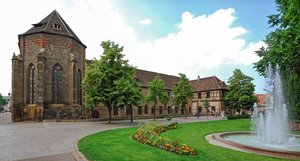 Musée d'Unterlinden |
Колмар | 4 | Resurrection of Christ, Deposition from the Cross, Entombment of Christ, Colmar Altarpiece |
Izbor obuhvata radove umetnika Caspar Isenmann kroz 14 godina, od 1452 do 1465, čuvajući najlepše originale svake godine.
Izaberite godinu da biste videli originalna dela.
Resurrection of Christ (1462), Musée d'Unterlinden, Колмар. Slede Deposition from the Cross, Entombment of Christ (1452) i Colmar Altarpiece (1465).
52 godina: Resurrection of Christ datira iz 1462, a Caspar Isenmann je rođen/a 1410.
Naš katalog sadrži 5 dela umetnika Caspar Isenmann, datiranih od 1452 do 1465.
Većinom u Musée d'Unterlinden (Колмар). Tabela muzeja iznad sadrži njih sve.
Na ovoj stranici, najstarije delo je iz Deposition from the Cross, Entombment of Christ (1452), a najnovije iz Colmar Altarpiece (1465).
Resurrection of Christ, Deposition from the Cross, Entombment of Christ i Colmar Altarpiece: Musée d'Unterlinden, Колмар čuva 4 dela sa ove stranice.
Caspar Isenmann moved through the streets of his native Colmar with the steady purpose of a man deeply woven into the fabric of his city. Though the exact year of his birth remains obscured by time, he emerged into the historical record around 1432, decorating the municipal counting board and eventually establishing himself as a burgher of the town. He was more than a mere painter; he served as the municipal painter for Colmar, a role that placed him at the heart of local civic and religious life.
His presence in the community extended beyond the studio. After 1450, Isenmann held the position of alderman, and in 1461, he helped organize a Mystery play for the feast of Corpus Christi. This involvement in public ritual suggests a man whose life was defined by the rhythms of Alsatian tradition. He lived in a house on the rue des Marchands that still bears an inscription from 1435, marking his early years in the city.
The work of Isenmann carries the weight of the Upper Rhenish school, a style shaped by the shifting currents of mid-15th-century Europe. While no certain record of his apprenticeship survives, scholars suggest he may have studied under Hans Hirtz of Strasbourg or Konrad Witz of Basel. His brushwork also reflects the quiet influence of Rogier van der Weyden and the Netherlandish tradition, bringing a specific gravity to his religious subjects.
His technical approach often utilized gold grounds, sometimes textured with low wood relief to suggest the sky. In his compositions, figures move with an arrested motion, their gestures carrying a certain pathos. He had a way of setting scenes within true landscapes, even while maintaining the formal constraints of the Gothic style. This balance between naturalism and convention defined his contribution to the region's visual language.
The most significant evidence of Isenmann’s skill remains the large altarpiece created for St Martin's Church in Colmar. Commissioned in 1462, the project was a massive undertaking involving oil on fir wood. The contract required delivery by 1464, though the finished work arrived in 1465. This expansive structure, which once dominated the church choir, spanned over eight meters and focused heavily on the Passion of Christ.
While much of the original altarpiece was dismantled in 1720, several panels survived to find a home in the Unterlinden Museum. These surviving pieces include:
Through these panels, Isenmann’s influence reached even the next generation. He is believed to have been the teacher of Martin Schongauer, one of the most important figures of the era, passing on the foundations of the Alsatian Gothic style to a master who would later refine it.


