Vrane su stigle
Slika pod naslovom Vrane su stigle nastala je 1871. godine. Reč je o delu ruskog umetnika koji se zove Aleksej Savrasov. Umetnik je rođen u Moskvi, u Rusiji, 1830. godine, i ostao je vezan za taj grad sve do svoje smrti 1897. godine.
Ukratko
Od svih originala koje je Aleksej Savrasov ostavio, najpoznatiji je Vrane su stigle (1871), koji se nalazi u kolekciji Tretyakovljeva galerija, Moskva. Odmah za njima slede Rooks come flying (1871) i Winter Night (1869). Naš katalog sadrži 281 dela umetnika Aleksej Savrasov; galerija je čuvala 100 dela koja svet najviše admira, od kojih je svako prikazano sa svojim datumom, muzejom i pričom.
Slika pod naslovom Vrane su stigle nastala je 1871. godine. Reč je o delu ruskog umetnika koji se zove Aleksej Savrasov. Umetnik je rođen u Moskvi, u Rusiji, 1830. godine, i ostao je vezan za taj grad sve do svoje smrti 1897. godine.
To gaze upon Alexei Kondratyevich Savrasov's "Rooks Come Flying" is to step directly into a moment suspended between the quiet hush of deep winter and the sudden, vibrant burst of life. This masterpiece, painted in 1871, is far more than a mere depiction of a snowy landscape; it is an emotional resonance captured on oil canvas. Savrasov, celebrated as a pioneer of the lyrical landscape, possessed a rare gift for…
A small house sits nestled among trees, its form partially obscured by the surrounding landscape. The scene is set during a winter night, where a soft, orange tint warms the sky, providing a subtle contrast to the cold, snow-covered terrain. A river flows through the background, its surface reflecting the muted light of the moon. Near the center, a horse and two figures—one standing to the left and another further…
To gaze upon Alexei Kondratyevich Savrasov's View of the Kremlin from the Krimsky Bridge in Inclement Weather is to step directly into a moment suspended between grandeur and quiet contemplation. This 1851 masterpiece does more than merely depict a vista; it captures the very breath of a Russian day when nature’s drama—the interplay of light, cloud, and enduring stone—becomes the central character. Savrasov, who elevated landscape painting to an art…
The painting presents a landscape centered on a single tree with sparse branches positioned in the foreground. This tree grows from a rugged, rocky terrain. In the middle distance, two figures stand near a building, their presence suggesting a quiet human activity amidst the terrain. The background is composed of a sky filled with dense cloud formations. Several birds are scattered throughout the composition, appearing in flight or resting within…
The painting titled Sea is a work by the Russian artist Alexei Savrasov. Created in 1860, this piece reflects the artist's early development during a period when he was refining his unique approach to the natural world. Savrasov, who was born in Moscow, Russia, in 1830, spent much of his life capturing the specific atmosphere of the landscapes he encountered. He remained in Moscow until his death in 1897.
In this work, titled After the storm, Alexei Savrasov presents a quiet moment of transition within the natural world. Painted about 1870, the scene captures the immediate aftermath of a tempest, focusing on the stillness that settles over the land once the wind has subsided. It is a study of the atmosphere that follows a period of turbulence, where the elements find a temporary, fragile equilibrium.
The painting presents a wide view of a cityscape situated beside a large body of water. In the foreground, the water occupies a significant portion of the lower frame, its surface reflecting the light from a sky filled with scattered clouds. Above the urban horizon, the clouds create a heavy, dramatic atmosphere. In the distance, the silhouettes of various buildings rise, suggesting a dense and active urban environment. Small figures…
The sun hangs low in the sky, casting a warm, golden glow over the scene in Summer landscape with windmills. Painted by Alexei Savrasov in 1859, this work invites the viewer into a quiet moment of the Russian countryside. The landscape genre finds its expression here through a serene depiction of nature, where the air feels heavy with the stillness of a summer afternoon. One can almost feel the gentle…
The ocean churns with a violent, restless energy, its dark waters rising hungrily toward the mast of a struggling vessel. Every wave seems to possess a heavy, liquid weight, threatening to pull the wooden hull into the depths. Above the chaos, birds scatter through the salt-heavy air, their frantic flight mirroring the desperation of the scene below. A smaller boat drifts in the distance, a lonely silhouette against the turbulent…
Četiri teme koje se najčešće ponavljaju u ovim originalima, svaka sa svojim vrhunskim primerom.
2 muzeja u kojima se nalazi najviše slika sa ove stranice.
| Muzej | Grad | Radovi umetnika Aleksej Savrasov | Slike iz ovog spiska |
|---|---|---|---|
| Moskva | 16 | Vrane su stigle, Rooks come flying, View of the Kremlin from the Krimsky Bridge in Inclement Weather | |
| Basel | 1 | Landscape with hut |
Izaberite deceniju da biste videli original koji je definiše.
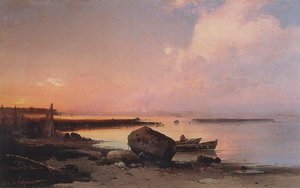
The canvas presents a view of a sunset over a body of water. In the distance, a single boat sails upon the surface. The sky occupies a significant portion of the upper frame, filled with warm hues that transition across the horizon. In the foreground, a hillside rises, where several people are positioned. These figures are oriented toward the water, watching the vessel move away. The light from the setting…
To gaze upon Alexei Kondratyevich Savrasov's View of the Kremlin from the Krimsky Bridge in Inclement Weather is to step directly into a moment suspended between grandeur and quiet contemplation. This 1851 masterpiece does more than merely depict a vista; it captures the very breath of a Russian day when nature’s drama—the interplay of light, cloud, and enduring stone—becomes the central character. Savrasov, who elevated landscape painting to an art…
A small house sits nestled among trees, its form partially obscured by the surrounding landscape. The scene is set during a winter night, where a soft, orange tint warms the sky, providing a subtle contrast to the cold, snow-covered terrain. A river flows through the background, its surface reflecting the muted light of the moon. Near the center, a horse and two figures—one standing to the left and another further…
Slika pod naslovom Vrane su stigle nastala je 1871. godine. Reč je o delu ruskog umetnika koji se zove Aleksej Savrasov. Umetnik je rođen u Moskvi, u Rusiji, 1830. godine, i ostao je vezan za taj grad sve do svoje smrti 1897. godine.
Early spring. Backwoods is a landscape painting by the Russian artist Alexei Savrasov. The work was executed in 1884. This piece captures a specific seasonal transition within a forest setting, focusing on the period when winter begins to recede.
A serene and melancholic landscape unfolds across a quiet stretch of the Volga River. The scene is dominated by muted earth tones, suggesting the damp, heavy atmosphere of autumn or winter. A small, dilapidated wooden structure sits near the riverbank, perhaps a fisherman’s hut or an abandoned dwelling, while a thin plume of smoke rises from a nearby fire. In the foreground, a few figures provide a sense of scale…
Vrane su stigle (1871), Tretyakovljeva galerija, Moskva. Slede Rooks come flying (1871) i Winter Night (1869).
41 godina: Vrane su stigle datira iz 1871, a Aleksej Savrasov je rođen/a 1830.
Vrane su stigle, Rooks come flying, Winter Night, View of the Kremlin from the Krimsky Bridge in Inclement Weather, Landscape with pine, Sea, After the storm, View of Moscow from Sparrow Hills, Summer landscape with windmills i The death of the ship at sea. Gornji rang pokazuje godinu i muzej za svako od njih.
Naš katalog sadrži 281 dela umetnika Aleksej Savrasov, datiranih od 1849 do 1893.
Većinom u Tretyakovljeva galerija (Moskva) i Kunstmuseum Basel (Basel). Tabela muzeja iznad sadrži njih sve.
U 1850s: 45 od 100 dela na ovoj stranici nastalo je tada, od čega je View of the Kremlin from the Krimsky Bridge in Inclement Weather.
Na ovoj stranici, najstarije delo je iz Ukrainian landscape (1849), a najnovije iz Spassky backwater on the Volga (1893).
Sky (46), Landscape (42) i Trees (34), kroz svih 100 dela na ovoj stranici.
Oil On Canvas, za 36 od 100 dela na ovoj stranici.
Realism, sudeći po originalima na ovoj stranici.
Vrane su stigle, Rooks come flying i View of the Kremlin from the Krimsky Bridge in Inclement Weather: Tretyakovljeva galerija, Moskva čuva 10 dela sa ove stranice.
U prostranstvu ruskog umetništva devetnaestog veka, malo je koji naziv tako dirljivo priziva tihu, melanholičnu lepotu prirodnog sveta kao Aleksej Kondratjevič Savrasov. Rođen u Moskvi 1830. godine, Savrasov nije samo slikao pejzaže; on je beležio sam dah ruske zemlje. Njegovo umetničko putovanje započelo je u uzvišenim prostorima Moskovske škole slikarstva, vajarstva i arhitekture, gde je studirao pod vođstvom majstora poput Vasilija Petroviča Verkofa. Upravo su tokom tih formativnih godina Savrasov razvio duboku osetljivost prema okolini, naučivši da gleda izvan same površine terena kako bi pronašao emocionalni puls skriveni ispod mraza i lišća. Njegovo rano obrazovanje ugradilo mu je rigoroznu posvećenost realizmu, ali je njegov duh ostao duboko vezan za lirijske nijanse romantizma, što mu je omogućilo da topografska zapažanja transformiše u duboka psihološka iskustva.
Evolucija Savrasovog stila najsjajnije se ogleda u njegovoj sposobnosti da pronađe veličinu u onome što je skromno i zanemareno. Dok su mnogi njegovi savremenici tražili dramatične vrhove dalekih planina, Savrasov je svoj pogled okrenuo ka intimnim, često sumornim realnostima ruskog sela. Njegov umetnički proboj stigao je sa monumentalnim delom „Zimski pejzaž” iz 1865. godine, delom koje će redefinisati čitav žanr. U ovom remek-delu, on se udaljio od puke fotografske tačnosti kako bi prihvatio atmosfersku perspektivu, koristeći prigušene palete i suptilne gradacije sive, bele i braon boje da dočara oštru hladnoću i tešku tišinu sveta prekrivenog snegom. Ovaj preokret ka raspoloženju umesto doslovnog detalja utvrdio ga je kao pionira lirskog pejzažnog slikarstva, dokazujući da slika može služiti kao ogledalo ljudske duše.
Savrasovska tehnička virtuoznost ležala je u njegovom vrhunskom vladanju svetlošću i tonalnim varijacijama. Posedovao je neslućenu sposobnost da dočara vlagu rastopljenog snega, tešku vlažnost koja prati oluju i meku, difuznu svetlost prolećnog popodneva. Njegova dela često prikazuju delikatnu igru tekstura — grubu koru breze naspram glatke, staklene površine smrznute reke. To je možda najpoznatije postignuto u njegovom kultnom delu „Vranog su se vratili” (1871). Na ovoj slici, prizor ptica koje se vraćaju u šumara prekrivenog snegom služi kao moćan simbol nade i ciklične prirode života, oličavajući jedinstveno rusko sezonsko melanholično stanje koje rezonuje sa posmatračima i danas.
Pored zimskih scena, njegov repertoar je obuhvatao dela neizmerne atmosferske dubine, kao što su:
Kroz ova dela, Savrasov je postigao osećaj sjedinjenja između posmatrača i onoga što se posmatra. On nije tretirao prirodu kao pozadinu za ljudsku dramu, već kao glavnog protagonista. Njegove slike pozivaju na stanje kontemplacije i samoće, podstičući gledaoca da pronađe lepotu u surovom, tihom i prolaznom. Podizanjem ruskog pejzaža na nivo teme od visoke emocionalne važnosti, Savrasov je ostavio neizbrisiv trag u istoriji umetnosti, osiguravši da njegova vizija duševne, žive zemlje opstane dugo nakon njegove smrti 1897. godine.