The Aesthetics of Disruption: Defining Fragmentation in Art History
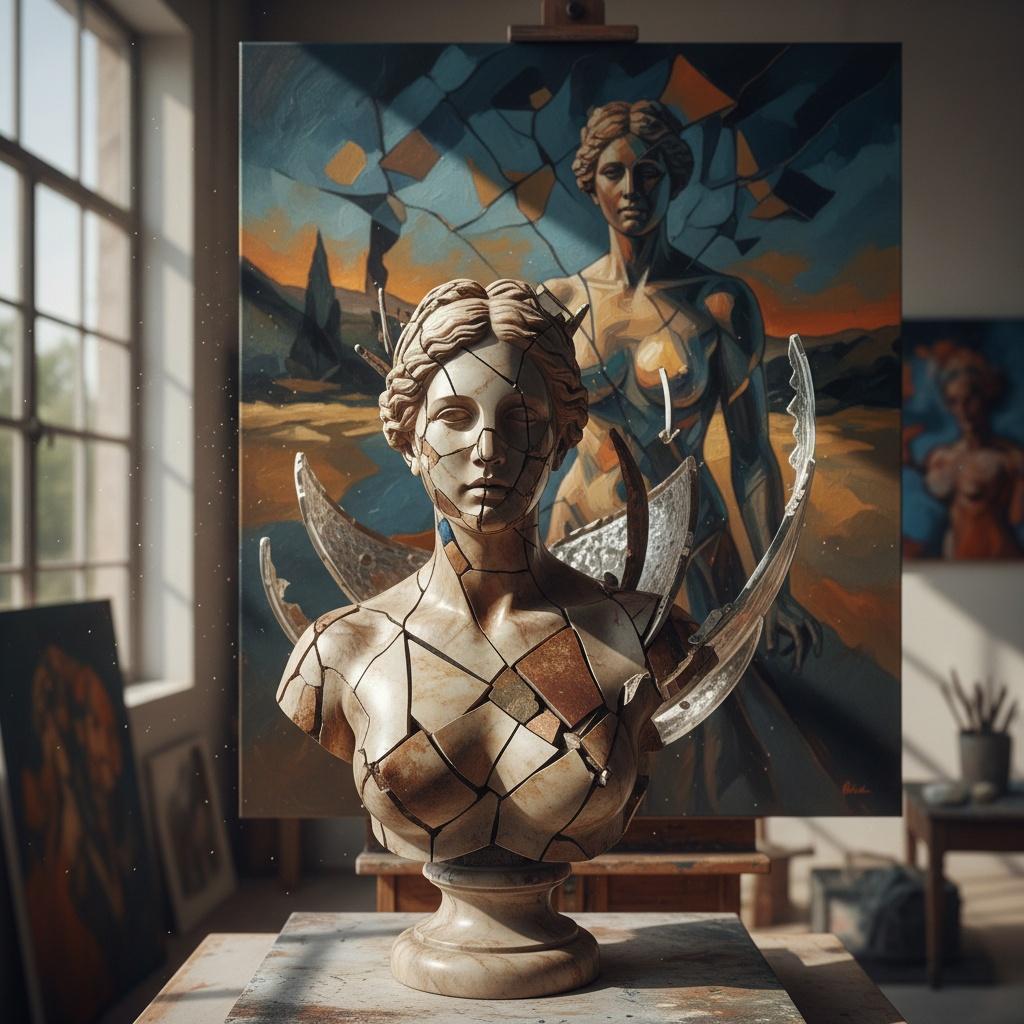
To the untrained eye, a fragment may appear as a mere remnant, a broken shard of a once-unified whole. Yet, for the discerning collector, fragmentation represents one of the most profound intellectual shifts in the history of human expression. It is the deliberate act of breaking the visual continuum to reveal deeper, often more complex, truths that a singular, unbroken perspective cannot convey. This aesthetic of disruption does not seek to destroy beauty, but rather to reconfigure it, challenging the viewer to reconstruct meaning from a mosaic of disparate elements.
Throughout the evolution of fine art, fragmentation has served as a powerful tool for exploring the multifaceted nature of reality. It moves us away from the static, mimetic traditions of the Renaissance—where the window to the world was clear and unobstructed—and toward a more psychological, layered experience. By deconstructing the subject, artists invite us into a participatory role, where our minds must bridge the gaps between planes, colors, and shapes. This tension between what is visible and what is implied creates a dynamic energy that breathes life into the canvas, transforming a passive viewing experience into an active intellectual pursuit.
Ultimately, the power of the fragment lies in its ability to evoke the infinite. When a form is broken, it suggests a world existing beyond the edges of the frame, a sense of movement and temporal flux that resonates with the complexities of modern existence. It is an invitation to find harmony within chaos and to recognize that true aesthetic depth often resides in the interplay of the incomplete.
Cubism and the Multi-Dimensional Lens: Deconstructing Reality through Picasso
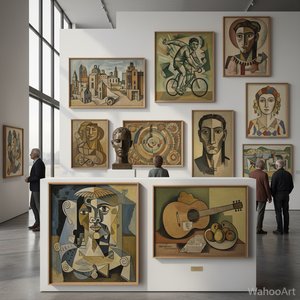
The dawn of the twentieth century brought with it a radical reimagining of space, spearheaded by the revolutionary movements of Cubism. At the heart of this upheaval was Pablo Picasso, an artist whose fascination with deconstruction forever altered the trajectory of modern art. In works such as Artist's Studio, we observe a profound dialogue with the past, specifically the techniques of Velázquez, yet filtered through a lens that embraces the fragmentation of form. Picasso did not merely paint objects; he dismantled them, presenting multiple viewpoints simultaneously to capture the essence of a subject in its entirety.
In the Cubist tradition, the subject is no longer bound by the constraints of a single, fixed perspective. Instead, the canvas becomes a site of geometric intersection, where planes overlap and edges dissolve. This technique allows for a multi-dimensional experience, simulating the way human perception actually functions—not as a static snapshot, but as a continuous, shifting accumulation of glances and memories. By breaking the subject into geometric facets, Picasso and his contemporaries were able to explore the structural integrity of the world, finding a new kind of rhythm in the fractured surface.
For the collector, embracing Cubist-inspired fragmentation means appreciating the intellectual rigor required to synthesize these broken planes into a cohesive vision. It is an art of reconstruction, where the beauty lies in the sophisticated arrangement of shards, creating a sense of depth that transcends the two-dimensional plane and offers a more profound engagement with the physical world.
Abstract Expressionism and the Fragmented Soul: Kandinsky’s Geometric Lyricism
If Cubism deconstructed the external object, then Abstract Expressionism sought to fragment the internal landscape of emotion and spirituality. Wassily Kandinsky, a pioneer of this movement, utilized fragmentation not as a structural tool, but as a lyrical one. In his Composition VII Fragment, we witness a vibrant explosion of color and form that defies traditional boundaries. Here, the fragment is not a piece of a broken object, but a pulse of pure energy—a swirling mass of red, blue, yellow, and green that suggests an infinite, cosmic dance.
Kandinsky’s approach to fragmentation is deeply tied to his belief in the spiritual resonance of color and shape. In works like Fragment 2 For Composition VII, the use of prominent triangles and circles amidst chaotic, organic forms creates a tension between order and spontaneity. The fragmentation here serves to represent the complexity of the human soul—a collection of intense emotions, spiritual impulses, and geometric certainties that are often in conflict. There is no singular focal point; instead, the eye wanders through a labyrinth of color, experiencing the "inner necessity" that Kandinsky so famously championed.
This form of abstraction offers a different kind of beauty: one that is felt rather than merely seen. The fragmented compositions act as visual music, where each stroke and hue contributes to a larger, albeit non-linear, emotional narrative. For those who seek art that speaks to the intangible, these fractured, vibrant landscapes provide a gateway to a deeper, more spiritual dimension of the aesthetic experience.
The Collector's Perspective: Finding Cohesion within Broken Forms
For the serious collector, the challenge—and the reward—of acquiring fragmented or abstract works lies in the ability to find cohesion within apparent discord. A collection of broken forms requires a sophisticated eye to recognize the underlying thread that binds them. It is not about seeking uniformity, but about identifying a shared language of rhythm, weight, and tonal balance that allows disparate pieces to converse with one another across a gallery or a private study.
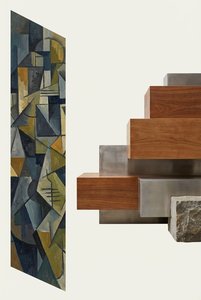
The mastery of collecting fragmented art involves understanding how the "voids" in a composition interact with the surrounding space. A piece that utilizes heavy impasto and fractured planes demands a certain architectural consideration; it requires a setting where its energy can breathe without overwhelming the environment. The collector must look beyond the surface disruption to see the structural integrity of the artist's vision, finding the hidden unity that exists within the deconstructed subject.
Furthermore, there is an inherent value in the tension provided by these works. A collection that balances the representational with the fragmented creates a sophisticated dialogue between tradition and modernity. By integrating pieces that challenge the viewer’s perception, a collector demonstrates an appreciation for the evolution of thought and the enduring power of complexity.
::