The Genesis of Fragmentation: Precursors to Cubism
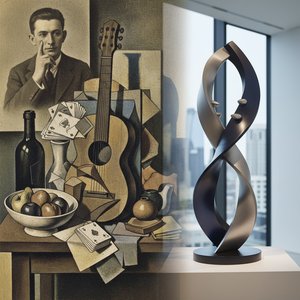
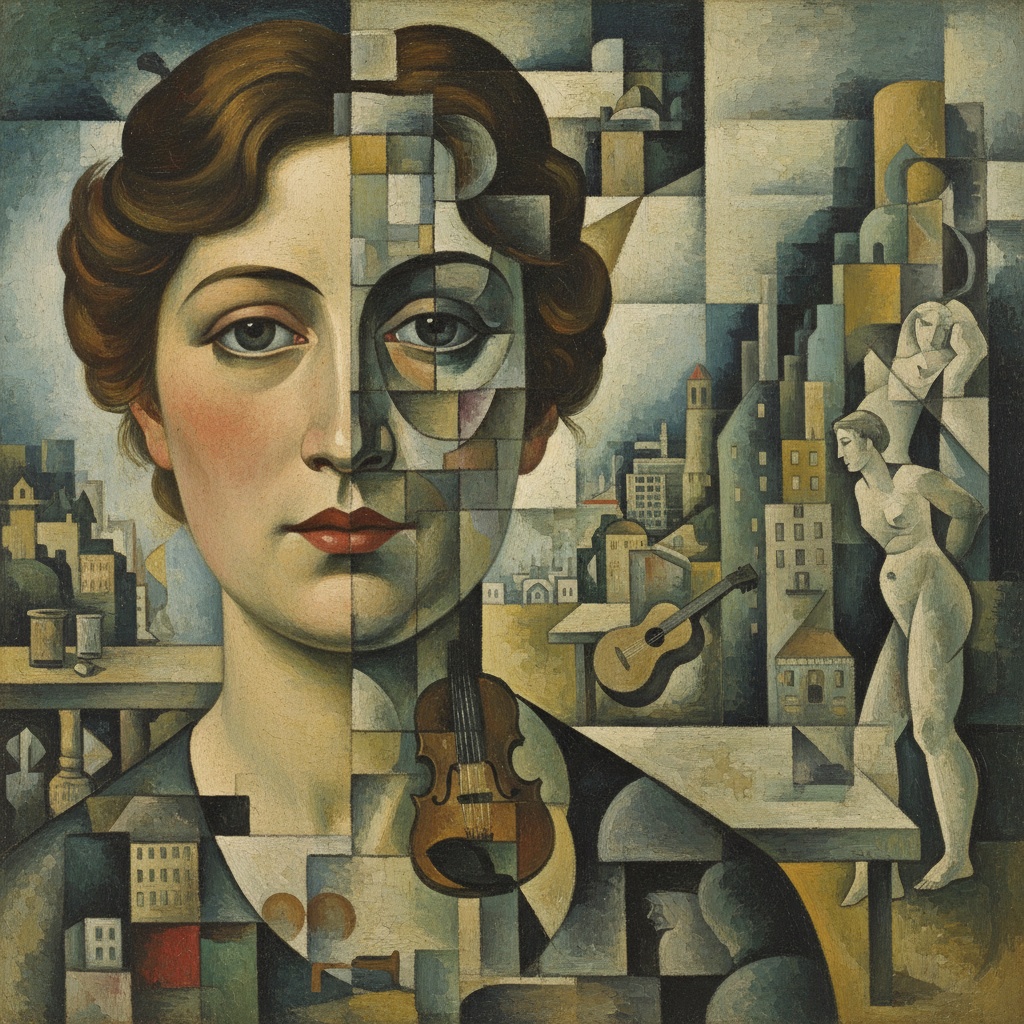
Cubism is an early-20th-century avant-garde art movement which began in Paris. It revolutionized painting and the visual arts, and sparked artistic innovations in music, ballet, literature, and architecture. Cubist subjects are analyzed, broken up, a...
Before the radical reshaping of form that we recognize as Cubism, a quiet revolution was brewing within the ateliers and intellectual circles of late 19th-century Europe. To understand the seismic shift initiated by Pablo Picasso and Georges Braque, one must first acknowledge the fertile ground from which it sprang. The Impressionists, with their fleeting glimpses of light and subjective experience, had already begun to dismantle academic traditions, prioritizing perception over precise representation. But it was Paul Cézanne who laid the most crucial groundwork. Cézanne’s relentless pursuit of underlying structure – his insistence on reducing natural forms to geometric volumes – became a foundational principle for the Cubists. He famously urged artists to “treat nature in terms of the cylinder, the sphere, the cone,” a directive that echoed powerfully in Picasso and Braque's early experiments.
Beyond Cézanne, the burgeoning field of anthropology offered another vital influence. The discovery of African masks and sculptures – objects imbued with spiritual power and characterized by abstracted forms – captivated artists seeking alternatives to Western artistic conventions. These non-European art forms challenged traditional notions of beauty and representation, demonstrating that compelling visual language didn’t necessarily rely on mimetic accuracy. The flattened perspective and symbolic weight of these artifacts resonated deeply with Picasso, particularly in his groundbreaking 1907 painting, *Les Demoiselles d'Avignon*, a work often considered the proto-Cubist masterpiece. This wasn’t merely an aesthetic borrowing; it was a philosophical embrace of different ways of seeing and representing the world.
The intellectual climate also played a critical role. New scientific theories, such as Einstein’s theory of relativity, were questioning established notions of space and time. Artists began to grapple with the idea that reality wasn't fixed or absolute but rather relative and dependent on perspective. This burgeoning sense of uncertainty and fragmentation found its visual expression in the nascent Cubist aesthetic.
Analytical Cubism: Breaking Down Form and Perspective
The period between 1908 and 1912 witnessed the birth of Analytical Cubism, a phase characterized by an intense deconstruction of form. Picasso and Braque embarked on a collaborative journey, working in such close proximity that their styles became almost indistinguishable. They systematically dissected objects into fragmented geometric shapes, analyzing them from multiple viewpoints simultaneously. Imagine taking apart a physical object – a guitar, a bottle, a human figure – and then reassembling it on the canvas not as it appears from one fixed vantage point, but as if seen from all sides at once.
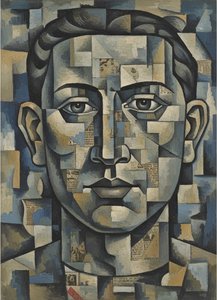
This process wasn’t about creating an optical illusion of depth; rather, it was about representing the *concept* of an object in its totality. Color palettes were deliberately muted – predominantly browns, grays, and blacks – to avoid distracting from the formal complexities of the composition. The emphasis was on structure, planes, and angles, a deliberate rejection of traditional Renaissance perspective. Overlapping forms created a sense of ambiguity and dynamism, challenging the viewer to actively reconstruct the image in their mind. Works like Picasso’s *Portrait of Georges Braque* (1909) exemplify this approach; the subject is barely recognizable as a human being, reduced instead to a network of intersecting planes and fragmented features.
The term “Analytical” aptly describes this phase, as the artists were essentially analyzing the very building blocks of visual representation. They weren’t simply depicting objects; they were dissecting them, questioning their inherent form, and exploring the limitations of traditional artistic techniques. This was a profoundly intellectual undertaking, demanding rigorous experimentation and a willingness to abandon established conventions.
Synthetic Cubism: Rebuilding Reality with Collage and Color
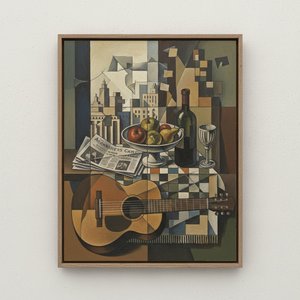
Around 1912, Analytical Cubism began to evolve into Synthetic Cubism, marking a significant shift in approach. While the earlier phase focused on breaking down objects, Synthetic Cubism embraced reconstruction – building up images from simplified forms and incorporating elements of collage. Instead of meticulously analyzing an object’s structure, artists began to synthesize it, using fragments of reality – newspaper clippings, wallpaper, fabric – as integral components of their compositions.
Juan Gris, who joined Picasso and Braque in exploring this new direction, played a pivotal role in defining the characteristics of Synthetic Cubism. He introduced brighter colors and more clearly defined shapes, moving away from the monochromatic palettes of Analytical Cubism. Collage allowed artists to introduce texture, pattern, and real-world references into their work, blurring the boundaries between painting and sculpture. The use of *papier collé* – glued paper – challenged traditional notions of artistic materials and techniques.
Bathing, a prime example from Picasso’s Synthetic period, demonstrates this shift. The composition is constructed from simplified forms and vibrant colors, incorporating elements of collage to create a dynamic and playful image. This wasn't simply about adding decorative elements; it was about questioning the very nature of representation and exploring the relationship between art and reality. Synthetic Cubism represented a move towards greater accessibility and clarity, while still retaining the intellectual rigor and formal complexities of its predecessor.
Beyond Painting: Cubism's Influence on Sculpture, Architecture & Design
The impact of Cubism extended far beyond the confines of painting, profoundly influencing sculpture, architecture, and design. Artists began to apply Cubist principles – fragmentation, multiple perspectives, geometric abstraction – to three-dimensional forms. Sculptors like Raymond Duchamp-Villon experimented with fractured planes and dynamic compositions, creating works that challenged traditional notions of volume and space.
In architecture, Cubism inspired a new aesthetic characterized by angularity, asymmetry, and the rejection of ornamentation. While fully realized Cubist buildings are rare, the influence can be seen in the work of architects who embraced geometric forms and fragmented compositions. The principles of Cubism also found their way into design – furniture, typography, and even fashion – influencing a generation of artists and designers seeking to break away from traditional styles.
The movement’s emphasis on abstraction and simplification resonated deeply with the burgeoning modernist aesthetic, paving the way for movements like Futurism and Constructivism. Cubism wasn't simply an artistic style; it was a philosophical revolution that challenged fundamental assumptions about representation, perception, and the nature of reality.
Key Figures of the Movement: Picasso, Braque, and Gris
While many artists experimented with Cubist principles, three figures stand out as central to the movement’s development: Pablo Picasso, Georges Braque, and Juan Gris. Pablo Picasso, arguably the most influential artist of the 20th century, was a relentless innovator who constantly pushed the boundaries of artistic convention. His early experiments with fragmentation in *Les Demoiselles d'Avignon* laid the groundwork for Cubism, and his subsequent explorations – both Analytical and Synthetic – defined its core characteristics.
Georges Braque, often overshadowed by Picasso, was an equally important figure in the movement’s development. His close collaboration with Picasso during the Analytical phase resulted in a remarkable period of artistic experimentation. Braque's meticulous attention to structure and his subtle use of color were crucial to defining the aesthetic of early Cubism.
Juan Gris, who joined the movement slightly later, brought a unique perspective to Synthetic Cubism. His introduction of brighter colors and more clearly defined shapes helped to move the style towards greater accessibility and clarity. Gris’s analytical approach to composition and his exploration of collage techniques further expanded the possibilities of Cubist representation.
The Enduring Legacy of Cubism: A Modern Revolution
Cubism's impact on 20th-century art is undeniable. It shattered traditional notions of perspective, representation, and artistic convention, paving the way for a new era of abstraction and experimentation. The movement’s emphasis on fragmentation, multiple perspectives, and geometric abstraction continues to resonate with artists today.
From its influence on sculpture and architecture to its impact on design and typography, Cubism's legacy is far-reaching. It challenged viewers to actively engage with the artwork, demanding a more intellectual and analytical approach to perception. The principles of Cubism can be seen in countless works of modern art, from the abstract paintings of Piet Mondrian to the dynamic sculptures of Constantin Brancusi.
At OriginalUniqueArt.com, we celebrate the enduring legacy of Cubism by offering high-quality reproductions of masterpieces by Picasso, Braque, Gris, and other key figures of the movement. Explore our collection today and discover the revolutionary world of Cubism for yourself. Whether you’re a seasoned art collector or simply beginning your journey into modern art, OriginalUniqueArt provides access to exceptional artworks that will inspire and challenge your perceptions.