Post-Impressionist Landscape
Химера (Јачек Малчевски)
Јачек Малчевски (1854–1929) je napravio Химера. Pripada pokretu Post-Impressionist Landscape. Izrađeno je u Ulje na platnu.
- Ulje na platnu

 Pregledaj u prostoru

 Ručno oslikano uljanim bojama
 Pošalji
 Podeli
 Informativni list za štampu


 Preuzmi
 Slični predmeti
 Rendgenski snimak
 Automatska prezentacija
 Pitanja i odgovori

 Statistika
Химера, ukratko
- Naslov
- Химера
- Umetnik
- Јачек Малчевски (1854–1929)
- Mesto rođenja umetnika
- Радом, Пољска
- Tehnika
- Ulje na platnu
- Period
- 19. vek
- Tema
- rural landscape, women dialogue, warm palette, impasto texture, atmospheric light, polish symbolism
Šta prikazuje Химера?
A Vision of Polish Identity: Exploring Jacek Malczewski’s “Chimera”
The painting "Chimera" by Jacek Malczewski stands as a cornerstone of Polish Symbolism, capturing not merely a picturesque landscape but also the very soul of a nation grappling with its heritage and aspirations. Created around 1897, this artwork transcends mere visual representation; it’s an emotive declaration of artistic conviction rooted in deeply held patriotic sentiments. Born in Radom during a period of Russian dominion over Congress Poland—a formative experience that instilled within him the fervent desire for Polish independence—Malczewski's life mirrored his art: driven by idealism and fueled by recollections of heroic narratives. His father, Julian Malczewski, nurtured this passion for Polish culture and history, shaping Jacek into a painter who would become synonymous with Symbolist aesthetics.- Subject Matter & Composition: The scene depicts two women engaged in conversation amidst a rural backdrop featuring a rustic building. The asymmetrical composition emphasizes the figures’ presence against an expansive sky, creating a dynamic interplay of light and shadow that underscores the intimacy of their interaction. Notice how the placement of the woman on the lower portion of the canvas contrasts with the dominant expanse of sky above – this deliberate imbalance contributes to the painting's overall mood and visual dynamism.
- Style & Technique: Malczewski’s approach firmly establishes itself within Post-Impressionism, incorporating expressive elements reminiscent of Expressionism. Thick impasto brushstrokes dominate the canvas, generating palpable texture and conveying an emotional intensity characteristic of Symbolist art. The artist skillfully employs atmospheric perspective to heighten the sense of depth and luminosity, prioritizing mood over precise realism. This technique—the layering of paint in visible strokes—allows for a remarkable capture of fleeting moments of light and color, mirroring the Impressionists’ fascination with capturing ephemeral beauty.
- Historical Context: “Chimera” emerged during a pivotal moment in Polish history—the waning years of the Austro-Hungarian Empire and the burgeoning movement for national revival. Malczewski’s Symbolist style reflects the broader intellectual currents of his time, aligning with artists who sought to transcend mere depiction and delve into psychological landscapes and spiritual truths. The painting speaks directly to the anxieties and hopes surrounding Poland's quest for autonomy during this era.
- Symbolism & Emotion: The painting’s title itself—"Chimera"—references mythological creatures combining disparate elements, symbolizing the multifaceted nature of Polish identity. It embodies themes of companionship, contemplation, and connection with the natural world, conveying a profound sense of melancholy mingled with hope for the future. Consider the visual metaphor – just as the Chimera represents unity amidst chaos, Malczewski’s painting suggests that Polish identity is forged from both tradition and aspiration.
- Material & Craftsmanship: Executed in oil paints on canvas, “Chimera” exemplifies meticulous craftsmanship. The layering of paint creates a rich surface texture that captures fleeting moments of light and color—a testament to Malczewski’s dedication to conveying both visual beauty and emotional resonance.
Slike visoke rezolucije za Химера
Јачек Малчевски, Химера. Javno dobro.
Odgovori na pitanja o Химера
Kojom tehnikom je urađeno „Химера”, autor Јачек Малчевски?
"Химера" je urađeno u tehnici Ulje na platnu.
Šta predstavlja delo "Химера"?
Motivi dela "Химера" su rural landscape, women dialogue, warm palette, impasto texture, atmospheric light, polish symbolism, quiet reflection.
Da li se prikaz „Химера”, autor Јачек Малчевски može slobodno reprodukovati?
„Химера”, autor Јачек Малчевски pripada u javnom vlasništvu – autorska prava su istekla. Ovaj status određuje način na koji se slika dela može reprodukovati.
Ko je autor dela "Химера"?
Delo "Химера" pripisuje se umetniku Јачек Малчевски.
Koji umetnički pravac pripada delu "Химера"?
„Химера“ je delo Post-Impressionist Landscape pokreta. Ovaj pokret označava umetničku tradiciju kojoj je delo pripada.
U kojoj fazi stvaralaštva umetnika Јачек Малчевски se nalazi delo "Химера"?
U okviru karijere umetnika Јачек Малчевски, delo "Химера" pripada periodu Mature Period, što omogućava poređenje sa drugim radovima ovog autora.
Zašto je status autorskih prava za "Химера" takav kakav jeste?
Status autorskih prava za delo "Химера" - u javnom vlasništvu – autorska prava su istekla - proizilazi iz godine smrti umetnika, 1929.
Šta "Химера" deli sa ostatkom stvaralaštva umetnika Јачек Малчевски?
U okviru celokupnog stvaralaštva umetnika Јачек Малчевски, delo "Химера" pripada stilu Post-Impressionist Landscape, uz prisustvo tema kao što su polish symbolism roots, romantic ideals vision, national identity echoes, landscape reflection depth.
Gde se "Химера" nalazi među uobičajenim motivima umetnika Јачек Малчевски?
"Химера" prikazuje rural landscape, women dialogue, warm palette, impasto texture, atmospheric light, polish symbolism, quiet reflection, dok su dokumentovane teme umetnika Јачек Малчевски zapravo polish symbolism roots, romantic ideals vision, national identity echoes, landscape reflection depth. Poređenje ova dva elementa pokazuje kako se ovo delo povezuje sa uobičajenim motivima ovog umetnika.
O umetniku, Јачек Малчевски
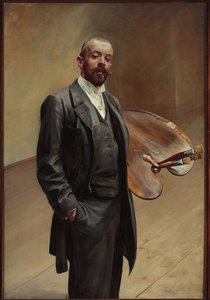
1854–1929, Пољска
Јачек Малчевски
Život prožet poljskom čežnjom Jacek Malczewski, rođen 1854. godine u Radomu, gradu koji je tada bio smešten unutar Kongresne Poljske pod ruskom kontrolom, bio je mnogo više od običnog slikara; bio je vizuelno utemeljenje polskog nacionalnog identiteta i duboki glas nacije koja je žudela za samodeterminacijom. Put njegove životne trajektorije i umetničke vizije bio je neraskidivo povezan sa romantičarskim idealima nezavisnosti, koje mu je duboko usadio otac, Julian Malczewski — posvećeni patriota koji je u mladom Jaceku negovao nepokolebljivu ljubav prema polskoj kulturi, književnosti i istoriji. Ovaj rani uticaj postao je temelj njegovog kreativnog izražavanja, oblikujući ga u vodeću figuru polskog simbolizma i donoseći mu prestižnu titulu „oca polskog simbolizma“.
O umetniku Јачек Малчевски Istaknuta dela umetnika Јачек Малчевски
Takođe i Јачек Малчевски
 Self-portrait in armor with violin.1908
 Madonna and Children1897
 Portrait of artist's sister Helene with lute1906
 The Artist's death1909
Eseji o delu Химера
 Polish artworks of the 1900sPolish Symbolism in the 1900s features masterpieces by Jacek Malczewski, Olga Boznańska, and Józef Mehoffer. View the full collection at Or…
 The Language of Brushstrokes: Decoding Emotion and Technique in Art HistoryExplore the profound connection between technique and emotion. From the sculptural depth of impasto to classical mastery, decode the langua…
 20th century Polish painters20th-century Polish painters like Tamara de Lempicka, Sigmar Polke, and Aleksandra Ekster define an era. Find museum-quality reproductions …