Portret Wincenty Smokowski

24 najbolj znanih slik umetnika Wincenty Smokowski, vsaka popolnoma edinstvena

Posodobljeno november 2026 · uvrščeno glede na naš skoraj priljubljenosti (iskanja, obiske in naročila za vsako delo) · 24 del v našem katalogu avtorja Wincenty Smokowski

Kratek opis

Conversation (1800) je slika avtorja Wincenty Smokowski, ki pritegne največ pogledov; original se nahaja v muzeju Lithuanian Art Fund, Vilnius. Nato se pogled smeri k Peasant talk (1800) in Entry of Boleslaus the Brave into Kiev. (1830). Med 24 dela umetnika Wincenty Smokowski v našem katalogu so ta 24 najbolj znana; vsako je edinstven original, predstavljen z letnico nastanka, muzejem in razlogom za njegovo nečasenost.

1797 – 1876, Vilna Academicism Največ del: Lithuanian Art Fund

10 najboljjših slik umetnika Wincenty Smokowski skozi oči galerije

1
Conversation (1800) avtorja Wincenty Smokowski

Conversation

1800 · Lithograph · Lithuanian Art Fund, Vilnius

This black and white lithograph captures a fleeting social moment through a group of four figures. Rendered with a loose, sketchy quality, the work functions as a preparatory study, prioritizing the immediacy of gesture and character over finished precision. The composition is centered on the group, utilizing an asymmetrical arrangement to create a sense of movement within the quietude of the scene. Lines are used expressively to define the anatomy…
2
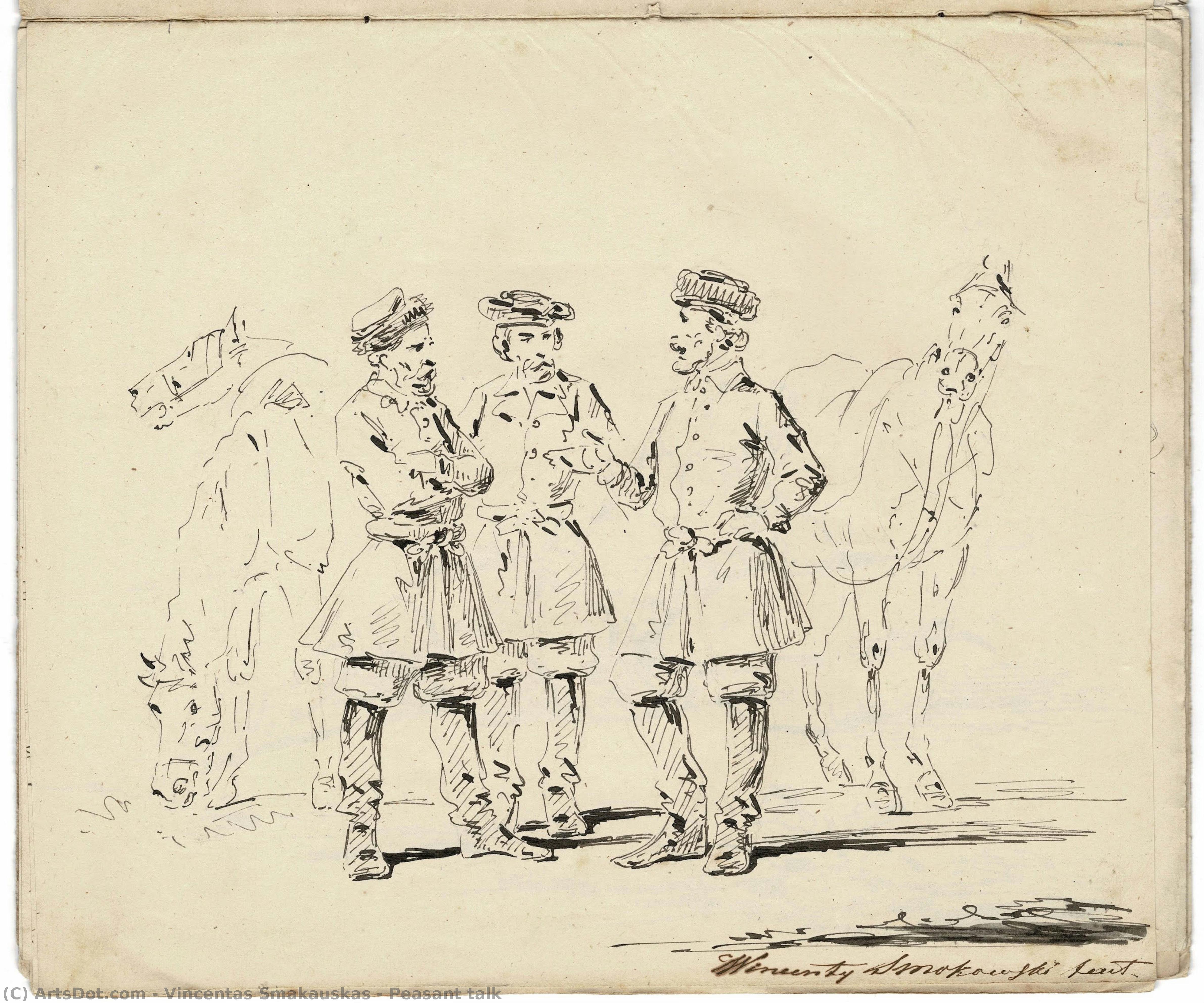
Peasant talk (1800) avtorja Wincenty Smokowski

Peasant talk

1800 · Ink On Paper · Lithuanian Art Fund, Vilnius

Four men stand locked in a quiet, urgent circle, their bodies leaning inward as if the very air between them holds a secret. They wear the heavy, structured uniforms of soldiers, yet the rigidity of their attire contrasts with the loose, spontaneous energy of their interaction. This is a study of human connection caught in a fleeting instant. The scene feels less like a formal portrait and more like a…

3
Entry of Boleslaus the Brave into Kiev. (1830) avtorja Wincenty Smokowski

Entry of Boleslaus the Brave into Kiev.

1830 · Oil · Narodni muzej v Varšavi, Varšava

The composition centers on a white horse carrying a knight, positioned within a crowded, dynamic military procession. This central figure moves through a fortified city gate, framed by an arched upper boundary that directs the eye toward the cavalry. The scene is filled with movement, established by the diagonal placement of horses and the upward gestures of the surrounding crowd. Deep reds appear in the banners and clothing of the…

4
Gypsy encampment upon a creek. (1850) avtorja Wincenty Smokowski

Gypsy encampment upon a creek.

1850 · Oil On Canvas · Narodni muzej v Varšavi, Varšava

The air feels heavy with the scent of damp earth and woodsmoke as twilight descends upon this secluded forest clearing. Shadows stretch long and deep from the massive, dark tree trunks that frame the scene, creating a sense of profound intimacy within the grove. At the center of this quiet drama, a group of figures gathers on a sandy bank beside a slow-moving creek. The light seems to emanate from…

5
Jewish wedding. (1858) avtorja Wincenty Smokowski

Jewish wedding.

1858 · Oil On Canvas · Narodni muzej v Varšavi, Varšava

The village street narrows under the weight of a celebration. A wedding procession moves through the earthy landscape, a slow river of humanity flowing between thatched-roof cottages. The air feels thick with the scent of dry straw and the sound of wood and string. Musicians lead the way, their cello and violin carving melodies into the late afternoon light. A bride moves through the center, her attire a quiet contrast…

6
Rest (1800) avtorja Wincenty Smokowski

Rest

1800 · Drawing · Lithuanian Art Fund, Vilnius

The drawing, rendered in black and white, depicts a solitary man lying on the ground in a state of repose. His head rests upon a large, solid stone, which provides a hard contrast to the softer lines of his body. The man's limbs appear heavy, suggesting a state of deep sleep or total exhaustion. The composition is quiet, focusing on the physical contact between the human form and the natural…

7
Domestic scene (Children and nannies) (1800) avtorja Wincenty Smokowski

Domestic scene (Children and nannies)

1800 · Drawing · Lithuanian Art Fund, Vilnius

In the delicate, monochromatic strokes of Vincentas Smakauskas’s 1800 drawing, Domestic scene (Children and nannies), we are invited to step through a portal into the private sanctums of nineteenth-century life. This exquisite work captures a fleeting moment of familial cohesion, where the boundaries between generations blur in a shared space of warmth and togetherness. The composition presents a gathering of at least nine individuals, a tapestry of souls woven together…

8
Domestic scene (noble family) (1800) avtorja Wincenty Smokowski

Domestic scene (noble family)

1800 · Drawing · Lithuanian Art Fund, Vilnius

The year 1800 arrives through a window of ink and shadow. In this black and white drawing, a mother exists as the center of a small, breathing universe. She holds an infant close, her form the anchor for a circle of children who gravitate toward her warmth. There is a stillness here, a held breath in the middle of a domestic afternoon. The light does not shout; it merely traces…

9
Sacrifice for beggar (1800) avtorja Wincenty Smokowski

Sacrifice for beggar

1800 · Ink · Lithuanian Art Fund, Vilnius

Around 1800, Vincentas Smakauskas captured a spirited street dance in this monochromatic drawing. The scene depicts figures moving in synchronized harmony, their forms etched with rhythmic precision. Light and shadow define the dancers, creating a sense of motion that transcends the stillness of the paper. Within the composition, two bowls sit placed in the frame, suggesting a narrative of shared sustenance and communal care. This small 6 x 17 cm…

Slavna platna umetnika Wincenty Smokowski, od številk 11 do 24

Slavna platna umetnika Wincenty Smokowski, razdeljena po obdobjih

Motivi, ki so očarali Wincenty Smokowski

Četiri teme, ki se v teh originalih najpogosteje ponavljajo, vsaka z svojim vrhunskim primerom.

Muzeji, ki hranijo originala umetnika Wincenty Smokowski

2 muzejev, ki vsebujo največ slik na tej strani.

Muzej Mesto Sloga Wincenty Smokowski Slike iz tega seznama
Lithuanian Art Fund, VilniusLithuanian Art Fund Vilnius 19 Conversation, Peasant talk, Rest
Narodni muzej v Varšavi, VaršavaNarodni muzej v Varšavi Varšava 5 Entry of Boleslaus the Brave into Kiev., Gypsy encampment upon a creek., Jewish wedding.

Wincenty Smokowski skozi desetetja: vsak unikatni original za vsako obdobje

Delo po desetletjih

Izberite desetletje, da si ogledate original, ki ga opredeljuje.

Slike umetnika Wincenty Smokowski: vprašanja za galerijo

Katero je najbolj znano delo umetnika Wincenty Smokowski?Razkriti odgovor

Conversation (1800), Lithuanian Art Fund, Vilnius. Zatem sledeta Peasant talk (1800) in Entry of Boleslaus the Brave into Kiev. (1830).

Katera desetina slik avtorja Wincenty Smokowski je najbolj znana?Razkriti odgovor

Conversation, Peasant talk, Entry of Boleslaus the Brave into Kiev., Gypsy encampment upon a creek., Jewish wedding., Rest, Domestic scene (Children and nannies), Domestic scene (noble family), Sacrifice for beggar in Grief. Zgornja lestica prikazuje leto nastanka in muzej za vsako delo.

Koliko je znanih del avtorja Wincenty Smokowski?Razkriti odgovor

Naš katalog vsebuje 24 del avtorja Wincenty Smokowski, datiranih od 1830 do 1858.

Kje si lahko ogledate najslavnejše originale umetnika Wincenty Smokowski?Razkriti odgovor

Večini v Lithuanian Art Fund (Vilnius) in Narodni muzej v Varšavi (Varšava). Zgoraj navedena tabela muzejev vsebuje njihov celoten seznam.

V katerem obdobju je Wincenty Smokowski ustvaril svoja najbolj znana dela?Razkriti odgovor

V obdobju 1850s: 2 od 24 del na tej strani je bilo izdelovanih takrat, med njimi pa Gypsy encampment upon a creek..

Katero znano sliko je naslikal Wincenty Smokowski najprej in katero najpozdneje?Razkriti odgovor

Na tej strani je najstarejše delo iz Entry of Boleslaus the Brave into Kiev. (1830) in najstarejše iz Jewish wedding. (1858).

Katere teme je Wincenty Smokowski najprej ravnate?Razkriti odgovor

19th century (5), People (3) in Black and white (3), na 24 delih na tej strani.

S katerimi materiali je Wincenty Smokowski najpogosteje slikal?Razkriti odgovor

Drawing, za 4 od 24 del na tej strani.

Kateri umetniški slog predstavlja delo umetnika Wincenty Smokowski?Razkriti odgovor

Academicism, glede na originala na tej strani.

Katere originale Wincenty Smokowski lahko vidim v muzeju Lithuanian Art Fund?Razkriti odgovor

Conversation, Peasant talk in Rest: v muzeju Lithuanian Art Fund, Vilnius se nahaja 19 del z te strani.

Wincenty Smokowski: portret umetnika

zgodnje življenje in izobraževanje

Vincentas Smakauskas, znan tudi kot Wincenty Smokowski, je bil izstopajoč poljsko-litajski slikar in ilustrator, rojen leta 1797 v Vilniusu na Litavi. Svojo umetniško pot je začel z študijem na Vilniški univerzi med leti 1817 in 1922, kjer je pod mentorstvom angleškega graverja in profesorja lepih umetnosti, Josepha Saundersa, začel razvijati svoj talent. Svojo izobraževanje je nato nadgradil na Imperialni akademiji lepih umetnosti v Sankt Peterburgu med leti 1823 in 1829, kjer je leta 1825 prejel srebrno medaljo, leta 1827 pa zlato medaljo za svojo interpretacijo smrti Epaminondasa.

umetniška kariera in znamenita dela

Smakauskas je bil prepoznaven po svojih portretih, zgodovinskih scenah, pejzažih in žanrskih delih, ki so pogosto vsebovala nepristransko in občutljivo prikazovanje Judov in Ciganov. Med njegovim najbolj udejanjivimi slikami izstopajo:
  • Grief (Litavski umetniški sklad, Vilnius, Litavija), pretripajoč primer njegove sposobnosti, da na platnu zajame globino človeškega doživljanja.
  • Bathing (Litavski umetniški sklad, Vilnius, Litavija), ki s svojo subtilnostjo prikazuje umetnikov veščino v odlaganju vsakdanjih prizorov.
  • Mischievous children (Litavski umetniški sklad, Vilnius, Litavija), toplo in nežno prikazovanje otroške nedolžnosti.
      Ta dela lahko najdete na strani Vincentasa Smakauskasa na OriginalUniqueArt.com, ki vključuje obsežno zbirko njegovih umetnin.

      medicinska kariera in pozna leta

      Poleg svojih umetniških težnji je Smakauskas leta 1836 diplomiral na "Vilniški medicinsko-kirurški akademiji" in od leta 1841 do 1856 deloval kot zdravnik na območju Švenčionisa. Nato je še do svoje smrti leta 1876 opravljal zdravniško prakso v posestvju svoje žene v Krikonysu.

      dediščina

      Smakauskov prispevek k umetnosti se ne omejuje le na njegova lastna dela; s svojo ilustratorsko pihom je oživljal tudi pomembna literarna dela, kot sta Konrad Wallenrod (1828) in Pan Tadeusz (1860) Adama Mickiewicza. Po njegovem imenu je poimenovana tudi ulica v okroju Pašilaičiai v Vilniusu, kar je edinsten spomen njegove trajne dediščine. Za dodatne informacije o tem fascinantnem umetniku lahko obiščete stran Wincenty Smokowski na Wikipediji. Več o Smakauskovih umetninah in drugih izstopajočih umetnikih pa boste našli na OriginalUniqueArt.com.