Portret William Mouncey

18 najbolj znanih slik umetnika William Mouncey, galerijska izbira

Posodobljeno november 2026 · uvrščeno glede na naš skoraj priljubljenosti (iskanja, obiske in naročila za vsako delo) · 21 del v našem katalogu avtorja William Mouncey

Kratek opis

Med vsem originalom, ki ga je William Mouncey pustil, je najbolj znan Carting Timber (1888). Takoj za njima sta Robert Christal (1875) in A Woodland Glade (1900). Naš katalog vsebuje 21 del umetnika William Mouncey; galerija je ohranila 18 del, ki jih svet najbolj oboževa, odlikovanih z datumom nastanka, pripadajočim muzajem in zgodbojo.

1852 – 1901, Kirkcudbright Največ del: The Dick Institute

10 najboljših slik umetnika William Mouncey: izbira galerije

1
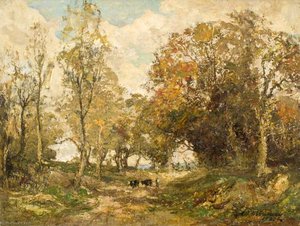
Carting Timber (1888) avtorja William Mouncey

Carting Timber

1888 · Oil On Canvas

In Carting Timber, William Mouncey presents a quiet, industrious moment from rural life. Created about 1888, this oil painting captures a group of laborers engaged in the heavy task of felling trees. There is a sense of seasonal transition here; the scene is set in a landscape that suggests the arrival of autumn, where the natural world begins its slow descent into dormancy. The figures are immersed in their work,…

2
Robert Christal (1875) avtorja William Mouncey

Robert Christal

1875 · Oil · The Stewartry Museum, Cairns

In this striking work, Robert Christal by William Mouncey, a man emerges from the shadows of a bygone era. Painted about 1875, the portrait captures a moment of intense stillness. He wears a formal suit and tie, his attire suggesting a sense of gravity and purpose. His gaze meets the viewer directly, holding an expression that feels heavy with unspoken thought. There is a quiet tension in his eyes that…

Izbor umetnika William Mouncey se nadaljuje, od 11 do 18

Muzeji, ki hranijo originala umetnika William Mouncey

4 muzejev, ki vsebujo največ slik na tej strani.

Muzeji Mesto Sloga William Mouncey Slike iz tega seznama
The Dick Institute, KilmarnockThe Dick Institute Kilmarnock 4 Old Kirkcudbright Pier, Thames River, Autumn in the Woods
The Stewartry Museum, CairnsThe Stewartry Museum Cairns 2 Robert Christal, In a Galloway Wood
Finnish National Gallery, HelsinkiFinnish National Gallery Helsinki 1 Autumn Trees
Harbour Cottage Gallery, CairnsHarbour Cottage Gallery Cairns 1 Pool on the River Dee

William Mouncey desetletje za desetletjem: originali, ki definira vsako od njih

Slikorstva po desetletjih

Izberite desetletje, da si ogledate original, ki ga opredeljuje.

Vprašanja zbirateljev o slikah umetnika William Mouncey

Za katero delo je William Mouncey najbolj znan/a?Razkriti odgovor

Carting Timber (1888). Zatem sledeta Robert Christal (1875) in A Woodland Glade (1900).

Koliko je bil William Mouncey let, ko je nastalo delo Carting Timber?Razkriti odgovor

36 let: delo Carting Timber iz leta 1888, William Mouncey pa je bil/a rojen/a leta 1852.

Katera je deset najbolj znanih slik umetnika William Mouncey?Razkriti odgovor

Carting Timber, Robert Christal, A Woodland Glade, Landscape, Kirkcudbrightshire Landscape, Gypsy Encampment, Kirkcudbright Harbour, Old Kirkcudbright Pier, Autumn Trees in Thames River. Zgornja lestica prikazuje leto nastanka in muzej za vsako delo.

Koliko slik je pustil William Mouncey?Razkriti odgovor

Naš katalog vsebuje 21 del avtorja William Mouncey, datiranih od 1875 do 1900.

V katerih muzejih so razložena remek dela umetnika William Mouncey?Razkriti odgovor

Večini v The Dick Institute (Kilmarnock), The Stewartry Museum (Cairns) in Finnish National Gallery (Helsinki). Zgoraj navedena tabela muzejev vsebuje njihov celoten seznam.

Kakšna sta prva in zadnja znana originala umetnika William Mouncey?Razkriti odgovor

Na tej strani je najstarejše delo iz Robert Christal (1875) in najstarejše iz A Woodland Glade (1900).

Katera dela umetnika William Mouncey so razstavljena v muzeju The Dick Institute?Razkriti odgovor

Old Kirkcudbright Pier, Thames River in Autumn in the Woods: v muzeju The Dick Institute, Kilmarnock se nahaja 4 del z te strani.

William Mouncey: življenje in delo

The Luminous Legacy of William Mouncey

In the quiet, mist-shrouded corners of Galloway, where the light dances across rolling hills and coastal vistas, the spirit of William Mouncey remains eternally preserved. Born in 1852 within the artistic cradle of Kirkcudbright, Mouncey was more than just a painter; he was a foundational architect of a movement. His life, though relatively brief, concluded in 1901, left behind a profound legacy that helped define the very essence of Scottish Impressionism. Growing up in a family steeped in artistic tradition, his early years were characterized by an intimate connection to the natural world, a bond that would later manifest as a deep, soulful resonance in every brushstroke he applied to canvas.

Mouncey’s journey was one of self-discovery and profound environmental influence. Rather than relying solely on formal academic rigidity, he honed his craft through dedicated self-study and an experimental approach to the medium. This independence allowed him to absorb the vibrant artistic spirit of the Kirkcudbright Artists’ Colony, a sanctuary for creative minds where luminaries like Margaret Hornel flourished. By joining forces with these fellow visionaries, Mouncey played an instrumental role in transforming Kirkcudbright into a renowned haven for Impressionistic experimentation. Within this collaborative atmosphere, he learned to move beyond mere representation, seeking instead to capture the fleeting, ephemeral moods of the Scottish landscape.

Technique and the Poetry of Light

To gaze upon a Mouncey original is to witness a masterclass in atmospheric perspective. His technique was never about the clinical precision of lines, but rather about the emotional weight of color and light. He possessed a singular ability to translate the transient moments of twilight and dawn into permanent visual poetry. His canvases are celebrated for their luminous palettes and loose, energetic brushstrokes, which work in harmony to convey the warmth and vitality of his surroundings. Whether depicting the rugged textures of a woodland path or the soft glow of a pastoral scene, Mouncey prioritized the emotional resonance of the atmosphere over the literal depiction of form.

His repertoire was as diverse as the landscapes he loved. While he is most famously remembered for his sweeping vistas of the Galloway hills and coastal reaches, his work often delved into the intimate rhythms of rural life. His paintings frequently featured:

  • Evocative Landscapes: Capturing the dramatic interplay of light and shadow across woodlands and hillsides.
  • Genre Scenes: Offering tender, nostalgic glimpses into the everyday labors and quiet moments of country living.
  • Atmospheric Studies: Utilizing Impressionistic textures to evoke the damp, heavy air of the Scottish coast or the golden warmth of an autumn afternoon.

A Lasting Impression on Scottish Art

The historical significance of William Mouncey extends far beyond the borders of Galloway. His reach was international; his works found their way into prestigious galleries and institutions, including the Royal Scottish Academy in Edinburgh, the Royal Glasgow Institute, and even as far afield as the Whitechapel Art Gallery in London and the Carnegie Institute in Philadelphia. This widespread recognition helped elevate the Kirkcudbright movement to a position of prominence within the broader European art scene. In his final years, his exhibitions at Messrs James Connell & Sons in Glasgow brought his evocative visions to the wider public, ensuring that his name would endure.

Today, Mouncey stands as a pioneer who bridged the gap between traditional landscape painting and the modern, emotive freedom of Impressionism. His ability to infuse the rugged Scottish terrain with a sense of romanticism and light continues to inspire collectors and historians alike. Through his eyes, we do not merely see the landscape; we feel its pulse, its weather, and its timeless, quiet beauty.