


1


Posodobljeno oktober 2026 · uvrščeno glede na naš skoraj priljubljenosti (iskanja, obiske in naročila za vsako delo) · 24 del v našem katalogu avtorja William Baziotes
Kratek opis
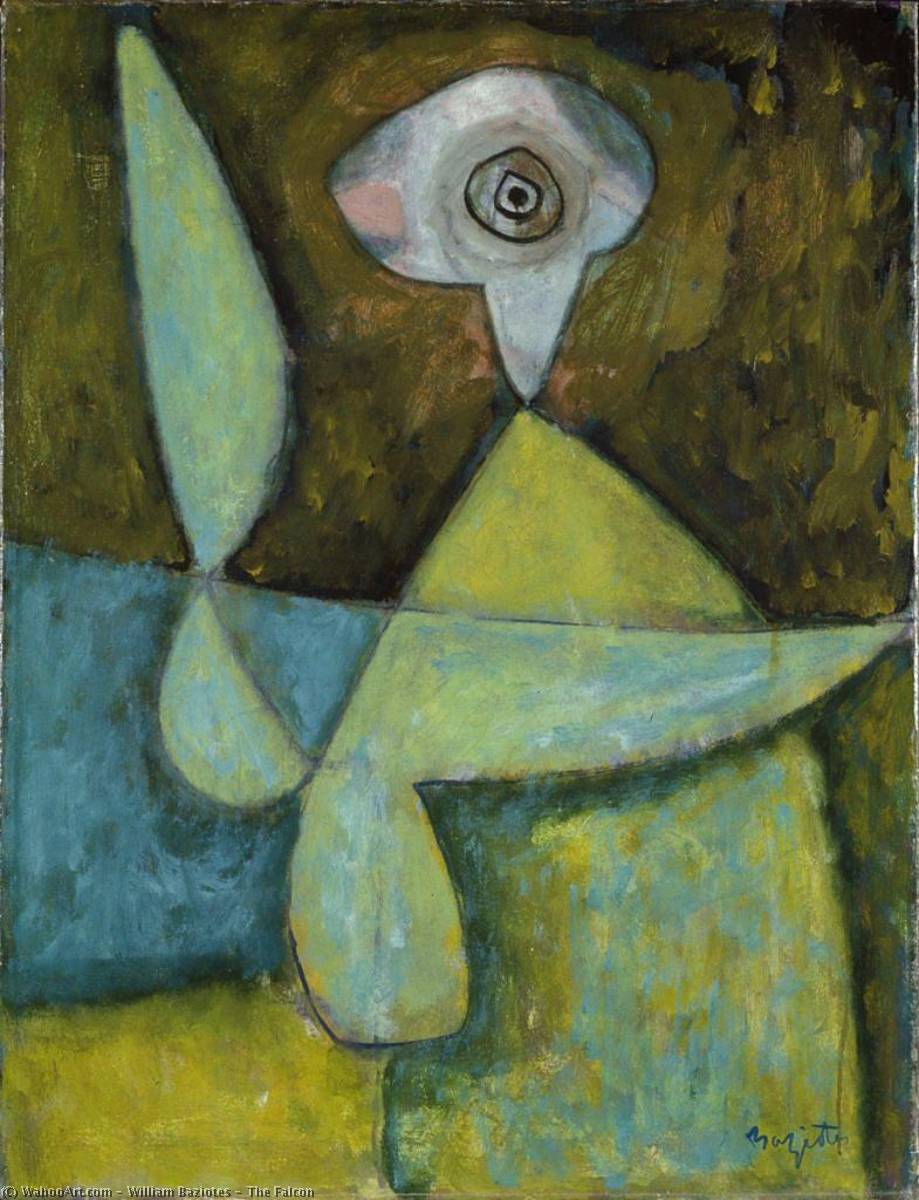
Med vsem originalom, ki ga je William Baziotes pustil, je najbolj znan Pierrot (1947). Takoj za njima sta Desert Landscape (1951) in The Falcon (1947). Naš katalog vsebuje 24 del umetnika William Baziotes; galerija je ohranila 24 del, ki jih svet najbolj oboževa, odlikovanih z datumom nastanka, pripadajočim muzajem in zgodbojo.


In the evocative depths of William Baziotes’ Jungle Form, viewers are invited into a dreamscape where the boundaries between the human silhouette and the primordial wild begin to dissolve. Created in 1952, this masterpiece serves as a profound testament to the artist's ability to bridge the psychological intensity of Surrealism with the raw, gestural energy of Abstract Expressionism. The painting presents a striking green figure, a woman seen from behind,…


 Cyclops1947 · Art Institute of Chicago
12
 Figure on a Tightrope1947
13
 Morning1953 · Izraelski muzej
14
 The Flesh Eaters1952
15
 Dragon1950
16
 Green Night1957
17
 Watercolor 41958
18
 Watercolor 21958
19
 Watercolor 5 Verso Composition1958
20
 Watercolor 3 Verso Cancelled Watercolor1958
21
 Watercolor 11958
22
 The Flesh Eaters1952
23
 Portrait of Ethel Baziotes
24
 Figurine and Mirror
5 muzejev, ki vsebujo največ slik na tej strani.
| Muzej | Mesto | Sloga William Baziotes | Slike iz tega seznama |
|---|---|---|---|
 Izraelski muzej |
Jeruzalem | 2 | Untitled, Morning |
 MAM Rio |
Rio de Janeiro | 1 | Jungle Form |
 Buffalo AKG Art Museum |
Buffalo | 1 | Puppets |
 Tucson Museum of Art |
Tucson | 1 | Tropical Bird |
 Art Institute of Chicago |
Chicago | 1 | Cyclops |
Od 1940 do 1958 je William Baziotes delal 19 let: izborka sledi tej dolgi karieri leta za letom, skozi njegova najlepša originalna dela.
Izberite leto in oglej originale.

In the evocative depths of William Baziotes’ Jungle Form, viewers are invited into a dreamscape where the boundaries between the human silhouette and the primordial wild begin to dissolve. Created in 1952, this masterpiece serves as a profound testament to the artist's ability to bridge the psychological intensity of Surrealism with the raw, gestural energy of Abstract Expressionism. The painting presents a striking green figure, a woman seen from behind,…
Več od 1952


Pierrot (1947). Zatem sledeta Desert Landscape (1951) in The Falcon (1947).
35 let: delo Pierrot iz leta 1947, William Baziotes pa je bil/a rojen/a leta 1912.
Pierrot, Desert Landscape, The Falcon, Jungle Form, Untitled, Ethel Baziotes (recto) Untitled (Clown and Female Nude) (verso), The Prisoner, Untitled, Puppets in Tropical Bird. Zgornja lestica prikazuje leto nastanka in muzej za vsako delo.
Naš katalog vsebuje 24 del avtorja William Baziotes, datiranih od 1940 do 1958.
Večini v Izraelski muzej (Jeruzalem), MAM Rio (Rio de Janeiro) in Buffalo AKG Art Museum (Buffalo). Zgoraj navedena tabela muzejev vsebuje njihov celoten seznam.
V obdobju 1947: 5 od 24 del na tej strani je bilo izdelovanih takrat, med njimi pa Pierrot.
Na tej strani je najstarejše delo iz Ethel Baziotes (recto) Untitled (Clown and Female Nude) (verso) (1940) in najstarejše iz Watercolor 4 (1958).
Abstract expressionism, glede na originala na tej strani.
Untitled in Morning: v muzeju Izraelski muzej, Jeruzalem se nahaja 2 del z te strani.
Within the vibrant, often turbulent constellation of the New York School, few artists captured the ethereal boundary between the conscious mind and the primordial subconscious as poignantly as William Baziotes. Born in 1912 to Greek immigrants in Pittsburgh, Pennsylvania, Baziotes carried within him a profound connection to ancient heritage—a fascination with classical sculpture and mythic resonance that would later breathe life into his abstract forms. His formal journey began at the National Academy of Design, where he emerged in 1936 as a painter deeply attuned to the technical rigors of his craft, yet possessed by an irrepressible urge to explore the unseen realms of the psyche.
The trajectory of Baziotes’ career was irrevocably shaped by the socio-economic landscape of the Great Depression. Through his involvement with the Works Progress Administration (WPA), particularly the easel project between 1938 and 1940, he found the freedom to experiment with large-scale canvases that demanded a more visceral, gestural approach. It was during this era that he began to weave together the disparate threads of European Surrealism and the burgeoning American Abstract Expressionism. While his contemporaries often leaned toward pure abstraction or intellectualized concepts, Baziotes remained a poet of the image, utilizing automatism not merely as a technique, but as a gateway to a more evocative, biomorphic language.
Baziotes’ visual vocabulary is perhaps most famously defined by its use of biomorphic forms—organic, rounded shapes that suggest biological life, cellular structures, or the fluid movement of deep-sea organisms. His work often feels like a window into a prehistoric or extraterrestrial landscape, where the distinction between flesh and flora becomes beautifully blurred. In masterpieces such as Jungle Form (1952), one encounters a mesmerizing metamorphosis; a verdant figure emerges from a tangled thicket, her very essence seemingly woven from emerald and mossy textures. This ability to marry the psychological intensity of Surrealism with the raw, energetic brushwork of Abstract Expressionism allowed him to create works that are simultaneously haunting and deeply rhythmic.
His inspirations were as diverse as they were profound. Beyond the visual influence of primitive art, Baziotes drew immense spiritual and linguistic nourishment from the poetry of Charles Baudelaire and the timeless elegance of ancient Greek art. This literary and historical depth infused his paintings with a sense of tragic beauty and ritualistic movement. Whether through the melancholic color palettes found in works like The Falcon or the stark, haunting compositions of The Flesh Eaters, Baziotes sought to capture a moment of transcendence—a reaching toward the heavens or an exploration of the shadows lurking within the human spirit.
The mid-1940s marked the zenith of Baziotes’ professional recognition. His 1944 debut solo exhibition at Peggy Guggenheim’s legendary Art of This Century gallery served as a definitive arrival, placing him at the epicenter of the modern art world. He was not merely a participant in this movement but a foundational architect of its community. Alongside luminaries such as Mark Rothko, Robert Motherwell, and David Hare, Baziotes co-founded the Subjects of the Artist School in 1948. This institution became a vital crucible for artistic dialogue, hosting lectures by icons like John Cage and Jean Arp, and fostering a collaborative environment that would define the postwar American aesthetic.
In his later years, Baziotes transitioned into a period of significant pedagogical influence, teaching at prestigious institutions including the Museum of Modern Art and New York University. Though his life was tragically cut short by lung cancer in 1963, just days before his fifty-first birthday, his contribution to the evolution of modern art remains indelible. He leaves behind a legacy characterized by:
Today, the works of William Baziotes continue to captivate collectors and historians alike, offering a profound meditation on the interconnectedness of the human soul and the untamed natural world.

