Portret Utagava Hirošige

Slike avtorja Utagava Hirošige: 100 najbolj znanih del skozi oči galerije

Posodobljeno november 2026 · uvrščeno glede na naš skoraj priljubljenosti (iskanja, obiske in naročila za vsako delo) · 353 del v našem katalogu avtorja Utagava Hirošige

Kratek opis

Za oči galerije je najbolj znano sliko umetnika Utagava Hirošige delo Early Department from a Daimyo, katere original visi v muzeju Nakagawa-machi Bato Hiroshige Museum of Art, Nagasaki. The maple leaves of Mama, Tekona shrine and Tsugi bridge (1857) in Hakone (1834) dopolnjujeta trijo, ki jo prepozna vsak pogled. Od 353 del avtorja Utagava Hirošige v našem katalogu galerija spodaj predstavlja 100 najbolj znanih; vsako je original z letom nastanka, pripadajočim mu muzejem in opisom tistega, kar ga dela edinstavnim.

1797 – 1858, Edo Ukiyo-e Največ del: Nakagawa-machi Bato Hiroshige Museum of Art

Top 10 slik umetnika Utagava Hirošige v galeriji

1
Early Department from a Daimyo avtorja Utagava Hirošige

Early Department from a Daimyo

Woodblock Print · Nakagawa-machi Bato Hiroshige Museum of Art, Nagasaki

In the delicate dance of lines and muted pigments, Utagawa Hiroshige’s Early Department from a Daimyo invites us to step through a portal into the heart of Edo-period Japan. This exquisite woodblock print captures a moment of vibrant communal life along a bustling riverside, where the rigid structures of social hierarchy melt into the shared leisure of a sunny afternoon. As we gaze upon the scene, we are not merely…

2
The maple leaves of Mama, Tekona shrine and Tsugi bridge (1857) avtorja Utagava Hirošige

The maple leaves of Mama, Tekona shrine and Tsugi bridge

1857 · Woodblock Print · Van Goghov muzej, Amsterdam

Utagawa Hiroshige (1797-1858), arguably the last titan of *ukiyo-e*, didn't merely depict landscapes; he crafted them into meditations on beauty and impermanence. “The Maple Leaves of Mama, Tekona Shrine and Tsugi Bridge,” created in 1857 during a period of significant societal transformation—the waning influence of feudal Japan as Western ideas crept in—stands as a testament to his enduring artistic legacy. More than just a visual record, it’s an embodiment of…

3
Hakone (1834) avtorja Utagava Hirošige

Hakone

1834 · Woodblock Print · Indianapolis Museum of Art, Indianapolis

Utagawa Hiroshige’s “Hakone,” created in 1834, is more than just a landscape; it's a poetic meditation on the beauty and transience of nature within Edo-period Japan. This woodblock print, part of his renowned series "The Fifty-three Stations of the Tōkaidō," captures a specific moment along the vital trade route connecting Tokyo (then Edo) with Kyoto. However, Hiroshige elevates this seemingly simple depiction of a mountain pass into something profoundly evocative,…

4
Station 36, Goyu; Kyoka Tokaido Series (1855) avtorja Utagava Hirošige

Station 36, Goyu; Kyoka Tokaido Series

1855 · Woodblock Print · Indianapolis Museum of Art, Indianapolis

In the delicate interplay of ink and paper, Utagawa Hiroshige’s "Station 36, Goyu; Kyoka Tokaido Series" offers much more than a mere topographical record of a journey. Completed in 1855, this exquisite woodblock print serves as a profound distillation of Edo-period sensibilities, capturing a yearning for tranquility amidst the burgeoning dynamism of a Japan in transition. As the nation stood at a pivotal crossroads between ancient feudal traditions and the…

5
Fushimi, Četrti postanek (1842) avtorja Utagava Hirošige

Fushimi, Četrti postanek

1842 · Drevesni tisk · Indianapolis Museum of Art, Indianapolis

Fushimi, Station # 51 – A Symphony of Tranquility and Observation Utagawa Hiroshige’s “Fushimi Station #51” transcends mere depiction; it embodies the spirit of Edo Japan—a meticulously crafted panorama that captures not just a physical location but also an intangible mood. Published in 1842 during the twilight years of the Tokugawa shogunate, this woodblock print exemplifies Hiroshige’s signature approach to landscape art: prioritizing atmospheric perspective and subtle tonal gradations over…

6
Ichikoku Bridge in the Eastern Capital (Tōto: Ichikoku bashi) (1858) avtorja Utagava Hirošige

Ichikoku Bridge in the Eastern Capital (Tōto: Ichikoku bashi)

1858 · Woodblock Print · Indianapolis Museum of Art, Indianapolis

The Ichikoku Bridge spans a quiet stretch of water in the Eastern Capital. Beneath its wooden arch, two boats drift through the current. People move across the structure, some carrying backpacks and others clutching small handbags. A mountain rises in the distance, watching over the scene. Trees frame the edges of the view, their leaves casting shadows near the water's edge.

7
Shinagawa Sunrise from the series Fifty-three Stations on the Tokaido Road (1834) avtorja Utagava Hirošige

Shinagawa Sunrise from the series Fifty-three Stations on the Tokaido Road

1834 · Woodblock Print · Hill-Stead Museum, Farmington

In the soft, burgeoning light of a nineteenth-century morning, Utagawa Hiroshige invites us to witness a moment of profound stillness along the Tōkaidō road. Shinagawa Sunrise is not merely a depiction of a coastal village; it is a masterclass in the art of atmosphere. As the sun begins its ascent, the boundary between the heavens and the earth dissolves into a luminous haze. The water of the bay reflects a…

8
The Rokugo River Ferry, Kawasaki, from the series the Fifty-three Stations of the Tokaido (Hoeido edition ) avtorja Utagava Hirošige

The Rokugo River Ferry, Kawasaki, from the series the Fifty-three Stations of the Tokaido (Hoeido edition )

Woodblock Print · Nakagawa-machi Bato Hiroshige Museum of Art, Nagasaki

In the delicate dance of woodblock printing, few masters captured the ephemeral beauty of Japanese life as profoundly as Utagawa Hiroshige. His masterpiece, The Rokugo River Ferry, Kawasaki, serves as a breathtaking window into the Edo period, inviting the viewer to step onto the bustling banks of one of the most vital crossings on the Tokaido road. This evocative scene from his legendary series, The Fifty-three Stations of the Tokaido,…

9
Itsukushima in Aki Province (1858) avtorja Utagava Hirošige

Itsukushima in Aki Province

1858 · Woodblock Print · Brooklyn Museum, Brooklyn

In the delicate interplay of mist and water, Itsukushima in Aki Province offers more than a mere glimpse of a Japanese landmark; it provides a profound meditation on the ephemeral nature of existence. Created by the legendary ukiyo-e master Ando Hiroshige in 1858, this woodcut print captures the spiritual essence of the Itsukushima shrine area with a poetic sensitivity that remains unparalleled. As one gazes upon the composition, the eye…

10
Tenryu River Ferry Crossing, Mitsuke, from the series The Fifty-three Stations of the Tokaido (Gyosho Edition) avtorja Utagava Hirošige

Tenryu River Ferry Crossing, Mitsuke, from the series The Fifty-three Stations of the Tokaido (Gyosho Edition)

Woodblock Print · Nakagawa-machi Bato Hiroshige Museum of Art, Nagasaki

The woodblock print depicts a section of the Tenryu River near the station of Mitsuke. In the center of the composition, a large sandbank divides the water into two distinct currents. Several small wooden boats occupy the river, with figures positioned within them to manage the crossing. Some vessels are moored directly against the central sandbank, while others navigate the moving water. The far shore is visible in the distance,…

Slikarska dela umetnika Utagava Hirošige, uvrščena od 11 do 100

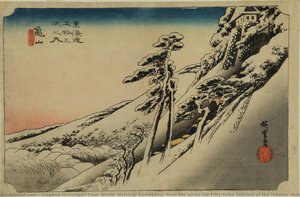
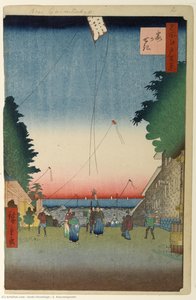
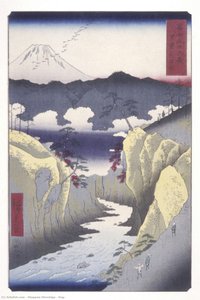
11Arapska ptica in vitičji žleza (1800) avtorja Utagava HirošigeArapska ptica in vitičji žleza1800 · Indianapolis Museum of Art 12The Pine Woods of Miho in Suruga Province (Suruga Miho no matsubara) (1858) avtorja Utagava HirošigeThe Pine Woods of Miho in Suruga Province (Suruga Miho no matsubara)1858 · Indianapolis Museum of Art 1362 (55) Komakata Hall and Azuma Bridge (1857) avtorja Utagava Hirošige62 (55) Komakata Hall and Azuma Bridge1857 · Brooklyn Museum 14Evening Snow at Kanbara (1834) avtorja Utagava HirošigeEvening Snow at Kanbara1834 · Los Angeles County Museum of Art 15Dawn in the licensed quarters (1857) avtorja Utagava HirošigeDawn in the licensed quarters1857 · Art Gallery of New South Wales 16Night View of Saruwakacho avtorja Utagava HirošigeNight View of Saruwakacho 17Station 28, Fukuroi (1855) avtorja Utagava HirošigeStation 28, Fukuroi1855 · Indianapolis Museum of Art 18Evening Snow at Asakusa or Woman with Umbrella from the series Eight Views of the Environs of Edo (1800) avtorja Utagava HirošigeEvening Snow at Asakusa or Woman with Umbrella from the series Eight Views of the Environs of Edo1800 · Hill-Stead Museum 19Keishi (Kyoto), Capital (1834) avtorja Utagava HirošigeKeishi (Kyoto), Capital1834 · Indianapolis Museum of Art 20Hara: View of Ashitakayama and Fuji (1855) avtorja Utagava HirošigeHara: View of Ashitakayama and Fuji1855 · Indianapolis Museum of Art 21Yokkaichi (Station #44) (1834) avtorja Utagava HirošigeYokkaichi (Station #44)1834 · Indianapolis Museum of Art 22Desolate Wintry Scene, Hamamatsu, from the series the Fifty-three Stations of the Tokaido (Hoeido edition) avtorja Utagava HirošigeDesolate Wintry Scene, Hamamatsu, from the series the Fifty-three Stations of the Tokaido (Hoeido edition)Nakagawa-machi Bato Hiroshige Museum of Art 23Noge and Yokohama in Musashi Province (Musashi, Noge, Yokohama) (1858) avtorja Utagava HirošigeNoge and Yokohama in Musashi Province (Musashi, Noge, Yokohama)1858 · Indianapolis Museum of Art 24Wild sea breaking on the rocks (1856) avtorja Utagava HirošigeWild sea breaking on the rocks1856 25Pogled na Shiomi Slopo (1833) avtorja Utagava HirošigePogled na Shiomi Slopo1833 · Indianapolis Museum of Art 26Mt.Fuji on the Left, Yoshiwara, from the series the Fifty-three Stations of the Tokaido (Hoeido edition) avtorja Utagava HirošigeMt.Fuji on the Left, Yoshiwara, from the series the Fifty-three Stations of the Tokaido (Hoeido edition)Nakagawa-machi Bato Hiroshige Museum of Art 27Tsukuda Offing in the Eastern Capital (Tōto: Tsukuda oki) (1858) avtorja Utagava HirošigeTsukuda Offing in the Eastern Capital (Tōto: Tsukuda oki)1858 · Indianapolis Museum of Art 28Kawachi (1853) avtorja Utagava HirošigeKawachi1853 · Indianapolis Museum of Art 29The Dye Craft Shops of Arimatsu, Narumi, from the series The Fifty-three Stations of the Tokaido (Gyosho edition) avtorja Utagava HirošigeThe Dye Craft Shops of Arimatsu, Narumi, from the series The Fifty-three Stations of the Tokaido (Gyosho edition)Nakagawa-machi Bato Hiroshige Museum of Art 30View of Shiomi Slope, Shirasuka, from the series The Fifty-three Stations of the Tokaido (Gyosho edition) avtorja Utagava HirošigeView of Shiomi Slope, Shirasuka, from the series The Fifty-three Stations of the Tokaido (Gyosho edition)Nakagawa-machi Bato Hiroshige Museum of Art 31Entrance to Enoshima in Sagami Province (Sagami Enoshima iriguchi) (1858) avtorja Utagava HirošigeEntrance to Enoshima in Sagami Province (Sagami Enoshima iriguchi)1858 · Indianapolis Museum of Art 32Morning Mist, Mishima, from the series the Fifty-three Stations of the Tokaido (Hoeido edition ) avtorja Utagava HirošigeMorning Mist, Mishima, from the series the Fifty-three Stations of the Tokaido (Hoeido edition )Nakagawa-machi Bato Hiroshige Museum of Art 33The Imagire Sea Ferry, Maisaka, from the series The Fifty-three Stations of the Tokaido (Gyosho edition) avtorja Utagava HirošigeThe Imagire Sea Ferry, Maisaka, from the series The Fifty-three Stations of the Tokaido (Gyosho edition)Nakagawa-machi Bato Hiroshige Museum of Art 34Sukiya Riverbank in the Eastern Capital (Tōto sukiya kaigan) (1858) avtorja Utagava HirošigeSukiya Riverbank in the Eastern Capital (Tōto sukiya kaigan)1858 · Indianapolis Museum of Art 35Satta Pass, Yui, from the series the Fifty-three Stations of the Tokaido (Hoeido edition) avtorja Utagava HirošigeSatta Pass, Yui, from the series the Fifty-three Stations of the Tokaido (Hoeido edition)Nakagawa-machi Bato Hiroshige Museum of Art 36True View of Imagire, Maisaka, from the series the Fifty-three Stations of the Tokaido (Hoeido edition) avtorja Utagava HirošigeTrue View of Imagire, Maisaka, from the series the Fifty-three Stations of the Tokaido (Hoeido edition)Nakagawa-machi Bato Hiroshige Museum of Art 37Clear Winter Morning, Kameyama, from the series the Fifty-three Stations of the Tokaido (Hoeido edition) avtorja Utagava HirošigeClear Winter Morning, Kameyama, from the series the Fifty-three Stations of the Tokaido (Hoeido edition)Nakagawa-machi Bato Hiroshige Museum of Art 38The Tenryu River, Mitsuke, from the series the Fifty-three Stations of the Tokaido (Hoeido edition) avtorja Utagava HirošigeThe Tenryu River, Mitsuke, from the series the Fifty-three Stations of the Tokaido (Hoeido edition)Nakagawa-machi Bato Hiroshige Museum of Art 39The Seven-ri Ferry Crossing, Kuwana, from the series the Fifty-three Stations of the Tokaido (Hoeido edition) avtorja Utagava HirošigeThe Seven-ri Ferry Crossing, Kuwana, from the series the Fifty-three Stations of the Tokaido (Hoeido edition)Nakagawa-machi Bato Hiroshige Museum of Art 40Aronia and Bullfinch avtorja Utagava HirošigeAronia and Bullfinch 41Ptice se vračajo v Katato (1834) avtorja Utagava HirošigePtice se vračajo v Katato1834 · Indianapolis Museum of Art 42Yugyoji Temple, Fujisawa, from the series the Fifty-three Stations of the Tokaido (Hoeido edition) avtorja Utagava HirošigeYugyoji Temple, Fujisawa, from the series the Fifty-three Stations of the Tokaido (Hoeido edition)Nakagawa-machi Bato Hiroshige Museum of Art 43Travellers and Soliciting Women, Goyu, from the series the Fifty-three Stations of the Tokaido (Hoeido edition) avtorja Utagava HirošigeTravellers and Soliciting Women, Goyu, from the series the Fifty-three Stations of the Tokaido (Hoeido edition)Nakagawa-machi Bato Hiroshige Museum of Art 44The Totoumi Bank of the Oi River, Kanaya, from the series the Fifty-three Stations of the Tokaido (Hoeido edition) avtorja Utagava HirošigeThe Totoumi Bank of the Oi River, Kanaya, from the series the Fifty-three Stations of the Tokaido (Hoeido edition)Nakagawa-machi Bato Hiroshige Museum of Art 45The Suruga Bank of the Oi River, Shimada, from the series the Fifty-three Stations of the Tokaido (Hoeido edition) avtorja Utagava HirošigeThe Suruga Bank of the Oi River, Shimada, from the series the Fifty-three Stations of the Tokaido (Hoeido edition)Nakagawa-machi Bato Hiroshige Museum of Art 46Kyoka Tokaido Series, Kanagawa (Yokohama) avtorja Utagava HirošigeKyoka Tokaido Series, Kanagawa (Yokohama)Indianapolis Museum of Art 47Distant View of Miho, Ejiri, from the series the Fifty-three Stations of the Tokaido (Hoeido edition) avtorja Utagava HirošigeDistant View of Miho, Ejiri, from the series the Fifty-three Stations of the Tokaido (Hoeido edition)Nakagawa-machi Bato Hiroshige Museum of Art 48Mt. Fuji in the Morning, Hara, from the series the Fifty-three Stations of the Tokaido (Hoeido edition) avtorja Utagava HirošigeMt. Fuji in the Morning, Hara, from the series the Fifty-three Stations of the Tokaido (Hoeido edition)Nakagawa-machi Bato Hiroshige Museum of Art 49A Horse Fair, Chiriu, from the series the Fifty-three Stations of the Tokaido (Hoeido edition) avtorja Utagava HirošigeA Horse Fair, Chiriu, from the series the Fifty-three Stations of the Tokaido (Hoeido edition)Nakagawa-machi Bato Hiroshige Museum of Art 50Wakasa (1853) avtorja Utagava HirošigeWakasa1853 · Indianapolis Museum of Art 51Distant View of Mt.Akiba, Kakegawa, from the series the Fifty-three Stations of the Tokaido (Hoeido edition) avtorja Utagava HirošigeDistant View of Mt.Akiba, Kakegawa, from the series the Fifty-three Stations of the Tokaido (Hoeido edition)Nakagawa-machi Bato Hiroshige Museum of Art 52The Ichiri-Han Sea Ferry, Arai, from the series The Fifty-three Stations of the Tokaido (Gyosho edition) avtorja Utagava HirošigeThe Ichiri-Han Sea Ferry, Arai, from the series The Fifty-three Stations of the Tokaido (Gyosho edition)Nakagawa-machi Bato Hiroshige Museum of Art 53Gateway Entrance to the Atsuta Shrine on the Beach, Miya, from the series The Fifty-three Stations of the Tokaido (Gyosho edition) avtorja Utagava HirošigeGateway Entrance to the Atsuta Shrine on the Beach, Miya, from the series The Fifty-three Stations of the Tokaido (Gyosho edition)Nakagawa-machi Bato Hiroshige Museum of Art 54Akasaka, from the series The Fifty-three Stations of the Tokaido (Gyosho edition) avtorja Utagava HirošigeAkasaka, from the series The Fifty-three Stations of the Tokaido (Gyosho edition)Nakagawa-machi Bato Hiroshige Museum of Art 55The Sakawa River, Odawara, from the series the Fifty-three Stations of the Tokaido (Hoeido edition) avtorja Utagava HirošigeThe Sakawa River, Odawara, from the series the Fifty-three Stations of the Tokaido (Hoeido edition)Nakagawa-machi Bato Hiroshige Museum of Art 56A Footpath between Ricefield, Hiratsuka, from the series the Fifty-three Stations of the Tokaido (Hoeido edition) avtorja Utagava HirošigeA Footpath between Ricefield, Hiratsuka, from the series the Fifty-three Stations of the Tokaido (Hoeido edition)Nakagawa-machi Bato Hiroshige Museum of Art 57Awa Province: Whirlpool at Naruto (1853) avtorja Utagava HirošigeAwa Province: Whirlpool at Naruto1853 5873 The City Flourishing, the Tanabata Festival (1857) avtorja Utagava Hirošige73 The City Flourishing, the Tanabata Festival1857 59Sarugababa Plain, Futagawa, from the series the Fifty-three Stations of the Tokaido (Hoeido edition) avtorja Utagava HirošigeSarugababa Plain, Futagawa, from the series the Fifty-three Stations of the Tokaido (Hoeido edition)Nakagawa-machi Bato Hiroshige Museum of Art 60Local Specialty Teahouse, Mariko, from the series the Fifty-three Stations of the Tokaido (Hoeido edition) avtorja Utagava HirošigeLocal Specialty Teahouse, Mariko, from the series the Fifty-three Stations of the Tokaido (Hoeido edition)Nakagawa-machi Bato Hiroshige Museum of Art 61Sakanoshita avtorja Utagava HirošigeSakanoshitaIndianapolis Museum of Art 62Postojanka 23, Fujida avtorja Utagava HirošigePostojanka 23, FujidaIndianapolis Museum of Art 63Marsh Grasses and Mandarin Ducks avtorja Utagava HirošigeMarsh Grasses and Mandarin Ducks 6450th station, Minakuchi avtorja Utagava Hirošige50th station, Minakuchi 65Sakanoshita: the Throwing Away the Brush Peak (1834) avtorja Utagava HirošigeSakanoshita: the Throwing Away the Brush Peak1834 · Brooklyn Museum 66Shibaura Bay of Musashi Province (801) avtorja Utagava HirošigeShibaura Bay of Musashi Province801 · Metropolitanski muzej umetnosti 67Koyurugi Beach of Sagami Province (801) avtorja Utagava HirošigeKoyurugi Beach of Sagami Province801 · Metropolitanski muzej umetnosti 68Honmoku Bay of Musashi Province (801) avtorja Utagava HirošigeHonmoku Bay of Musashi Province801 · Metropolitanski muzej umetnosti 69Untitled (Two Rabbits, Pampas Grass, and Full Moon) (1851) avtorja Utagava HirošigeUntitled (Two Rabbits, Pampas Grass, and Full Moon)1851 7011. Kiyomizu Hall and Shinobazu Pond at Ueno (1857) avtorja Utagava Hirošige11. Kiyomizu Hall and Shinobazu Pond at Ueno1857 7185. Kinokuni Hill and Distant View of Akasaka and the Tameike Pond (1857) avtorja Utagava Hirošige85. Kinokuni Hill and Distant View of Akasaka and the Tameike Pond1857 7276 Bamboo Quay by Kyōbashi Bridge (1857) avtorja Utagava Hirošige76 Bamboo Quay by Kyōbashi Bridge1857 7358 (52) Sudden Shower over Shin-Ōhashi bridge and Atake (1857) avtorja Utagava Hirošige58 (52) Sudden Shower over Shin-Ōhashi bridge and Atake1857 · Tokyo Fuji Art Museum 74103. Senju Great Bridge (1857) avtorja Utagava Hirošige103. Senju Great Bridge1857 7518. The Ōji Inari Shrine (1857) avtorja Utagava Hirošige18. The Ōji Inari Shrine1857 76113. Aoi Slope Outside Toranomon Gate (1857) avtorja Utagava Hirošige113. Aoi Slope Outside Toranomon Gate1857 77114. Bikuni Bridge in Snow (1857) avtorja Utagava Hirošige114. Bikuni Bridge in Snow1857 7870 (60) The Mouth of the Nakagawa River (1857) avtorja Utagava Hirošige70 (60) The Mouth of the Nakagawa River1857 792. Kasumigaseki (1857) avtorja Utagava Hirošige2. Kasumigaseki1857 8015. Suwa Bluff in Nippori (1857) avtorja Utagava Hirošige15. Suwa Bluff in Nippori1857 8163 (69) The Ayase River and Kanegafuchi (1857) avtorja Utagava Hirošige63 (69) The Ayase River and Kanegafuchi1857 82115. The Takata Riding Grounds (1857) avtorja Utagava Hirošige115. The Takata Riding Grounds1857 8386. Naitō Shinjuku in Yotsuya (1857) avtorja Utagava Hirošige86. Naitō Shinjuku in Yotsuya1857 8416. Flower Park and Dangozaka Slope in Sendagi (1857) avtorja Utagava Hirošige16. Flower Park and Dangozaka Slope in Sendagi1857 8568 (59) Open Garden at the Hachiman Shrine in Fukagawa (1857) avtorja Utagava Hirošige68 (59) Open Garden at the Hachiman Shrine in Fukagawa1857 8610. Sunrise at Kanda Myōjin Shrine (1857) avtorja Utagava Hirošige10. Sunrise at Kanda Myōjin Shrine1857 87Peach and Long-tailed Bird avtorja Utagava HirošigePeach and Long-tailed Bird 88Golden Pheasant in Bracken avtorja Utagava HirošigeGolden Pheasant in Bracken 89The Imado Bridge at the Foot of Mount Matsuchi (801) avtorja Utagava HirošigeThe Imado Bridge at the Foot of Mount Matsuchi801 · Metropolitanski muzej umetnosti 90Dog (1858) avtorja Utagava HirošigeDog1858 · Indianapolis Museum of Art 91118. Kitsunebi on New Year's Night Under the Enoki Tree near Ōji (1857) avtorja Utagava Hirošige118. Kitsunebi on New Year's Night Under the Enoki Tree near Ōji1857 92109. Minami Shinagawa and Samezu Coast (1857) avtorja Utagava Hirošige109. Minami Shinagawa and Samezu Coast1857 93Night View of Matsuchiyama and the San (1857) avtorja Utagava HirošigeNight View of Matsuchiyama and the San1857 · Los Angeles County Museum of Art 94Akasaka, No. 37 avtorja Utagava HirošigeAkasaka, No. 37Indianapolis Museum of Art 95Shiojiri Pass in Shinano Province (Shinano Shiojiritōge) (1858) avtorja Utagava HirošigeShiojiri Pass in Shinano Province (Shinano Shiojiritōge)1858 · Indianapolis Museum of Art 96Yoshiwara avtorja Utagava HirošigeYoshiwaraIndianapolis Museum of Art 97Fuchu, No. 20 avtorja Utagava HirošigeFuchu, No. 20Indianapolis Museum of Art 98Woman Walking in the Snow (1850) avtorja Utagava HirošigeWoman Walking in the Snow1850 · Metropolitanski muzej umetnosti 9982. Moon Viewing (1857) avtorja Utagava Hirošige82. Moon Viewing1857 100Station 27, Kakegawa (1855) avtorja Utagava HirošigeStation 27, Kakegawa1855 · Indianapolis Museum of Art

Slavna platna umetnika Utagava Hirošige, razdeljena po obdobjih

Motivi, ki so očarali Utagava Hirošige

Četiri teme, ki se v teh originalih najpogosteje ponavljajo, vsaka z svojim vrhunskim primerom.

Muzeji, ki hranijo originala umetnika Utagava Hirošige

8 muzejev, ki vsebujo največ slik na tej strani.

Muzej Mesto Sloga Utagava Hirošige Slike iz tega seznama
Nakagawa-machi Bato Hiroshige Museum of Art, NagasakiNakagawa-machi Bato Hiroshige Museum of Art Nagasaki 30 Early Department from a Daimyo, The Rokugo River Ferry, Kawasaki, from the series the Fifty-three Stations of the Tokaido (Hoeido edition ), Tenryu River Ferry Crossing, Mitsuke, from the series The Fifty-three Stations of the Tokaido (Gyosho Edition)
Indianapolis Museum of Art, IndianapolisIndianapolis Museum of Art Indianapolis 35 Hakone, Station 36, Goyu; Kyoka Tokaido Series, Fushimi, Četrti postanek
Metropolitanski muzej umetnosti, New YorkMetropolitanski muzej umetnosti New York 8 Shibaura Bay of Musashi Province, Koyurugi Beach of Sagami Province, Honmoku Bay of Musashi Province
Brooklyn Museum, BrooklynBrooklyn Museum Brooklyn 4 Itsukushima in Aki Province, 62 (55) Komakata Hall and Azuma Bridge, Sakanoshita: the Throwing Away the Brush Peak
Hill-Stead Museum, FarmingtonHill-Stead Museum Farmington 3 Shinagawa Sunrise from the series Fifty-three Stations on the Tokaido Road, Evening Snow at Asakusa or Woman with Umbrella from the series Eight Views of the Environs of Edo
Los Angeles County Museum of Art, Los AngelesLos Angeles County Museum of Art Los Angeles 2 Evening Snow at Kanbara, Night View of Matsuchiyama and the San
Van Goghov muzej, AmsterdamVan Goghov muzej Amsterdam 1 The maple leaves of Mama, Tekona shrine and Tsugi bridge
Art Gallery of New South Wales, SidnejArt Gallery of New South Wales Sidnej 1 Dawn in the licensed quarters

Utagava Hirošige, ena značilna slika na desetletje

Delo po desetletjih

Izberite desetletje, da si ogledate original, ki ga opredeljuje.

Slike umetnika Utagava Hirošige: odgovori galerije

Katero sliko avtorja Utagava Hirošige je najbolj znana med vsemi?Razkriti odgovor

Early Department from a Daimyo, Nakagawa-machi Bato Hiroshige Museum of Art, Nagasaki. Zatem sledeta The maple leaves of Mama, Tekona shrine and Tsugi bridge (1857) in Hakone (1834).

Katera je 10 najboljjših slik umetnika Utagava Hirošige?Razkriti odgovor

Early Department from a Daimyo, The maple leaves of Mama, Tekona shrine and Tsugi bridge, Hakone, Station 36, Goyu; Kyoka Tokaido Series, Fushimi, Četrti postanek, Ichikoku Bridge in the Eastern Capital (Tōto: Ichikoku bashi), Shinagawa Sunrise from the series Fifty-three Stations on the Tokaido Road, The Rokugo River Ferry, Kawasaki, from the series the Fifty-three Stations of the Tokaido (Hoeido edition ), Itsukushima in Aki Province in Tenryu River Ferry Crossing, Mitsuke, from the series The Fifty-three Stations of the Tokaido (Gyosho Edition). Zgornja lestica prikazuje leto nastanka in muzej za vsako delo.

Koliko dzieł stworzył Utagava Hirošige?Razkriti odgovor

Naš katalog vsebuje 353 del avtorja Utagava Hirošige, datiranih od 1833 do 1858.

Kje so razpostavljena najbolj znana originala umetnika Utagava Hirošige?Razkriti odgovor

Večini v Nakagawa-machi Bato Hiroshige Museum of Art (Nagasaki), Indianapolis Museum of Art (Indianapolis) in Metropolitanski muzej umetnosti (New York). Zgoraj navedena tabela muzejev vsebuje njihov celoten seznam.

Kdaj je Utagava Hirošige ustvaril svoja najbolj znana slika?Razkriti odgovor

V obdobju 1850s: 44 od 100 del na tej strani je bilo izdelovanih takrat, med njimi pa The maple leaves of Mama, Tekona shrine and Tsugi bridge.

Kateri so najstarejši in najmlajši znanii dela umetnika Utagava Hirošige?Razkriti odgovor

Na tej strani je najstarejše delo iz Pogled na Shiomi Slopo (1833) in najstarejše iz Ichikoku Bridge in the Eastern Capital (Tōto: Ichikoku bashi) (1858).

Kateri motivi so bili za Utagava Hirošige najbolj značilni?Razkriti odgovor

Landscape (35), Edo period (31) in Japanese landscape (27), na 100 delih na tej strani.

Pri katerem medijem je Utagava Hirošige delal največ?Razkriti odgovor

Woodblock Print, za 89 od 100 del na tej strani.

S katerim umetnostnim slogom je povezan Utagava Hirošige?Razkriti odgovor

Ukiyo-e, glede na originala na tej strani.

Katera originalna dela umetnika Utagava Hirošige ima v svoji zbirki Nakagawa-machi Bato Hiroshige Museum of Art?Razkriti odgovor

Early Department from a Daimyo, The Rokugo River Ferry, Kawasaki, from the series the Fifty-three Stations of the Tokaido (Hoeido edition ) in Tenryu River Ferry Crossing, Mitsuke, from the series The Fifty-three Stations of the Tokaido (Gyosho Edition): v muzeju Nakagawa-machi Bato Hiroshige Museum of Art, Nagasaki se nahaja 29 del z te strani.

Utagava Hirošige: umetnik

Poetična vizija japonskega Eda: Življenje in umetnost Utagawa Hiroshigija

Utagawa Hiroshige, rojen kot Andō Tokutarō leta 1797 v živahnem mestu Edo (današnji Tokyo), predstavlja ključno osebnost v svetu ukiyo-e, ali »slik floating world« ali »ulovljenih trenutkov«. Čeprav je bil globoko zakoreninjen v tradicijah japonskega lesoreza, je Hiroshige presegel zgolj kopiranje in svojim pejzažem podelil poetično občutljivost, ki je močno odmevala tako v Japonskem kot kasneje v celotnem zapadnem umetniškem svetu. Njegovo življenje se je odvijalo v obdobju relativnega miru in blaginje pod šogunatom Tokugawa, vendar tudi v času naraščajočih družbenih sprememb in končne westernizacije – sil, ki so sčasoma prispele k upadu ukiyo-e, hkrati pa so okrepile Hiroshigijevo trajno dediščino. Prvotno namenjen bolj konvencionalni poti v samurajski družini – njegov oče je služil kot požarni uradnik – ga je umetniška nagnjenost vodila v učeništvo pri Utagawa Toyohiriju, mojstru Utagawa šole. To je predstavljalo ključno prelomnico, ki ga je odvrnila od priljubljenih prikazov kurtizan in igralcev, ki so bili v okusu mnogih umetnikov ukiyo-e, usmerila pa v fokus na pejzaž, žanr, ki ga bo dokončno na novo opredelil.

Od žanrovskih scen do vzburjajočih pejzažev

Hiroshavino zgodnje delo je sledilo konvencijam njegove šole in vključevalo portrete ter prizore iz vsakdanjega življenja. Vendar pa je ravno njegovo objemanje pejzaža, da se je zares izkazal. Pod vplivom predhodnih mojstrov, kot je bil Hokusai – čija serija Trideset šest pogledov na Fuji je že očarala občinstvo – je Hiroshige razvil edinstven slog, ki ga odlikuje atmosferska perspektiva, subtilna paleta barv in globoka občutljivost za spreminjajoče se življenja. Ni le prikazoval krajev; priklical je njihove razpoloženje in zajemal bistvo določenega trenutka v času. Serija Pedeset tri postaje Tōkaidō (1833–1834), morda njegovo najslavnejše dosežek, utira ta pristop. To monumentalno delo je dokumentiralo pot po cesti Tōkaidō, glavni poti, ki povezuje Edo z Kyotom, ne kot preprost potopis, temveč kot serijo vzburjajočih vignet – nenaden dež v Shonoju, oddaljen pogled na Fuji iz Kanaye, živahno gibanje v Odawari. Vsak tisk je prežet z občutkom prehodnosti in tihe lepote, ki gledalca vabi, da bi pot alongside potnikov doživljal s svojo čustvenostjo. Maestralno je uporabljal tehniko bokashi, ki vključuje več tiskov za ustvarjanje subtilnih stopenj barv, s čimer je svojim kompozicijam dodal globino in vzdušje.

Mojster atmosfere in tehnike

Hiroshigijeva tehnična izobrazba je bila tako izstopajoča kot njegova umetniška vizija. Zanimala ga ni bilo le natančno predstavljanje; iskal je način, kako zajeti čutje kraja. Njegova uporaba barv, čeprav pogosto zmerna v primerjavah z nekaterimi sodobniki, je bila ključna pri doseganju tega učinka. Pogosto je uporabljal več blokov za eno barvo, kar mu je omogočalo ustvarjanje niancnih odseskov in atmosferskih učinkov, ki so bili neverjetno težko ponovljivi. Nežne modre prelivnosti v njegovih prikazih yağ ali megle, tople barve jesenskega listja – to niso bili naključni elementi; bili so skrbno premišljeni deli, zasnovani za priklic specifičnih čustev in občutkov. Poleg bokashi je bil Hiroshige sposoben uporabljati tudi prazno prostor – ma – koncept, ki je osrednji za japonsko estetiko, kar delom tiska omogoča, da "diha", in povečuje splošni občutek miru. Njegova serija Sto znamenitih pogledov na Edo (1856–1858) je še naprej prikazala njegovo mojstvo in ponudila intimen vpogled v življenje in pejzaže njegove ljubljene mestne.

Trajna dediščina: Japonizem in beyond

Čeprav se je tradicija ukiyo-e po Hiroshigijem smrti leta 1858 začela zmanjševati – upad, ki ga je pospešila Meijijska obnova in kasnejši dotok zahodne kulture – je njegov vpliv na svet umetnosti ostal neverjetno trajen. V končini 19. stoletja so japonski tisk prišli v Evropo in sprožili fenomen, znan kot Japonizem. Umetniki, kot so Édouard Manet, Claude Monet in Edgar Degas, so bili očarvani z drznimi kompozicijami, plošnimi perspektivami in nekonvencionalnimi barvnimi shemami ukiyo-e, te elemente pa so vključili v lastna dela. Vincent van Gogh je bil še posebej navdušen nad Hiroshigijevimi tiskami; izdelal je kopije več njih, vključno z "Višnjim parkom v Kameidu", s čimer je pokazal globoko občudovanje za uporabo barv in kompozicijo tega japonskega mojstra. Hiroshigijev vpliv se je razširil izven slikarstva; videti ga je lahko v arhitekturi, oblikovanju in celo v literaturi. Danes se Utagawa Hiroshige spominja ne le kot briljantnega umetnika, temveč tudi kot kultnega ambasadorja, ki je pomagal premostiti vrzel med Vzhodom in Zapisom ter pustil neizbrisno sled v zgodovini umetnosti. Njegovi spokojni pejzaži še vedno navdihujejo čuden občutek in razmišljanje, ki nas opominjajo na lepoto in prehodnost naravnega sveta.

Pomembna dela

  • Pedeset tri postaje Tōkaidō: Hiroshigijeva najslavnejša serija, ki prikazuje pot po glavni cesti med Edo in Kyoto.
  • Sto znamenitih pogledov na Edo: Čarobna predstavitev življenja in pejzažev v njegovem ljubljeni mestu.
  • Vpliv na serijo Japonaiserie Vincenta van Gogha: Vključno z delom "Cvetočoče višnje drevo po Hiroshigiju", ki dokazuje globoko občudovanje Van Gogha do tega japonskega mojstra.