Portret Gustave Moreau

100 najbolj znanih slik umetnika Gustave Moreau, galerijska izbira

Posodobljeno november 2026 · uvrščeno glede na naš skoraj priljubljenosti (iskanja, obiske in naročila za vsako delo) · 535 del v našem katalogu avtorja Gustave Moreau

Kratek opis

Med vsem originalom, ki ga je Gustave Moreau pustil, je najbolj znan Aparicija (1876). Takoj za njima sta Feton (1878) in Sirene, okoli leta 1885. Naš katalog vsebuje 535 del umetnika Gustave Moreau; galerija je ohranila 100 del, ki jih svet najbolj oboževa, odlikovanih z datumom nastanka, pripadajočim muzajem in zgodbojo.

1826 – 1898, Pariz Simbolistična slikarstvo Največ del: Musée Gustave Moreau

10 najboljših slik umetnika Gustave Moreau: izbira galerije

1
Aparicija (1876) avtorja Gustave Moreau

Aparicija

1876 · Olje na platnu

Gustavova "Aparicija" (1876) je vrhunsko delo, ki presega čas in v očarljivem izrazu simbolistične umetnosti združuje sveto z čutno. Ta akvarel, ki se nahaja v muzeju Musée d'Orsay, zajema biblični trenutek, ko Salome pleše pred Herodom Antipasom, medtem ko jo v svoji viziji spremlja odtrgana glava Sv. Janeza Krstnika. Moreaujeva zapletena kompozicija in svetlobna paleta ustvarjata onostranji vzdušje, ki še po več kot stoletju navdušuje gledalce.

2
Feton (1878) avtorja Gustave Moreau

Feton

1878 · Olje na platnu · Louvre, Pariz

Fajton: Simfonija mitov in simbolizma Moreaujev Fajton, dokončan leta 1878, je osupljiv primer simbolističnega slikarstva – delo, ki presega zgolj prikazovanje in se poglobi v okraje mitov, čustev in človeške usode. Trenutno pohranjeno v prestižnem Louvru v Parizu, to oljno platno na platnu gledalce vabi v dramatično in psihološko nabojeno pripoved. Ponovna pripoved mitov: Scena neustrezne ambicije Slikovina prikazuje vrhunec iz grške mitologije, ko se Fajton, sin boga sonca Heliosa,…

3
Sirene, okoli leta 1885 avtorja Gustave Moreau

Sirene, okoli leta 1885

Olje na platnu · Grand Palais, Pariz

Podmorska odiseja duše Gustave Moreaujevo delo Sirene, okoli leta 1885 je veliko več od zgolj pomorske fantazije; je globok prehod v samo srce simbolistične gibanja. Ko se gledalec potopi v to zapleteno podmorsko kraljevino, se sreča s troje siren, katere prisotnost presega preprosto mitologijo.Zainteresiran z epskimi zgodbami Homerove Odiseje, Moreau ponovno interpretira nevarno srečanje med Odisejem in sirenami, ne kot fizično boritvo, temveč kot psihološko meditacijo o skušnjah, desideriji in…

4
Salome z glavo Janeza Krstnika (1876) avtorja Gustave Moreau

Salome z glavo Janeza Krstnika

1876 · Akril na platnu · Metropolitanski muzej umetnosti, New York

Moreaujevo oljno slikarstvo iz leta 1876, Salome z Glavo Janeza Krstnika, ni spektakel zmage ali grozne predstave, temveč intimna in pretresljiva raziskava psihološkega prostora. Kljub majhnim dimenzijam, le 22 x 12 cm, in podlagi na lesu, to majhno platno nosi neizmerno moč, ki trenutno očaruje obiskovalce v Metropolitanskem muzeju umetnosti v New Yorku. Moreau nam ne prikazuje samega dejevanja, niti Salome, ki uživa v svoji zmagi; namesto tega ponuja trenutek,…

5
Jason in Medeja (1865) avtorja Gustave Moreau

Jason in Medeja

1865 · Akril na platnu · Louvre, Pariz

Gustave Moreau: Vizija mitične temote Moreaujevo »Jason in Medeja« ni le prikaz grške mitologije; je potovanje v kraljestvo, kjer prevladuje temnota, občasno osvetljena s silnikami pretresljive lepote. Naslovno platno, naslikano leta 1865 na vrhuncu simbolističnega navdušenja, presega zgolj pripovedovanje zgodbe; namesto tega si postavlja za cilj priklic na globoka psihološka stanja – strah, željo in končno obupanje – skozi skrbno oblikovan vizualni jezik. Moreauov cilj ni bil ponoviti Homerove veličastnosti,…

6
Jupiter in Semele (1890) avtorja Gustave Moreau

Jupiter in Semele

1890 · Olje na platnu · Musée Gustave Moreau, Pariz

Zrak postane gost zaradi težke, električne napetosti, ko se meja med smrtnim in božanskim razpušča. V tem prostoru sedi Jupiter, kralj bogov, na masivnem prestolu, njegov pogled pa je usmerjen naravnost naprej z neumirno, široko odprto intenzivnostjo. Ni le mitološka figura, temveč prisotnost, ki izžarava strašljiv splenor. Prek njegovega desnega stegna leži Semele, njeno telo pa je uvarjeno v natančnem trenutku prehodu med življenjem in uničenjem. Njene roke so v…

7
The Daughters of Thespius (1853) avtorja Gustave Moreau

The Daughters of Thespius

1853 · Oil On Canvas · Musée Gustave Moreau, Pariz

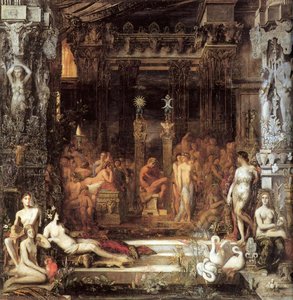
A Portal into the Mythic Dreamscape In the heart of nineteenth-century Paris, Gustave Moreau emerged not merely as a painter, but as a weaver of dreams, and nowhere is this more evident than in his monumental work, The Daughters of Thespius. Created in 1853, this breathtaking oil on canvas serves as an early testament to the artist's profound ability to conjure realms that exist at the intersection of reality and…

8
Jupiter and Semele (1895) avtorja Gustave Moreau

Jupiter and Semele

1895 · Oil On Canvas

In the grand tapestry of nineteenth-century art, few threads shimmer with as much mystery and nocturnal beauty as Gustave Moreau’s Jupiter and Semele. Completed in 1895, this monumental canvas stands as a cornerstone of the Symbolist movement, embodying a profound fascination with dreamlike imagery and psychological exploration. The painting plunges viewers into a scene brimming with dramatic tension, capturing a pivotal moment from Greek mythology where the celestial and the…

9
Zjavitev (1876) avtorja Gustave Moreau

Zjavitev

1876 · Olje na platnu · Fogg Museum, Cambridge

V tem olju na platnu zasojno, lebdeče glavo v zgornjem središču okvira obotoči svetlobni spektakel. Okoli nje se širi blestava, zvezdasta halo iz bele svetlobe, ki skozi prizor razprostira svoje žarke. Pod to pojavnost stoji ženska z dolgimi, valovitimi brunimi lasmi, oblečena v okrasno, polnagosto oblačilo. Nosi izšite rob, krono in številne dragulje. Njena desna roka se iztrenja proti levitirajoči figuri, medtem ko se ji pri nogah počita leopard. V…

10
Jakob in angel (1876) avtorja Gustave Moreau

Jakob in angel

1876 · Olje na platnu · Fogg Museum, Cambridge

The canvas captures a nocturnal struggle between the mortal Jacob and a divine presence. Set against a turbulent landscape under a pale moon, the composition centers on the physical tension of the wrestling match. To the left, an angelic figure is draped in intricate, jewel-like garments, her head framed by a multi-colored halo of radiating light. Opposite her, a muscular male figure strains with dynamic effort, his body contorted in…

Izbor umetnika Gustave Moreau se nadaljuje, od 11 do 100

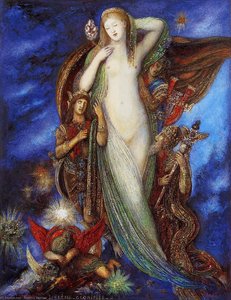
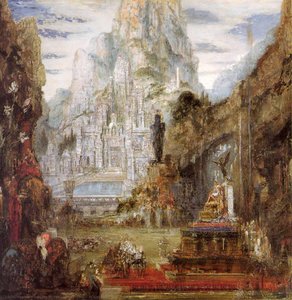
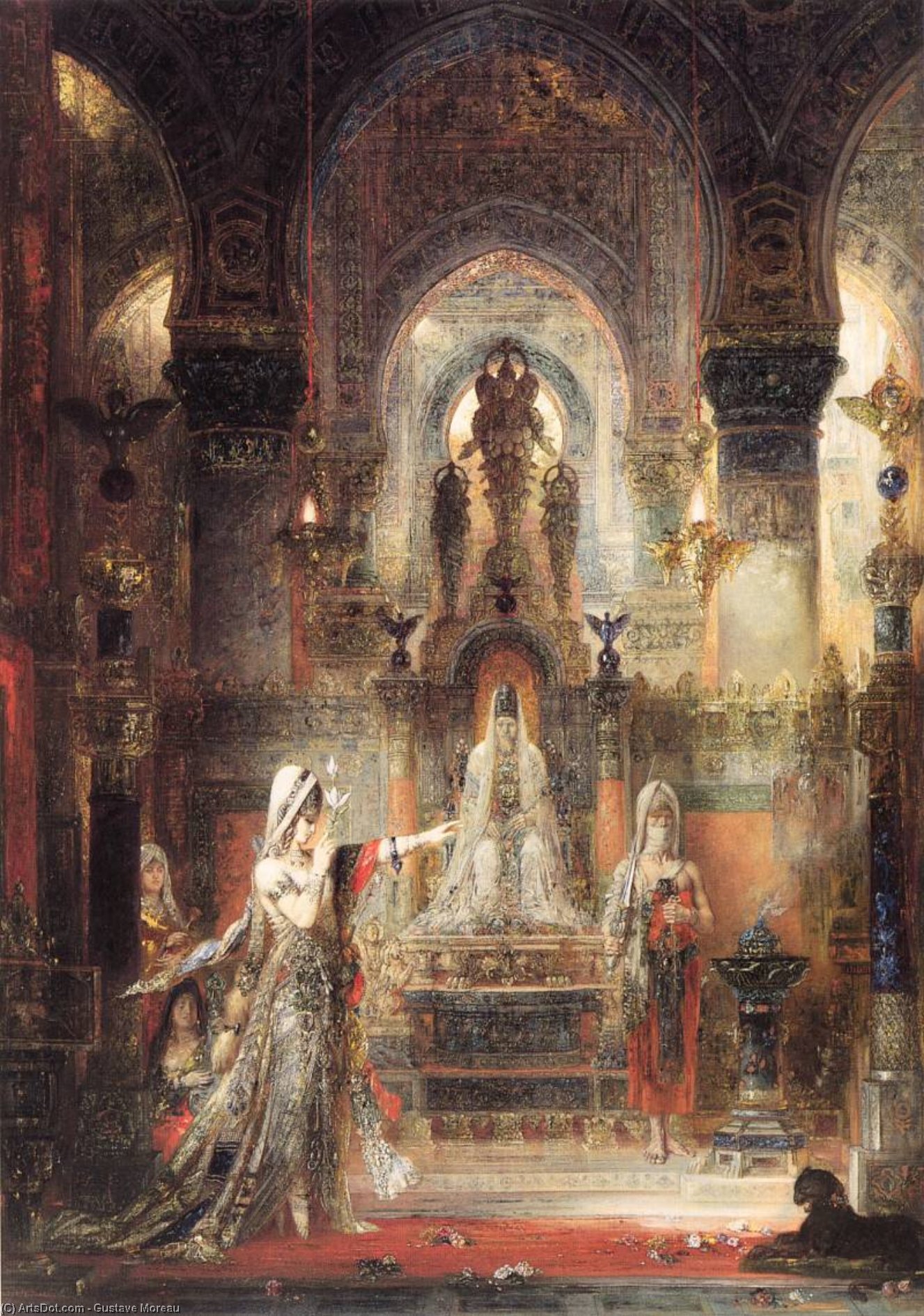
11Salome Dancing (1886) avtorja Gustave MoreauSalome Dancing1886 · Musée d'Orsay 12Salome v uglemu (1876) avtorja Gustave MoreauSalome v uglemu1876 · Narodni muzej zahodne umetnosti 13Salom Dancing before Herod (1876) avtorja Gustave MoreauSalom Dancing before Herod1876 · Muzej umetnosti Armand Hammer 14The Muses Leaving Their Father Apollo to go and Enlighten th avtorja Gustave MoreauThe Muses Leaving Their Father Apollo to go and Enlighten thMusée Gustave Moreau 15Hercules and the Lernaean Hydra (1876) avtorja Gustave MoreauHercules and the Lernaean Hydra1876 · Musée Gustave Moreau 16helene glorifiee avtorja Gustave Moreauhelene glorifiee 17Pijata (1854) avtorja Gustave MoreauPijata1854 · Städelsches Kunstinstitut und Städtische Galerie 18Sainte Cécile et les Anges de la musique avtorja Gustave MoreauSainte Cécile et les Anges de la musique 19The Triumph of Alexander the Great (1892) avtorja Gustave MoreauThe Triumph of Alexander the Great1892 · Musée Gustave Moreau 20Salome Dancing before Herod avtorja Gustave MoreauSalome Dancing before HerodHammer Museum 21Sapfova smrt (1850) avtorja Gustave MoreauSapfova smrt1850 · Musée Gustave Moreau 22Jakob in angel (1878) avtorja Gustave MoreauJakob in angel1878 · Musée Gustave Moreau 23Les Argonautes avtorja Gustave MoreauLes Argonautes 24The Death of Sappho (1872) avtorja Gustave MoreauThe Death of Sappho1872 · Musée Municipal 25Pieta avtorja Gustave MoreauPietaNarodni muzej zahodne umetnosti 26Hercules and the Hydra (1876) avtorja Gustave MoreauHercules and the Hydra1876 27The Suitors avtorja Gustave MoreauThe SuitorsMusée Gustave Moreau 28Prince Hamlet kill King Claudius avtorja Gustave MoreauPrince Hamlet kill King Claudius 29La Toilette (1885) avtorja Gustave MoreauLa Toilette1885 · Artizon Museum 30The Sphinx (1864) avtorja Gustave MoreauThe Sphinx1864 31Jupiter et Sémélé avtorja Gustave MoreauJupiter et Sémélé 32Ganymede (1886) avtorja Gustave MoreauGanymede1886 33Tatuirana Salome (1875) avtorja Gustave MoreauTatuirana Salome1875 · Musée Gustave Moreau 34Saint Michael Vanquishing Satan (1882) avtorja Gustave MoreauSaint Michael Vanquishing Satan1882 35La Vie de l'Humanité l'Age d'or, Adam Le soir. Le Sommeil avtorja Gustave MoreauLa Vie de l'Humanité l'Age d'or, Adam Le soir. Le Sommeil 36Sappho (1893) avtorja Gustave MoreauSappho1893 37Les Anges voyageurs ou Les voyageurs avtorja Gustave MoreauLes Anges voyageurs ou Les voyageurs 38Saint George and the Dragon avtorja Gustave MoreauSaint George and the Dragon 39Hercule et le Lion de Némée avtorja Gustave MoreauHercule et le Lion de Némée 40The Birth of Venus avtorja Gustave MoreauThe Birth of Venus 41Rape of Deianira (1850) avtorja Gustave MoreauRape of Deianira1850 · Musée Gustave Moreau 42Apollo Vanquishing the Serpent Python (1885) avtorja Gustave MoreauApollo Vanquishing the Serpent Python1885 · Narodna galerija Kanade 43Apollo and the Nine Muses avtorja Gustave MoreauApollo and the Nine Muses 44Prometheus, Variant (1870) avtorja Gustave MoreauPrometheus, Variant1870 · Musée Gustave Moreau 45Naissance de Vénus avtorja Gustave MoreauNaissance de Vénus 46Léda avtorja Gustave MoreauLéda 47Salome with Column (1890) avtorja Gustave MoreauSalome with Column1890 48Salome (1875) avtorja Gustave MoreauSalome1875 · Musée Gustave Moreau 49Jacob and the Angel avtorja Gustave MoreauJacob and the Angel 50King David (1878) avtorja Gustave MoreauKing David1878 · Musée Gustave Moreau 51Pasiphaë (1880) avtorja Gustave MoreauPasiphaë1880 · Musée Gustave Moreau 52The Peacock complaining to Juno (1881) avtorja Gustave MoreauThe Peacock complaining to Juno1881 53Salome Carrying the Head of John the Baptist on a Platter (1876) avtorja Gustave MoreauSalome Carrying the Head of John the Baptist on a Platter1876 54La Vie de l'Humanité l'Age d'or, Adam Le Midi. L'Extase avtorja Gustave MoreauLa Vie de l'Humanité l'Age d'or, Adam Le Midi. L'Extase 55Hercule et les filles de Thespius avtorja Gustave MoreauHercule et les filles de Thespius 56St. Elisabeth of Hungary (The Miracle of the Roses) (1879) avtorja Gustave MoreauSt. Elisabeth of Hungary (The Miracle of the Roses)1879 57L'enlèvement d'Europe ou Jupiter et Europe avtorja Gustave MoreauL'enlèvement d'Europe ou Jupiter et EuropeMusée Gustave Moreau 58Cleopatra (1887) avtorja Gustave MoreauCleopatra1887 59Jacob et l'Ange avtorja Gustave MoreauJacob et l'AngeMusée Gustave Moreau 60The Pietà (1867) avtorja Gustave MoreauThe Pietà1867 · Harvard Art Museums 61Salome in the Garden (1878) avtorja Gustave MoreauSalome in the Garden1878 62Bethsabée avtorja Gustave MoreauBethsabée 63Delilah (1896) avtorja Gustave MoreauDelilah1896 · Museo de Arte de Ponce 64Diana bathing (1900) avtorja Gustave MoreauDiana bathing1900 · Musée Gustave Moreau 65Galatée avtorja Gustave MoreauGalatée 66Death of Sappho (1870) avtorja Gustave MoreauDeath of Sappho1870 67Moïse sauvé des eaux avtorja Gustave MoreauMoïse sauvé des eauxMusée Gustave Moreau 68Les Licornes avtorja Gustave MoreauLes Licornes 69The Chimera (1867) avtorja Gustave MoreauThe Chimera1867 · Fogg Art Museum 70Moses, in Sight of the Promised Land, Takes His Sandals Off (1854) avtorja Gustave MoreauMoses, in Sight of the Promised Land, Takes His Sandals Off1854 · Musée Gustave Moreau 71Lucretia and Tarquin (1850) avtorja Gustave MoreauLucretia and Tarquin1850 · Musée Gustave Moreau 72The childhood of Sixtus V. (1853) avtorja Gustave MoreauThe childhood of Sixtus V.1853 · Musée d'Orsay 73Cléopâtre avtorja Gustave MoreauCléopâtre 74Hercules and the Stymphalian Birds (1872) avtorja Gustave MoreauHercules and the Stymphalian Birds1872 · Frances Lehman Loeb Art Center 75The Entombment (1867) avtorja Gustave MoreauThe Entombment1867 · Harvard Art Museums 76Sémélé avtorja Gustave MoreauSémélé 77Life of Humanity (1886) avtorja Gustave MoreauLife of Humanity1886 · Musée Gustave Moreau 78Evening and Sorrow (1882) avtorja Gustave MoreauEvening and Sorrow1882 79La Vie de l'Humanité l'Age de fer, Caïn. Le Soir. La Mort avtorja Gustave MoreauLa Vie de l'Humanité l'Age de fer, Caïn. Le Soir. La Mort 80A Saint in the Desert (1879) avtorja Gustave MoreauA Saint in the Desert1879 · Petit Palais 81The Poet and the Siren avtorja Gustave MoreauThe Poet and the Siren 82Françoise de Rimini avtorja Gustave MoreauFrançoise de Rimini 83Ebauche pour Le Triomphe d'Alexandre le Grand avtorja Gustave MoreauEbauche pour Le Triomphe d'Alexandre le Grand 84Saint Martin (1882) avtorja Gustave MoreauSaint Martin1882 85Young Man and Death (1865) avtorja Gustave MoreauYoung Man and Death1865 86The Magi (1860) avtorja Gustave MoreauThe Magi1860 · Musée Gustave Moreau 87Diomedes Devoured by His Horses (1865) avtorja Gustave MoreauDiomedes Devoured by His Horses1865 · Detroit Institute of Arts 88untitled (6379) avtorja Gustave Moreauuntitled (6379) 89Rose thé avtorja Gustave MoreauRose thé 90Hercules and the Lernaean Hydra (1878) avtorja Gustave MoreauHercules and the Lernaean Hydra1878 91Voices of Evening (1885) avtorja Gustave MoreauVoices of Evening1885 · Musée Gustave Moreau 92The Chimera (1867) avtorja Gustave MoreauThe Chimera1867 93Dalila avtorja Gustave MoreauDalila 94Venice (1885) avtorja Gustave MoreauVenice1885 · Musée Gustave Moreau 95Les Prétendants avtorja Gustave MoreauLes Prétendants 96Poète persan avtorja Gustave MoreauPoète persan 97Mystical Flower (1890) avtorja Gustave MoreauMystical Flower1890 · Musée Gustave Moreau 98Scottish Horseman (1854) avtorja Gustave MoreauScottish Horseman1854 · Musée Gustave Moreau 99The Poet and the Saint (1868) avtorja Gustave MoreauThe Poet and the Saint1868 100Salome (Entering the Banquet Room) (1875) avtorja Gustave MoreauSalome (Entering the Banquet Room)1875

Slavna platna umetnika Gustave Moreau, razdeljena po obdobjih

Motivi, ki so očarali Gustave Moreau

Četiri teme, ki se v teh originalih najpogosteje ponavljajo, vsaka z svojim vrhunskim primerom.

Muzeji, ki hranijo originala umetnika Gustave Moreau

8 muzejev, ki vsebujo največ slik na tej strani.

Muzej Mesto Sloga Gustave Moreau Slike iz tega seznama
Musée Gustave Moreau, ParizMusée Gustave Moreau Pariz 85 Jupiter in Semele, The Daughters of Thespius, The Muses Leaving Their Father Apollo to go and Enlighten th
Musée d'Orsay, ParizMusée d'Orsay Pariz 7 Salome Dancing, The childhood of Sixtus V.
Fogg Museum, CambridgeFogg Museum Cambridge 4 Zjavitev, Jakob in angel
Narodni muzej zahodne umetnosti, TokyoNarodni muzej zahodne umetnosti Tokyo 3 Salome v uglemu, Pieta
Harvard Art Museums, CambridgeHarvard Art Museums Cambridge 3 The Pietà, The Entombment
Louvre, ParizLouvre Pariz 2 Feton, Jason in Medeja
Metropolitanski muzej umetnosti, New YorkMetropolitanski muzej umetnosti New York 2 Salome z glavo Janeza Krstnika
Petit Palais, ParizPetit Palais Pariz 2 A Saint in the Desert

Gustave Moreau desetletje za desetletjem: originali, ki definira vsako od njih

Delo po desetletjih

Izberite desetletje, da si ogledate original, ki ga opredeljuje.

Vprašanja zbirateljev o slikah umetnika Gustave Moreau

Za katero delo je Gustave Moreau najbolj znan/a?Razkriti odgovor

Aparicija (1876). Zatem sledeta Feton (1878) in Sirene, okoli leta 1885.

Koliko je bil Gustave Moreau let, ko je nastalo delo Aparicija?Razkriti odgovor

50 let: delo Aparicija iz leta 1876, Gustave Moreau pa je bil/a rojen/a leta 1826.

Katera je deset najbolj znanih slik umetnika Gustave Moreau?Razkriti odgovor

Aparicija, Feton, Sirene, okoli leta 1885, Salome z glavo Janeza Krstnika, Jason in Medeja, Jupiter in Semele, The Daughters of Thespius, Jupiter and Semele, Zjavitev in Jakob in angel. Zgornja lestica prikazuje leto nastanka in muzej za vsako delo.

Koliko slik je pustil Gustave Moreau?Razkriti odgovor

Naš katalog vsebuje 535 del avtorja Gustave Moreau, datiranih od 1850 do 1896.

V katerih muzejih so razložena remek dela umetnika Gustave Moreau?Razkriti odgovor

Večini v Musée Gustave Moreau (Pariz), Musée d'Orsay (Pariz) in Fogg Museum (Cambridge). Zgoraj navedena tabela muzejev vsebuje njihov celoten seznam.

V katerih letih je Gustave Moreau naslikal svoja najbolj znana dela?Razkriti odgovor

V obdobju 1870s: 23 od 100 del na tej strani je bilo izdelovanih takrat, med njimi pa Aparicija.

Kakšna sta prva in zadnja znana originala umetnika Gustave Moreau?Razkriti odgovor

Na tej strani je najstarejše delo iz Sapfova smrt (1850) in najstarejše iz Delilah (1896).

Katere teme je Gustave Moreau najpogosteje izbiral?Razkriti odgovor

Mythology (49), Woman (11) in Birds (10), na 100 delih na tej strani.

Katero tehniko je Gustave Moreau najpogosteje uporabljal?Razkriti odgovor

Oil On Canvas, za 42 od 100 del na tej strani.

Kateri umetniški slog pripada Gustave Moreau?Razkriti odgovor

Simbolistična slikarstvo, glede na originala na tej strani.

Katera dela umetnika Gustave Moreau so razstavljena v muzeju Musée Gustave Moreau?Razkriti odgovor

Jupiter in Semele, The Daughters of Thespius in The Muses Leaving Their Father Apollo to go and Enlighten th: v muzeju Musée Gustave Moreau, Pariz se nahaja 26 del z te strani.

Gustave Moreau: življenje in delo

The Life and Art of Gustave Moreau

Gustave Moreau was a French artist who lived a life deeply connected to the streets of Paris. Born in the city on April 6, 1826, he spent his years navigating the shifting currents of the nineteenth century. He was a central figure in the Symbolist movement, a period that looked away from the literal world to find meaning in the unseen. His work was not a pursuit of mere imitation, but an attempt to give form to the internal landscape of the human psyche.

His output was immense. Throughout his life, he produced over 15,000 paintings, watercolors, and drawings. This vast collection reflects a man who was constantly translating myth and religion into a personal visual language. He worked with an intensity that saw him create a massive body of work before he passed away in Paris on April 18, 1898.

His art often focused on the heavy, psychological weight of ancient stories. Rather than simply illustrating a scene, he sought to capture the spiritual essence of his subjects. This approach made him a singular voice in a time when many of his peers were focused on the fleeting light of the natural world. His dedication to this inward exploration left behind a profound record of the human soul.

Early Life, Family and Training

Born into a bourgeois family in Paris, France, Gustave Moreau grew up in a household where structure and melody met. His father, Louis Jean Marie Moreau, worked as an architect and archivist, providing a sense of order and historical depth to their home. His mother, Adèle-Pauline Desmoutier, was a musician, and her influence added a rhythmic sensibility to the family's atmosphere. From a very young age, Gustave showed a natural talent for drawing, a gift that seemed to emerge almost instinctively as he explored the world around him.

His formal education began at Collège Rollin, which is known today as Collège-lycée Jacques-Decour. This early schooling provided the foundation for his later, more specialized studies. He eventually entered the École des Beaux-Arts, where he underwent rigorous academic training. It was here that he studied under figures such as François-Édouard Picot, learning the technical discipline required to master the classical traditions of his time.

Artistic Development and Italian Travels

By the 1850s, Moreau felt the pull of the past, a need to understand the foundations of the art he so deeply respected. This led him to Italy, a period that would fundamentally reshape his vision. He did not merely observe the works of the masters; he lived among them, spending his time making hundreds of copies and studies of Old Master paintings. These were not simple exercises for him. Through the act of replication, he sought to absorb the secrets of composition and the psychological depth found in the works of Michelangelo and Leonardo da Vinci. He studied their anatomy and their ability to capture the human spirit, absorbing their techniques to build his own visual language.

While the Italian masters provided a structural foundation, other influences added a layer of emotional intensity to his developing style. He found himself drawn to the dramatic use of color seen in the works of Eugène Delacroix. This fascination with how color could convey narrative and feeling became a cornerstone of his approach. He was not interested in the objective reality of the world around him, but rather in how light and pigment could express the internal movements of the soul. His time in Italy allowed him to synthesize these diverse influences, blending the classical precision of the Renaissance with a more modern, expressive use of color.

Technique and Symbolic Style

Moreau’s approach to the canvas was a slow, deliberate process. He favored a meticulous layering of paint, building up surfaces that possessed a heavy, physical presence. This method allowed him to create rich textures that seemed to hold light within them. To deepen the spiritual weight of his subjects, he often incorporated gold leaf, a choice that lent his scenes a Byzantine quality. He was less interested in the surface of the natural world and more focused on the expressive power of color and form to convey a specific mood or a hidden meaning.

His paintings are filled with a dense language of symbols. A serpent might appear to represent temptation, while jewels are used to signify earthly desires. These elements do not merely decorate the scene; they act as visual cues for the viewer to look toward the psychological or the spiritual. Through this intricate detail, he built a dreamlike atmosphere where the boundaries of reality felt thin. The figures in his work often seem to exist in a state of suspension, caught between the physical and the ethereal.

Notable Masterpieces and Works

Many of Moreau's most recognized paintings emerged from his deep interest in the stories of antiquity and the Bible. In 1864, he exhibited Oedipus and the Sphinx, a work that helped establish his reputation. His fascination with the figure of Salome led to several different interpretations. One of his most famous works is Salome Dancing before Herod, which captures the tension of the biblical narrative through his unique, detailed approach. He also produced The Apparition between 1874 and 1876, a piece that highlights the strange, dreamlike atmosphere he often sought to create.

As his career progressed, his compositions grew in complexity. In 1885, he painted Voices of Evening, a watercolor that demonstrates his ability to use soft textures to convey a sense of spiritual quietude. Later in his life, in 1895, he completed Jupiter and Semele, a work that reflects the grand, mythological scale he favored. His canvases often felt less like windows into a real room and more like stages for the subconscious, where light and shadow worked together to suggest something beyond the physical world.

Circle, Pupils and Teaching

In his later years, Moreau moved from the quiet seclusion of his studio into the classroom. In 1893, he accepted a professorship at the École des Beaux-Arts, a position that allowed him to pass his ideas to a new generation of painters. He did not teach his students to merely mimic his hand or his specific way of applying paint. Instead, he encouraged them to look inward. He urged them to embrace their own imagination and to find their own unique modes of individual expression, pushing them to move beyond the rigid rules of the academy.

This emphasis on the internal life of the artist left a mark on many who sat in his lectures. Among those who studied under him was Henri Matisse, who would go on to reshape the landscape of modern art. Georges Rouault was another of his pupils, absorbing the lessons of symbolism and personal vision that Moreau championed. Through these students, his belief in the importance of the subconscious and the spiritual became a part of the broader evolution of French painting.

Legacy and Enduring Influence

By the 1890s, Moreau had become a central figure in the Symbolist movement. He did not seek the spotlight, yet his presence was felt deeply by those who followed him. His influence reached into the classrooms of the École des Beaux-Arts, where he encouraged his students to look inward and embrace their own imagination. This focus on individual expression helped pave the way for the modern art that would emerge in the decades following his death.

While his specific style was sometimes met with mixed reactions during his lifetime, his importance was recognized again in the latter half of the 20th century. This period saw a significant reevaluation of his work, as people looked past the surface to find the psychological depth he had spent his life exploring. He is now widely regarded as a precursor to modern art, a man who helped shift the focus of painting from the external world to the internal soul.

The Musée Gustave Moreau in Paris remains a place where his vision is preserved. The building itself, which he helped transform into a museum, keeps his memory alive in the very space where he lived and worked. It is a quiet place that holds the weight of his many years of study and creation.

Where to See the Works Today

To experience his art in the most intimate way, one can visit the Musée Gustave Moreau in Paris, France. This museum is housed in the very building that served as his home and studio. Walking through these spaces allows you to see the environment where he lived and worked, providing a direct connection to his daily life and creative process.

Beyond his personal residence, several major institutions hold his paintings. In Paris, the Louvre also maintains two of his works in its collection. For those traveling further, the Metropolitan Museum of Art in New York holds two more of his paintings, allowing his vision to reach audiences far beyond the streets of France.