


1


Posodobljeno oktober 2026 · uvrščeno glede na naš skoraj priljubljenosti (iskanja, obiske in naročila za vsako delo) · 36 del v našem katalogu avtorja Alan Davie
Kratek opis
Izpostavljeno v galeriji je najbolj znano sliko umetnika Alan Davie, ki je Woman Arranging Flowers (1945). Untitled Abstract in Self Portrait with Brushes (1937) dopolnjujeta trijo, ki jo prepozna vsak pogled. Od 36 del avtorja Alan Davie v našem katalogu galerija spodaj predstavlja 36 najbolj znanih; vsako je original z letom nastanka, pripadajočim mu muzejem in opisom tistega, kar ga dela edinstavnim.


 Joe's Magic Lantern1961
12
 Joe's Lucky Dip1961
13
 Keep Your Fingers Crossed1961
14
 Hopi Studies No.32, Opus 0.11731991 · University of Hertfordshire
15
 Hopi Studies No.30 (Big Blue) (Opus O.1171)1991
16
 Homage to an Earth Goddess No.61992
17
 Symbols in a Landscape1994 · The Pier Arts Centre
18
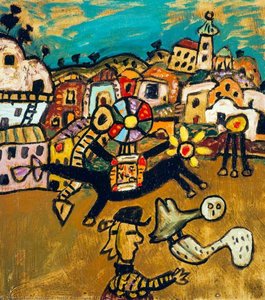 Village Witch (Opus O.1263)1994
19
 Magic Casket1997 · Scottish National Gallery of Modern Art
20
 Celtic Landscape (Dreamscape)1996 · The Pier Arts Centre
21
 Magic Landscape (Opus O.1337)1996
22
 The Alchemist's Mirror No.1 (Opus 1357)1997
23
 Cosmic Signals I2000
24
 Cosmic Signals No.72000
25
 The Golden Palace1999
26
 Magician's Mirror No.22000 · The Mercer Art Gallery
27
 Serpent's Idea of a Horse2000
28
 The Magician's Mirror No.3 (Opus 1450)2000
29
 Without Devices2004 · Pembroke College Oxford Jcr Art Collection
30
 Around and Around in the PinkNarodna galerija Kanade
31
 Kaleidoscope for a Parrot
32
 Prize for a Serpent
33
 Flowers on a TableThe Fleming Collection
34Prophet in a Tree, 1963Fitzwilliam College
35
 Double MonumentRobinson College
36
 Hallucination with Monster and Cock
8 muzejev, ki vsebujo največ slik na tej strani.
| Muzej | Mesto | Sloga Alan Davie | Slike iz tega seznama |
|---|---|---|---|
 The Pier Arts Centre |
Stromness | 2 | Symbols in a Landscape, Celtic Landscape (Dreamscape) |
 University of Hertfordshire |
North Hatley | 1 | Hopi Studies No.32, Opus 0.1173 |
 Scottish National Gallery of Modern Art |
Edinburgh | 1 | Magic Casket |
 The Mercer Art Gallery |
Harrogate | 1 | Magician's Mirror No.2 |
 Pembroke College Oxford Jcr Art Collection |
Oxford | 1 | Without Devices |
 Narodna galerija Kanade |
Ottawa | 1 | Around and Around in the Pink |
 The Fleming Collection |
London | 1 | Flowers on a Table |
 Fitzwilliam College |
Cambridge | 1 | Prophet in a Tree, 1963 |
Izberite desetletje, da si ogledate original, ki ga opredeljuje.
Woman Arranging Flowers (1945). Zatem sledeta Untitled Abstract in Self Portrait with Brushes (1937).
25 let: delo Woman Arranging Flowers iz leta 1945, Alan Davie pa je bil/a rojen/a leta 1920.
Woman Arranging Flowers, Untitled Abstract, Self Portrait with Brushes, The Saint, Entrance to a Paradise, Jingling Space, Ram Grip, Piggy Chain, Joy Bag No. 1 in Entrance For A Red Temple No. 4. Zgornja lestica prikazuje leto nastanka in muzej za vsako delo.
Naš katalog vsebuje 36 del avtorja Alan Davie, datiranih od 1937 do 2004.
Večini v The Pier Arts Centre (Stromness), University of Hertfordshire (North Hatley) in Scottish National Gallery of Modern Art (Edinburgh). Zgoraj navedena tabela muzejev vsebuje njihov celoten seznam.
V obdobju 1990s: 10 od 36 del na tej strani je bilo izdelovanih takrat, med njimi pa Hopi Studies No.32, Opus 0.1173.
Na tej strani je najstarejše delo iz Self Portrait with Brushes (1937) in najstarejše iz Without Devices (2004).
Abstract expressionism, glede na originala na tej strani.
Symbols in a Landscape in Celtic Landscape (Dreamscape): v muzeju The Pier Arts Centre, Stromness se nahaja 2 del z te strani.

