The Versatile Legacy of Thomas Eyre Macklin
In the rich tapestry of British art history, few figures embody the transition from Victorian sentiment to modern elegance as gracefully as Thomas Eyre Macklin. Born on March 30, 1863, in the industrial and cultural heart of Newcastle upon Tyne, Macklin emerged from a world steeped in the meticulous observation of the late nineteenth century. His artistic journey was not merely a career but an eighty-year odyssey that saw him masterfully navigate the shifting tides of aesthetic movements, moving from the emotive depths of Romanticism to the streamlined sophistication of Art Deco. As a painter in oils and watercolor, illustrator, and sculptor, Macklin possessed a rare polymathic ability to translate the soul of the British landscape and the gravity of civic memory into enduring physical forms.
The foundations of Macklin’s talent were laid within the prestigious halls of the Royal Academy Schools and nurtured by an environment rich with artistic lineage. His early training was profoundly shaped by the influence of masters such as George Frederic Watts and William Ord Kendall. From Watts, Macklin inherited a fascination with symbolism and the spiritual weight of subject matter, a quality that would later infuse his landscapes with a sense of the sublime. This period of his life was characterized by a rigorous commitment to the Victorian ethos, where every brushstroke served to document the grandeur of nature and the dignity of the human form, often through delicate black-and-white illustrations that captured the imagination of readers across the United Kingdom.
A Visionary of Landscape and Form
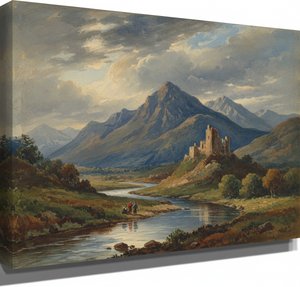
As his career matured, Macklin became a celebrated chronicler of the Northumberland countryside. His landscape paintings are far more than mere topographical records; they are atmospheric meditations on peace and permanence. In works such as ‘Whittle Mill’, created in 1904, one can witness his mastery of light and shadow. Through a palette of soft, muted tones and a keen eye for atmospheric perspective, he transformed scenes of riverbanks and bridges into tranquil sanctuaries. These paintings often featured the quiet rhythms of community life—a mother with her child or figures moving through a pastoral setting—imbued with an emotional resonance that invited the viewer to find stillness within the canvas.
However, Macklin’s creative spirit was never confined to the two-dimensional plane. He possessed a monumental drive that found expression in the heavy, tactile medium of sculpture. This facet of his work allowed him to engage with the public consciousness on a civic scale. His ability to design monuments for significant historical events brought a sense of permanence to the urban landscapes of Northern England. Notable achievements include:
- The South African War Memorial: A profound bronze tribute located in Newcastle Cathedral, which stands as a testament to his ability to embody Victorian ideals of patriotism and sacrifice.
- Civic Portraiture: His realistic oil paintings, such as ‘Portrait of an Alderman’, showcased his skill in capturing the character and social standing of the era's influential figures through rich textures and academic precision.
- Art Deco Innovations: In the twentieth century, Macklin successfully pivoted toward the burgeoning Art Deco movement, applying a new sense of geometric elegance and decorative flair to his sculptural commissions.
An Enduring Artistic Impression
The historical significance of Thomas Eyre Macklin lies in his role as a bridge between eras. He was an artist who could honor the traditions of the past while fearlessly embracing the stylistic revolutions of the future. Whether he was signing his work as T. Eyre Macklin or T.E. Macklin, his hand was recognizable for its ability to balance meticulous detail with expressive movement. His life, which concluded in 1943 in Budleigh Salterton, Devon, left behind a legacy that spans the breadth of British artistic evolution.
Today, collectors and scholars look to Macklin not just as a regional master of Newcastle, but as a significant figure whose work captures the very essence of a changing Britain. From the romanticized, misty hills of his early landscapes to the bold, structured monuments of his later years, Macklin’s oeuvre remains a vital window into the aesthetic soul of the late nineteenth and early twentieth centuries.
Vprašanja in odgovori
Koliko umetnin umetnika Thomas Eyre Macklin je na voljo za ogled?
Na strani Vsi umetniški slogi si lahko ogledate 14 umetnin del umetnika Thomas Eyre Macklin.
V katerih umetnostnih smernih je delal/a Thomas Eyre Macklin?
Stran Vsi umetnostni slogi grupirá dela umetnika Thomas Eyre Macklin po umetniškem slogu.
Kje so dela umetnika Thomas Eyre Macklin organizirana po barvah?
Delo umetnika Thomas Eyre Macklin lahko raziskujete po barvah na njegovi strani Spektralni indeks.
Kje lahko ogledam vse umetniške dela umetnika Thomas Eyre Macklin?
Vsa dela umetnika Thomas Eyre Macklin na platformi ta spletna stran si lahko ogledate na njegovi strani Vsi umetniški slogi.
Ali obstaja časovnica del umetnika Thomas Eyre Macklin?
Stran Zgodovinski pregled del umetnika prikazuje dela umetnika Thomas Eyre Macklin razvrščena po datumu, leto za leto.
Katera dela umetnika Thomas Eyre Macklin so najbolj obiskovana?
Stran Statistika umetnika Thomas Eyre Macklin prikazuje statistiko, izračunano iz umetnin tega umetnika, ki so navedene na ta spletna stran.
V katerem zgodovinskem obdobju je delal/a Thomas Eyre Macklin?
Thomas Eyre Macklin je delal v obdobju 19th Century. To obdobje umetnikovo dejavnost umešča v zgodovinski okvir.