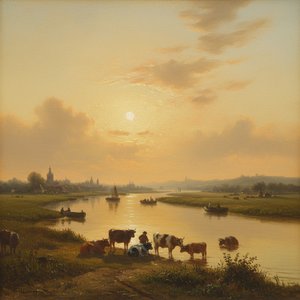
1605 - 1655

Osnovni podatki

  • Nationality: Netherlands
  • Art period: Early Modern
  • Typical colors: espresso
  • Copyright status: Public domain
  • Color intensity:
    • monochromatic
    • balanced
  • Top 3 works:
    • Grotto Scene
    • At the Hermit
  • Lifespan: 50 years

A Master of Ruin and Shadow: The Life and Art of Rombout van Troyen

Rombout van Troyen, a name perhaps less instantly recognizable than some of his Dutch Golden Age contemporaries, nevertheless occupies a fascinating niche within the pantheon of 17th-century painters. Born around 1605 in Amsterdam, Van Troyen dedicated his career to crafting evocative landscapes and architectural scenes—a curious pursuit for an artist who, as historical accounts suggest, never actually set foot in Italy, the very source of inspiration for his most celebrated works. His paintings are not depictions of observed reality but rather meticulously constructed fantasies, born from a deep study of other artists’ interpretations of the Italian countryside and a remarkable talent for atmospheric effect.

Early Training and Artistic Development

Van Troyen's artistic journey began around 1615 with a seven-year apprenticeship under Jan Pynas, a respected painter in Amsterdam known for his landscapes and history paintings. This formative period proved crucial to Van Troyen’s development. Pynas introduced him to the traditions of Adam Elsheimer, a German artist whose small-scale, intensely detailed landscapes had a profound impact on Dutch painting. Elsheimer's influence is visible in Van Troyen’s early works—a penchant for dramatic lighting and a focus on classical ruins as symbols of time’s passage and human mortality. However, while Pynas provided the initial foundation, Van Troyen quickly began to forge his own distinctive style, moving beyond simple imitation towards a more complex and emotionally resonant vision. He absorbed influences from other sources too, developing a unique blend that would define his oeuvre.

The Italianate Landscape: A World Imagined

Van Troyen specialized in what became known as the “Italianate landscape”—scenes depicting the rolling hills, crumbling palaces, and sun-drenched grottos of Italy. These paintings were immensely popular during the Dutch Golden Age, appealing to a growing merchant class eager to display their sophistication and worldliness. Yet, Van Troyen’s approach differed from many of his contemporaries. He wasn't interested in recreating specific Italian locations; instead, he constructed idealized visions—landscapes populated with classical architecture, often bathed in a melancholic light. His scenes are frequently characterized by a sense of drama and mystery, achieved through the skillful use of chiaroscuro – the dramatic contrast between light and shadow. The Burning of Troy, for example, exemplifies this approach, depicting a historical event within a shadowy, expansive setting that heightens tension and emotion. His compositions often feature numerous figures engaged in various activities, adding narrative depth to his landscapes.

Technique and Style: A Masterful Hand

Van Troyen’s technical skill was undeniable. He worked primarily with oil on panel, employing a meticulous brushstroke and a keen eye for detail. His paintings are characterized by their rich color palettes, often dominated by warm earth tones and subtle gradations of light. He possessed an exceptional ability to create atmospheric perspective—the illusion of depth achieved through the blurring of distant objects—which contributed significantly to the sense of realism in his landscapes. Chiaroscuro was central to his style; he used it not merely as a technical device but as a means of conveying mood and emotion. The dramatic interplay of light and shadow often draws the viewer’s eye to specific focal points within the composition, while simultaneously creating a sense of mystery and intrigue. His works are also notable for their intricate architectural details—crumbling columns, arched doorways, and overgrown ruins—which add a layer of historical depth and symbolic resonance.

Legacy and Historical Significance

Despite facing financial difficulties in his later years – records indicate he relocated to Friesland in the 1650s – Rombout van Troyen left behind a significant body of work that continues to captivate art enthusiasts today. While often overshadowed by more famous Dutch masters, his paintings offer a unique perspective on the Italianate landscape tradition and demonstrate a remarkable talent for atmospheric effect and narrative storytelling. His ability to create compelling scenes from imagination rather than direct observation sets him apart, revealing a sophisticated artistic sensibility and a deep understanding of classical symbolism. Recent scholarship has begun to shed new light on Van Troyen’s life and career, solidifying his place as an important figure within the Dutch Golden Age and a master of ruin and shadow.

Kviz

Pri vsakem vprašanju je na voljo le eden pravilen odgovor.

Vprašanje 1:
According to Houbraken, what type of landscapes did Rombout van Troyen primarily paint?
Vprašanje 2:
With whom did Rombout van Troyen apprentice for seven years?
Vprašanje 3:
What artistic style influenced Van Troyen through his master's earlier experiences?
Vprašanje 4:
According to the RKD, whose works are often confused with those of Rombout van Troyen?
Vprašanje 5:
In what city was Rombout van Troyen born and based?

Vprašanja in odgovori

Ali je na voljo 3D virtualni ogled del Rombout Van Troyen?

Dela umetnika Rombout Van Troyen si lahko ogledate v 3D galeriji na njegovi strani 3D galerija umetnosti.

S kakšnimi pseudonimi ali alternativnimi imeni je znan/a Rombout Van Troyen?

Rombout Van Troyen je znana tudi pod imenom Rombout van Roijen, Rombout van Trooijen, Rombout van Troye, Rombout van Trayen, Rombout van Trayers.

Kje lahko vidim barvni profil del Rombout Van Troyen?

Barvni profil del opusov umetnika Rombout Van Troyen je prikazan na njegovi strani Genom palete.

V katerem zgodovinskem obdobju je delal/a Rombout Van Troyen?

Rombout Van Troyen je deloval v obdobju Early Modern. To obdobje umetnikovo dejavnost umešča v zgodovinski okvir.

Kje so dela umetnika Rombout Van Troyen razvrščena po tehniki?

Stran Vse tehnike razvršča dela umetnika Rombout Van Troyen po tehniki.

Ali lahko raziskujem dela umetnika Rombout Van Troyen po tematikah?

Delo umetnika Rombout Van Troyen lahko raziskujete po temah na njegovi strani Atlas motivov.

Kje se je rodil/a Rombout Van Troyen in v kateri državi?

Rombout Van Troyen se je rodil/a v mestu Amsterdam v državi Netherlands.

Ali lahko dela umetnika Rombout Van Troyen brskam po barvni paleti?

Delo umetnika Rombout Van Troyen si lahko ogledate po barvni paleti na njegovi strani Po barvnih paletah.

Ali obstaja celoten seznam umetnin umetnika Rombout Van Troyen?

Vsa dela umetnika Rombout Van Troyen na platformi ta spletna stran si lahko ogledate na njegovi strani Vsi umetniški slogi.