Kratek opis
Za oči galerije je najbolj znano sliko umetnika Robert Adam delo Ceremonial scene with Abundance and Piping Pan, katere original visi v muzeju Metropolitanski muzej umetnosti, New York. The Illuminations At Buckingham House To Celebrate in The Theatre Royal, Drury Lane, Engraved By Patrick dopolnjujeta trijo, ki jo prepozna vsak pogled. Od 32 del avtorja Robert Adam v našem katalogu galerija spodaj predstavlja 31 najbolj znanih; vsako je original z letom nastanka, pripadajočim mu muzejem in opisom tistega, kar ga dela edinstavnim.
Top 10 slik umetnika Robert Adam v galeriji
Slikarska dela umetnika Robert Adam, uvrščena od 11 do 31
Motivi, ki so očarali Robert Adam
Četiri teme, ki se v teh originalih najpogosteje ponavljajo, vsaka z svojim vrhunskim primerom.
Buildings 6 delo
Temples 6 delo
Ruins 5 delo
Muzeji, ki hranijo originala umetnika Robert Adam
2 muzejev, ki vsebujo največ slik na tej strani.
| Muzej | Mesto | Sloga Robert Adam | Slike iz tega seznama |
|---|---|---|---|

| New York | 1 | Ceremonial scene with Abundance and Piping Pan | |
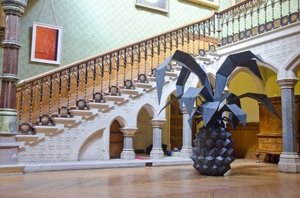
| London | 1 | Apocalyptic Figure |
Slike umetnika Robert Adam: odgovori galerije
Katero sliko avtorja Robert Adam je najbolj znana med vsemi?Razkriti odgovor
Ceremonial scene with Abundance and Piping Pan, Metropolitanski muzej umetnosti, New York. Zatem sledeta The Illuminations At Buckingham House To Celebrate in The Theatre Royal, Drury Lane, Engraved By Patrick.
Katera je 10 najboljjših slik umetnika Robert Adam?Razkriti odgovor
Ceremonial scene with Abundance and Piping Pan, The Illuminations At Buckingham House To Celebrate, The Theatre Royal, Drury Lane, Engraved By Patrick, View Of The Peristyle Of The Palace Of Diocletian, The Temple Of Jupiter In The Palace Of Diocletian, Side View Of The Temple Of Jupiter, From 'ruins Of, The Porta Aurea, From 'ruins Of The Palace Of, Classical landscape with cascade, The illuminations at buckingham house for king george iii's birthday in Landscape with castle on a rock. Zgornja lestica prikazuje leto nastanka in muzej za vsako delo.
Koliko dzieł stworzył Robert Adam?Razkriti odgovor
Naš katalog vsebuje 32 del avtorja Robert Adam.
Kje so razpostavljena najbolj znana originala umetnika Robert Adam?Razkriti odgovor
Večini v Metropolitanski muzej umetnosti (New York) in Arts Council Collection (London). Zgoraj navedena tabela muzejev vsebuje njihov celoten seznam.
Kateri motivi so bili za Robert Adam najbolj značilni?Razkriti odgovor
Buildings (6), Temples (6) in Ruins (5), na 31 delih na tej strani.
S katerim umetnostnim slogom je povezan Robert Adam?Razkriti odgovor
Neoclassicism, glede na originala na tej strani.
Robert Adam: umetnik
A Scottish Visionary: The Life and Legacy of Robert Adam
Born in Kirkcaldy, Scotland, on July 3rd, 1728, Robert Adam emerged from a family already deeply entrenched in the world of architecture. His father, William Adam, was a prominent figure in shaping the Scottish landscape, and young Robert’s initial education wasn't confined to academic pursuits like Latin at Edinburgh’s Royal High School; it was interwoven with the practical realities of building design and construction through apprenticeship under his father’s tutelage. This early immersion laid a crucial foundation, exposing him to both the theoretical principles and the tangible challenges inherent in architectural creation. Projects such as Inveraray Castle and extensions at Hopetoun House served as invaluable learning experiences, honing his skills and igniting a passion that would define his life's work. However, it was a journey beyond Scotland’s borders – the Grand Tour of 1754-1757 – that truly catalyzed Adam’s artistic evolution.The Italian Imprint: Shaping an Aesthetic
Accompanied by his brother James, Robert embarked on an extended exploration of Europe, with Italy serving as its focal point. Rome became a crucible for his developing aesthetic sensibilities. He studied under the tutelage of Charles-Louis Clérisseau and Giovanni Battista Piranesi, immersing himself in the world of classical architecture and ancient art. The ruins of Rome weren’t merely historical relics to Adam; they were living textbooks, offering profound insights into proportion, form, and spatial relationships. The influence of Piranesi's evocative etchings, capturing the grandeur and decay of Roman structures, was particularly potent, shaping his understanding of how to evoke atmosphere and narrative through architectural representation. This period wasn’t simply about copying classical forms; it was about absorbing a philosophy – a belief in the power of architecture to embody order, harmony, and intellectual refinement. He began to formulate a vision that moved beyond the prevailing Baroque styles, seeking instead a lightness, grace, and clarity inspired by antiquity.The Adam Style: A Revolution in Design
Upon his return to Britain, Robert Adam established a thriving architectural practice in London, quickly joined by his brother James. It was here that the “Adam style” began to take shape – a distinctive aesthetic characterized by elegant simplicity, refined proportions, and the seamless integration of classical motifs. This wasn’t merely about applying decorative elements; it was a holistic approach to design, encompassing not only buildings but also their interiors, furniture, and ornamental details. Adam's theory of “movement” in architecture emphasized harmonious transitions between spaces, creating a sense of flow and unity that was revolutionary for its time. He moved away from the heavy ornamentation and dramatic contrasts of Baroque, favoring lighter colors, delicate plasterwork featuring swags, garlands, and classical figures, and an overall emphasis on symmetry and balance. Key features included:- Emphasis on symmetry and balance in composition.
- Use of delicate ornamentation derived from classical sources.
- Integration of architecture with interior design to create cohesive spaces.
- A focus on creating a sense of harmony, flow, and refined elegance.


