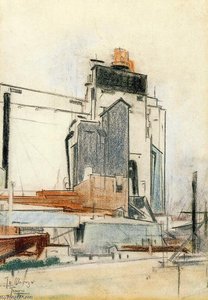
Portret Preston Dickinson

35 najbolj znanih slik umetnika Preston Dickinson, vsaka popolnoma edinstvena

Posodobljeno november 2026 · uvrščeno glede na naš skoraj priljubljenosti (iskanja, obiske in naročila za vsako delo) · 37 del v našem katalogu avtorja Preston Dickinson

Kratek opis

The World I Live In (1920) je slika umetnika Preston Dickinson, ki pritegne največ pogledov. Nato se pogled smeri k Still Life in Interior (1920) in Still Life (1924). Med 37 dela umetnika Preston Dickinson v našem katalogu so ta 35 najbolj znana; vsako je edinstven original, predstavljen z letnico nastanka, muzejem in razlogom za njegovo nečasenost.

1889 – 1930, New York City Precisionism Največ del: Smithsonian American Art Museum

10 najboljjših slik umetnika Preston Dickinson skozi oči galerije

1
The World I Live In (1920) avtorja Preston Dickinson

The World I Live In

1920 · Oil On Canvas

A white house with red trim anchors the scene, its geometric lines cutting through a soft, diffused light. It sits under a pale sky, framed by the dark, stylized branches of a tree that reaches from the left. The structure is a collection of sharp angles and clean planes, a study in the stability of domestic life. Two figures linger near the front door, their presence small against the architectural…

2
Still Life in Interior (1920) avtorja Preston Dickinson

Still Life in Interior

1920 · Oil On Canvas · Art Institute of Chicago, Chicago

In this composition, we find ourselves observing a quiet, domestic scene that has been dismantled and reassembled through a modern lens. The work presents a collection of everyday objects—a sake bottle, a tea canister adorned with Japanese figures, a cup and saucer, and various pieces of fruit like lemons—all arranged within an interior that feels both intimate and structurally complex. Rather than a traditional, singular viewpoint, the perspective is exaggerated…

3
Still Life (1924) avtorja Preston Dickinson

Still Life

1924 · Oil On Paper · Metropolitanski muzej umetnosti, New York

This 1924 oil painting on paper, mounted on composition board, presents a monochromatic arrangement of fragmented shapes. The composition is dense, utilizing a grayscale palette that ranges from deep blacks to bright whites. Sharp angles, overlapping planes, and curved segments create a rhythmic movement across the surface. Lines function as both structural boundaries for the shapes and as expressive elements that guide the eye through the fractured space. The perspective…

4
Vase of Flowers (1926) avtorja Preston Dickinson

Vase of Flowers

1926 · Oil On Canvas · Metropolitanski muzej umetnosti, New York

The composition is vertically oriented, centered on a tall, translucent blue glass vase. Inside the vessel, several lilies and long green leaves extend upward. The vase rests upon a wooden table that occupies the foreground. To the left, a heavy blue drapery with a white vertical stripe creates a structural border for the scene. The tabletop is tilted at a sharp angle, creating a sense of geometric tension against the…

6
Untitled Landscape (1918) avtorja Preston Dickinson

Untitled Landscape

1918 · Smithsonian American Art Museum, Washington, D.C.

The Untitled Landscape painting by William Preston Dickinson is a stunning example of American modern art, created in 1918. This oil on canvas piece measures 36 x 50 cm and is currently housed at the Hirshhorn Museum and Sculpture Garden in the United States. Artist Background William Preston Dickinson was an American artist known for his contributions to the Precisionist style, which emphasized industrial subjects. His work often featured geometric…

Slavna platna umetnika Preston Dickinson, od številk 11 do 35

Slavna platna umetnika Preston Dickinson, razdeljena po obdobjih

Motivi, ki so očarali Preston Dickinson

Četiri teme, ki se v teh originalih najpogosteje ponavljajo, vsaka z svojim vrhunskim primerom.

Muzeji, ki hranijo originala umetnika Preston Dickinson

7 muzejev, ki vsebujo največ slik na tej strani.

Muzej Mesto Sloga Preston Dickinson Slike iz tega seznama
Smithsonian American Art Museum, Washington, D.C.Smithsonian American Art Museum Washington, D.C. 5 Untitled Landscape, The Hills, Houses and Landscape
Metropolitanski muzej umetnosti, New YorkMetropolitanski muzej umetnosti New York 3 Still Life, Vase of Flowers, Interior
Columbus Museum of Art, ColumbusColumbus Museum of Art Columbus 2 Factory, Outskirts of the City
The Phillips Collection, Washington, D.C.The Phillips Collection Washington, D.C. 2 Street in Quebec, Winter, Harlem River
Art Institute of Chicago, ChicagoArt Institute of Chicago Chicago 1 Still Life in Interior
Cleveland Museum of Art, ClevelandCleveland Museum of Art Cleveland 1 Still Life
Muzej fine arts, BostonMuzej fine arts Boston 1 Quebec

Preston Dickinson skozi desetetja: vsak unikatni original za vsako obdobje

Delo po desetletjih

Izberite desetletje, da si ogledate original, ki ga opredeljuje.

Slike umetnika Preston Dickinson: vprašanja za galerijo

Katero je najbolj znano delo umetnika Preston Dickinson?Razkriti odgovor

The World I Live In (1920). Zatem sledeta Still Life in Interior (1920) in Still Life (1924).

Pri kateri dobe je Preston Dickinson ustvaril The World I Live In?Razkriti odgovor

31 let: delo The World I Live In iz leta 1920, Preston Dickinson pa je bil/a rojen/a leta 1889.

Katera desetina slik avtorja Preston Dickinson je najbolj znana?Razkriti odgovor

The World I Live In, Still Life in Interior, Still Life, Vase of Flowers, Tower of Gold, Untitled Landscape, Harlem River, Still LIfe with Pipe and Letters, Harlem River Bridge in Village by the Sea. Zgornja lestica prikazuje leto nastanka in muzej za vsako delo.

Koliko je znanih del avtorja Preston Dickinson?Razkriti odgovor

Naš katalog vsebuje 37 del avtorja Preston Dickinson, datiranih od 1915 do 1930.

Kje si lahko ogledate najslavnejše originale umetnika Preston Dickinson?Razkriti odgovor

Večini v Smithsonian American Art Museum (Washington, D.C.), Metropolitanski muzej umetnosti (New York) in Columbus Museum of Art (Columbus). Zgoraj navedena tabela muzejev vsebuje njihov celoten seznam.

V katerem obdobju je Preston Dickinson ustvaril svoja najbolj znana dela?Razkriti odgovor

V obdobju 1920s: 21 od 35 del na tej strani je bilo izdelovanih takrat, med njimi pa The World I Live In.

Katero znano sliko je naslikal Preston Dickinson najprej in katero najpozdneje?Razkriti odgovor

Na tej strani je najstarejše delo iz Tower of Gold (1915) in najstarejše iz The Siphon (1930).

Katere teme je Preston Dickinson najprej ravnate?Razkriti odgovor

Life (4), Flowers (3) in American landscape (2), na 35 delih na tej strani.

S katerimi materiali je Preston Dickinson najpogosteje slikal?Razkriti odgovor

Oil On Canvas, za 3 od 35 del na tej strani.

Kateri umetniški slog predstavlja delo umetnika Preston Dickinson?Razkriti odgovor

Precisionism, glede na originala na tej strani.

Katere originale Preston Dickinson lahko vidim v muzeju Smithsonian American Art Museum?Razkriti odgovor

Untitled Landscape, The Hills in Houses and Landscape: v muzeju Smithsonian American Art Museum, Washington, D.C. se nahaja 5 del z te strani.

Preston Dickinson: portret umetnika

The Industrial Visionary: The Life and Legacy of William Preston Dickinson

In the grand tapestry of American Modernism, few threads are as intricately woven yet as tragically short-lived as those left by William Preston Dickinson. Born in New York City in 1889, Dickinson emerged from a working-class background, shaped by the early loss of his father and the quiet resilience of a family that moved to Suffern, New York. His journey into the heart of the avant-garde was fueled by an innate talent and the generous patronage of figures like Henry Barbey, which allowed him to traverse the artistic epicenters of the early twentieth century. From the rigorous training at the Art Students League under William Merritt Chase to the transformative years spent in Paris studying at the Académie Julian, Dickinson’s eye was constantly being refined by the shifting currents of European modernism.

Dickinson's artistic evolution was a sophisticated dance between tradition and the radical new languages of his time. While his early training provided a foundation in classical technique, his exposure to Cubism and Futurism in Europe fundamentally altered his perception of form and motion. He did not merely observe the world; he reconstructed it through a lens of geometric precision. This stylistic maturation eventually led him to become a pivotal figure in the Precisionist movement. His work began to capture the rhythmic, structural beauty of the industrial age—a period defined by steel, steam, and the monumental scale of human engineering. Through his brush, the grit of factories and the stark lines of granaries were elevated to the status of high art, imbued with a sense of order and architectural majesty.

A Journey Through Landscapes and Industry

The breadth of Dickinson's oeuvre reflects a restless spirit that sought beauty in both the mechanical and the natural. His travels played a crucial role in defining his visual vocabulary. During his time in Quebec, he captured the quiet dignity of landscapes and street scenes, applying his modernist sensibilities to the rugged textures of the North American terrain. Later, his summer in Omaha, Nebraska, provided him with some of his most iconic subject matter; his series of drawings depicting the Peters Mills granaries and factory complexes stands as a testament to his ability to find poetic structure within industrial landscapes. These works are characterized by a sharp clarity and a deliberate reduction of detail, focusing instead on the interplay of light, shadow, and geometric volume.

Beyond the monumental scale of industry, Dickinson possessed a profound sensitivity for more intimate subjects. His mastery extended to:

  • Still Life Paintings: Where he explored the tension between organic forms and structured compositions.
  • Urban Landscapes: Capturing the evolving skyline and the rhythmic pulse of the city.
  • Geometric Abstraction: Utilizing the principles of Cubism to deconstruct and reassemble his surroundings.

The Final Act and Enduring Significance

Despite his rising reputation and the successful solo exhibitions at the Daniel Gallery, Dickinson's life was marked by a persistent struggle with ill health. His final chapter unfolded in Spain, a move intended to find both creative inspiration and economic stability. However, the shadows of tragedy followed him to Irún, where a bout of double pneumonia claimed his life in November 1930, at the tender age of forty-one. He left behind a body of work that serves as a vital bridge between the representational traditions of the nineteenth century and the abstract explorations of the twentieth.

Today, the historical significance of William Preston Dickinson lies in his ability to have synthesized the chaotic energy of the industrial revolution into a disciplined, aesthetic language. He remains a cornerstone of American Modernism, reminding us that even within the cold steel of a factory or the stark lines of a granary, there exists a profound and enduring beauty. His legacy continues to resonate through the collections of major museums, where his paintings stand as silent, powerful witnesses to an era of unprecedented transformation.