


1


Posodobljeno november 2026 · uvrščeno glede na naš skoraj priljubljenosti (iskanja, obiske in naročila za vsako delo) · 28 del v našem katalogu avtorja Henri Evenepoel
Kratek opis
Man in Red (1894) je slika avtorja Henri Evenepoel, ki pritegne največ pogledov; original se nahaja v muzeju Musées Royaux Des Beaux, Brzlja. Nato se pogled smeri k My Ill Grandfather (1892) in Charles Milcendeau (1899). Med 28 dela umetnika Henri Evenepoel v našem katalogu so ta 26 najbolj znana; vsako je edinstven original, predstavljen z letnico nastanka, muzejem in razlogom za njegovo nečasenost.


This portrait, titled Charles Milcendeau, was painted by Henri Evenepoel in 1899. It captures a specific individual, Charles Edmond Théodore Soullans, who is known to us through this work as Charles Milcendeau. The painting offers a direct encounter with the subject, presented in a way that feels both personal and quiet.


 Count Aymer de la Chevalerie1896 · Kraljevski muzej lepih umetnosti v Antwerpu
12
 The running girl1895 · Kraljevski muzej lepih umetnosti v Antwerpu
13
 Wrestling Barrack at a Fair1898 · Kraljevski muzej lepih umetnosti v Antwerpu
14
 The Poulterer1897 · Kraljevski muzej lepih umetnosti v Antwerpu
15
 The Box1896 · Kraljevski muzej lepih umetnosti v Antwerpu
16
 Portrait of Edward Tuck, Vice-Consul of the United States in Paris1899 · Museum of Fine Arts Ghent (MSK)
17
 Sunday at the Bois de Boulogne1899 · Kraljevski muzej lepih umetnosti v Antwerpu
18
 Sunday in the Bois de Boulogne1891
19
 Orange Market at Blida1898 · Kraljevi muzeji lepih umetnosti na Belgiji
20
 Sunday Fair at Les Invalides1897 · Kraljevski muzej lepih umetnosti v Antwerpu
21
 Mendiant. Algerie1897
22
 Veterans' Festival1898 · Musées Royaux des Beaux-Arts
23
 Henriette in a Large Hat1899 · Musées Royaux Des Beaux
24
 La chambre de l'artiste
25
 Charles in a Striped Jersey1898
26
 The Spaniard in Paris1899 · Museum of Fine Arts Ghent (MSK)
8 muzejev, ki vsebujo največ slik na tej strani.
| Muzej | Mesto | Sloga Henri Evenepoel | Slike iz tega seznama |
|---|---|---|---|
 Kraljevski muzej lepih umetnosti v Antwerpu |
Antverp | 10 | My Ill Grandfather, Louise in Mourning, Returning from Work at Sunset |
 Museum of Fine Arts Ghent (MSK) |
Gent | 4 | Portrait of Hélène Roulet, the Wife of the Artist Adolphe Crespin, The Clown, Portrait of Edward Tuck, Vice-Consul of the United States in Paris |
 Musées Royaux Des Beaux |
Brzlja | 2 | Man in Red, Henriette in a Large Hat |
 Kraljevi muzeji lepih umetnosti na Belgiji |
Bruselj | 2 | Pictures - Portrait of Louis Charles Crespin, Orange Market at Blida |
 Musée d'Orsay |
Pariz | 1 | Charles Milcendeau |
 Städel Museum |
Frankfurt | 1 | In the Café d'Harcourt in Paris |
 Museum of Fine Arts |
Houston | 1 | At the Moulin Rouge |
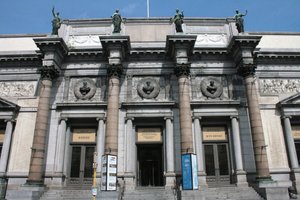 Musées Royaux des Beaux-Arts |
Bruselj | 1 | Veterans' Festival |
Originalna dela umetnika Henri Evenepoel, prikazana tukaj, pokrivajo obdobje približno deset let, od 1891 do 1899: oko jih sledi leto za letom.
Izberite leto in oglej originale.

Več od 1896
This portrait, titled Charles Milcendeau, was painted by Henri Evenepoel in 1899. It captures a specific individual, Charles Edmond Théodore Soullans, who is known to us through this work as Charles Milcendeau. The painting offers a direct encounter with the subject, presented in a way that feels both personal and quiet.
Več od 1899
Man in Red (1894), Musées Royaux Des Beaux, Brzlja. Zatem sledeta My Ill Grandfather (1892) in Charles Milcendeau (1899).
22 let: delo Man in Red iz leta 1894, Henri Evenepoel pa je bil/a rojen/a leta 1872.
Man in Red, My Ill Grandfather, Charles Milcendeau, In the Café d'Harcourt in Paris, Pictures - Portrait of Louis Charles Crespin, At the Moulin Rouge, Portrait of Hélène Roulet, the Wife of the Artist Adolphe Crespin, The Clown, Louise in Mourning in Returning from Work at Sunset. Zgornja lestica prikazuje leto nastanka in muzej za vsako delo.
Naš katalog vsebuje 28 del avtorja Henri Evenepoel, datiranih od 1891 do 1899.
Večini v Kraljevski muzej lepih umetnosti v Antwerpu (Antverp), Museum of Fine Arts Ghent (MSK) (Gent) in Musées Royaux Des Beaux (Brzlja). Zgoraj navedena tabela muzejev vsebuje njihov celoten seznam.
V obdobju 1897: 5 od 26 del na tej strani je bilo izdelovanih takrat, med njimi pa In the Café d'Harcourt in Paris.
Na tej strani je najstarejše delo iz Sunday in the Bois de Boulogne (1891) in najstarejše iz Charles Milcendeau (1899).
My Ill Grandfather, Louise in Mourning in Returning from Work at Sunset: v muzeju Kraljevski muzej lepih umetnosti v Antwerpu, Antverp se nahaja 10 del z te strani.


