Portret George Hand Wright

12 najbolj znanih slik umetnika George Hand Wright, galerijska izbira

Posodobljeno oktober 2026 · uvrščeno glede na naš skoraj priljubljenosti (iskanja, obiske in naročila za vsako delo) · 12 del v našem katalogu avtorja George Hand Wright

Kratek opis

Med vsem originalom, ki ga je George Hand Wright pustil, je najbolj znan Washington at Valley Forge (from the portfolio The Bicentennial Pageant of George Washington ) (1932). Takoj za njima sta The royal mail crossing a bridge in Fresh Rolls (1882). Naš katalog vsebuje 12 del umetnika George Hand Wright; galerija je ohranila 12 del, ki jih svet najbolj oboževa, odlikovanih z datumom nastanka, pripadajočim muzajem in zgodbojo.

1872 – 1951, Fox Chase

10 najboljših slik umetnika George Hand Wright: izbira galerije

1
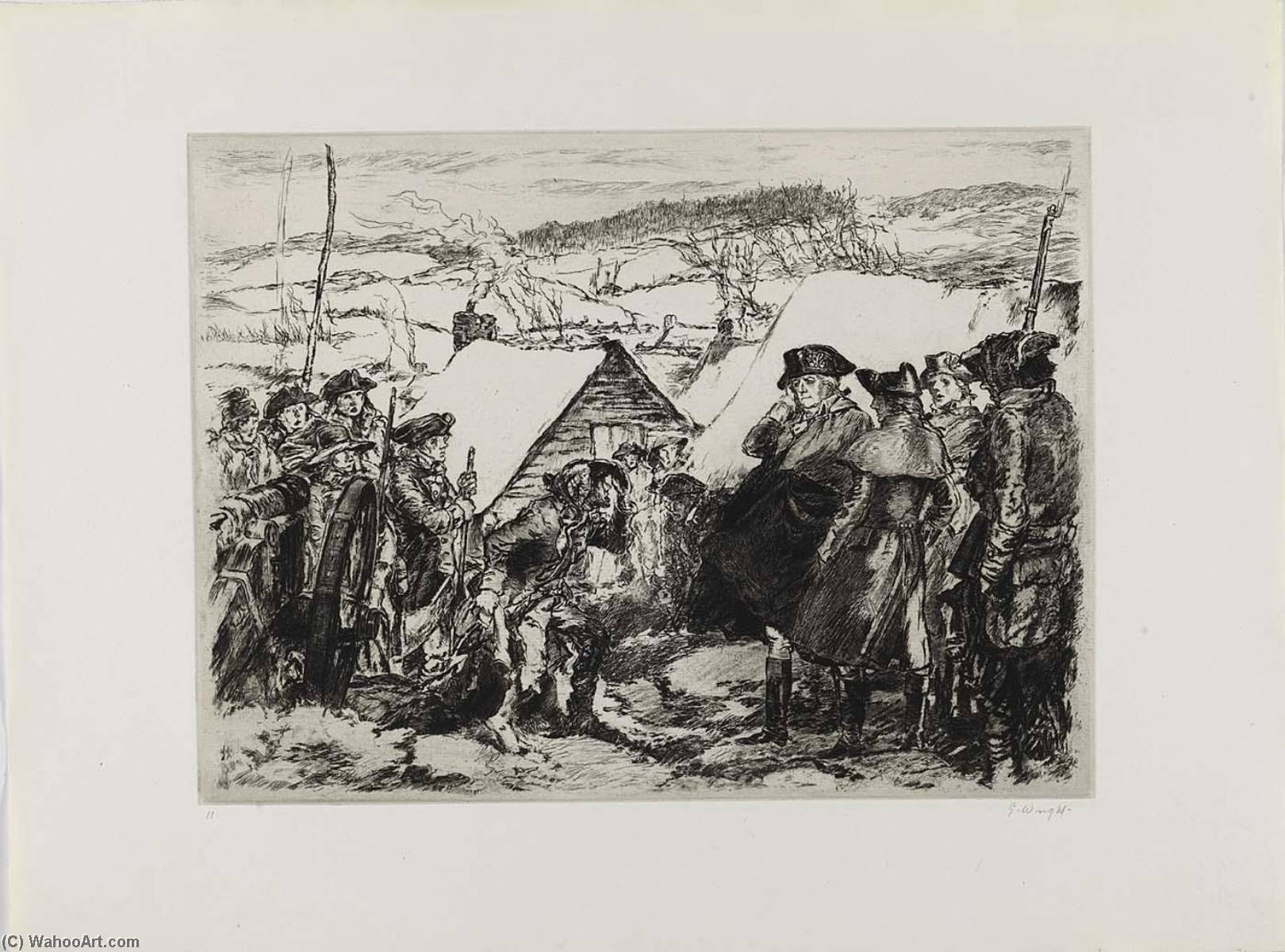
Washington at Valley Forge (from the portfolio The Bicentennial Pageant of George Washington ) (1932) avtorja George Hand Wright

Washington at Valley Forge (from the portfolio The Bicentennial Pageant of George Washington )

1932 · Etching

In this black and white etching, we find ourselves amidst the quiet, heavy stillness of Valley Forge. The scene is composed around a central tent, a modest structure that acts as the anchor for a gathering of thirteen figures. These men, draped in heavy coats and hats, are caught in a moment of quietude. Some are lost in conversation, while others simply observe the surroundings, their presence felt through the…

Izbor umetnika George Hand Wright se nadaljuje, od 11 do 12

George Hand Wright leta za letom: originali, ki definira vsako obdobje

Od 1882 do 1932 je George Hand Wright delal 51 let: izborka sledi tej dolgi karieri leta za letom, skozi njegova najlepša originalna dela.

Delo po letih

Izberite leto in oglej originale.

Vprašanja zbirateljev o slikah umetnika George Hand Wright

Za katero delo je George Hand Wright najbolj znan/a?Razkriti odgovor

Washington at Valley Forge (from the portfolio The Bicentennial Pageant of George Washington ) (1932). Zatem sledeta The royal mail crossing a bridge in Fresh Rolls (1882).

Koliko je bil George Hand Wright let, ko je nastalo delo Washington at Valley Forge (from the portfolio The Bicentennial Pageant of George Washington )?Razkriti odgovor

60 let: delo Washington at Valley Forge (from the portfolio The Bicentennial Pageant of George Washington ) iz leta 1932, George Hand Wright pa je bil/a rojen/a leta 1872.

Katera je deset najbolj znanih slik umetnika George Hand Wright?Razkriti odgovor

Washington at Valley Forge (from the portfolio The Bicentennial Pageant of George Washington ), The royal mail crossing a bridge, Fresh Rolls, A Monopolise, A coach and four on the open road, Washington at Valley Forge, Washington at Valley Forge (cancelled plate from the portfolio The Bicentennial Pageant of George Washington ), A fresh team, The lost scent in Homewards. Zgornja lestica prikazuje leto nastanka in muzej za vsako delo.

Koliko slik je pustil George Hand Wright?Razkriti odgovor

Naš katalog vsebuje 12 del avtorja George Hand Wright, datiranih od 1882 do 1932.

V katerih letih je George Hand Wright naslikal svoja najbolj znana dela?Razkriti odgovor

V obdobju 1932: 2 od 12 del na tej strani je bilo izdelovanih takrat, med njimi pa Washington at Valley Forge (from the portfolio The Bicentennial Pageant of George Washington ).

Kakšna sta prva in zadnja znana originala umetnika George Hand Wright?Razkriti odgovor

Na tej strani je najstarejše delo iz Fresh Rolls (1882) in najstarejše iz Washington at Valley Forge (from the portfolio The Bicentennial Pageant of George Washington ) (1932).

George Hand Wright: življenje in delo

A Life Forged in Ink and Light

Born in the Fox Chase section of Philadelphia, Pennsylvania, George Hand Wright carried within him a profound sympathy for the rustic and the hardworking, a sentiment likely inherited from his father, a blacksmith. His journey into the world of fine art began with technical discipline at the Spring Garden Institute, where he was apprenticed to a lithographer. This early immersion in the mechanics of printmaking would later inform the precision and soul found in his diverse body of work. Seeking deeper artistic expression, he moved to the prestigious Pennsylvania Academy of the Fine Arts, studying under Robert Vonnoh alongside luminaries such as Robert Henri, John Sloan, and William Glackens. These formative years placed him at the heart of a vibrant American artistic evolution.

In 1893, Wright’s career took a significant turn when his first illustration appeared in Scribner's Magazine. This marked the beginning of a prolific era as an illustrator, where his keen eye for detail and reportorial instinct allowed him to capture the essence of contemporary life. His work became a regular fixture in legendary publications including Harper's, Collier's, and The Saturday Evening Post. Wright did not merely draw; he researched his subjects with the rigor of a reporter, filling sketchbooks with on-the-spot observations that breathed life into his finished pieces. This unique approach allowed him to bridge the gap between commercial illustration and fine art, treating a magazine commission with the same reverence as a gallery print.

Evolution of Style and Artistic Legacy

As his career matured, Wright underwent a beautiful metamorphosis, transitioning from the demanding world of commercial illustration toward more personal, expressive mediums. He turned his focus to watercolors, pastels, and etchings, finding in these delicate forms a way to explore light and atmosphere with greater intimacy. His later years were marked by a dedication to the fine arts, where he explored the nuances of landscape and coastal scenes through evocative black and white etchings and serene oil paintings. Whether capturing the nostalgic beauty of a coach on an open road or the quiet majesty of a beach at Baie, St. Paul, his work remained anchored in a deep respect for his subjects.

Wright’s contributions to the American art community were both creative and leadership-oriented. He was a foundational figure in the artistic community of Westport, Connecticut, where he settled with his wife, Anne Boylan. His professional accolades were numerous, including serving as president of the Society of Illustrators in 1926 and 1927, and being elected to the National Academy of Design in 1939. His legacy is preserved through his membership in prestigious groups like the Salmagundi Club and the Society of American Etchers, and through collections such as those held by the Smithsonian American Art Museum and the Library of Congress. Through his versatile hand, Wright left an indelible mark on the visual narrative of early twentieth-century America.